- The paper demonstrates how 5D rotating primordial black holes exhibit prolonged evaporation due to quantum memory effects, altering their dark matter viability.
- The paper applies detailed mass-spin evolution and scalar-induced gravitational wave modeling to pinpoint distinctive observational signatures.
- The paper uses Fisher forecasts to reveal that planned GW detectors like LISA, DECIGO, and BBO can tightly constrain extra-dimensional and quantum gravitational parameters.
Secondary Gravitational Wave Signatures from 5D Rotating Primordial Black Holes in the Dark Dimension
Theoretical Context: Swampland Constraints and the Dark Dimension
The paper presents an analysis of five-dimensional (5D) rotating primordial black holes (PBHs) as dark matter (DM) candidates, formulated within the Dark Dimension (DD) scenario. The context is rooted in the Swampland Program, which differentiates between low-energy effective theories consistent with quantum gravity (“landscape”) and inconsistent ones (“swampland”). The Swampland Distance Conjecture and its connection to the observed cosmological constant suggests the plausibility of a single, micron-scale compact extra dimension. Experimental tests restrict these extra dimensions, yielding a compactification scale RC∼μm and a 5D Planck scale M∗∼1010GeV.
In this framework, black holes with horizon radii rH≪RC exhibit genuine higher-dimensional (Tangherlini) behavior, while those with rH≫RC revert to 4D effective dynamics. This distinction modifies the phase space for Hawking evaporation and is central to the survival of light PBHs as DM candidates under DD.
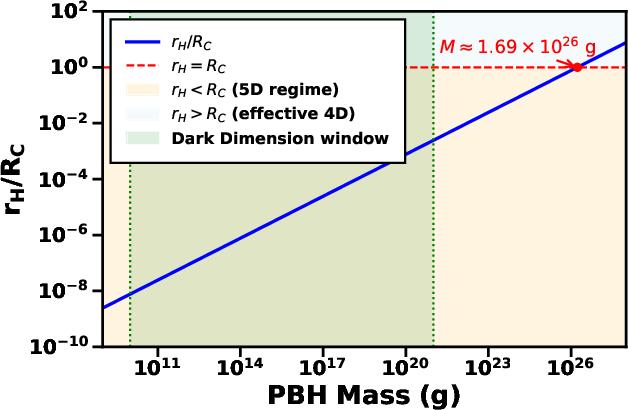
Figure 1: Ratio of the five-dimensional Schwarzschild radius rH to compactification radius RC, illustrating the transition from 5D to 4D black hole behavior as a function of mass.
The enhancement of the 5D PBH lifetime is further amplified by the “memory burden” (MB) effect, a quantum gravitational mechanism where information retention suppresses evaporation, scaling as S−p (with p the MB exponent). This non-thermal suppression stabilizes PBHs against complete evaporation, fundamentally altering their cosmological signatures and DM viability.
The evaporation of higher-dimensional, rotating black holes is technically distinct from 4D scenarios due to both increased modes and modified thermodynamics. For rotating 5D PBHs (Myers-Perry solutions), the coupled mass-spin evolution yields richer phenomenology.
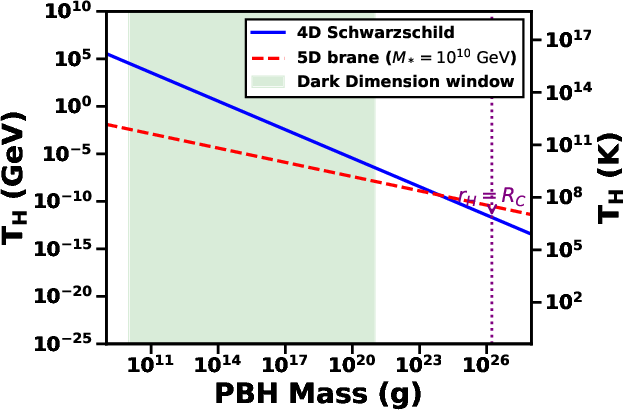
Figure 2: Hawking temperature as a function of mass, contrasted between 4D and 5D regimes, demonstrating strong suppression of evaporation in the 5D window characteristic of the DD scenario.
The coupled evolution equations for mass (M) and angular momentum (J) depend on greybody factors and are parameterized by dimensionless spin M∗∼1010GeV0 and attendant coefficients M∗∼1010GeV1. High initial spin extends the "spin-down" phase, resulting in a mass loss between 40–60% before settling into a non-rotating Schwarzschild regime.
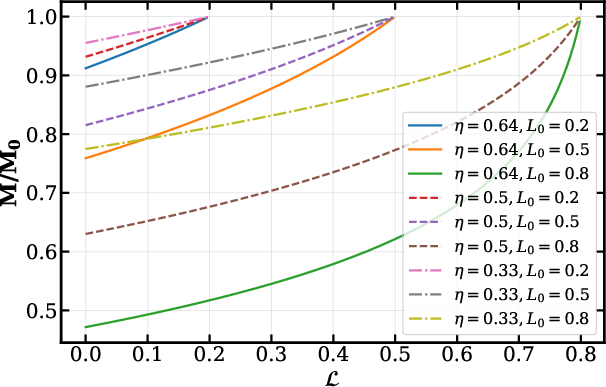
Figure 3: Evolution of the mass fraction M∗∼1010GeV2 as a function of the normalized angular momentum M∗∼1010GeV3, illustrating the spin-down process and consequent mass loss in 5D rotating black holes.
The standard 5D Hawking evaporation timescale M∗∼1010GeV4 is drastically modified with MB feedback. When MB with M∗∼1010GeV5 is included, the lifetime scales as M∗∼1010GeV6, lengthening PBH survival and opening a broad viable DM window down to much lighter masses. For M∗∼1010GeV7, energy injection constraints from BBN and the CMB render most of the parameter space observationally inaccessible due to inefficient suppression.
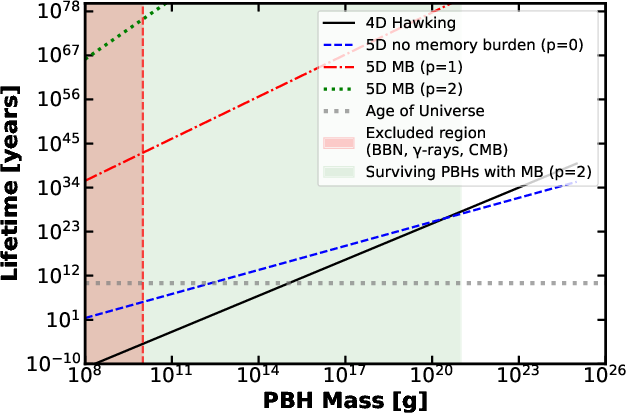
Figure 4: PBH lifetime versus mass for different evaporation scenarios. Only the 5D+MB (M∗∼1010GeV8) scenario opens a substantial new viable window below M∗∼1010GeV9 g, consistent with all cosmological constraints.
PBH formation is sourced by inflationary curvature perturbations with a sharply enhanced (typically log-normal) power spectrum at small scales. The amplitude and width of this spectrum uniquely determine the PBH initial mass distribution as well as the associated dark matter fraction rH≪RC0. The allowed DD window extends from rH≪RC1 g to rH≪RC2 g, contiguous with and extending below the standard 4D mass window.
Scalar-Induced Gravitational Waves as Observational Probes
The same curvature perturbations responsible for PBH collapse inevitably source gravitational waves at second order—the so-called scalar-induced gravitational waves (SIGWs). Because the compactification scale is sub-Hubble throughout relevant epochs, the evolution of cosmological tensor modes reduces to standard 4D propagation, and all observable GW phenomenology is calculable from the brane-localized scalar sector.
SIGW spectra are computed by convolving the log-normal primordial scalar spectrum. Their peak frequency is set by the PBH mass (rH≪RC3), enabling precise mapping onto the sensitivity bands of GW observatories.
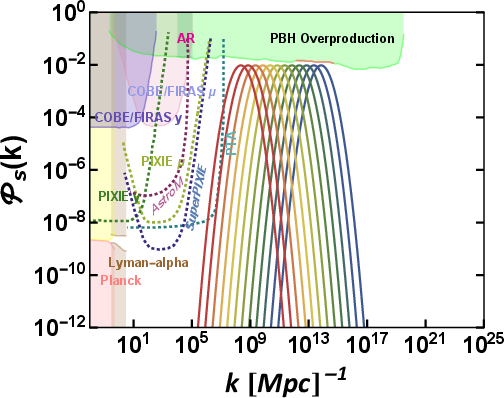
Figure 5: Log-normal primordial curvature power spectra, with peak wavenumber corresponding to the PBH formation scale, compared to cosmological constraints from CMB and large-scale structure.
The amplitude of the predicted GW background remains subdominant to current CMB rH≪RC4-distortion bounds, but is typically within reach of LISA, DECIGO, and BBO at representative PBH masses in the DD window.
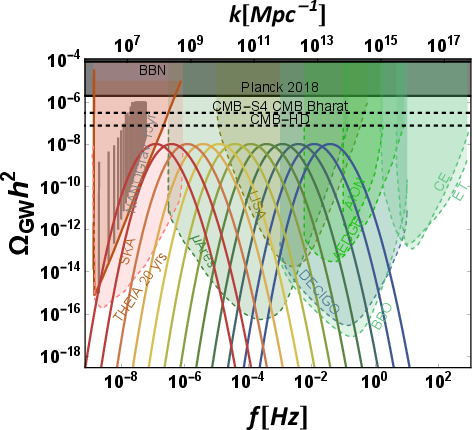
Figure 6: Present-day SIGW spectra for PBH masses rH≪RC5–rH≪RC6 g, superimposed on the sensitivity curves for LISA, BBO, DECIGO, and pulsar timing arrays. These signals are testable for a wide parameter range.
Parameter Determination: Fisher Forecasts for Gravitational Wave Observatories
A significant advance in the analysis is the quantification of how tightly GW experiments can constrain the model parameters via Fisher matrix forecasts. By modeling the SIGW spectra for the relevant PBH mass, fraction, width, and MB exponent, the analysis shows that LISA, DECIGO, and BBO can each achieve percent-level precisions, with BBO leading due to its superior sensitivity.
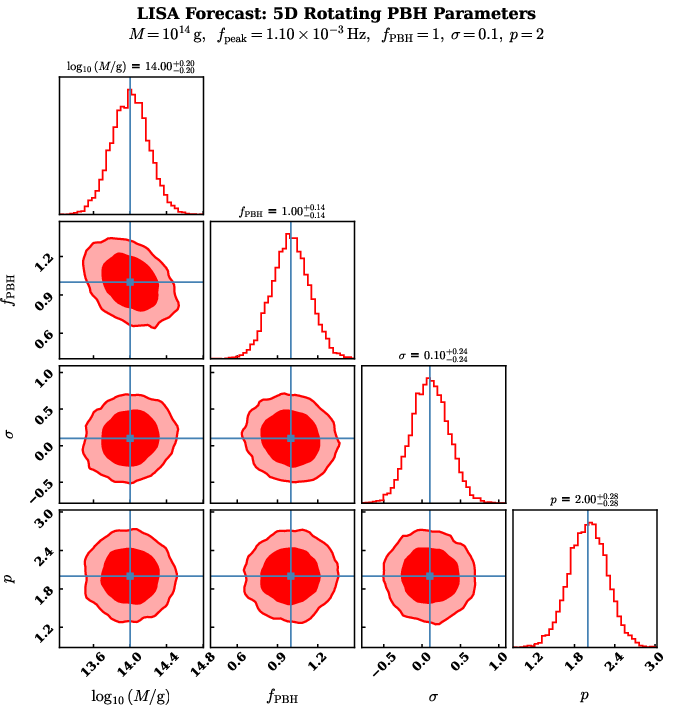
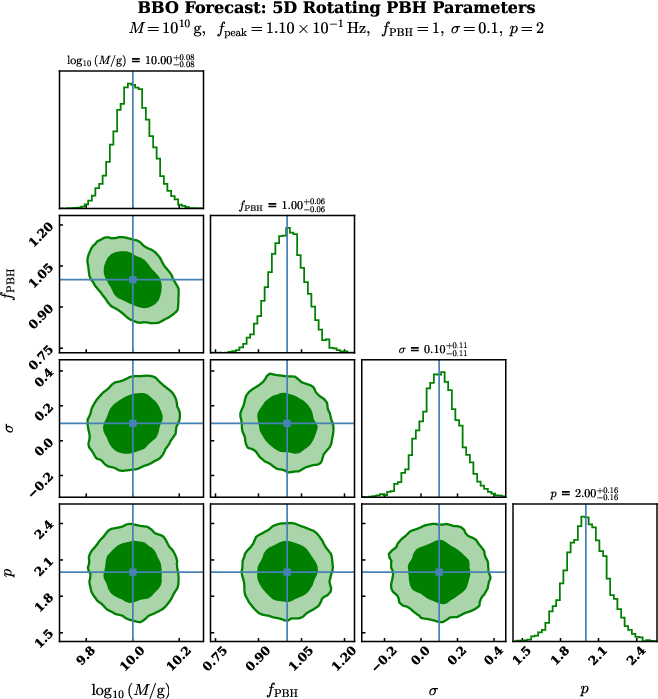
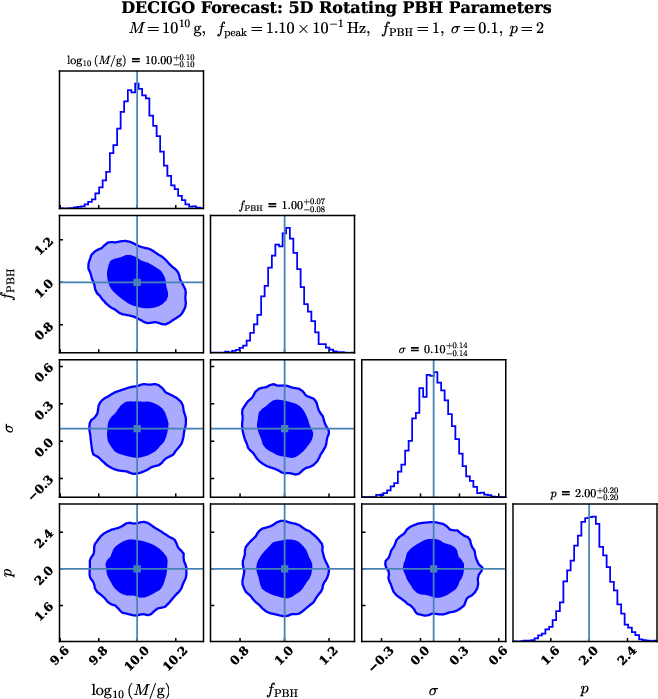
Figure 7: Fisher matrix corner plots for LISA, DECIGO, and BBO, showing weak parameter degeneracies and prospect for tight simultaneous constraints on PBH mass, fraction, spectrum width, and MB exponent rH≪RC7.
The ability of these detectors to isolate the MB exponent rH≪RC8 notably enables them to test quantum gravitational feedback effects via GW observation—a concrete, falsifiable phenomenological probe.
Implications and Future Outlook
This work rigorously establishes that the combination of extra-dimensional gravity (micron-scale extra dimension), the quantum MB effect, and spinning PBH populations leads to distinctive gravitational wave backgrounds within the sensitivity of multiple planned detectors. Practically, a positive detection would simultaneously support:
- The existence of a micron-scale DD,
- PBHs as at least a significant dark matter fraction,
- Quantum gravitational backreaction effects (MB) as a mechanism for information preservation.
Non-observation would set strong upper limits on small-scale curvature perturbations and strongly constrain the parameter space for extra-dimensional dark matter models and quantum modifications of black hole evaporation. Extension of the analysis to higher dimensions (e.g., 6D) promises even stronger cosmological constraints, as briefly noted.
Conclusion
The scenario outlined provides an explicit, testable connection between string-theoretic quantum gravity constraints, higher-dimensional black hole dynamics, information-theoretic feedback mechanisms, and gravitational wave cosmology. The synthesis of detailed PBH lifetime modeling (including the MB effect), precise SIGW calculations, and robust parameter inference forecasts demonstrates a high level of theoretical and observational maturity. Future GW experiments (LISA, DECIGO, BBO) will be capable of probing this intersection of quantum gravity, cosmology, and dark sector phenomenology with unprecedented sensitivity.

