- The paper introduces ISOMORPH, a modular digital twin simulator for supply chain forecasting that benchmarks logistics dynamics using interpretable conservation laws.
- It employs a unified Markovian state-space with discrete transitions and stochastic inputs, enabling forward uncertainty quantification through Latin-hypercube perturbations.
- Empirical evaluations reveal challenging TSF scenarios with bullwhip effects and higher MASE values compared to standard benchmarks, underscoring the simulator’s robustness.
ISOMORPH: A Modular Supply Chain Digital Twin for Benchmarking Time Series Forecasting
Motivation and Context
Supply chain time-series forecasting (TSF) is underrepresented in open benchmark datasets, particularly regarding multi-echelon network logistics. Existing datasets either provide limited views of demand without logistics topologies (e.g., SupplyGraph), neglect inventory and transport dynamics, or offer static and non-interpretable structures lacking the fidelity of real-world logistics chains. The demand for reproducible, extensible, and physically grounded benchmarks is unmet, limiting the evaluation and development of TSF models in logistics domains.
ISOMORPH Framework and Architecture
ISOMORPH introduces a fully open, modular digital twin simulator for supply chain logistics. It operates on user-configurable directed graphs comprising factories, intermediate warehouses, and customer-facing destinations. All structural and scenario parameters—including topology, edge transit times, capacities, demand generators, and control policies—are interpretable and independently swappable. The simulator advances the network in discrete time, processing per-node inventories, outstanding orders, shipments in transit, and smoothed demand estimates as a unified Markovian state.
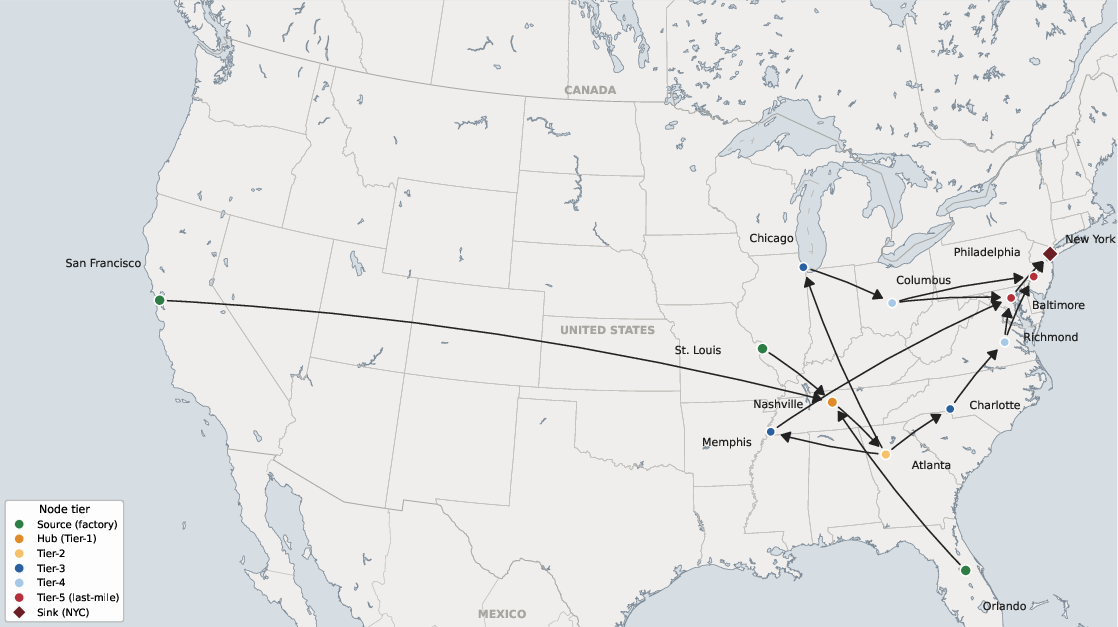
Figure 1: ISOMORPH architecture—(a) released network topology of 13 U.S. cities with user-determined edge transit times; (b) Markov chain dynamics as a dynamic Bayesian network across time slices.
The state ξt contains five components: on-hand inventory, backlog, outstanding source orders, scheduled destination arrivals, and a smoothed demand estimate. This augmented representation explicitly closes the dynamics as a Markov chain, enabling scalar computation, forward uncertainty quantification (UQ), and downstream stochastic control.
Transition dynamics ξt+1=Ψ(ξt,yt,Lt) are defined as deterministic algorithms sequenced through replenishment, dispatch, service, flow, and stochastic inputs (Poisson demand and Gaussian lead times). Dijkstra routing and greedy first-fit packing are used for shipment allocation—ensuring tractable path-resolution with adherence to physical transport constraints.
(Figure 2)
Figure 2: Seven-stage transition map Ψ for ISOMORPH, decomposing each step into deterministic and stochastic sub-steps with physical state updates.
Conservation Laws and Structural Validation
ISOMORPH encodes three conservation laws directly in its Markovian transition:
- Per-node mass conservation: Inventory evolves strictly via receipts and dispatches.
- Global mass conservation: Total network-internal stock changes only by boundary inflow (source arrivals) and outflow (destination service).
- Backlog conservation: Destination backlog is incremented only by unmet demand.
These identities hold pathwise and serve as algebraic invariants—verifying simulator integrity under arbitrary modifications of control policies or network extensions. The discrete conservation relations correspond precisely to classical transport and queueing fluid limits under large-scale scaling, linking ISOMORPH to established stochastic network theory.
Dataset Generation, Dynamics, and Empirical Validation
Released datasets include two catalogue sizes (C=50 and C=200) on the 13-node network, each horizon spanning T=52,560 time units. Six scenario sweeps, 30 additional rollouts, and 20 Latin-hypercube perturbations showcase dynamics such as variance amplification, cascading bottlenecks, regime shifts, and cross-channel macro shocks—phenomena absent in fixed TSF benchmarks.
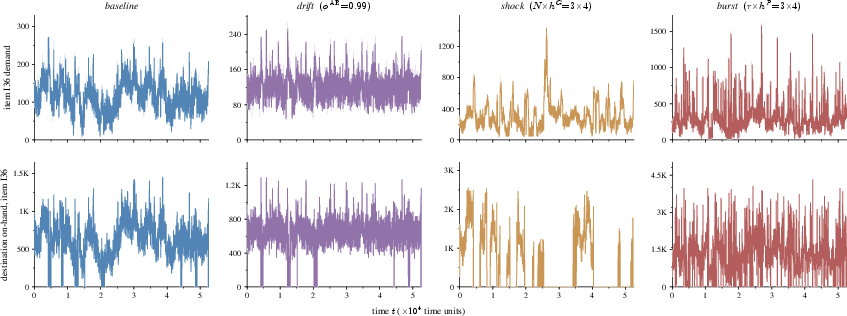
Figure 3: Scenario diversity for item I36—baseline, drift, shock, and burst settings drive distinct demand and stock responses.
Dataset validation confirms empirically consistent bullwhip amplification: tier-level monthly ratios (Bˉ) from $1.07$ to $1.57$ align with industry empirical distributions [cachon2007search].
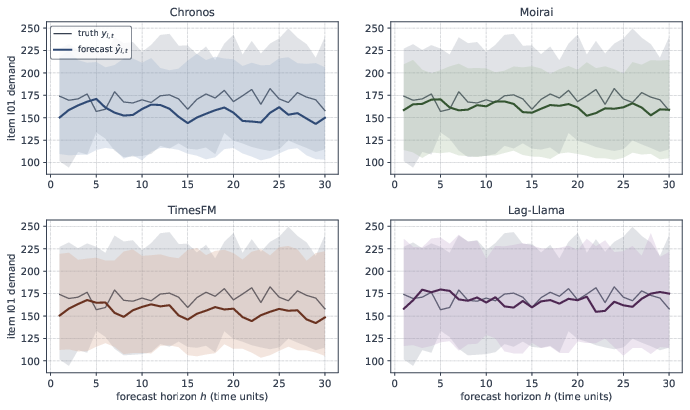
Figure 4: Forward UQ forecast envelope for item I01 at a forecast window, demonstrating propagation of parameter uncertainty through both digital twin and foundation models.
Foundation Model Benchmarking and Forward UQ
ISOMORPH datasets are evaluated using four TSF foundation models—Chronos, Moirai, TimesFM, Lag-Llama—against public GIFT-Eval reference MASE values [aksu2024gifteval]. At moderate horizons (h≥14), MASE values for all foundation models exceed public benchmarks, demonstrating that ISOMORPH-generated logistics dynamics are more challenging and diverse than current benchmarks.
Moreover, propagating parameter uncertainty via Latin-hypercube perturbation across demand-side knobs enables forward UQ—producing forecast envelopes not available on standard TSF datasets. Zero-shot foundation models serve as surrogate UQ engines, yielding forecast bands closely matching the simulator ground truth.
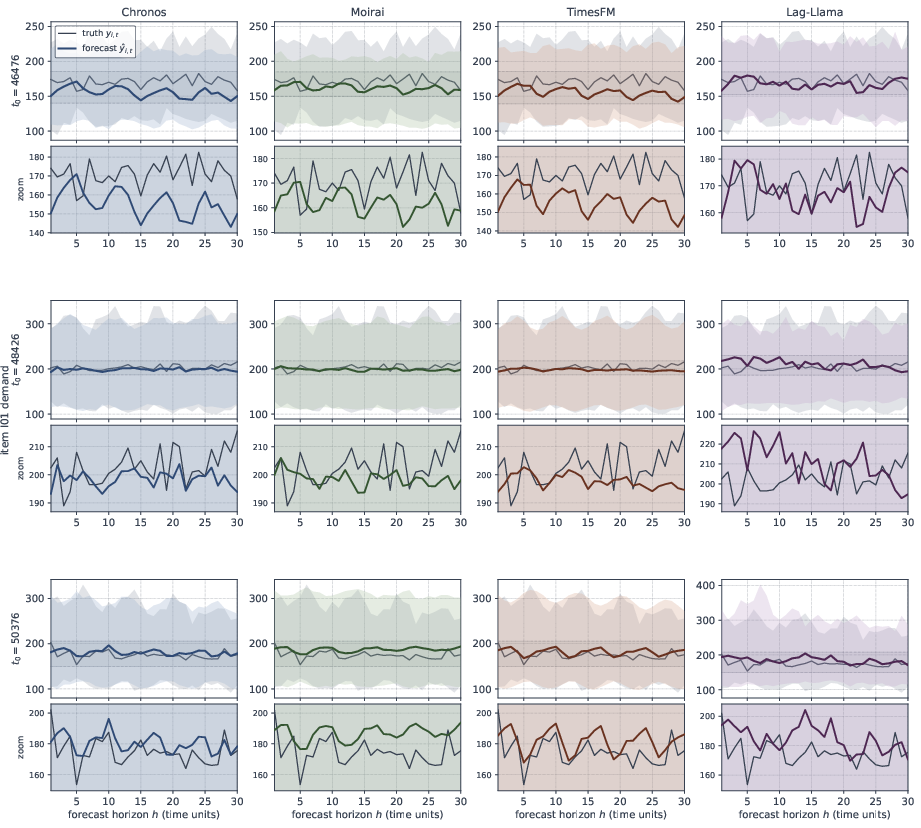
Figure 5: Forward UQ forecast envelopes for item I01 at three forecast windows, illustrating envelope consistency across models and time.
Practical and Theoretical Implications
ISOMORPH's extensible architecture enables:
- Direct benchmarking of TSF models on physically interpretable logistics dynamics, extending domain generalizability and robustness.
- Structure-aware model development—ML architectures can be designed to comply with conservation laws, linking to physics-informed forecasting.
- Reproducible and scalable synthetic-twin evaluation in supply chain analytics, compatible with real-data scenarios as they become available.
- Efficient surrogate UQ via foundation models, streamlining risk quantification for operational and planning decisions.
From a theoretical perspective, ISOMORPH bridges discrete agent-based simulation with continuum transport and queueing fluid limits. The explicit conservation laws facilitate rigorous validation and future development of structure-aware forecasting algorithms.
Future Directions
Potential avenues include:
- Incorporating correlated shocks, supplier failure models, and multi-region covariate-driven dynamics.
- Extending forecast targets to network state variables beyond demand—utilization, fill rate, backlog.
- Experimenting with alternative control policies (dynamic inventory, adaptive routing) and structural uncertainty propagation.
- Fine-tuning foundation models on ISOMORPH-generated datasets to build logistics-domain surrogates.
- Integrating ISOMORPH into major TSF benchmark suites (e.g., GIFT-Eval) as a logistics domain entry.
Conclusion
ISOMORPH delivers the first public digital twin of a multi-echelon logistics network for TSF benchmarking. Its modular design, structural fidelity, and algorithmic transparency support advanced evaluation and development of TSF models. The reproduction of bullwhip dynamics, strong conservation properties, and challenging forecast patterns establish ISOMORPH as a foundational tool for supply chain AI research, with broad implications for benchmarking, risk analysis, and structure-aware forecasting (2605.12768).

