- The paper reveals that multidimensional transport modeling significantly improves permeability inference in FLiBe systems by accounting for complex geometries and boundary conditions.
- The study applies a validation-informed framework using FESTIM to align simulated flux with experimental measurements, illustrating temperature-dependent Arrhenius behavior.
- The research highlights that uncoated boundary conditions can lead to substantial sidewall losses—up to 97% flux loss—affecting system design in fusion applications.
Quantifying Multidimensional Transport Effects on Permeability Inference in FLiBe Systems
Introduction
This paper presents a comprehensive analysis of hydrogen isotope transport and permeability inference in FLiBe systems, focusing on the multidimensional effects introduced by complex experimental geometries and external boundary conditions. The research utilizes a validation-informed modeling framework, leveraging FESTIM to interpret permeation data from the HYPERION experiment at MIT. Traditional one-dimensional (1D) models often fail to capture intricate transport pathways present in realistic systems, resulting in permeability values that amalgamate material properties with geometric and boundary effects. Here, a multidomain and multi-material model is applied to resolve coupled transport across molten salt, nickel structures, and external boundaries, enabling physically consistent property inference.
Experimental Configuration and Multidomain Modeling
The HYPERION setup comprises a nickel membrane segregating an upstream molten FLiBe region from a downstream gas measurement port. Hydrogen or deuterium is introduced under controlled conditions; isotopes diffuse into FLiBe, permeate through the salt, partition thermodynamically at the salt-metal interface, and finally traverse the nickel membrane to be detected downstream. Crucially, the experiment reveals substantial lateral transport and leakage via structural sidewalls—mechanisms inherently absent in idealized 1D models.
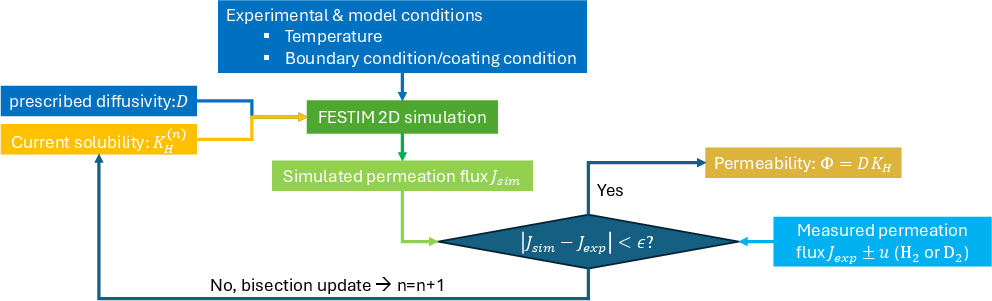
Figure 1: Schematic of the permeability inference framework; iterative solubility adjustment ensures simulated flux matches measured flux within tolerance.
The FESTIM-based framework models these processes in an axisymmetric (r-z) geometry, treating boundary interfaces with both Henry and Sieverts laws as appropriate. External vessel boundaries are considered in two limits: (i) ideal coating (zero-flux), and (ii) uncoated (fully exposed), providing an envelope for environmental exchange and directly impacting permeability inference.
Numerical Methodology
Steady-state permeation flux is determined from GC-measured mole fractions, sweep-gas flow rates, and pressure/temperature conditions. Uncertainty quantification integrates measurement repeatability and instrument specifications (ISO GUM methodology), propagating error to permeability through sensitivity analysis. Inverse modeling iteratively adjusts FLiBe solubility in simulations, aiming for convergence between measured and simulated flux under defined boundary conditions.
Temperature-dependent geometry is rigorously incorporated; FLiBe thickness is recalculated for each temperature using measured salt mass and established density correlations, maintaining consistency in transport path length across conditions. Arrhenius representations are employed to characterize inferred permeability's temperature dependence.
Results: Boundary Effects, Sidewall Loss, and Permeability
Hydrogen concentration mapping under different boundary conditions demonstrates stark contrasts in spatial distribution:

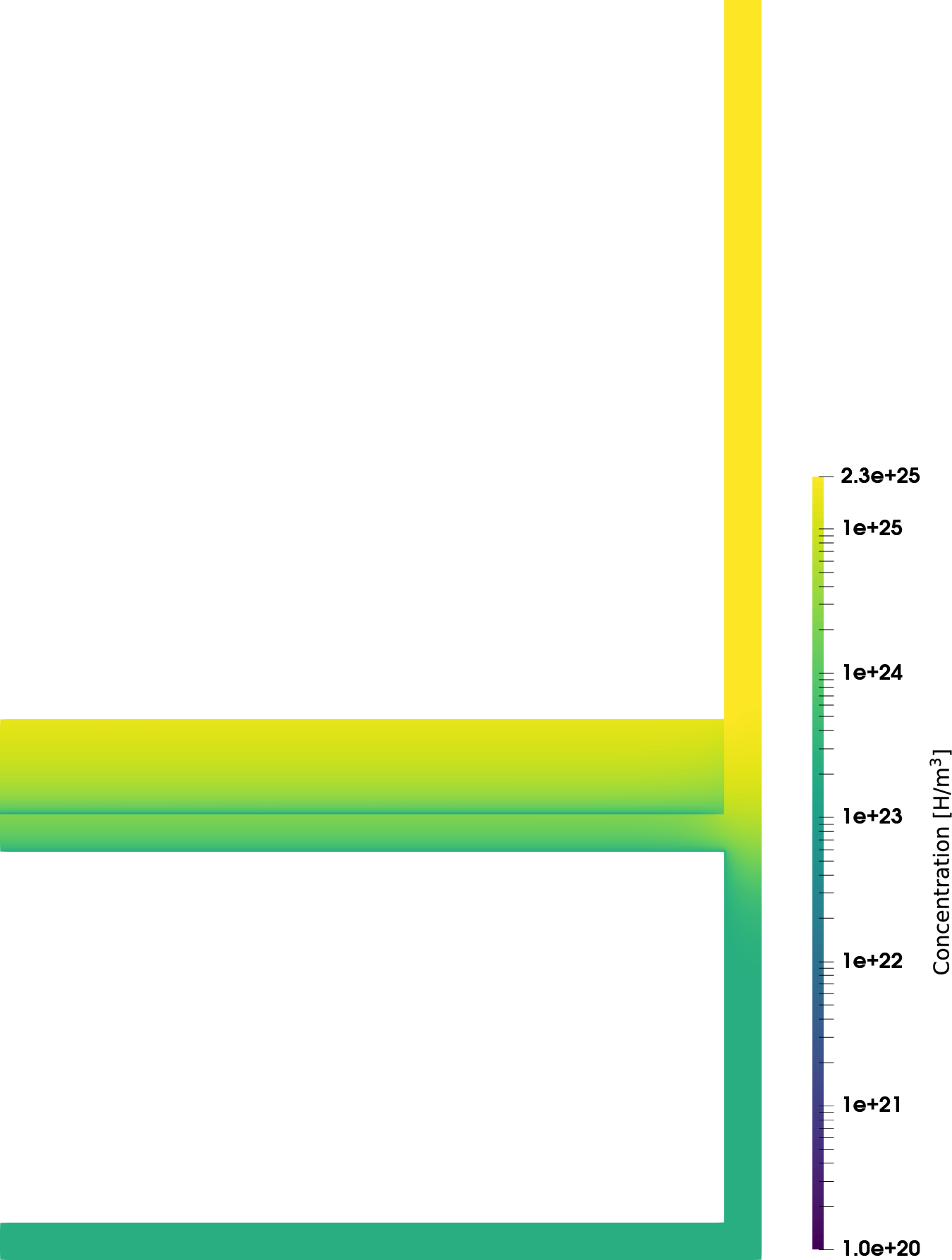
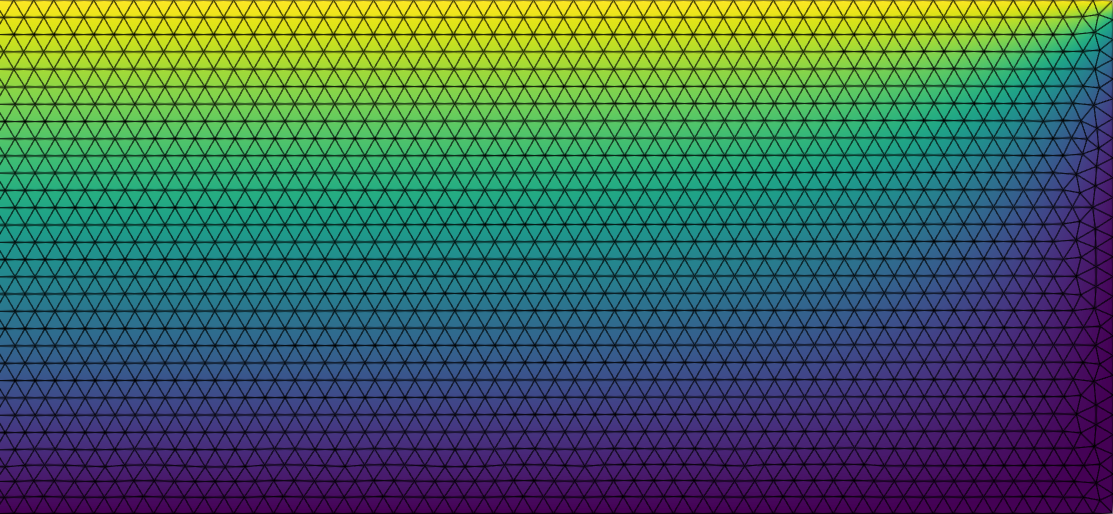
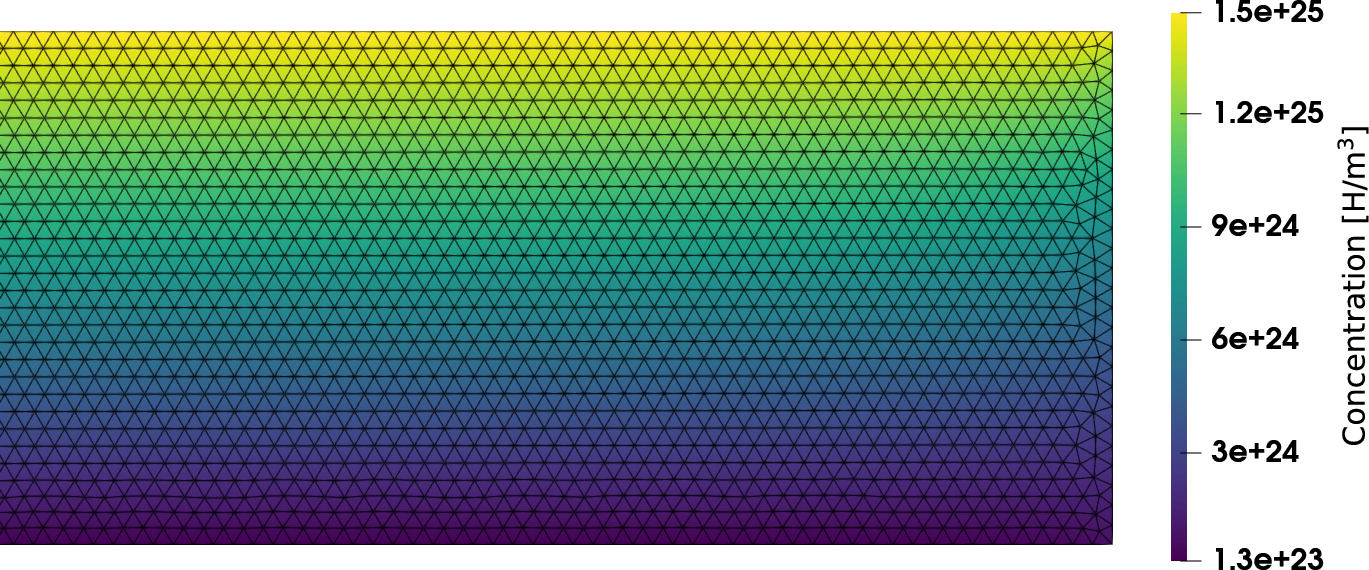
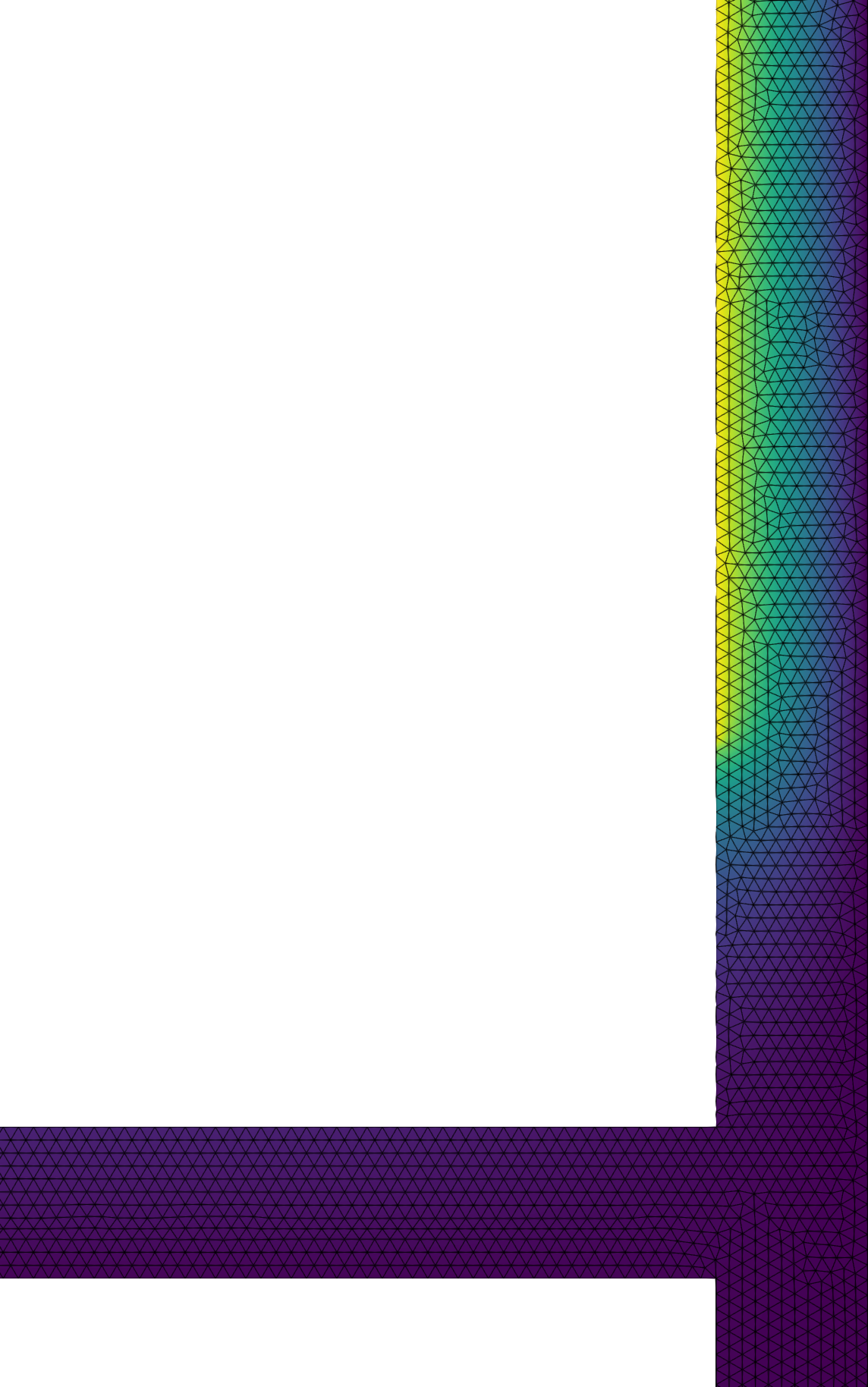
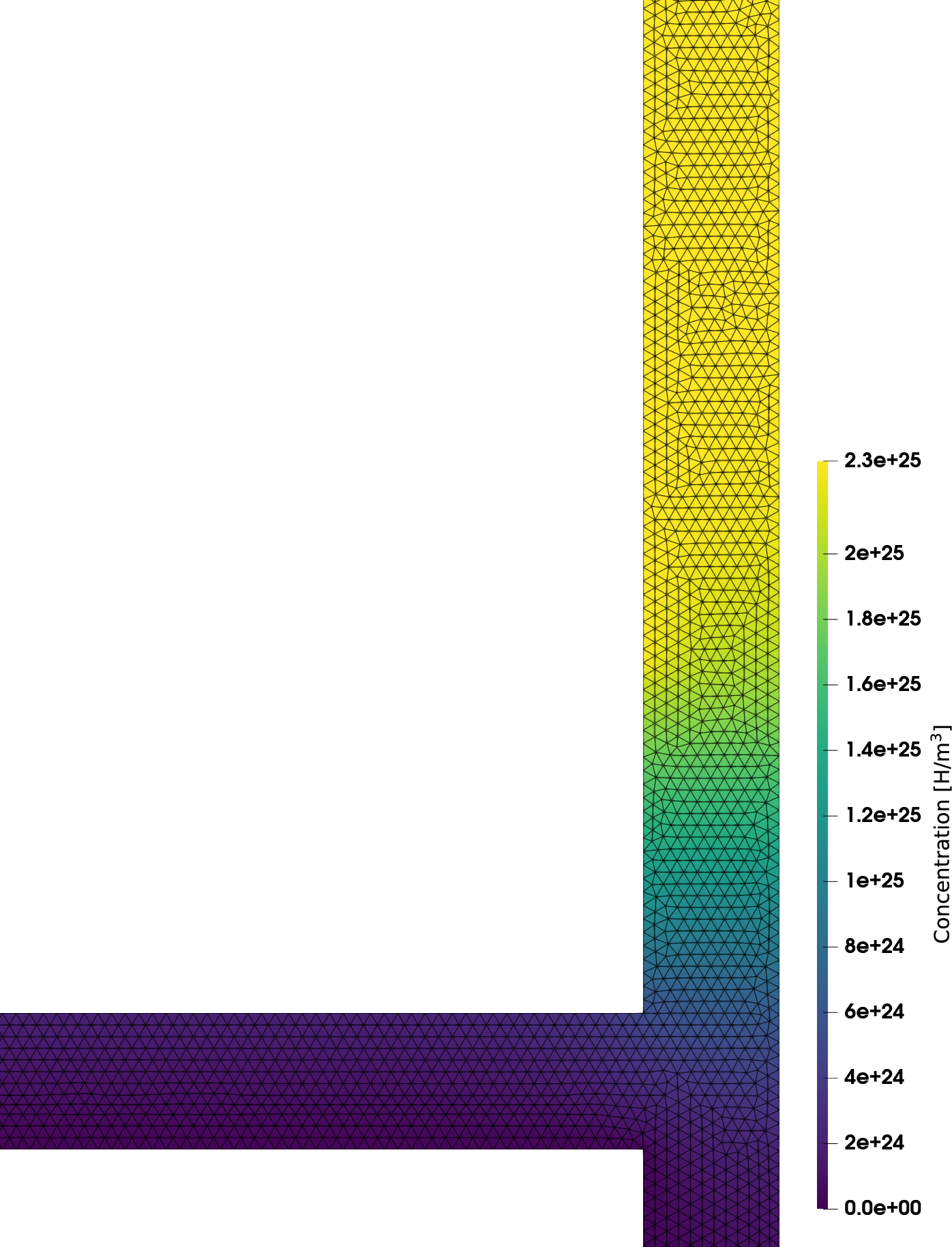
Figure 2: Full domain transport visualization (uncoated), highlighting significant sidewall gradients and depletion.
With an ideal coating, outward flux is suppressed with minimal lateral gradients. Under uncoated boundaries, radial losses and sidewall leakage become dominant. Nickel-only (dry-run) calibration aligns measured flux with literature correlations; the intrinsic nickel permeability for each boundary scenario is established via inverse fitting.
Temperature influences both salt thickness and transport resistance, affecting flux mapping. Permeability inference yields Arrhenius-type relations for both isotopes across boundary condition limits. The simulated fluxes match experimental measurements only when multidimensional transport—including sidewall effects—is explicitly modeled.
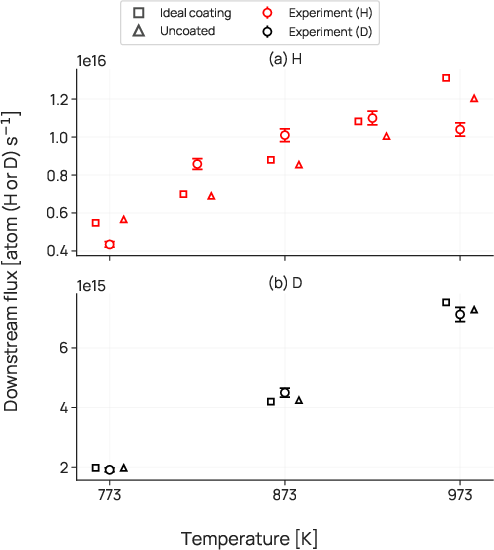
Figure 3: Comparison between simulated and measured permeation fluxes for H and D under different boundary condition assumptions.
The inferred FLiBe permeability for hydrogen under ideal coating is an order of magnitude lower compared to uncoated vessel conditions, and both reside below most literature values, particularly at elevated temperatures.
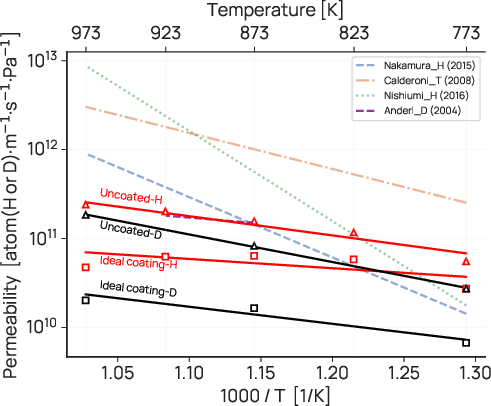
Figure 4: Arrhenius plots of FLiBe permeability for H and D, under both boundary condition limits, contrasted with canonical literature correlations.
Discussion: Quantitative Role of Multidimensional Pathways
Quantitative analysis shows that sidewall loss mechanisms contribute substantially to transport:
- Under uncoated boundaries, ~97% of upstream flux is lost through vessel structure, with downstream flux depleted accordingly.
- Ideal coating reduces sidewall loss but retains significant bypass, especially for deuterium (up to 55% at highest temperatures).
- One-dimensional models systematically underpredict downstream flux under ideal coating (neglecting bypass), but overpredict under uncoated conditions (neglecting losses).
These observations directly illustrate the geometry and boundary condition sensitivity of inferred permeability, and that most scatter in FLiBe permeability literature may originate from inadequately resolved multidomain transport, not intrinsic material variability.
Implications for Fusion Blanket Modeling and Permeation Experiments
The research has strong ramifications for tritium transport quantification in fusion blanket applications. Intrinsic permeability data extracted via 1D analysis is not transferable across divergent geometries; multidimensional modeling is essential for reliable system-level prediction. Future experiments should be co-designed with multidomain modeling capabilities and instrumentation for direct measurement and mass balance closure at vessel boundaries. Incorporation of interfacial bubble dynamics, as observed at elevated temperatures, remains an open challenge for further investigations.
Conclusion
Multidimensional transport and boundary condition assumptions exert decisive influence on permeability inference in molten salt systems. Standard 1D models are inadequate for extracting intrinsic material properties in environments where structural transport pathways and environmental exchange exist. The physically grounded, validation-informed multidomain modeling described herein elucidates and quantifies these effects, providing a framework for more accurate property inference and interpretation of permeation data in fusion-relevant systems. The implications extend to tritium control strategies, blanket design, and the standardization of permeability measurements for predictive modeling in advanced nuclear technologies.

