- The paper introduces EchoTracker2, which eliminates coarse initialization by using a fine-stage-only architecture grounded in locally constrained motion priors.
- It employs hierarchical spatiotemporal feature extraction, local 4D correlation computation, and transformer-based joint temporal refinement for pixel-precise trajectory estimation.
- Experimental results show up to a 6.52% accuracy increase and significant improvements in GLS agreement, demonstrating the method's superiority over current state-of-the-art trackers.
EchoTracker2: Enhancing Myocardial Point Tracking by Modeling Local Motion
Introduction
Myocardial point tracking (MPT) is pivotal for motion estimation in echocardiography, directly impacting deformation-based function assessment such as global longitudinal strain (GLS). Conventional point tracking techniques, primarily developed for unconstrained natural videos, often rely on coarse-to-fine architectures to handle abrupt or unpredictable motion. However, myocardial motion exhibits physiologically dictated, locally spatial and temporally continuous deformation throughout the cardiac cycle. Thus, natural video-inspired coarse initialization may represent a suboptimal inductive bias in this domain. EchoTracker2 proposes a fine-stage-only architecture leveraging locally confined motion priors, eschewing global correspondence and coarse initialization in favor of pixel-precise local spatiotemporal feature modeling and joint temporal refinement.

Figure 1: Motion trajectories of selected query points in a natural video (TAP-Vid DAVIS, left) illustrate large, arbitrary displacements, whereas cardiac trajectories (right) demonstrate locally confined, structured deformation.
Methodological Framework
EchoTracker2 formulates MPT as trajectory estimation for myocardium points in a full cardiac cycle, optimizing for local correspondences rooted in tissue biomechanics. The architecture is composed of three principal modules:
- Hierarchical Spatiotemporal Feature Extraction: Adopts iTSM-ResNet, injecting temporal shift modules (TSMs) after each ResNet block, thereby facilitating temporal context aggregation at all spatial scales. This progressive integration of local temporal data ensures feature maps encode tissue-level spatiotemporal regularity.
- Local 4D Correlation Computation: Restricts correspondence estimation to a windowed local neighborhood, leveraging 4D correlation for robust matching amid ubiquitous ultrasound image ambiguities. High-dimensional correlation maps are encoded and concatenated across multiple feature scales.
- KNP-Joint Temporal Refinement: Extends transformer-based joint reasoning via multi-head self-attention over K nearest neighbor trajectories, aligning with myocardial spatial coherency. Trajectory updates are iteratively predicted and applied, enhancing robustness against out-of-plane motion and artifacts.
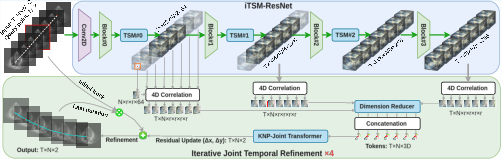
Figure 2: EchoTracker2 architecture: temporally-aware features are extracted via injected TSMs across ResNet blocks, followed by local 4D correlation and iterative joint temporal refinement for point tracking.
Experimental Evaluation
Datasets and Metrics
The evaluation encompasses a comprehensive suite of in-house and public datasets spanning both anatomical (LV/RV) and imaging (apical chamber views) variability, including synthetic CAMUS data. Trajectory accuracy is assessed via percentage of points within clinically relevant pixel thresholds (<δavgx,x∈{1,2,4}), median trajectory error (MTE), and average inference time (AIT). Downstream assessment leverages GLS agreement and reproducibility metrics, directly reflecting clinical utility.
Ablation Studies
Ablation experiments rigorously quantify the impact of local window size, temporal feature enrichment strategy, and joint reasoning mechanisms. Optimal configuration employs a 9×9 4D correlation window, iTSM-ResNet backbone, and KNP-Joint transformer refinement. Notably, architectural ablations confirm that removal of coarse initialization yields negligible performance loss, substantiating the hypothesis that local motion modeling is sufficient.
EchoTracker2 consistently surpasses domain-specific and general-purpose SOTA baselines, including EchoTracker, LocoTrack, and CoTracker3, for both in-distribution and OOD datasets, as well as synthetic contours. EchoTracker2 achieves a 6.52% increase in position accuracy and 12.22% reduction in median trajectory error over domain-specific SOTA. Relative to general-purpose LocoTrack, gains are 2.02% in accuracy and 5.28% in trajectory error.
The architecture demonstrates robust generalizability, with superior accuracy in synthetic (CAMUS) datasets, reinforcing the efficacy of locally constrained motion priors.
Clinical Utility: GLS Agreement and Reproducibility
EchoTracker2 yields GLS measurements with improved agreement to expert annotations and higher reproducibility across test-retest paradigms. The mean absolute difference (MAD) and coefficient of variation (CV) approach inter-observer variability benchmarks, indicating practical suitability for routine echocardiography. EchoTracker2 exhibits stronger consistency compared to both general and domain-specific baselines.
Implications and Future Directions
EchoTracker2 underscores the criticality of designing domain-adaptive architectures grounded in physiological motion constraints, diverging from general-purpose video tracking assumptions. Its fine-stage-only paradigm—eschewing global initialization—reduces computational cost, enhances ambiguity resolution, and yields pixel-precise trajectories pivotal for strain imaging.
Practically, these advancements have direct implications for automatic myocardial functional assessment, including algorithmic GLS measurement, where reproducibility and expert concordance are paramount. Theoretical implications include the potential for transfer to other domains characterized by locally confined, structured motion, such as musculoskeletal ultrasound or organ deformation modeling.
Further research may extend EchoTracker2 to 3D echocardiography, integrate multi-view fusion, or augment tracking under severe imaging artifacts. Real-time deployment and integration with clinical workflows for automated echocardiographic assessment represent eminent future directions.
Conclusion
EchoTracker2 establishes a new standard for MPT in echocardiography by leveraging locally constrained motion priors, hierarchical spatiotemporal feature modeling, robust local 4D correlation, and iterative joint temporal refinement. Its superiority in both tracking accuracy and clinical strain measurement supports its translation into automated diagnostic tools, advancing reliability and precision in myocardial function imaging (2605.12140).