Estimating Subgraph Importance with Structural Prior Domain Knowledge
Published 12 May 2026 in cs.LG | (2605.12009v1)
Abstract: We propose a subgraph importance estimation method for pretrained Graph Neural Networks (GNNs) on graph-level tasks, formulated as a linear Group Lasso regression problem in the embedding space. Our method effectively leverages prior domain knowledge of graph substructures, while remaining independent of the specific form of the output layer or readout function used in the GNN architecture, and it does not require access to ground-truth target labels. Experiments on real-world graph datasets demonstrate that our method consistently outperforms existing baselines in subgraph importance estimation. Furthermore, we extend our method to identify important nodes within the graph.
The paper presents eXEL, a domain-aligned framework using Group Lasso to estimate subgraph importance in pretrained GNNs.
It achieves high fidelity in subgraph identification across diverse molecular datasets and architectures, outperforming alternatives in 82.1% of scenarios.
The method is model-agnostic and extends to node-level explanations, offering stable and interpretable insights through structural prior knowledge.
Subgraph Importance Estimation in GNNs with Structural Priors
Introduction and Motivation
The paper "Estimating Subgraph Importance with Structural Prior Domain Knowledge" (2605.12009) presents a domain-aligned method for subgraph importance estimation in pretrained Graph Neural Networks (GNNs). Existing GNN explanation methods face two critical challenges: (1) limited incorporation of domain-specific prior knowledge into subgraph identification, often resulting in non-interpretable or semantically invalid explanations, and (2) difficulties connected to the permutation-invariant nature of the readout function, which inhibits gradient-based attributions at the node or subgraph level.
The authors introduce eXEL, a procedure based on Group Lasso regularization in the node embedding space, explicitly leveraging predefined subgraph groupings derived from available domain knowledge. The formulation is model-agnostic with respect to the GNN architecture, does not require modifications to the readout function, and is label-agnostic at the inference stage.
Methodology
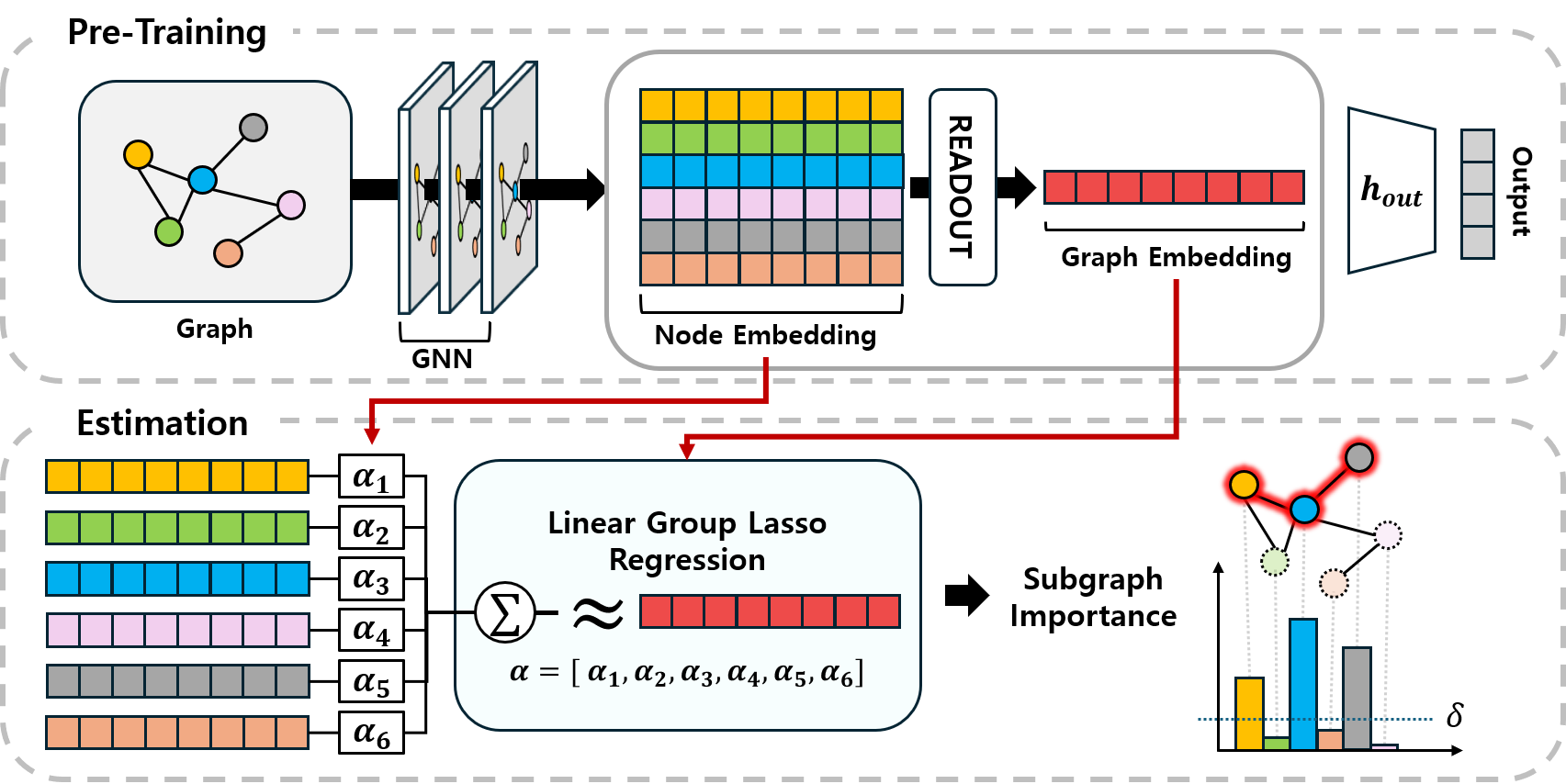
eXEL addresses subgraph importance by introducing a sparsity-induced regression in the embedding space post-training. For a given graph G=(X,A) and a trained GNN model decomposable as hout∘h∘f, the method optimizes a Group Lasso objective to find a sparse set of subgraph coefficients whose affine combination of node embeddings reconstructs the graph-level embedding vector with minimal error:
α∈Rnmin(h∘f)(X,A)−α⊤f(X,A)2+λs=1∑m∥αs∥
where nodes are partitioned into m groups (PG) representing domain-meaningful subgraphs.
The approach is illustrated by a workflow where domain knowledge (e.g., functional groups in molecules, motifs in biological graphs) determines the grouping for the Group Lasso penalty. This structural prior is essential for mapping GNN internal representations back to meaningful subgraph units and ensuring interpretability.
Figure 1: Overall process for subgraph importance estimation using structural prior information and Group Lasso in the embedding space.
The method subsequently averages node-level coefficients within each group to yield per-subgraph importance scores, filtering salient subgraphs via a threshold. The design is compatible with arbitrary readout functions (mean, sum, max), making it broadly applicable across standard GNN settings.
Empirical Results
A comprehensive empirical evaluation is conducted across 13 molecular datasets and multiple GNN architectures (GCN, GAT, GIN, GraphSAGE), emphasizing the method's robustness and generality.
Key highlights:
eXEL achieves top or second-best FidelityF1 scores in all 28 subgraph-level experiment settings (4 architectures × 7 datasets).
On several datasets (e.g., Benzene, Alkane, Fluoride), eXEL demonstrates notably higher fidelity in subgraph identification compared to PGExplainer, GNNExplainer, SubgraphX, GradCAM, GraphMask, and saliency-style methods.
An ablation study replacing Group Lasso with Lasso (node-level sparsity) reveals that Group Lasso offers superior performance in 82.1% of scenarios, underlining the impact of structured sparsity induced by domain priors.
An ROC/PR-AUC analysis against ground-truth subgraph annotations (where available) further supports these findings, showing that eXEL substantially outperforms alternative attribution benchmarks, both classical and GNN-specific.
Visualization of selected subgraph explanations (Benzene and Fluoride) confirms that eXEL respects connectivity and group semantic constraints (as defined by domain knowledge) far better than node-wise or permutation-invariant explanations, which often yield disconnected or fragmentary importance patterns.
Scalability and Extension to Node-Level Explanation
The framework is naturally extensible to node-level importance tasks by simply adopting the Lasso penalty (singleton group partition). On real and synthetic datasets with node-level annotation tasks (IMDB, ENZYMES, PROTEIN, UPFD, MOTIF, MULTI), the node-level variant consistently matches or exceeds the performance of established techniques (GNNExplainer, SubgraphX, GradCAM, GraphMask, Saliency, Guided Backpropagation).
This provides strong empirical support for the generalized utility of the regression-based framework in both subgraph and node attribution regimes, depending on application needs and the availability of structural priors.
Theoretical Properties
The paper formalizes the conditions under which its approach yields faithful subgraph importances, leveraging the Lipschitz continuity of standard graph-level loss objectives (e.g., cross-entropy, hinge loss). The theoretical analysis ensures that the reconstructed graph embedding exhibits bounded deviation in the GNN loss landscape, providing a stability guarantee for downstream attributions.
Notably, the regression operates post hoc and treats the pretrained embeddings as fixed. This circumvents architectural dependencies and ensures that the method is both model-agnostic and output-independent, differentiating it from integrated-gradient or perturbation-based approaches that require internal model access or label information.
Implications, Limitations, and Future Directions
Practically, eXEL enables domain-expert-aligned explanations for GNNs in structural applications (e.g., molecular property prediction, engineered system analysis). The strong empirical performance and model-agnostic nature lower the barrier for interpretability in sensitive or regulated domains, where post hoc justifiability is crucial.
The main limitation is the reliance on a predefined subgraph partition, restricting explanations to granularities for which structural priors are available, and to graphs amenable to node partitioning. Furthermore, the reconstruction strategy applies only to GNNs with aggregation readouts and does not resolve explanations for atypical models without such a layer.
The method could be extended by incorporating more complex structured regularizers (e.g., tree-guided Group Lasso) for hierarchical priors or hybrid sparsity controls (combining node-level and group-level penalties across GNN layers). This would make the framework more flexible, particularly in domains with overlapping or nested structural knowledge.
Conclusion
The paper introduces a Group Lasso-based regression framework for subgraph importance estimation in pretrained GNNs that effectively integrates domain structural priors. It is empirically validated to outperform prior post hoc GNN explainers on both molecular and synthetic datasets and is theoretically motivated by loss continuity arguments. The approach promotes more interpretable and domain-consistent attributions—an imperative for both practical deployment and further theoretical scrutiny in explainability research. The integration of richer structural priors and hybrid penalty schemes stands as a compelling direction for future work.
“Emergent Mind helps me see which AI papers have caught fire online.”
Philip
Creator, AI Explained on YouTube
Sign up for free to explore the frontiers of research
Discover trending papers, chat with arXiv, and track the latest research shaping the future of science and technology.Discover trending papers, chat with arXiv, and more.