- The paper introduces EqOD, a fully automatic approach that integrates Galilean invariance detection with randomized LASSO stability selection for sparse PDE identification.
- It employs adaptive library pruning and weak-form LASSO regression to achieve high fidelity, even at noise levels up to 20%, with F1 scores reaching 1.00 in benchmark tests.
- Empirical comparisons demonstrate that EqOD outperforms traditional methods in noise resilience and efficiency, particularly for 1D scalar PDEs.
Overview and Motivation
EqOD (Equivariant Operator Discovery) presents a principled, fully automatic approach for identifying sparse partial differential equations (PDEs) from noisy spatiotemporal trajectory data. The method directly addresses a central challenge in data-driven PDE discovery: operator library selection. Large libraries increase false-positive risk under noise, while small libraries risk omitting physically relevant terms. EqOD operates by a dual mechanism: (i) physics-based reduction via detected symmetries—specifically Galilean invariance—and (ii) statistics-based reduction via randomized LASSO stability selection. This allows EqOD to adaptively select the correct sparse support from candidate terms, suppressing spurious selections and maintaining high fidelity even in high-noise regimes.
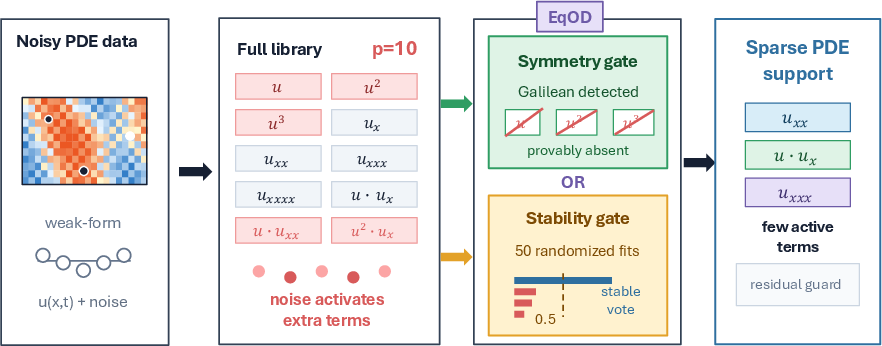
Figure 1: EqOD workflow — noisy trajectory data are converted into a weak-form regression system; detected Galilean invariance triggers symmetry-based pruning, otherwise randomized stability selection is applied; residual guard protects the final sparse equation.
Theoretical Principles and Pipeline Architecture
EqOD operates in four stages, leveraging both structural and statistical information:
- Lie Symmetry Detection: Five independent tests search for translation, Galilean, scaling, and reflection symmetry from the data. Galilean invariance is established via a weak-form structural test achieving F1=1.00 at noise thresholds up to 10%.
- Adaptive Library Selection: If Galilean symmetry is detected, EqOD provably removes reaction terms (e.g. u, u2, u3). Otherwise, it applies stability selection by performing 50 randomized LASSO subsample fits and retaining only terms with majority support.
- Sparse Identification via WF-LASSO: The reduced library is used in a weak-form LASSO regression (with cross-validation and OLS debiasing) to extract sparse support and final coefficients.
- Residual-Based Fallback: If the regression residual increases beyond a path-dependent threshold, EqOD falls back to the full-library WF-LASSO result, preventing catastrophic failures in statistical pruning.

Figure 2: EqOD's library reduction flow chart — physics-based pruning removes reaction terms for Galilean-invariant PDEs, and statistical stability selection isolates robust terms otherwise.
The Galilean reduction mechanism is formally derived from Lie symmetry determining equations and guarantees the exclusion of non-invariant terms under explicit autonomy assumptions. The stability selection path is motivated by classical false-positive bounds but lacks formal guarantees for correlated design matrices, which remains an open area.
EqOD was benchmarked against three established baselines (WF-LASSO, PySINDy, WSINDy) across 8 scalar 1D PDEs (diffusive, reactive, convective, dispersive), at four noise levels (0%,5%,10%,20%) and 10 seeds per condition. Extensions include 2D cases, coupled systems, NLS, and real cylinder wake data.
Numerically, EqOD achieves consistent improvements:
- Heat equation (non-Galilean): At 20% noise, EqOD attains F1=1.00±0.00; WF-LASSO drops to 0.475±0.181, PySINDy collapses to $0.00$.
- Burgers (Galilean-invariant): EqOD reaches $0.92$ (20% noise) vs. $0.60$ for WF-LASSO.
- Aggregate: Using strict statistical criteria, EqOD wins 7 of 32 cells; WF-LASSO wins none, 25 are ties.
- External benchmarks (WeakIdent, PINN-SR): EqOD achieves u20 on all 5 datasets.
- NLS extension: EqOD produces u21 up to u22 noise, outperforming PySINDy (u23).
Performance consistency is illustrated by the F1 heatmaps and stability selection profiles, showing robust term selection and marked noise resilience.
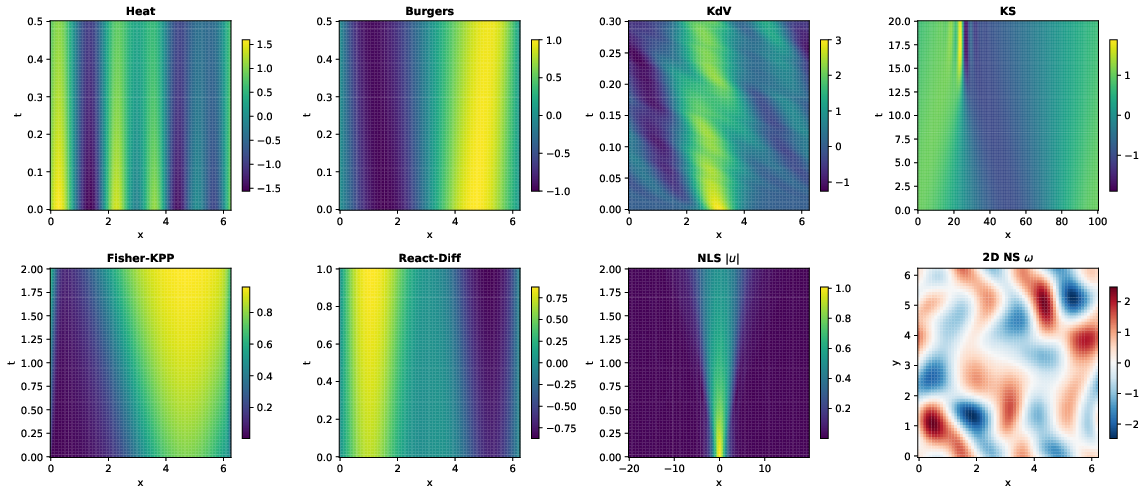
Figure 3: Representative solution snapshots for benchmark PDEs, spanning Heat, Burgers, KdV, KS, Fisher-KPP, reaction-diffusion, NLS, and 2D Navier-Stokes.
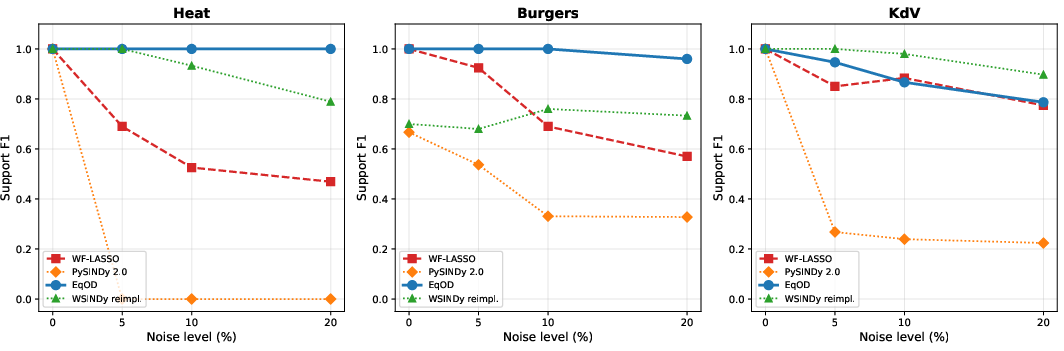
Figure 4: F1 scores vs. noise for Heat, Burgers, and KdV. EqOD maintains near-perfect accuracy where baselines degrade rapidly.
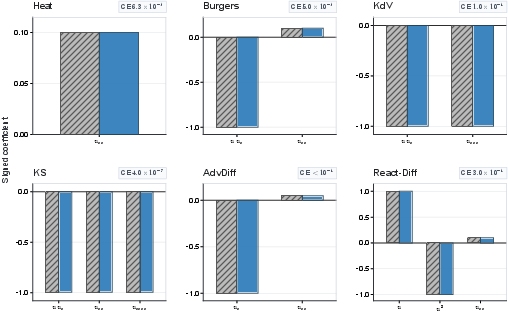
Figure 5: Identified vs. true coefficients for six PDEs — EqOD estimates (blue) display sub-u24 error except on low-magnitude terms (Fisher-KPP omitted as a failure case).
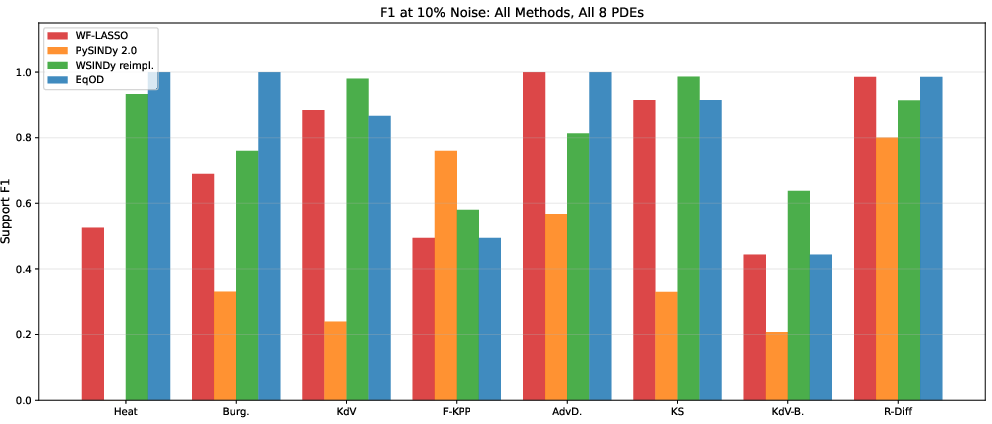
Figure 6: Comparative F1 at u25 noise for all four methods over 8 PDEs — EqOD matches or exceeds baselines except reaction-dominated cases.
Practical and Theoretical Implications
The key implication is that symmetry-informed library pruning provides a deterministic reduction in false-positive rates, while stability selection enables robust term recovery in non-Galilean/noisy scenarios. EqOD's pipeline can be integrated into existing scientific ML workflows, notably in settings with unknown structural properties and high observational noise.
However, EqOD's advantages are concentrated in 1D scalar, low-support ratio PDEs. For coupled systems or 2D, the relative value of stability selection declines; residual fallback mitigates severe errors but does not improve over full-library WF-LASSO.
In theory, the automatic symmetry detection and provable exclusion via Lie determining equations close a practical gap not addressed by prior approaches that require symmetry as a prior. The weak-form regression—by transferring derivatives from noisy data to smooth test functions—confers robustness that is critical in real-world high-noise scenarios.
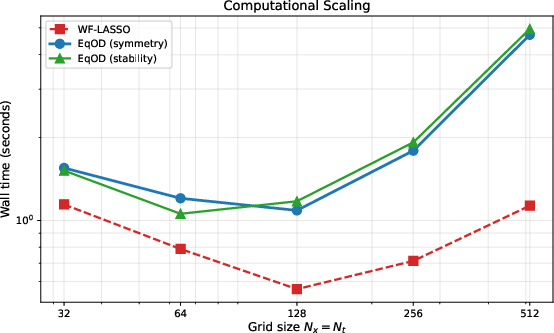
Figure 7: Computational scaling — wall time as a function of grid size. Both EqOD paths scale with moderate overhead due to bootstrap and symmetry detection.
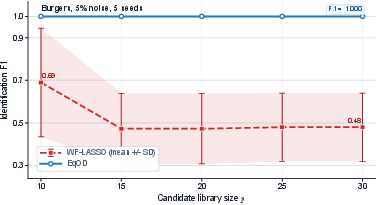
Figure 8: Library scaling experiment — EqOD's accuracy is invariant to library size due to symmetry reduction; WF-LASSO degrades as candidate terms increase.
Future Directions
Open problems include rigorous statistical guarantees under correlated feature design for stability selection, extension to generalized symmetries (e.g. learned Lie generators), adaptations to coupled/multivariate or 2D/3D PDEs, and non-periodic domain discretizations.
Advances in symmetry learning [ko2024symmetry], differential invariants [hu2025di], and symbolic differential equation discovery [yang2025si] may inform future variants of EqOD or successor frameworks. Empirical work is also required to tune stability selection for high support ratios and to exploit more flexible library construction for complex PDEs.
Conclusion
EqOD demonstrates that automatic symmetry detection and stability-informed library pruning are decisive for robust, sparse PDE identification in noisy, low-support regimes. Its pipeline achieves notable accuracy and resilience, outperforming classical baselines across the majority of tested cases. While its empirical advantage currently favors scalar 1D problems, EqOD's formal architecture presents a scalable foundation for symmetry-adaptive scientific ML. Remaining challenges are linked to more general symmetries, high-dimensional systems, and formal bounds for stability selection in correlated settings.
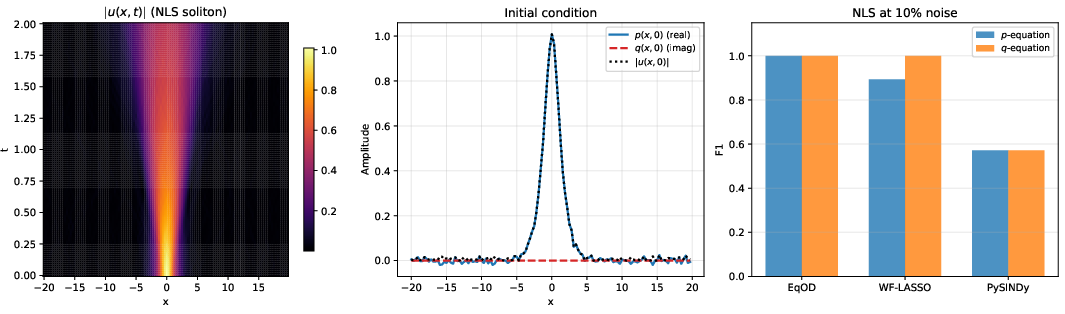
Figure 9: NLS identification — EqOD achieves perfect F1 for both real and imaginary equations while baselines fail under noise.
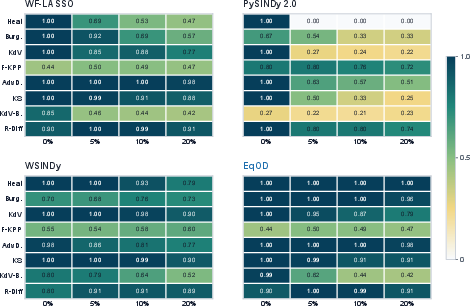
Figure 10: F1 heatmap — EqOD exhibits most consistent performance across PDE types and noise levels compared to conventional methods.
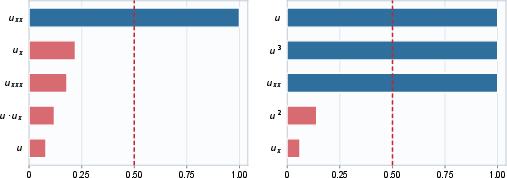
Figure 11: Stability selection probability profiles — clear separation between stably selected (blue) and unstable (red) terms.
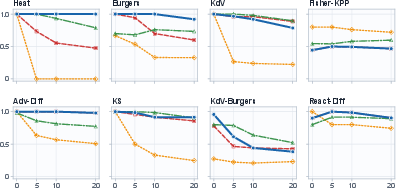
Figure 12: Noise robustness curves — EqOD sustains high F1 even as observation noise increases across all PDEs.
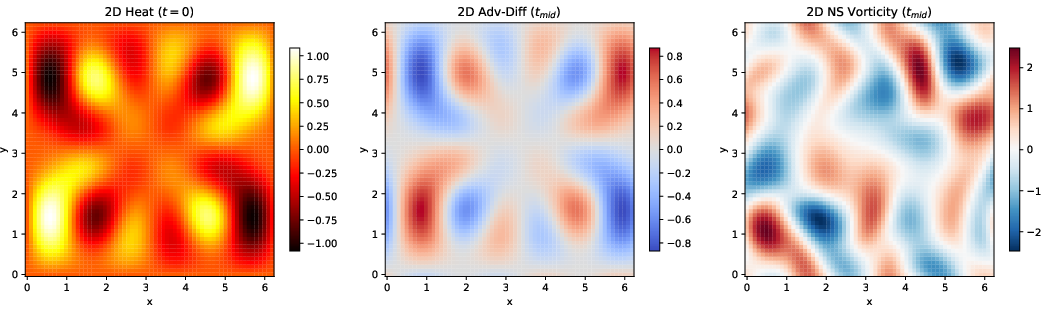
Figure 13: 2D PDE solution fields for Heat, advection-diffusion, and Navier-Stokes.
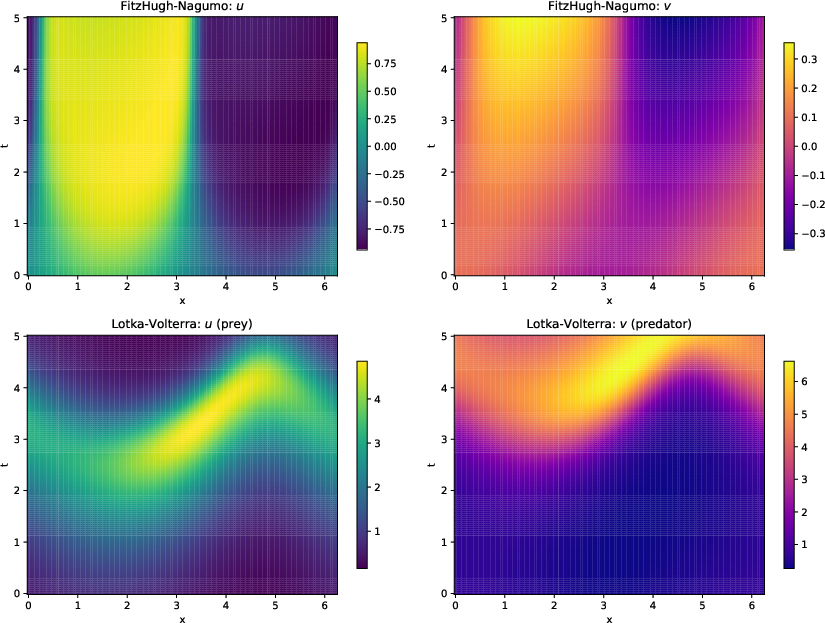
Figure 14: Coupled system solution snapshots — spatiotemporal evolution in FitzHugh-Nagumo and Lotka-Volterra systems.
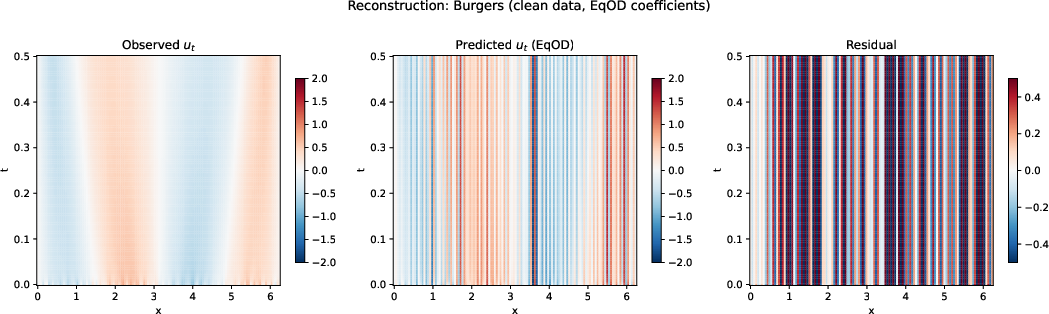
Figure 15: Reconstruction comparison — weak-form EqOD prediction matches Burgers u26 closely even near shocks.
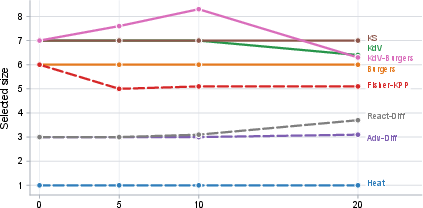
Figure 16: Library size selected by EqOD — symmetry path produces fixed-size libraries, while statistics path is adaptive to noise.
References
- "EqOD: Symmetry-Informed Stability Selection for PDE Identification" (2605.11524)
- Additional symmetry and invariance learning approaches [ko2024symmetry; hu2025di; yang2025si]
- Benchmark and baseline methods [messenger2021wsindy; desilva2020pysindy; kaptanoglu2022pysindy; maddu2022stability]

