- The paper introduces a novel zero-reference framework that decouples illumination correction from detail restoration using adaptive gamma correction and perturbed diffusion consistency loss.
- It combines Retinex decomposition with spatially varying gamma maps and histogram-guided loss to achieve robust, unsupervised correction of exposure errors.
- Evaluations on multiple benchmarks show improved PSNR, SSIM, and visual fidelity, marking a significant advancement over conventional supervised methods.
ZeroIDIR: Zero-Reference Diffusion-Based Illumination Degradation Image Restoration
Illumination degradation in images, encompassing low-light, backlit, and exposure errors, significantly deteriorates image visibility and impairs downstream vision tasks. Traditional restoration schemes predominantly rely on hand-crafted priors or paired datasets, limiting their adaptability and robustness in real-world conditions. Deep learning and generative models, including diffusion-based approaches, have improved restoration quality but remain constrained by paired supervision or external references, often exhibiting exposure bias, noise amplification, or limited generalization. ZeroIDIR directly addresses these deficits by decoupling illumination correction and detail restoration in a fully zero-reference setting, leveraging adaptive gamma correction and a perturbed consistency diffusion model (PCDM) solely trained on degraded images.
Framework Overview
ZeroIDIR comprises two sequential phases: adaptive illumination correction and diffusion-based reconstruction. The restoration pipeline begins with Retinex decomposition to isolate reflectance and illumination maps. The adaptive gamma correction module (AGCM) estimates spatially varying gamma and weighting maps to correct illumination non-uniformities without amplifying noise or compromising structural fidelity. A histogram-guided loss regularizes the correction towards empirical illumination distributions observed in natural scenes. The resultant illumination-corrected image is conceptualized as a perturbed noisy state, conditioned for the PCDM to perform high-fidelity detail reconstruction and noise suppression. The perturbed diffusion consistency loss aligns the trajectory of diffusion reconstruction with the intermediate input, ensuring robust restoration in the absence of supervision.
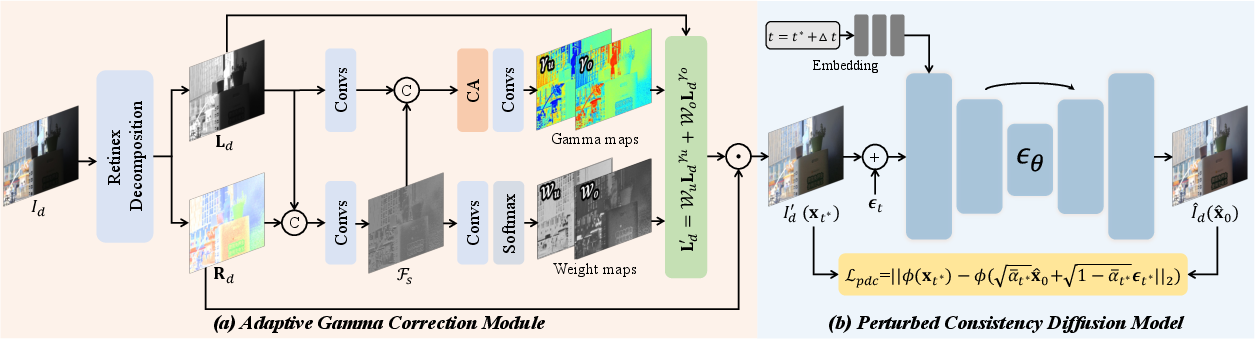
Figure 1: The ZeroIDIR pipeline stages: Retinex decomposition, AGCM-based correction, and diffusion-based reconstruction facilitated by consistency losses.
Adaptive Gamma Correction Module (AGCM)
The AGCM operates on the illumination map derived via Retinex decomposition, guided by both local structure features and global exposure priors. Two spatially varying gamma maps (γu, γo) and their corresponding weight maps (Wu, Wo) are predicted to perform localized corrections for under- and over-exposed regions. The corrected illumination is fused with reflectance to generate the intermediate image. The histogram-guided illumination correction loss, formulated via KL-divergence, constrains the corrected illumination distribution to match that of well-lit reference datasets, operationalizing adaptive exposure compensation.
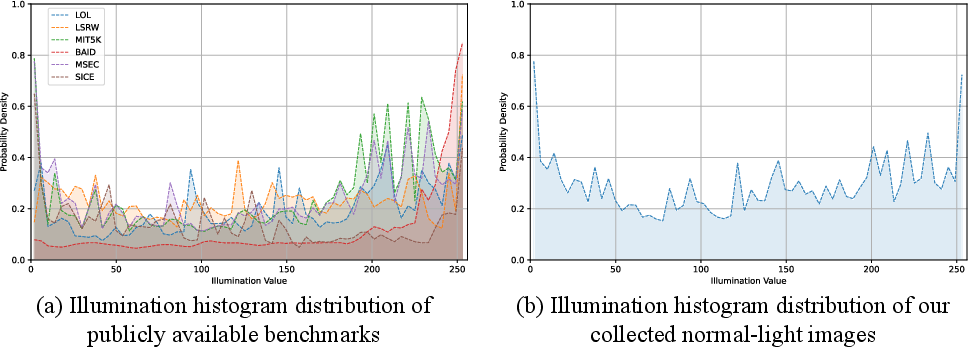
Figure 2: Empirical illumination histogram distributions from normal-light image benchmarks and aggregate priors.
Perturbed Consistency Diffusion Model (PCDM)
The PCDM treats the AGCM output as an intermediate diffusion state, enabling conditional generation conditioned on illumination-corrected images. The model is optimized to estimate noise mappings and reconstruct high-quality images, guided by a perturbed diffusion consistency loss. This loss enforces trajectory alignment in feature space between the forward diffusion of the generated image and the original intermediate state (via VGG-16 perceptual metrics), enhancing fidelity and stability. Training samples are produced by further diffusing the AGCM result with additional noise steps, allowing robust adaptation to varying degradation intensities.
Evaluation and Results
Quantitative Comparisons
ZeroIDIR is evaluated on low-light (LOL, LSRW, MIT5K), backlit (BAID, Backlit300), and multiple exposure correction (MSEC, SICE) datasets. It exhibits superior generalization and consistently outperforms all unsupervised competitors across tasks, with competitive or superior performance relative to state-of-the-art supervised methods. For example, on LSRW and MIT5K—where supervised competitors are not specifically trained—ZeroIDIR achieves higher PSNR and SSIM, demonstrating its adaptability. On SICE, ZeroIDIR surpasses all unsupervised and several supervised baselines in both distortion and perceptual metrics, evidencing robust exposure correction and noise suppression while preserving fine details.
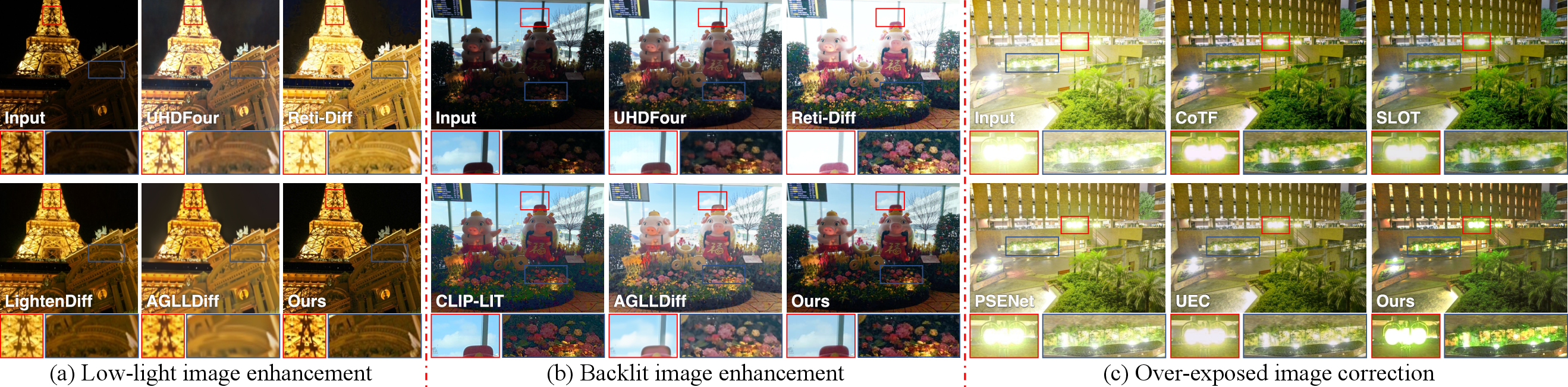
Figure 3: Visual comparisons of ZeroIDIR with state-of-the-art supervised and unsupervised IDIR methods, demonstrating accurate exposure, vivid color, and sharp detail reconstruction.
Qualitative Comparisons
Visual inspection on diverse test sets confirms that previous methods suffer from exposure imbalance, color distortions, or noise amplification. ZeroIDIR reliably restores global and local illumination, eliminates color shifts, and reconstructs sharp detail, achieving visually consistent results.
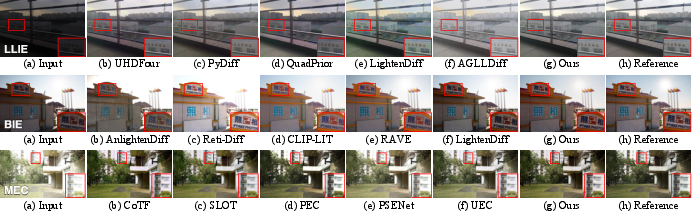
Figure 4: Qualitative comparison on the LSRW dataset, illustrating ZeroIDIR’s capability to jointly correct illumination and preserve detail.
Ablation Studies
Ablation evaluations validate the critical importance of AGCM (Retinex decomposition, histogram-guided loss) and PCDM (illumination-corrected conditioning, consistency loss). Removing AGCM or its losses, or reverting to naïve gamma correction, degrades performance via inflexible exposure adjustment or noise/color artifacts. Training PCDM with the original degraded image as a condition (as in prior works) leads to unstable exposure correction, while omitting diffusion consistency loss results in perceptual artifacts and reduced stability.
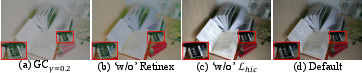
Figure 5: AGCM ablation visualization showing the benefits of spatial gamma correction and histogram-guided loss.
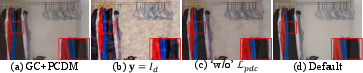
Figure 6: PCDM ablation visualization demonstrating improved consistency and fidelity with the proposed losses and conditioning.
Implications and Future Directions
ZeroIDIR constitutes a substantive advance in zero-reference IDIR, eliminating dependence on paired or external supervision while maintaining restoration quality comparable to supervised approaches. The modular decomposition (illumination correction + diffusion reconstruction) introduces a flexible paradigm applicable to diverse illumination degradations and holds promise for generalizable restoration pipelines. Theoretically, the integration of statistical histogram priors and trajectory consistency in diffusion learning establishes a principled approach to self-supervised restoration under ill-posed conditions. Practically, ZeroIDIR’s robustness across domains and degradations enables deployment in real-world vision systems, including autonomous navigation and surveillance.
Future developments may extend ZeroIDIR’s paradigm to other image restoration domains (e.g., adverse weather, multi-modal denoising), incorporate advanced structural priors or transformer-based diffusion networks, and exploit dynamic multi-stage conditioning for complex degradation scenarios. Further work can also investigate cross-domain adaptation and scalability for ultra-high-definition and real-time restoration tasks.
Conclusion
ZeroIDIR delivers a zero-reference, diffusion-based framework for illumination degradation image restoration, leveraging spatially adaptive gamma correction and perturbed consistency diffusion to achieve resilient detail reconstruction, effective exposure correction, and competitive quantitative and qualitative performance. The approach sets a new benchmark for unsupervised IDIR, demonstrating notable generalization and practical viability for real-world scenarios (2605.11435).

