- The paper provides a robust 15-year multi-instrument RV confirmation of Ross 318 b with a 39.63-day period and a minimum mass of 6.21±0.62 M⊕.
- It employs achromatic visible and NIR spectroscopic measurements alongside Bayesian analysis to distinctly separate the planetary signal from stellar activity.
- Located within the conservative habitable zone of an active M3.5V dwarf, Ross 318 b is highlighted as a prime target for future atmospheric and compositional investigations.
Detection and Characterization of the Temperate Super-Earth Ross 318 b
Introduction
The search for terrestrial-mass exoplanets in the habitable zones (HZs) of M-dwarfs is a central focus in exoplanetary science due to their prevalence and advantageous stellar properties for precision Doppler measurements. However, high stellar magnetic activity and rotational modulation in active M-dwarfs introduce significant challenges for disentangling low-amplitude planetary signals from stellar-induced variability. The system Ross 318, an M3.5V dwarf at 8.58 pc, exemplifies these issues, with a stellar rotation period of ∼51.5 d and substantial activity signatures. The present study (2605.11123) delivers a comprehensive, multi-year spectroscopic and photometric investigation culminating in the robust detection and characterization of the temperate super-Earth Ross 318 b.
Radial Velocity Analysis and Signal Validation
The combined radial velocity (RV) dataset spans 15 years, integrating 152 CARMENES-VIS, 78 HIRES, and CARMENES-NIR epochs to leverage both high Doppler precision and temporal baseline. The planetary signal emerges as a coherent, achromatic modulation at P=39.6299±0.29 d with a semi-amplitude K=2.38±0.24 m s−1, corresponding to Msini=6.21±0.62M⊕. The planetary nature is decisively favored (ΔBIC≈313 vs. null hypothesis), with the following critical validation protocols:
- Achromaticity: VIS and NIR RV amplitudes are consistent within 1σ, precluding temperature-dependent activity as the signal source.
- Activity Indicators: The CRX/dLW metrics from SERVAL show no correlated power or phase coherence at P=39.63 d; the observed chromatic and RV-domain activity is exclusively at Prot∼51.5 d.
- Bayesian Model Selection: Simultaneous 2-signal (planet + rotation) fits yield statistically independent periods/amplitudes; time/phase coherence is maintained across ∼140 orbital cycles.
- Cross-validation: An independent 719-d CARMENES analysis recovers compatible periods and amplitudes (P=39.6299±0.290 tension), confirming reproducibility and robustness (see discussion under Table 1 in the original text).
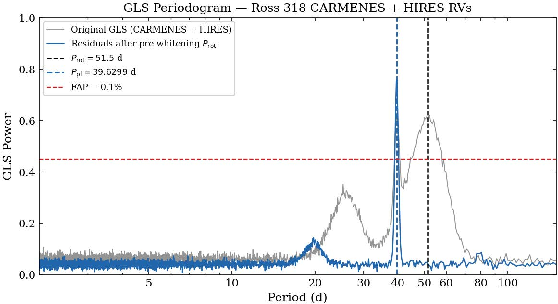
Figure 1: Generalized Lomb-Scargle (GLS) periodogram of combined CARMENES and HIRES RVs. Residuals after pre-whitening highlight the planet's signal at P=39.6299±0.291 d, distinct from the stellar rotation and above the P=39.6299±0.292 FAP threshold.
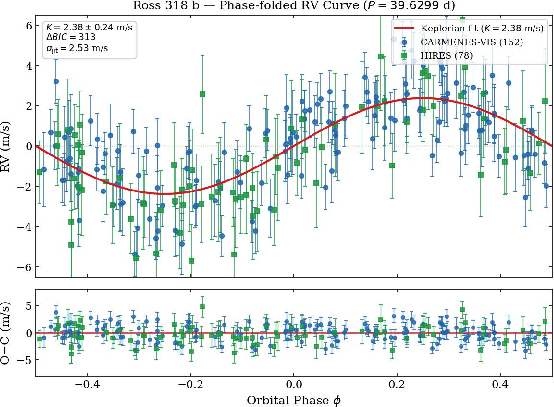
Figure 2: Phase-folded RV curve for Ross 318 b at P=39.6299±0.293 d. CARMENES and HIRES data overlay the best-fit Keplerian model, with post-fit residuals displayed below.
Photometric Constraints and Orbital Geometry
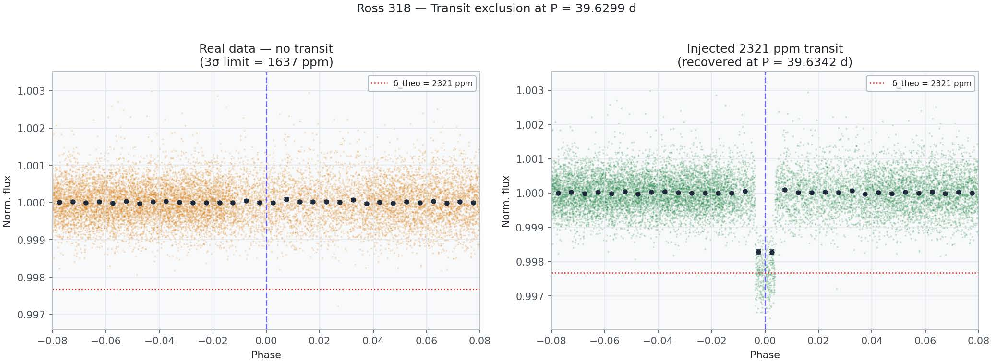
TESS photometry (four sectors; P=39.6299±0.294 d baseline; 66,983 cadences) is analyzed to probe for both rotational and planetary photometric modulation:
Habitable Zone Placement and System Parameters
With K=2.38±0.246, semi-major axis K=2.38±0.247 au, and incident flux K=2.38±0.248, Ross 318 b resides securely within the conservative HZ per the Kopparapu et al. boundaries for an M3.5V primary (inner edge K=2.38±0.249 au, outer −10 au). The equilibrium temperature, assuming −11, is −12 K. This parameter space—moderate irradiation, robust mass, and proximity to the inner HZ boundary—recalls the most compelling non-transiting super-Earths identified around nearby M-dwarfs.
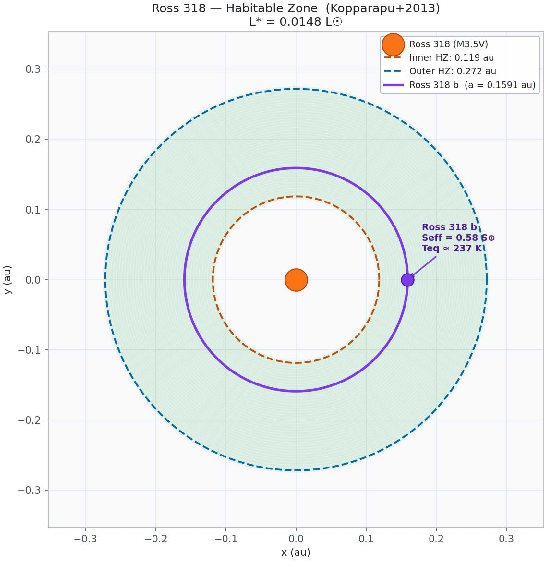
Figure 4: Habitable Zone diagram for the Ross 318 system. The planet's semi-major axis and irradiation place it well within the conservative HZ.
Implications and Prospects
The availability of both time-domain, achromatic, and statistically independent confirmation techniques makes Ross 318 b an exemplary template for future Doppler surveys of active mid-M dwarfs. The planetary signal's separation from the star's rotational timescale (−13) and the contrasting photometric inactivity at the orbital period provide a methodological advance in distinguishing planetary RV signatures from complex activity signals.
Given its secure HZ positioning, minimum mass, and the proximity of the Ross 318 system, Ross 318 b is a high-priority target for atmospheric characterization. Transmission and emission studies—although hindered by non-transiting geometry—may be feasible with next-generation instrumentation leveraging stellar reflex motion, direct imaging, or phase curve analysis if the inclination is favorable. The effect of energetic M-dwarf activity on atmospheric retention and evolution remains a critical theoretical question, raising the need for follow-up studies on stellar wind/flare histories and planetary magnetospheric protection.
Conclusion
This investigation delivers a rigorous multi-instrument confirmation of Ross 318 b, a temperate, non-transiting super-Earth with −14 in a −15 d orbit within the conservative habitable zone of an active M3.5V dwarf. Multi-epoch, chromatic, and Bayesian methodologies render the planetary interpretation robust against confounding activity. The exclusion of transits places geometric and compositional constraints, enabling future work on true mass estimation and atmospheric status. Ross 318 b exemplifies the potency of integrated RV-photometric frameworks in the characterization of small planets around magnetically active, cool stars, and underscores the necessity of sophisticated RV and photometric analyses for advancing habitable exoplanet discovery and assessment.