- The paper demonstrates that electron-based direct detection experiments can probe freeze-in produced sub-GeV dark matter via intermediate-mass dark photons.
- It uses a scattering formalism with a mediator form factor to interpolate between light and heavy mediator limits, impacting sensitivity in Si and Ge detectors.
- Sensitivity analyses show that DAMIC-M can test dark matter masses from 3 to 460 MeV with mediator masses up to 10 keV, thereby refining the mapping of theoretical parameter space.
Introduction and Motivation
This paper analyzes the sensitivity of electron-based direct detection experiments to sub-GeV dark matter (DM) interacting with the Standard Model (SM) via a kinetically-mixed dark photon, emphasizing the regime where the mediator mass is intermediate between the canonical light and heavy limits. The study is motivated by recent DAMIC-M results, which for the first time excluded freeze-in produced DM for certain masses using electron recoil in silicon (Si) and germanium (Ge) targets. Conventional analyses primarily consider mediator masses that are either much lighter or much heavier than characteristic momentum transfers in the target, but this work demonstrates that the intermediate regime spans up to three orders of magnitude in mediator mass for sub-GeV DM, necessitating a more nuanced approach.
The theoretical framework is based on a Dirac fermion DM candidate χ charged under a broken U(1)′ symmetry, interacting with SM electrons via a kinetically-mixed dark photon A′. The relevant interaction Lagrangian is:
L⊃Aμ′(−g′χˉγμχ+εeℓˉγμℓ)
The detectability of χ through electron-based direct detection is governed by the combination εg′, or equivalently, via a reference cross section σˉe, parameterized as:
σˉe=πμχe2(α2me2+mA′2)2g′2(εe)2
The DM-electron scattering rate depends explicitly on the mediator mass through the mediator form factor:
F(q)=q2+mA′2α2me2+mA′2
This form factor interpolates between 1/q2 in the light mediator limit (U(1)′0) and unity in the heavy mediator limit (U(1)′1), with U(1)′2 and U(1)′3 set by detector threshold and DM mass.
The paper rigorously defines the intermediate-mass regime for the dark photon by comparing U(1)′4 to the kinematically allowed momentum transfer in the detector, rather than the typical U(1)′5 scale used in previous literature. For Si and Ge targets with eV-scale band gaps, the relevant momentum scales span from U(1)′6 (minimum, U(1)′7 keV) to U(1)′8 (maximum, U(1)′9 MeV for GeV DM). The intermediate-mass regime arises when A′0 is between these two bounds, a range that can encompass several orders of magnitude for heavy DM.
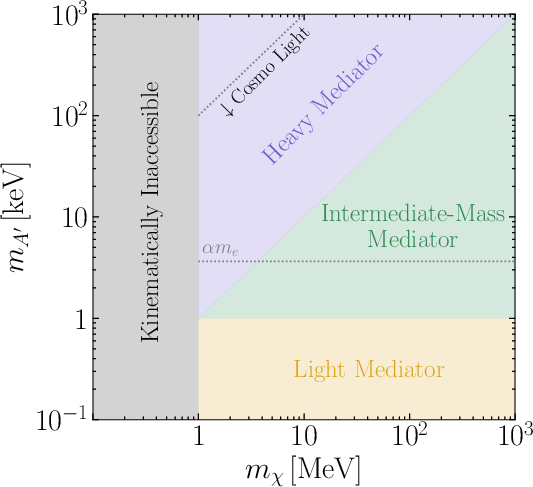
Figure 1: Dark photon mass regimes for eV-threshold direct detection: light mediator, heavy mediator, intermediate-mass mediator, and kinematically inaccessible regions.
This refinement in regime definition substantially impacts both theoretical mapping and experimental sensitivity projections, especially for freeze-in production scenarios where relic abundance is generated via out-of-equilibrium processes mediated by a cosmologically light dark photon.
Sensitivity Calculations: Background-Free and Projected DAMIC-M
Background-Free Sensitivity
The authors compute projected 95% C.L. sensitivity for background-free Si and Ge detectors (kg-yr exposures, A′1 ionization threshold), explicitly accounting for intermediate-mass mediator effects. They compare the cross section sensitivities to the freeze-in benchmark A′2 as a function of both DM and mediator mass. The detection sensitivity exhibits strong dependence on both A′3 and A′4, especially in Ge where high-momentum transfer enhances sensitivity at larger A′5.
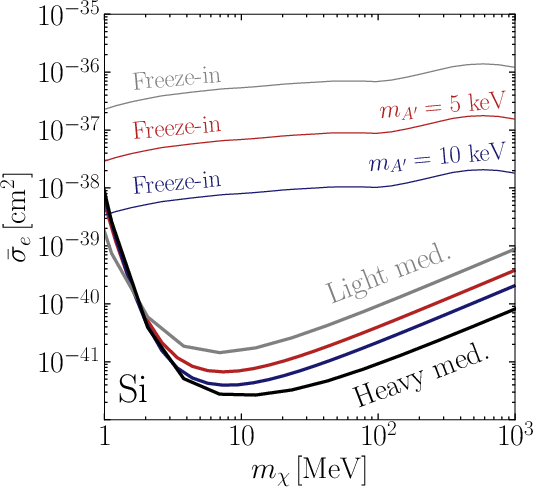
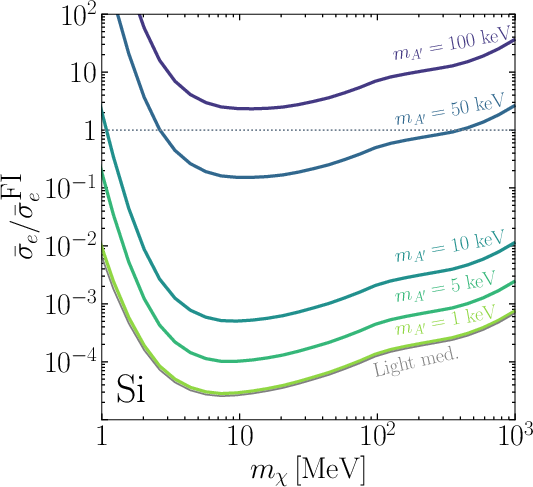
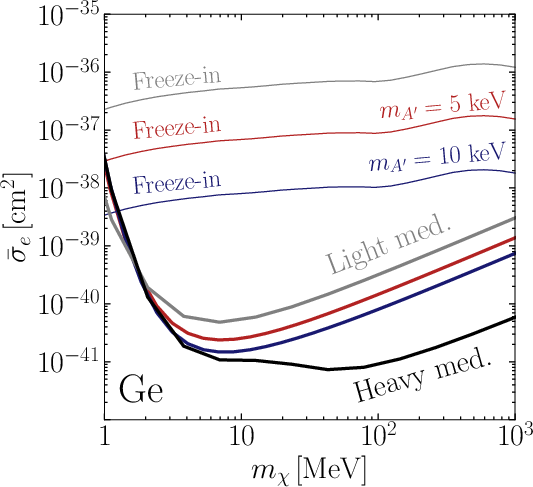
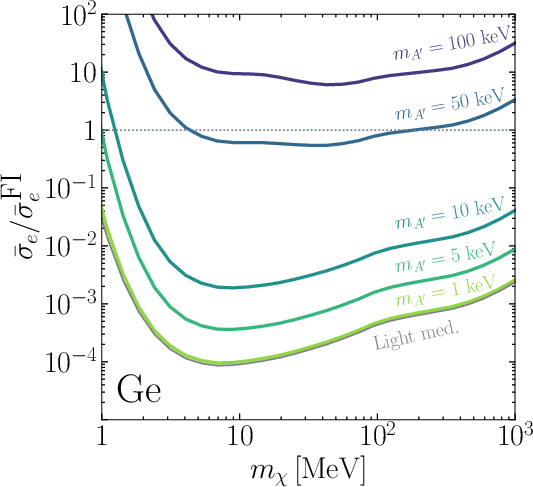
Figure 2: Projected cross section sensitivity and its ratio to the freeze-in target for background-free Si and Ge detectors across different mediator masses.
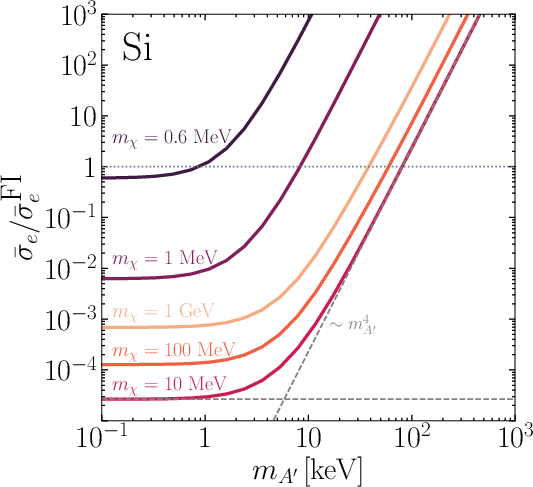
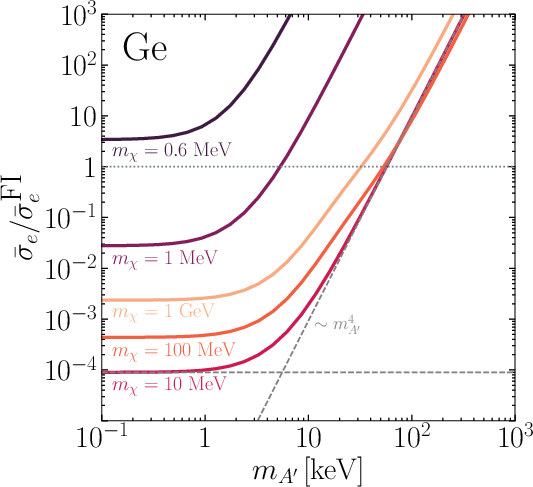
Figure 3: Ratio of projected sensitivity to the freeze-in cross section as a function of dark photon mass for several DM masses in Si and Ge targets.
Sensitivity rapidly declines for mediator masses above the heavy mediator regime due to steep A′6 scaling. For intermediate-mass mediators, the sensitivity interpolates between light and heavy limits, and in Ge, large A′7 transitions lead to milder scaling (A′8) before eventual suppression.
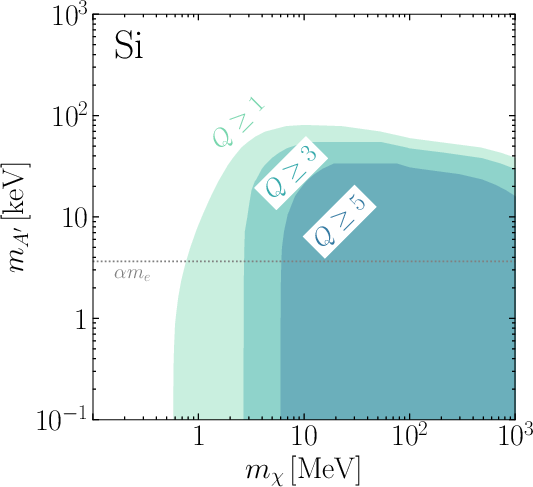
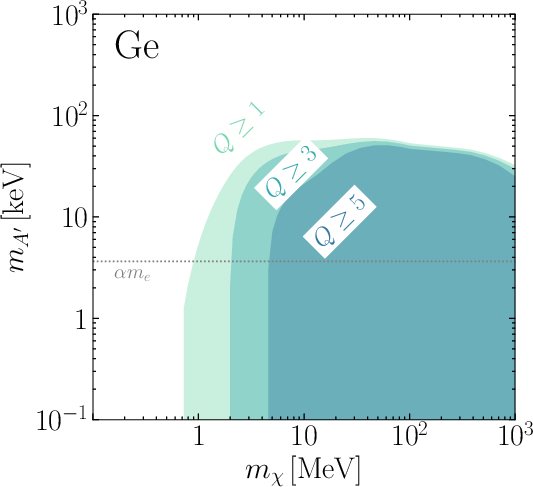
Figure 4: Parameter space in A′9-L⊃Aμ′(−g′χˉγμχ+εeℓˉγμℓ)0 excluded by background-free Si and Ge detectors for freeze-in cross sections, shown for several ionization charge thresholds.
Comparison across thresholds demonstrates that increasing threshold energy reduces sensitivity, but for L⊃Aμ′(−g′χˉγμχ+εeℓˉγμℓ)110 MeV in Ge, the effect is negligible due to rate dominance by large energy deposits.
Projected DAMIC-M Sensitivity
The DAMIC-M experiment’s projected sensitivity is computed using their binned count data and inclusion of expected backgrounds. The authors adopt a Poisson-based likelihood formalism to determine the 90% C.L. sensitivity to L⊃Aμ′(−g′χˉγμχ+εeℓˉγμℓ)2, comparing the projected bounds to L⊃Aμ′(−g′χˉγμχ+εeℓˉγμℓ)3. The region of exclusion is mapped as a function of both L⊃Aμ′(−g′χˉγμχ+εeℓˉγμℓ)4 and L⊃Aμ′(−g′χˉγμχ+εeℓˉγμℓ)5.
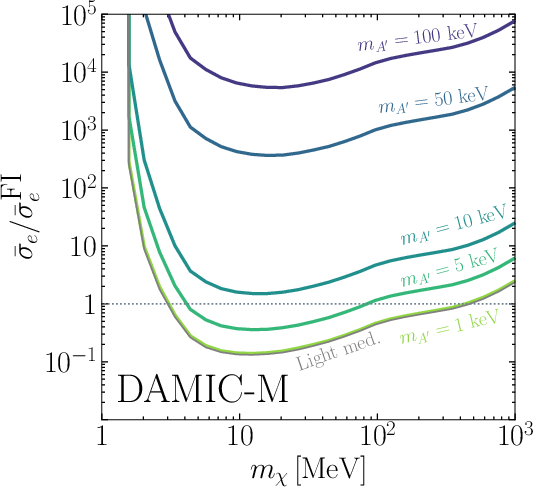
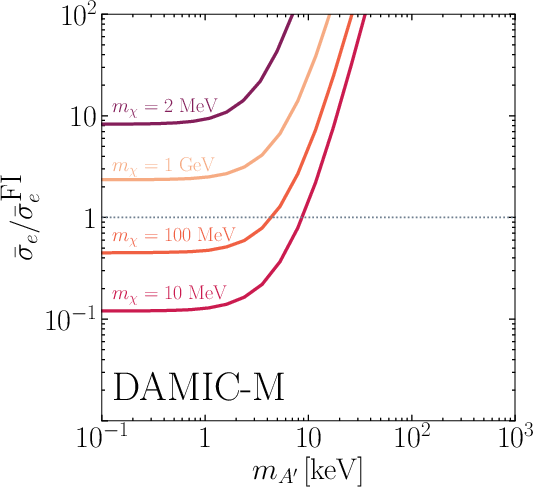
Figure 5: Ratio of DAMIC-M projected sensitivity to freeze-in cross section as a function of DM and mediator mass.
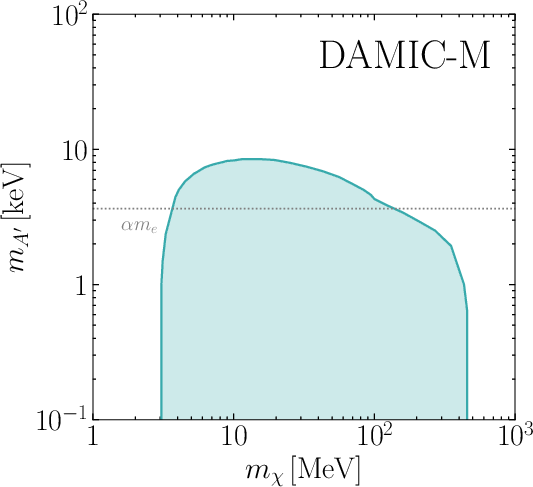
Figure 6: L⊃Aμ′(−g′χˉγμχ+εeℓˉγμℓ)6-L⊃Aμ′(−g′χˉγμχ+εeℓˉγμℓ)7 parameter space excluded at 90% C.L. by DAMIC-M for freeze-in generated relic density.
The projected DAMIC-M exclusion closely matches the published bounds in the light mediator regime. DAMIC-M is shown to be sensitive to freeze-in produced DM for L⊃Aμ′(−g′χˉγμχ+εeℓˉγμℓ)83–460 MeV and L⊃Aμ′(−g′χˉγμχ+εeℓˉγμℓ)910 keV.
Implications, Complementarity, and Future Directions
This work precisely demarcates the sensitivity of current and near-future electron-based direct detection experiments to freeze-in produced DM interacting through intermediate-mass mediators. The analysis reveals that sensitivity extends to mediator masses nearly two orders of magnitude above the conventional light mediator boundary. These results are complementary to constraints from astrophysical probes, such as stellar energy loss and SIDM bounds, though such constraints can be suppressed by density-dependent mechanisms or relaxed if DM constitutes a subcomponent.
The authors underscore the need for integrating exact experimental analysis pipelines, for comparison with other approaches such as QCDark2 (which models local field effects). The extension to meV-threshold detectors will further enlarge the intermediate-mass regime, rendering these findings crucial for interpreting next-generation electron, phonon, and magnon-based searches.
Conclusion
The paper provides a detailed treatment of the intermediate-mass mediator regime for electron-based direct detection of sub-GeV DM, offering precise sensitivity calculations for both idealized and realistic experimental scenarios. The main results establish that detectors can probe freeze-in produced DM over a significantly expanded range of mediator masses, contingent on target material, threshold, and exposure. This substantially clarifies the mapping between theoretical parameter space and experimental reach, with direct implications for both ongoing searches and future detector design.

