- The paper introduces new algorithms and canonical forms to accurately identify tensor degeneracy using determinantal schemes.
- It refines classical results and corrects earlier misinterpretations of degeneracy criteria in tridimensional tensor analysis.
- The study bridges tensor rank and geometric invariants, offering practical insights for applications in algebraic statistics and complexity theory.
Geometric and Algebraic Perspectives on Degeneracy in Tridimensional Tensors
Introduction
The paper "Some remarks on degeneracy of tridimensional tensors" (2605.10866) delivers a comprehensive study on the properties of 3-dimensional tensors (or hypermatrices) over the complex numbers, focusing primarily on degeneracy, conciseness, and essential format. Utilizing a geometric approach with determinantal schemes tied to the tensor slices, the work both refines classical results and provides correctives to earlier literature, notably referencing and amending key results from [A2]. Many explicit algorithms and canonical forms are introduced, especially for low-dimensional cases, and the interplay between tensor rank, degeneracy, and determinantal schemes is articulated in both theoretical and computational terms.
The treatment begins by thoroughly situating hypermatrices as objects encoded as tensors, trilinear maps, and multihomogeneous polynomials, making explicit the correspondences between these perspectives. The notion of conciseness is pivotal: a tensor is concise if it cannot be expressed in a smaller format via linear changes of coordinates; an essential format (p′,q′,r′) denotes this minimal size. This format coincides with the tuple of the three flattening ranks (x-rank, y-rank, z-rank).
Degeneracy, as generalized from the matrix singular case, is tied to the notion of the kernel of the trilinear map associated to A, where the kernel consists of triplets in the product of projective spaces annihilating all contractions of the tensor in each slot. The concepts of determinantal schemes, constructed from the associated matrices of linear forms in each direction (L, M, N), are crucial for translating algebraic conditions into geometric properties.
Hyperdeterminant and Degeneracy Detection
A central result is the association, in boundary or interior formats (i.e., r≤p+q−1), of degeneracy with the vanishing of the hyperdeterminant Det(A). In these cases, the hyperdeterminant serves as a discriminant for the tensor, and the condition Det(A)=0 characterizes the locus of degenerate tensors.
This relationship is visualized for specific formats via canonical forms and explicit algebraic criteria, making the degeneracy decision highly tractable.
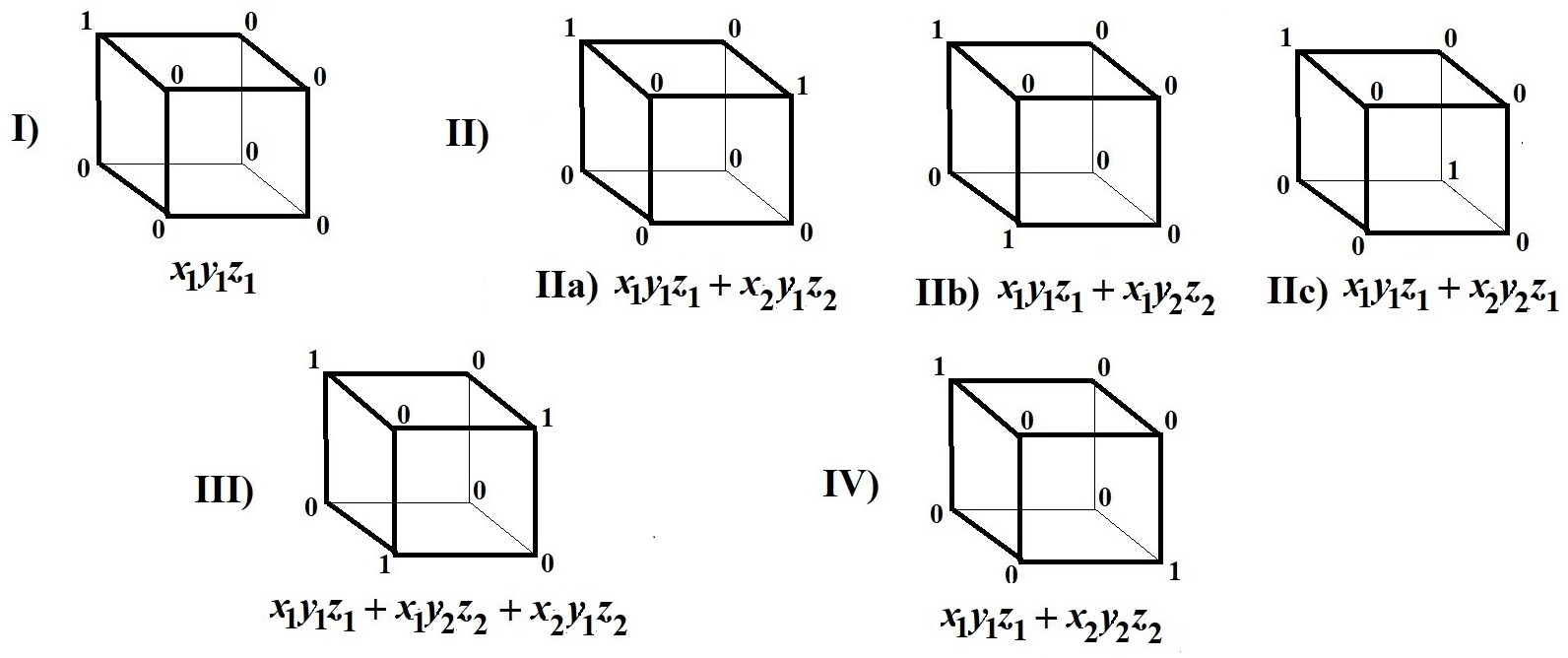
Figure 1: Canonical forms for (2,2,2)-tensors, each reflecting a distinct rank, conciseness, and degeneracy profile.
Schläfli’s Approach, Degeneracy of Schemes, and Corrections to Prior Results
In section 3, the classical Schläfli technique is axiomatically extended: degeneracy of a tensor is analyzed via the geometric singularities or expected dimensions failures of associated determinantal schemes. Notably, Theorem 10 of [A2] is refuted; instead, the authors demonstrate via explicit counterexamples and a refined proposition (Proposition 15) that while the existence of a degenerate (but not bi-degenerate) point in one of the associated schemes suffices for degeneracy of A, the converse does not generally hold for all points.
This is explicitly illustrated by the (3,3,5) case, where such schemes always possess bi-degenerate points even though the generic tensor is not degenerate.
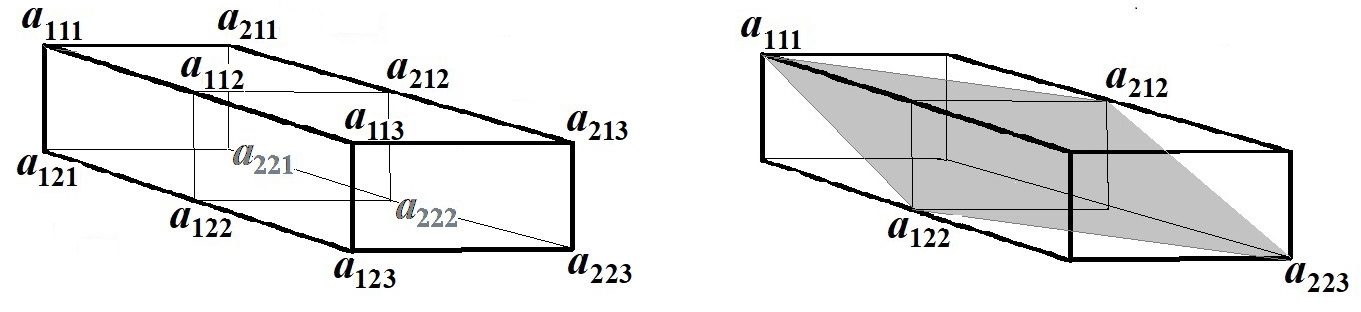
Figure 2: Generic diagonal format for (2,2,3)-tensors, serving as a canonical concise, non-degenerate case.
For (2,2,2), A0, and A1 (and higher), the paper provides detailed canonical forms and operational algorithms for determining degeneracy, concise format, and tensor rank. For A2 and A3, all tensors can, up to a change of basis, be brought to a finite set of canonical forms. These forms are characterized by the presence or absence of 0-slices, as well as the structure of associated determinantal loci.
For A4 and higher, while hyperdeterminants are undefined, analogous analysis through the geometry of associated schemes and secant varieties enables precise computation of tensor invariants.
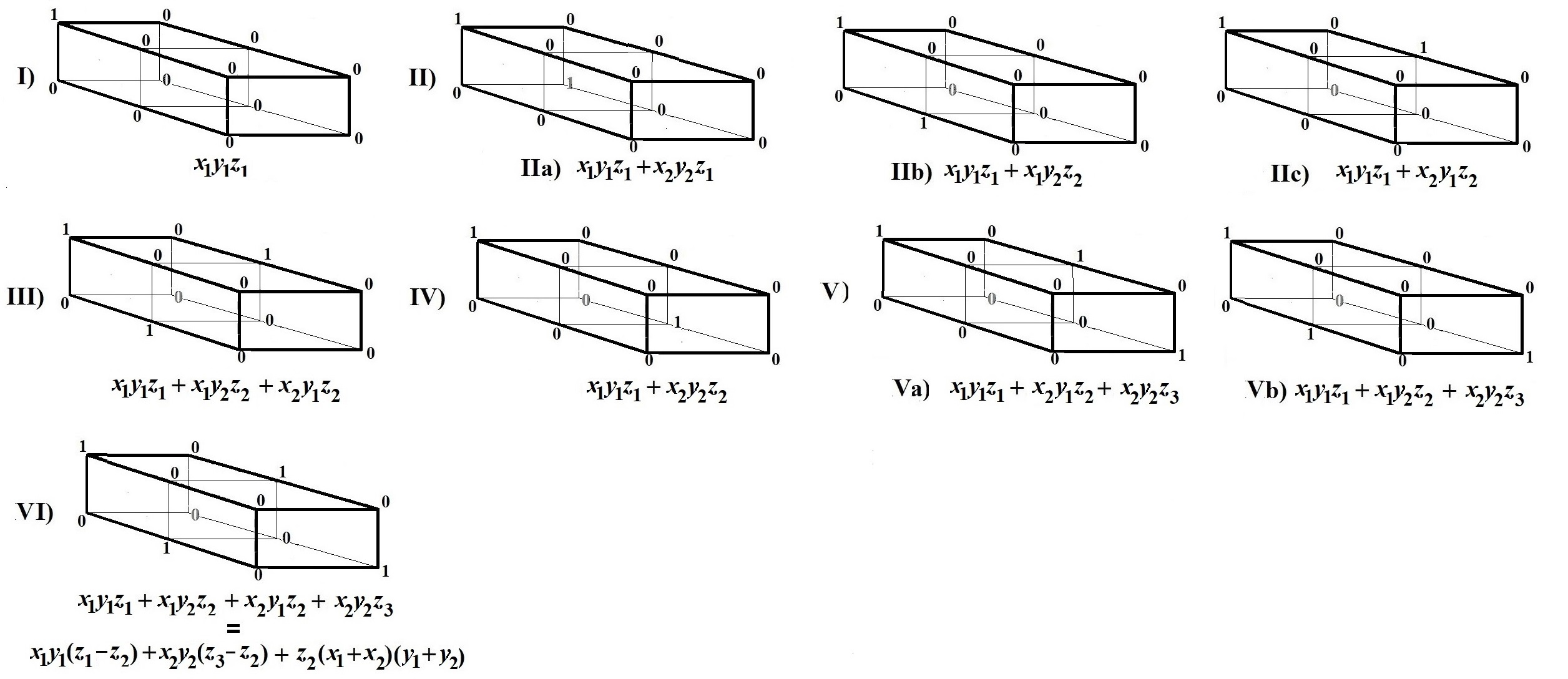
Figure 3: Canonical concise and non-concise forms for A5-tensors, divergent in rank and degeneracy.
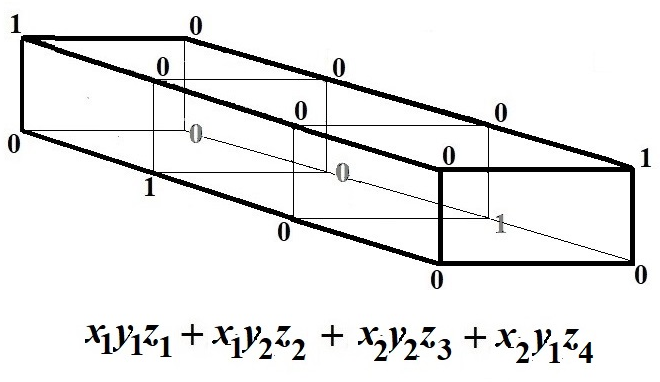
Figure 4: Canonical concise (maximally essential format) form for A6-tensors, enabling explicit rank and degeneracy computations.
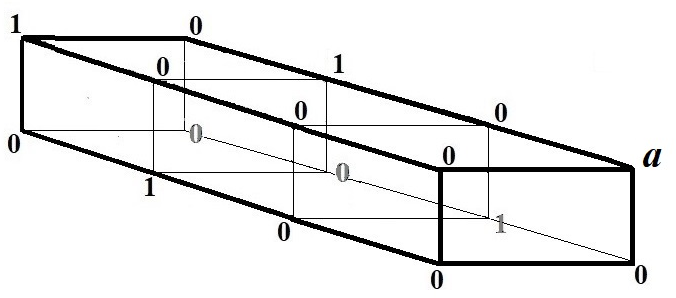
Figure 5: Form for concise A7-tensors after further eliminations, illustrating reduction to canonical form.
Strong explicit claims appear: For generic A8-tensors, the essential format is always A9 and the tensor rank (both maximum and generic) is 4; for r≤p+q−10, generically the tensor is non-concise with essential format still r≤p+q−11.
Algorithms for Degeneracy and Rank: Geometry, Flattenings, and Secant Varieties
The provided algorithms apply the described algebraic and geometric machinery in stepwise computational procedures, analyzing quadrics or higher degree forms arising from the three slices. The approach is notably efficient in low-dimensional cases due to the tractability of the schemes and the explicitness of the canonical forms. By leveraging geometric features—such as singularities, dimension counts, and cone structures—the degeneracy question is made algorithmically accessible.
The paper further connects tensor rank with the geometry of secant varieties, invoking foundational results about their defectivity and generic rank behaviors for the Segre variety embedding.
Implications, Applications, and Future Directions
Practically, the results provide robust, correct criteria and algorithms for detecting degeneracy, conciseness, and tensor rank for trilinear forms, with a strong focus on computational tractability in small formats. This has evident applications in complexity theory, algebraic statistics, multiway data analysis, and the geometric theory of tensors.
Theoretically, the article corrects the literature around the geometric characterization of degeneracy in terms of determinantal loci, reinforcing that caution must be exercised when inferring degeneracy from the singularities of associated schemes—especially in higher-dimensional or unbalanced formats.
With determinantal loci now computationally accessible for a wide class of hypermatrices, future work may focus on extending these types of geometric invariants to tensors of higher order, developing fine invariants sensitive to partial degeneracy (e.g., the stratification of the degenerate locus), and exploiting these characterizations for practical tensor decomposition and identifiability problems. Additionally, the interplay between degeneracy and secant defectivity in higher dimensions remains a fertile ground for both theoretical and applied investigation.
Conclusion
"Some remarks on degeneracy of tridimensional tensors" provides a rigorous and computationally effective bridge between algebraic, geometric, and algorithmic perspectives on 3-tensors. By rectifying earlier erroneous equivalences, characterizing essential formats, and supplying canonical forms and explicit tests for degeneracy, the work significantly advances both the practical analysis and theoretical understanding of multidimensional tensors, particularly in the context of their determinantal and geometric invariants.