- The paper demonstrates that local transverse field perturbations can engineer synthetic twist defects in the Wen-plaquette surface code, enabling projective non-Abelian anyons.
- Using dual analytical frameworks—the stabilizer-spin and Majorana fermion representations—the study quantifies phase transitions and defect-induced ground state degeneracies via numerical simulations.
- The work reveals geometry-dependent effects on defect emergence, offering actionable insights for scalable topological quantum computation and experimental validations.
Emergence of Synthetic Twist Defects in the Surface Code under Local Perturbation
Introduction and Motivation
The study addresses the controlled creation and characterization of synthetic twist defects in topologically ordered quantum systems, focusing on the Wen-plaquette (WP) surface code as a prototypical Z2 topological code. Traditional approaches to harness non-Abelian excitations for quantum information rely on fixed, static lattice defects, posing experimental constraints. This work builds upon theoretical proposals [you_synthetic_2013] to realize projective non-Abelian anyons by inducing synthetic twist defects via local transverse field perturbations rather than physically engineering lattice dislocations. Detailed analysis of these processes in finite systems with finite-strength, experimentally realistic perturbations has been lacking and is essential given the requirements of actual quantum devices.
The paper formulates the problem in the WP code subject to a spatially localized transverse field perturbation. The unperturbed Hamiltonian,
H0=−∑α∈ΣOα,
where Oα are $4$-spin plaquette or $2$-spin boundary stabilizers, admits a well-known topological order isomorphic to the Kitaev toric code. Synthetic defects are introduced by applying a Y field to a subset C of spins, yielding the perturbed Hamiltonian,
H(μ,w)=−2μα∈Σ∑Oα+wi∈C∑Yi.
The work systematically develops two alternative analytical frameworks:
- Stabilizer-spin representation: The eigenstates are block-diagonalized based on the configuration of stabilizer violations localized near the cut defined by C. A virtual spin model is constructed on the dual lattice, with Hamiltonian blocks of dimension 2∣C∣ for a linear cut.
- Majorana fermion representation: Mapping spins to Majoranas recasts the local perturbation as a Kitaev chain, allowing explicit treatment of emergent Majorana edge modes corresponding to synthetic twists, with exponential Hilbert space reduction for diagonalization.
This dual approach clarifies both the reduced computational complexity and rich physical interpretation for general defect geometries.

Figure 1: The Wen-plaquette surface code (upper) with sublattice structure, string operators, and (lower) a lattice dislocation yielding twist defects realized as enlarged stabilizers; local conservation of anyon type is lost at the twist.
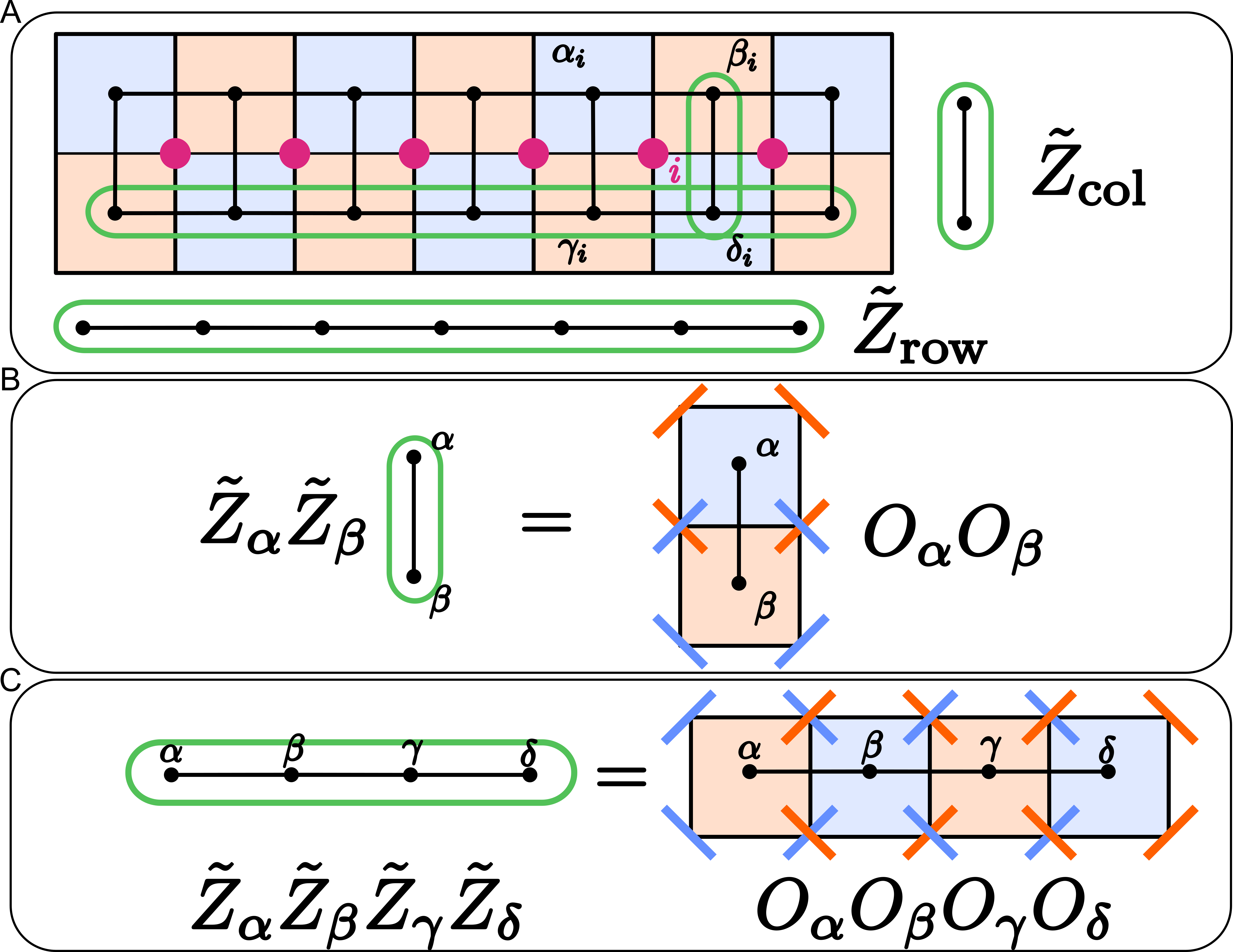
Figure 2: Construction of the virtual spin problem on dual plaquette faces, indicating virtual symmetries (row/column) emerging from the cut geometry.
Simulation Results: Phase Structure and Defect Emergence
Numerical exact diagonalization in the stabilizer-spin basis reveals the following principal results:
- Quantum phase transition: At a critical ratio H0=−∑α∈ΣOα,0, a transition occurs between the original topological phase and a defect-rich phase supporting synthetic twists. Scaling analysis of the energy gap and order parameters (virtual magnetization H0=−∑α∈ΣOα,1) corroborates an exponentially closing gap in the large-cut (thermodynamic) limit, aligning with analytic predictions for the Kitaev chain.
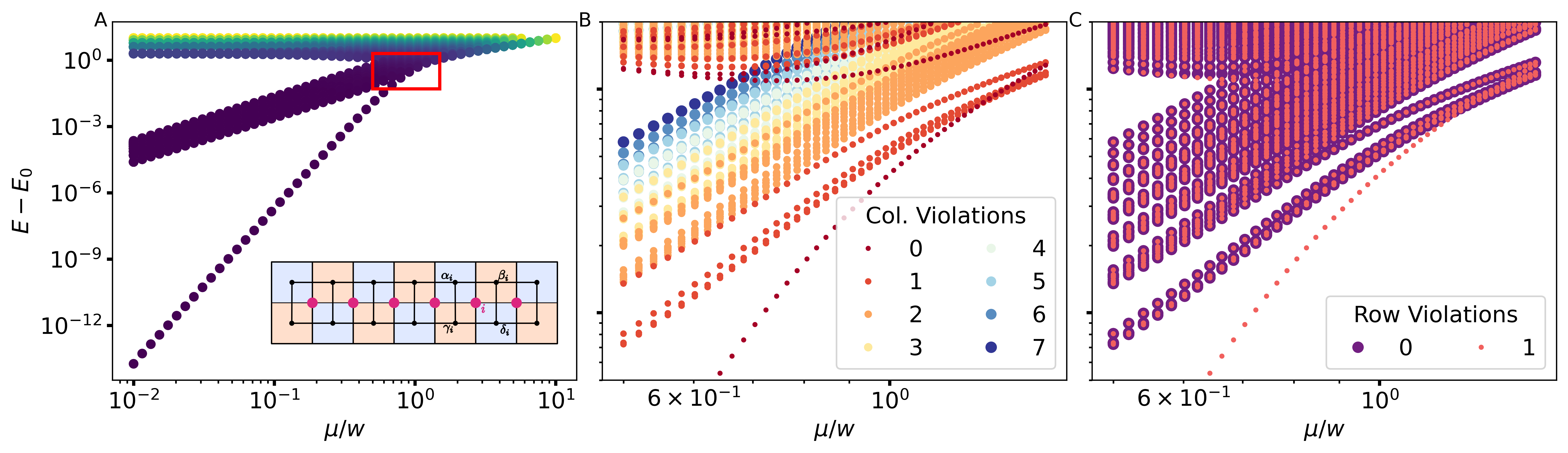
Figure 3: Normalized eigenvalues across H0=−∑α∈ΣOα,2 for a linear cut of size H0=−∑α∈ΣOα,3, demonstrating ground state splitting and the exponential closure of the gap in the strong H0=−∑α∈ΣOα,4 regime.
- The emergent ground states for H0=−∑α∈ΣOα,5 are characterized by violation of virtual row symmetries, directly connected to new logical operators in the defect phase, and can be analytically tracked via the stabilizer mapping.
- Degeneracy and geometry dependence: For 1D (linear) cuts, the transition produces a pair of quasi-degenerate ground states as expected for Ising-like (Majorana) edge excitations. In contrast, simulations with 2D (rectangular) cut geometries yield increased ground state degeneracy, reflecting the higher number of independent logical operators associated with multiple twist rows.
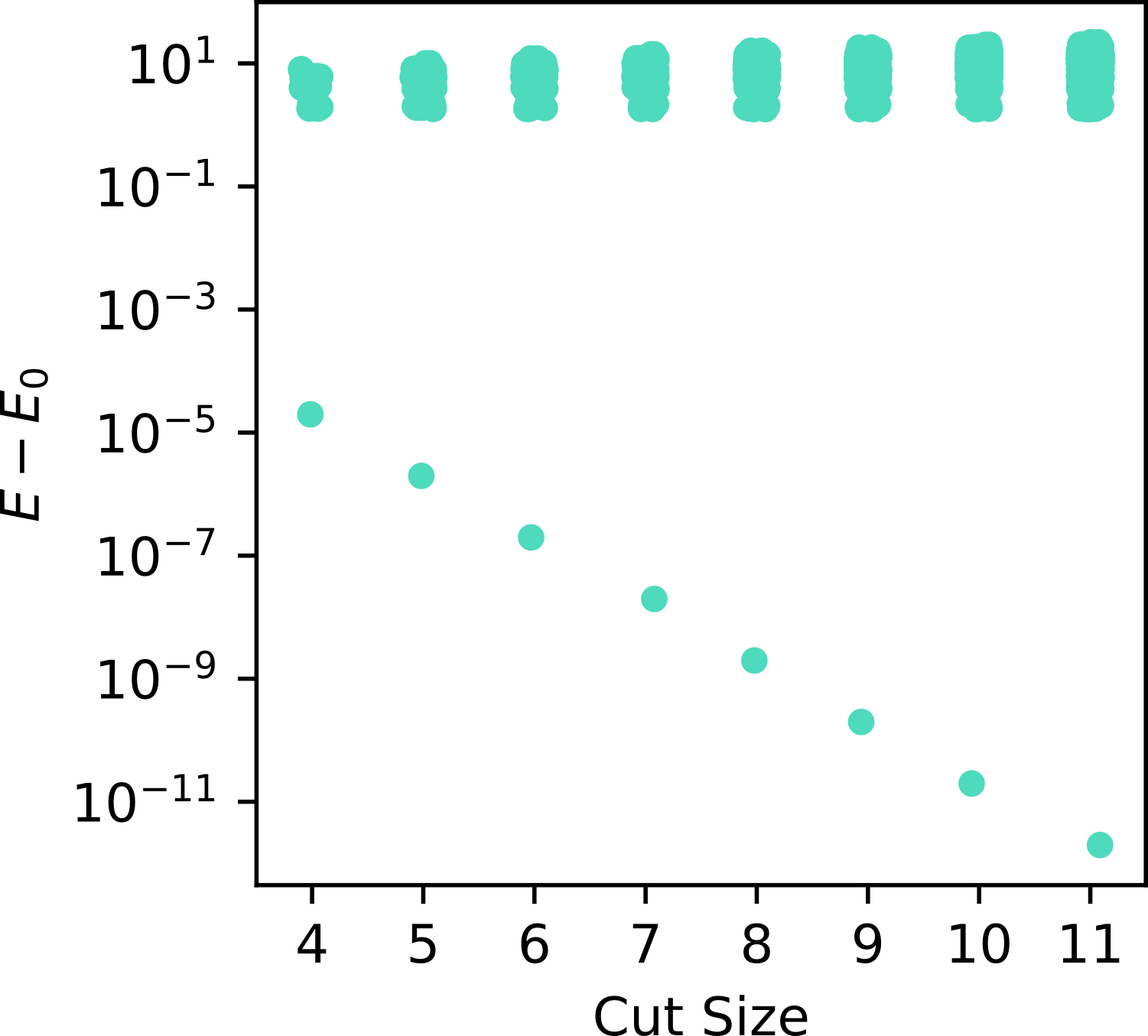
Figure 4: Scaling of the energy gap vs. cut size, substantiating the exponentially vanishing gap as ground state degeneracy emerges in the large-system or strong-perturbation regime.
- The location of the critical point is observed through quantum fidelity dip of the ground state at H0=−∑α∈ΣOα,6, and the transition remains smooth (continuous) as per the known behavior of 1D free fermion chains.
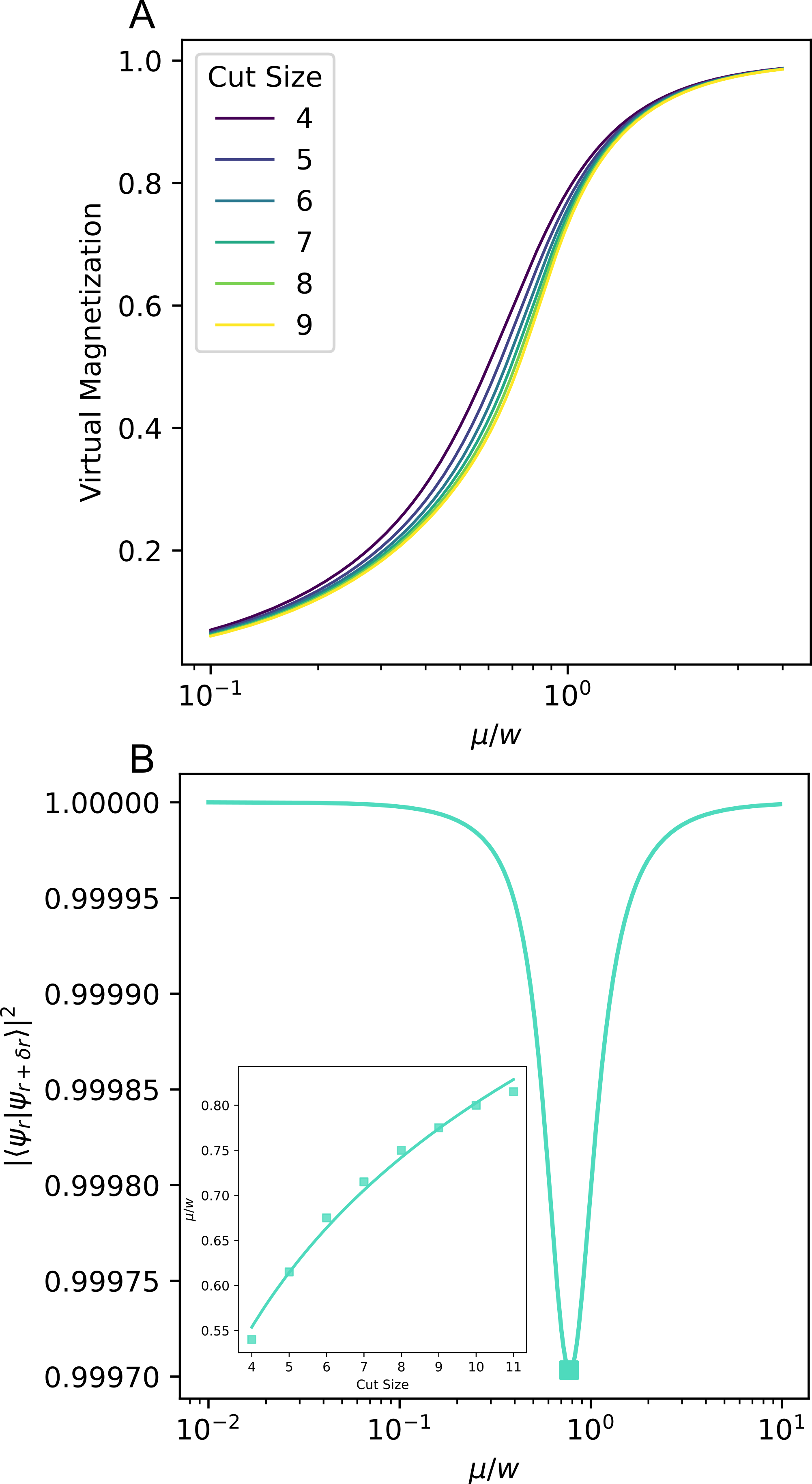
Figure 5: (A) Virtual magnetization versus H0=−∑α∈ΣOα,7 for various cut sizes; (B) Fidelity minimum tracks the phase transition and migrates towards H0=−∑α∈ΣOα,8 as system size increases.
- Novel 2D geometrical effects: Beyond linear cuts, rectangular patch perturbations reveal new classes of emergent ground states with distinct symmetry violations, demonstrating the sensitivity of defect-induced topological order to the detailed shape of the perturbation.
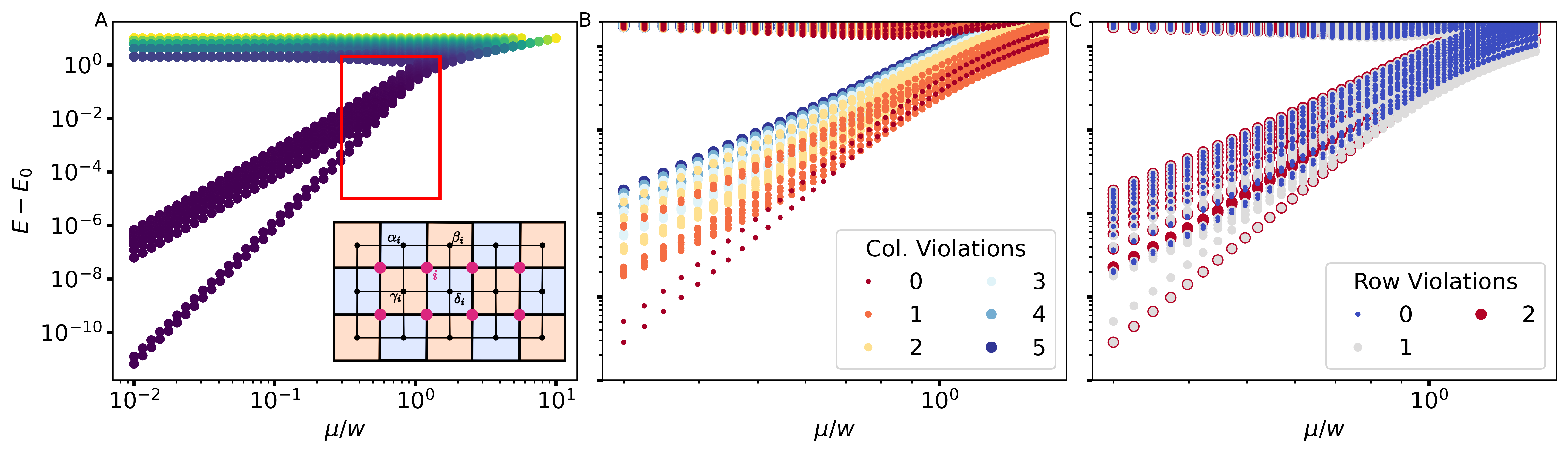
Figure 6: Spectral evolution in a rectangular cut geometry showing multi-fold ground state degeneracy and classification of eigenstates by virtual row and column symmetry violations.
Theoretical and Practical Implications
Computational modeling:
By leveraging the block-diagonal structure and exploiting virtual symmetries, the exponential computational expense for simulating synthetic defects is dramatically reduced, enabling exact diagonalization for experimentally relevant system sizes otherwise inaccessible by brute-force methods.
Synthetic twist control:
Synthetic twists inherit the projective non-Abelian statistics of physical lattice dislocations, supporting the same Ising anyon fusion and braiding rules [bombin_topological_2010, you_synthetic_2013, brown_topological_2013]. This approach removes materials synthesis barriers and replaces them with in-situ programmable control of defect geometry and dynamics. Analytical reduction to the Kitaev chain confirms the existence and stability of edge Majoranas associated with the synthetic twists [kitaev2001unpaired].
Defect engineering and quantum computing:
The explicit mapping between virtual symmetries/logical operators and the physical code supports the design of code deformation protocols with tunable non-Abelian anyons, impacting schemes for topologically protected gate operations and braiding-based computation [nayak_non-abelian_2008, lensky_graph_2023, andersen_non-abelian_2023, iqbal_non-abelian_2024]. The work provides numerical confirmation and a clear computational pathway for proposals to generate, move, and fuse non-Abelian defects with local control.
Geometry dependence and experimental relevance:
The finding that the emergent ground state structure and phase transition details are sensitively dependent on the geometry of the synthetic defect is of immediate practical concern for near-term experimental testbeds. Patch-like local disturbances can display richer, less trivial topological structure versus minimal 1D cuts, requiring careful engineering in quantum devices [satzinger_realizing_2021].
Prospect and Relation to Recent Advances
Recent experimental progress has enabled realization and direct manipulation of non-Abelian anyons and topological codes in programmable quantum simulators, including evidence of twist-induced projective anyons and their braiding through measurement and feedforward techniques [andersen_non-abelian_2023, iqbal_topological_2024, tantivasadakarn_shortest_2023]. The framework provided here, particularly the systematic treatment of finite-size and geometry effects, forms a rigorous basis for interpreting and guiding such experiments.
Extensions to dynamical creation and manipulation of synthetic defects via time-dependent control are suggested by the ability to efficiently simulate both static spectra and dynamical symmetries. Potential incorporation of disorder, temperature, and dissipative effects is a likely avenue for subsequent work to further align with experimental constraints.
Conclusion
This study rigorously establishes how synthetic twist defects, possessing projective non-Abelian statistics, emerge in H0=−∑α∈ΣOα,9 topological codes under realistic, local perturbations. Through analytical mappings and numerically tractable models, the work quantifies the phase transitions, ground state structure, and geometric dependencies of these defects. The results provide key insights for defect-based topological quantum computation and pave the way for experimental validation and future theoretical developments in the engineering and control of synthetic non-Abelian excitations.
References
- (2605.10839)
- ["Synthetic non-Abelian statistics by Abelian anyon condensation", Phys. Rev. B 87, 045106]
- ["Topological Order with a Twist: Ising Anyons from an Abelian Model", Phys. Rev. Lett. 105, 030403 (2010)]
- ["Topological Entanglement Entropy with a Twist", Phys. Rev. Lett. 111, 220402 (2013)]
- ["Unpaired Majorana fermions in quantum wires", Physics-Uspekhi 44, 131 (2001)]
- ["Non-Abelian topological order and anyons on a trapped-ion processor", Nature 626, 505–511 (2024)]
- ["Non-Abelian braiding of graph vertices in a superconducting processor", Nature 618, 264–269 (2023)]
- ["Graph gauge theory of mobile non-Abelian anyons in a qubit stabilizer code", Ann. Phys. 452, 169286 (2023)]
- ["Short Route to Non-Abelian Topological Order on a Quantum Processor", Phys. Rev. Lett. 131, 060405 (2023)]

