- The paper establishes that a DEM plate yields Casimir energies equivalent to a PMC plate by employing a full BRST-invariant quantization framework.
- It derives closed-form expressions for Casimir energy and pressure as functions of the PEMC duality angle, showing both attractive and repulsive force regimes.
- The work highlights that including edge-localized ghosts and auxiliary fields is essential to maintaining gauge invariance and decoupling unphysical edge modes.
Casimir Effect in Mixed DEM–PEMC Setups: BRST Structure, Edge Modes, and Energetics
Introduction
This work investigates the Casimir effect for a parallel-plate system in which one plate is endowed with dynamical edge mode (DEM) boundary conditions and the other realizes a perfect electromagnetic conductor (PEMC) condition (2605.10662). DEM conditions, developed as a robust approach to encode entanglement-relevant edge excitations in gauge theories, are particularly interesting for their explicit (albeit local) breaking of gauge invariance, leading to edge-localized physical degrees of freedom. PEMC boundaries interpolate continuously between perfect electric (PEC) and magnetic (PMC) conducting conditions. A key insight of this study is that, as far as the Casimir energy is concerned, a DEM plate is operationally equivalent to a PMC plate. The work additionally demonstrates the necessity of boundary-localized ghost and BRST auxiliary fields to guarantee gauge-invariant quantization in the DEM scenario.
Methodology and Theoretical Setup
The considered geometry consists of two infinite parallel plates: the first, at z=−L/2, enforces a PEMC boundary with duality angle θ; the second, at z=+L/2, is subject to DEM boundary conditions. The Euclidean Maxwell action is supplemented by suitable Lagrange multipliers to implement both types of boundary constraints via the path integral.
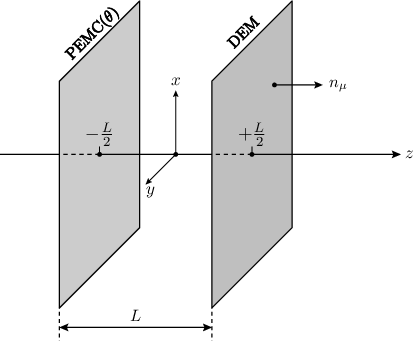
Figure 1: Representation of two infinitely large, infinitely thin parallel plates: the plate at z=−2L implements PEMC conditions (parameterized by θ), while the plate at z=+2L enforces DEM conditions.
DEM conditions break gauge invariance locally, necessitating a BRST extension. This is achieved by the introduction of additional plate-localized ghost and Nakanishi-Lautrup fields together with closure relations encoding BRST symmetry. The formulation is carried out in both Landau and Coulomb gauges to demonstrate gauge-parameter independence at all stages, contingent upon correct implementation of the edge field sector. Vacuum energy differences are extracted from ratios of partition functions—as usual in field-theoretic Casimir analyses—with the functional method systematically employed to integrate out the bulk and edge degrees of freedom.
Edge Mode Sector and BRST Invariance
DEM plates permit large gauge transformations only with temporal support annihilated on the plate, giving rise to physical scalar edge modes localized at z=z+. These fields, together with the normal electric field component, form canonical pairs on the boundary. Imposing BRST invariance requires boundary ghosts and additional scalar multipliers, which enforce Dirichlet conditions for the Faddeev-Popov and Nakanishi-Lautrup fields on the DEM plate. The construction ensures full BRST nilpotency and path integral measure consistency.
Upon integrating out Maxwell, ghost, and auxiliary fields, the residual boundary theory is nonlocal, with the DEM edge sector entering as coupled Lagrange multipliers enforcing the DEM constraints in the functional measure. Crucially, the resultant determinants separate into bulk and edge contributions, with the latter shown explicitly to not contribute to the physically observable Casimir energy after proper BRST-invariant quantization.
Casimir Energy Calculation and Results
After complete evaluation, the Casimir energy per unit plate area is obtained in closed form as a function of the PEMC duality angle θ: ECas(L,θ)=−8π2L31ReLi4(e2iθ)
where Li4 denotes the fourth-order polylogarithm. Differentiation gives the Casimir pressure: θ0
This force is repulsive or attractive depending on θ1, with maximal repulsion for θ2 (PEC–DEM) and maximal attraction at θ3 (PMC–DEM). The relative force, normalized to the standard Casimir value, reads: θ4
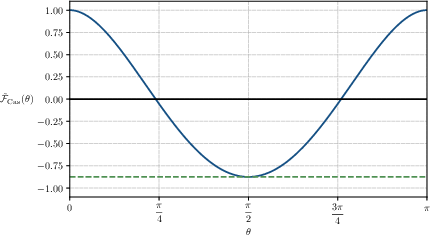
Figure 2: The relative Casimir force θ5, exhibiting the continuous interpolation between attractive and repulsive domains as a function of PEMC duality angle θ6 (see Eq. above).
Key claim: The Casimir energy in the DEM–PEMC configuration is identical to that of the PMC–PEMC geometry, showing that, within the BRST-invariant formalism, the DEM boundary is indistinguishable from a PMC boundary as far as quantum vacuum energetics are concerned.
Gauge Independence and Edge Mode Decoupling
BRST completion, including boundary-localized ghost and auxiliary fields, is essential for the gauge-independence of the vacuum energy. Failure to include these fields leads to explicit gauge parameter dependence in intermediate results. Careful block matrix analysis and application of the Schur complement show that the dynamical edge mode sector's contributions cancel—thus, while edge modes are physical degrees of freedom from the entanglement perspective, they do not source the Casimir force in this context.
Practical and Theoretical Implications
The results provide a comprehensive understanding of how new classes of boundary conditions (DEM) interact with traditional electromagnetically dual boundaries (PEMC) in quantum field theory. The finding that DEM and PMC plates are indistinguishable in Casimir energetics, despite their distinct gauge properties and physical interpretability, simplifies prospective analyses of mixed-boundary configurations. This has practical implications for experimental designs aiming to realize repulsive or tunable Casimir forces, including micro/nanomechanical device engineering.
Theoretically, the work clarifies the status of edge modes in BRST-complete quantum Maxwell theory and contributes to ongoing clarifications of the relation between edge mode quantization, entanglement entropy, and physical observables. The formalism can be generalized naturally to higher forms, non-Abelian fields, and to include internal or background chiral media.
Outlook
Future work may extend this functional path integral approach to plate systems in chiral media, where the DEM/PMC equivalence is seemingly broken and new contributions are anticipated. Applications to curved manifolds—and thus gravitational Casimir problems—are direct, with potential cross-fertilization in gravitational entropy and quantum information. Further, the construction suggests experimental directions for the realization of DEM-like boundaries in laboratory materials.
Conclusion
This paper establishes, via a full BRST-invariant analysis, that the Casimir force for a PEMC–DEM mixed boundary system is equivalent to that computed for a PEMC–PMC pair, with the DEM plate exhibiting no observable deviation from PMC behavior as far as vacuum energies are concerned. The methodology highlights the importance of correctly handling boundary ghosts and edge sector BRST closures, providing a general framework for field-theoretic Casimir calculations with nonstandard boundaries (2605.10662).