- The paper introduces a covariant hydrodynamic (polar) decomposition of the Dirac field, providing a single-tetrad-free and Clifford-matrix-free formulation.
- A (1+1+2) covariant splitting is applied to LRS space-times, allowing detailed analysis across LRS I, II, and III models through both analytical and numerical methods.
- Numerical results reveal that transitional dynamics in LRSIII solutions suppress sustained spatial twist, opening pathways to modeling compact astrophysical objects.
Introduction and Motivation
This work presents a systematic, covariant framework for describing the Dirac field in Locally Rotationally Symmetric (LRS) space-times, employing a (1+1+2) splitting and a hydrodynamic (polar) decomposition of the spinor field. The underlying goal is to deliver a single-tetrad-free, Clifford-matrix-free, fully covariant description that allows both analytic and numerical study of self-gravitating Dirac fields compatible with the symmetries of LRS class I, II, and III universes. The approach generalizes earlier results by relaxing the requirement that the geometric congruences coincide with the spinor velocity and spin directions, introducing instead a coplanarity condition that leads to a significant extension of the space of allowed solutions, especially in LRSIII.
Theoretical Framework
Polar Decomposition of the Dirac Field
The paper builds on the polar/hydrodynamic decomposition, in which the regular Dirac spinor is characterized by a real modulus, a chiral angle, velocity and spin vectors, and a phase. All physical quantities, including the energy-momentum tensor, are reexpressed in terms of these variables, enabling manifestly real, coordinate-free equations. The covariant derivative of the spinor is reinterpreted via an effective momentum and "tensorial connection", encasing all information not already contained in derivatives of the hydrodynamic bilinears.
The geometry is decomposed using two mutually orthogonal congruences: the time-like vi and space-like ei unit vectors, with induced hij and Nij metrics for the subspaces orthogonal to vi and both vi, ei, respectively. The Einstein equations, energy-momentum tensor, and all matter sector quantities are systematically split accordingly. The key innovation here is allowing the Dirac velocity and spin vectors (ui,si) to merely be coplanar with (1+1+2)0, rather than identical, parameterized by a hyperbolic angle (1+1+2)1.
This reduces the Dirac sector to a set of scalar and vector functions adapted to the LRS symmetry, and—crucially for tractability—leads to scalar evolution, propagation, and constraint equations for all relevant quantities.
Analysis in LRS I, II, and III
LRSI (Rotating, Non-twisting) Space-times
The authors show that in LRSI, with (1+1+2)2, stationary axisymmetric solutions are possible both for perfect and non-perfect spinorial fluids. Their analysis fully decomposes the covariant and Dirac equations into a closed dynamical system for the kinematic, spinorial, and thermodynamic variables, admitting explicit well-posedness under generic regular initial data. They identify an equation of state (1+1+2)3, with explicit structure of energy density and pressure in terms of the polar spinor variables.
Numerical solutions illustrate the possible "stiff shell" configurations—effectively fluid layers with discontinuities in the radial pressure, and a surface gravity showing non-trivial sign changes—suggesting potential applications to models of relativistic stars (details in the next section). The behavior of the spinorial degrees of freedom such as (1+1+2)4 (chiral angle) and (1+1+2)5 (coplanarity parameter) dynamically tend to values where the spinor congruences align with the geometric ones.
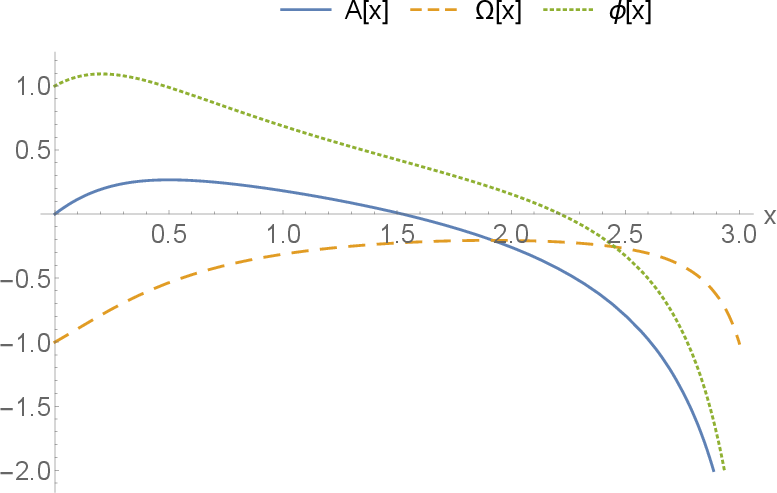
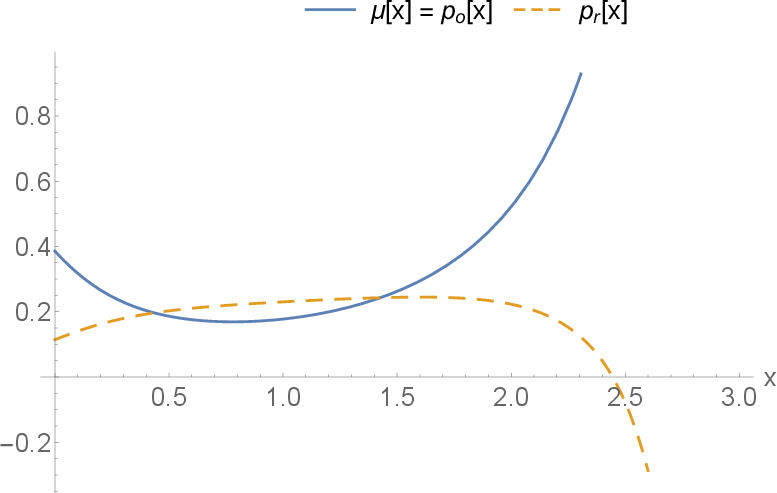
Figure 1: Evolution of key variables in LRSI non-perfect spinorial fluid models under the (1+1+2)6 decomposition.
LRSII (Non-rotating, Non-twisting) Space-times
For LRSII ((1+1+2)7), both perfect and non-perfect spinorial fluids are discussed. In perfect fluids, the only consistent solution is a dust equation of state ((1+1+2)8), and the dynamics reduce to the standard LRSII cosmology with dust, with evolution primarily dictated by the effective mass-energy density constructed from spinor bilinears.
Exact analytical solutions are obtained for the homogeneous and isotropic case. The time evolution of the expansion, density, and Dirac bilinears is computed, showing explicitly that the oscillatory nature of the spinor bilinears produces only secular evolution in the effective energy-momentum, consistently realizing the classical Friedmannian dynamics in the presence of a nontrivial spinorial background.
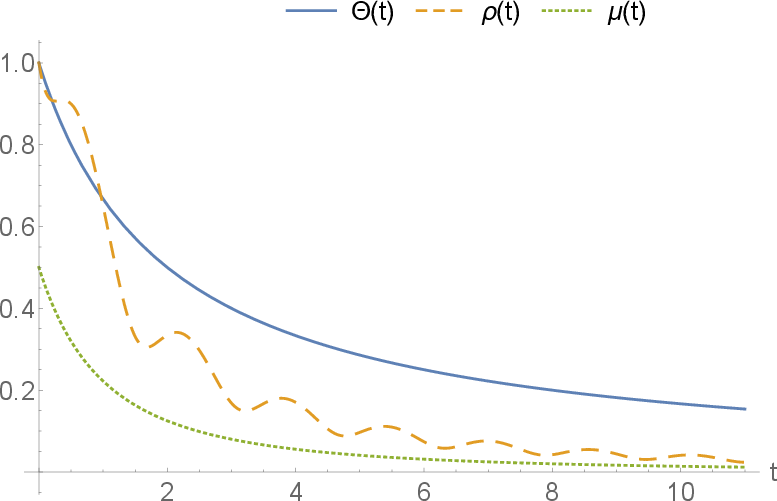
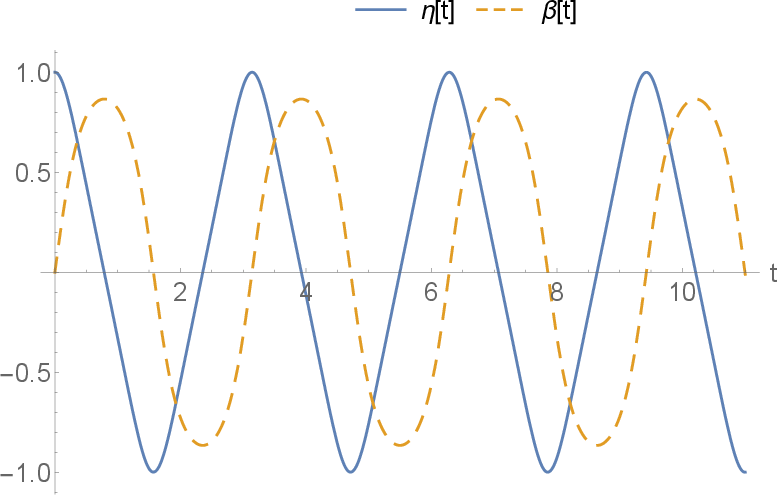
Figure 2: Time evolution for the solution in the homogeneous and isotropic LRSII case with spinorial dust, showing coupled oscillations in spinor-modulus variables and monotonic decay in scalar curvature variables.
The stability and dynamics in non-isotropic settings, including anisotropic homogeneous universes (Bianchi I, III, etc.), are accessed numerically. Notably, by varying the initial expansion scalar, the system displays bifurcations between recollapsing (Kantowski-Sachs-like) and ever-expanding (Bianchi III-like) regimes, with the sign of the 3-Ricci curvature controlling the late-time fate.
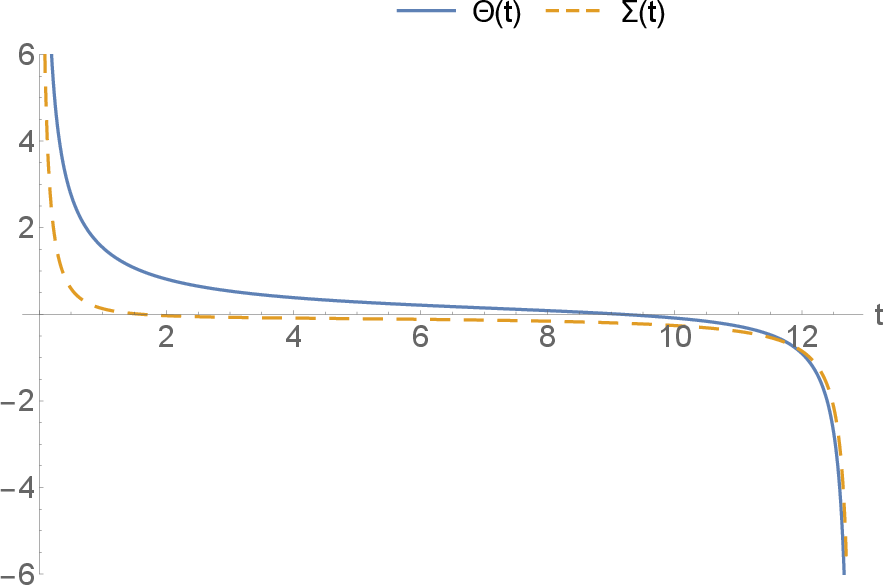
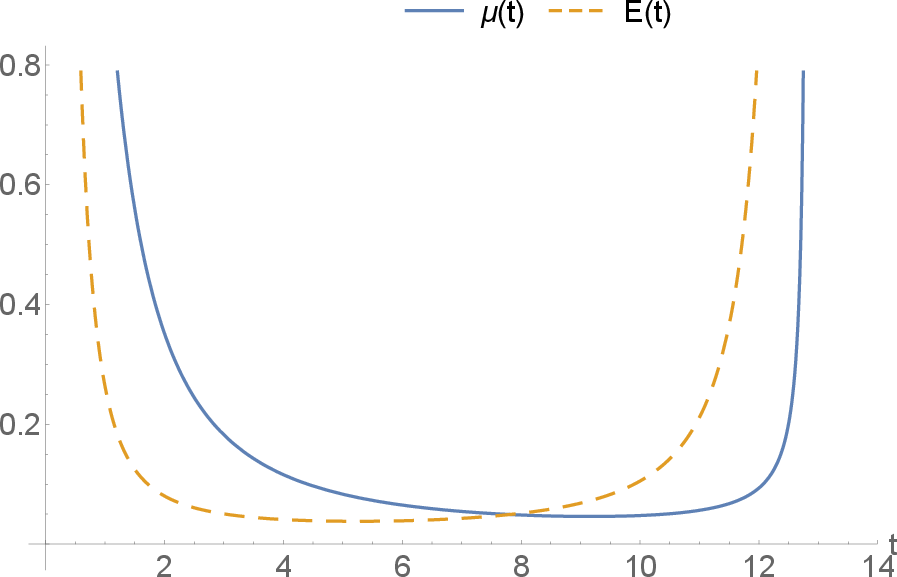
Figure 3: Evolution of expansion, shear, and spinor variables in anisotropic LRSII solutions, highlighting sensitivity to initial expansion rate.
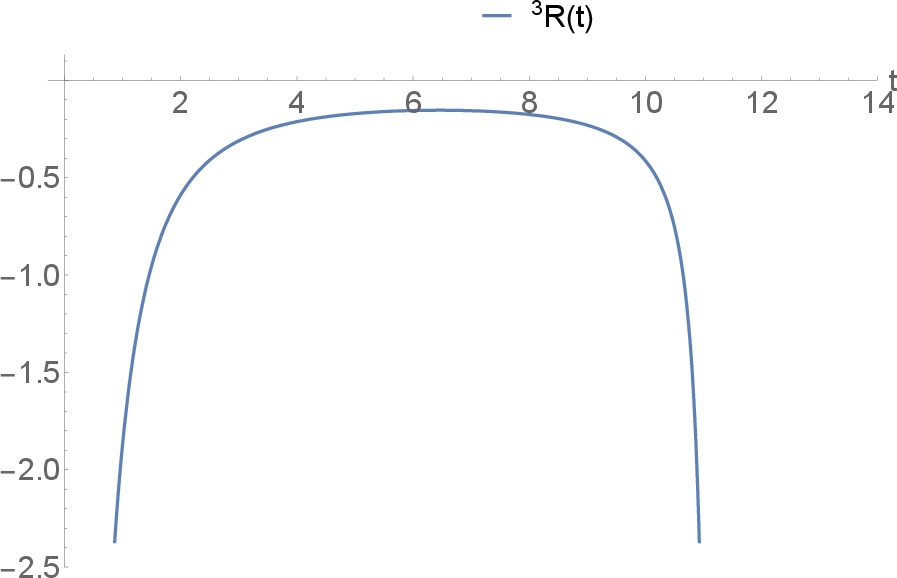
Figure 4: Time dependence of the 3-Ricci scalar for a set of LRSII initial data, displaying the transition from positive to negative curvature and its impact on the geometrical evolution.
LRSIII (Twisting, Non-rotating) Space-times
The most significant extension enabled by the relaxed congruence prescription is realized in LRSIII ((1+1+2)9). The authors provide for the first time a class of well-posed, non-perfect fluid solutions filling LRSIII space-times with a self-gravitating Dirac field, a result unattainable in the previous, more restrictive framework. Analysis of the resulting system shows that while the twist scalar vi0 may initially dominate the dynamics, the system rapidly evolves toward LRSII-like behavior, with the fermionic fluid effectively suppressing sustained twisting. This is interpreted as an indication of an intrinsic incompatibility of stable fermionic fluids and persistent spacetime twist.
The numerical solutions evidence a transition from strongly twisting to effectively non-twisting geometry, with all kinematic and thermodynamic variables captured by the dynamical system and their evolution in affine time.
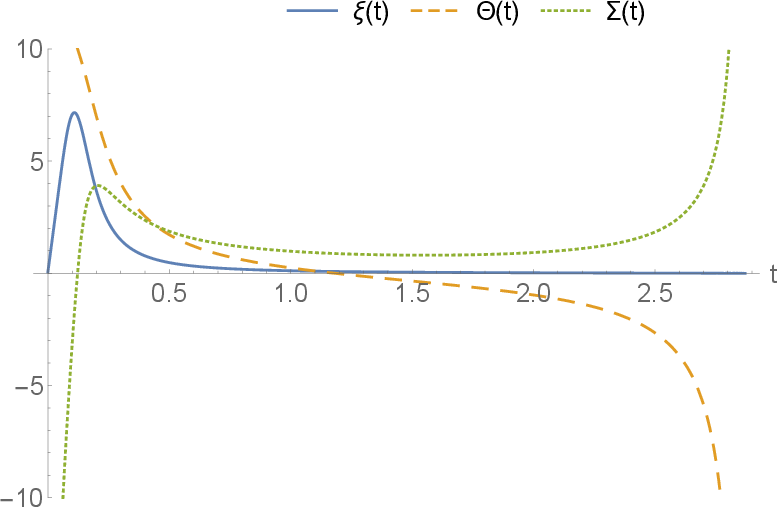
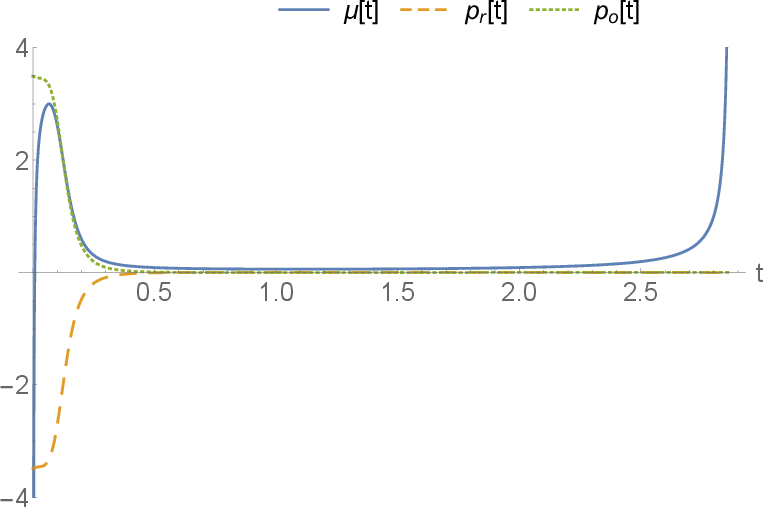
Figure 5: Dynamical evolution of key quantities in numerically constructed LRSIII solutions containing Dirac fluid.
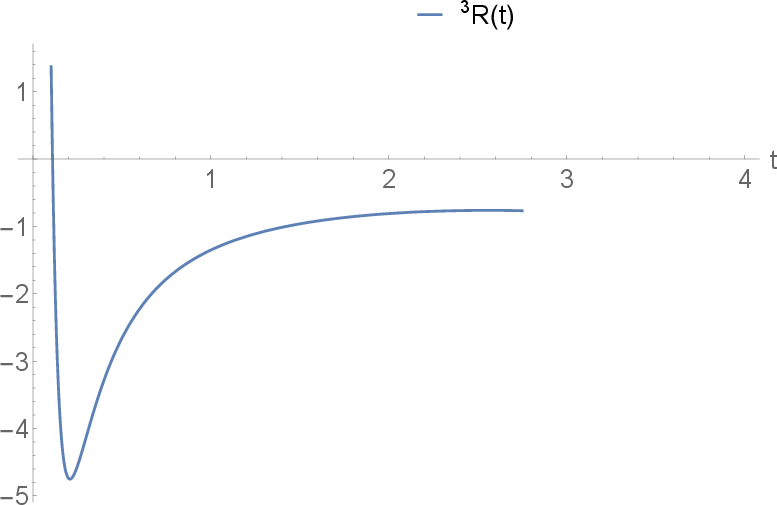
Figure 6: Corresponding evolution of the 3-Ricci scalar, showing collapse into a highly anisotropic Kantowski-Sachs geometry.
Numerical Results and Physical Implications
The strong numerical suite confirms the key qualitative and quantitative findings for all LRS types:
- Oscillatory internal degrees of freedom (Dirac bilinears) contribute subtly to the macroscopic evolution, such that only certain combinations (e.g., energy density, pressure) influence the geometry, while internal spinorial variables may undergo rich nontrivial dynamics.
- Highly sensitive dependence on initial LRSII expansion scalar, causing transitions from recollapsing to expanding regimes—this is directly tied to the sign of the spatial curvature, in line with standard Bianchi cosmology, but derived here from first-principles Dirac fluid dynamics.
- Stationary LRSI scenarios show behavior reminiscent of interior solutions for compact objects, with radial pressure vanishing at finite radius, surface gravity sign change, and nontrivial alignment of spinorial and geometric congruences. This opens a pathway—subject to careful treatment of fermionic matching conditions—for Dirac fluid descriptions of relativistic stars or effective models of nucleon pressure distributions.
- LRSIII solutions exist only for non-perfect spinorial fluids, and display transient twist, suggesting a dynamical selection against persistent twisting in realistic fermion-fluid-coupled Einstein spacetimes.
Theoretical and Practical Outlook
The extension of the formalism to a fully covariant, congruence-flexible regime significantly enlarges the catalog of admissible solutions, particularly making the study of LRSIII-Dirac field configurations possible. The methodology unifies several disparate approaches and provides a route for exploring cosmic dynamics, interiors of compact objects, and analogs of quantum pressure effects within a classical hydrodynamic Dirac treatment.
Technical issues remain, especially regarding the formulation of suitable matching/junction conditions at fluid-vacuum interfaces, and a physical interpretation of the sign change in the surface gravity, which could affect observables or stability. There is also the open question of the fate of these solutions when quantum effects are fully included.
Conclusion
The paper achieves a substantial advance in the covariant formulation of Dirac fields coupled to gravity in symmetric spacetimes, both from an analytical and computational perspective. The introduction of a coplanar, rather than coincident, congruence prescription yields new LRSIII solutions and a broader understanding of the interplay between spinor degrees of freedom and spacetime geometry. Both numerical and analytic results confirm the practical adequacy and consistency of the approach, opening new directions for applications to compact astrophysical objects and early-universe cosmology. Future research is required for the derivation of appropriate boundary conditions, detailed stability analyses, and extensions to quantum or semiclassical regimes.

