- The paper shows that reducing axionic or magnetic charge causes a topological transition from wineglass wormholes to no-boundary instantons, initiating prolonged inflation.
- The paper employs numerical shooting methods with Neumann and Dirichlet boundary conditions to connect rim-to-minimum field configurations and validate universality across flat and AdS spacetimes.
- The paper explores exotic multi-stem and multi-barrier solutions, offering insights into topology change in the gravitational path integral and its implications for early universe cosmology.
Quantum Nucleation of Inflationary Universes via Wineglass Wormholes and Their No-Boundary Relatives
Introduction and Motivation
The creation of inflationary universes remains a pivotal open problem in quantum cosmology. While the inflationary paradigm efficiently accounts for primordial perturbations and the observed homogeneity and isotropy, the mechanism for the quantum creation of inflationary initial conditions is non-generic and demands a mechanism that circumvents initial singularity theorems. This work analyzes the quantum nucleation of expanding universes mediated by a family of Euclidean wormholes, specifically "wineglass" wormholes, and elucidates their intricate relationship to no-boundary instantons. The study systematically explores cases with both asymptotically flat and AdS boundary conditions, provides explicit numerical solutions with axion and magnetic support, and investigates a rich menagerie of multi-stemmed and multi-barrier solutions.
Geometry and Classification of Wineglass Wormholes
Wineglass wormholes constitute a distinct class of spherically symmetric, Euclidean solutions with a nontrivial topology characterized by a local minimum ("stem") and a local maximum ("rim") of the scale factor. Crucially, the rim guarantees an expanding Lorentzian universe upon analytic continuation, in direct contrast with Giddings-Strominger-type wormholes that yield recollapsing or "crunching" universes.
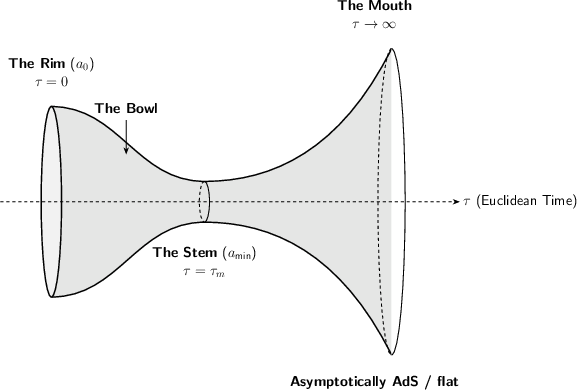
Figure 1: Euclidean wineglass wormholes mediate the creation of an expanding universe from a flat or AdS region; the local maximum (rim) is essential for post-nucleation expansion.
The general action incorporates Einstein-Hilbert gravity, an axionic or magnetic charge (governed by conserved Qa/Qm), and a self-interacting scalar field with a periodic (sinusoidal) potential. The existence, initial conditions, and dynamical evolution of solutions are determined by the constraints imposed by the equations of motion and by both Neumann and Dirichlet boundary conditions depending on context (flat vs. AdS).
A key discovery is that as the axionic or magnetic charge is dialed to zero, the stem connecting the "baby universe" to the asymptotic region pinches off, producing a topological transition: in this limit, the wormhole solution bifurcates into a standard no-boundary instanton (describing the universe nucleated "from nothing") and a disconnected Minkowski or AdS region.
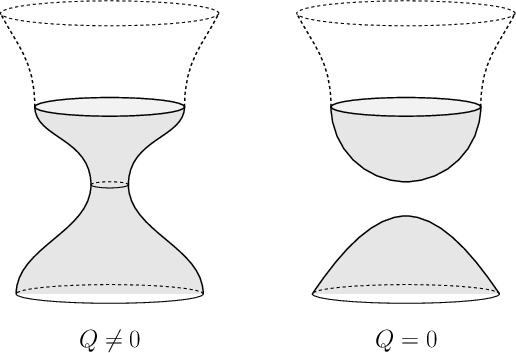
Figure 2: Reducing the charge Q contracts the stem; at Q→0 a topological transition occurs, leaving a disconnected no-boundary instanton and asymptotic region.
Explicit Solutions: Asymptotically Flat and AdS Boundaries
Asymptotically Flat Solutions
By imposing suitable Neumann boundary conditions at the outer radius and at the origin (rim), the authors construct axionic and magnetic wineglass wormholes in potentials with a Minkowski minimum. Shooting methods (undershoot/overshoot bracketing) efficiently locate unique initial data that interpolate between a rim at a local maximum, with ϕ0 near the top of the potential, and flat asymptotics where ϕ settles at the minimum. Quantitative analysis reveals that for decreasing Qa,m, the initial field value approaches the potential barrier and the corresponding inflationary epoch in the Lorentzian universe lengthens.
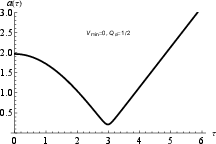
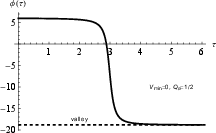
Figure 3: Axionic wineglass wormhole with flat boundary: the evolution of the scale factor (left) and scalar field (right) exhibiting expected rim-to-minimum interpolation.
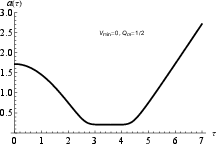
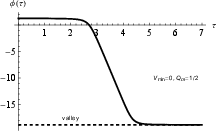
Figure 4: Magnetic wineglass wormhole analog, with a broader stem, showing protracted interpolation across the barrier.
The weighting (minus the on-shell Euclidean action) for these solutions increases (i.e., action becomes less negative) for smaller charge, favoring long inflation. Strikingly, the action approaches the no-boundary result as Q→0, supporting universality in the tunneling family.
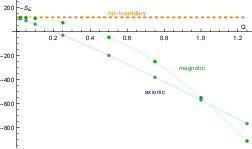
Figure 5: Weightings for axionic and magnetic wormholes with flat asymptotics; all converge to the no-boundary weighting for small charges.
Asymptotically AdS Solutions
In the AdS case, Dirichlet boundary conditions are enforced at the AdS boundary, and the action is renormalized by standard holographic counterterms. The potential supports a positive region (inflationary plateau) and a tunable negative minimum. The initial scalar data (at the rim) converge to the top of the potential barrier as the charge decreases, mirroring the flat-space scenario.
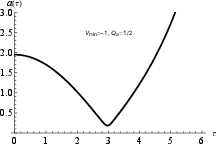
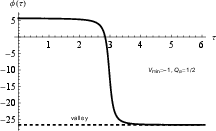
Figure 6: Axionic wineglass wormhole with AdS boundary: scale factor (left) and scalar field (right) evolution, with exponential approach to AdS at infinity.
Renormalized, background-subtracted actions confirm the dominance of small-charge solutions regardless of the depth of the AdS vacuum. These results demonstrate that the universe can be nucleated with essentially identical probability from AdS or Minkowski backgrounds in the extreme small charge limit.
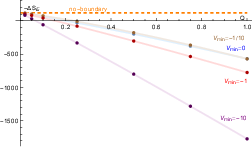
Figure 7: Renormalized, background-subtracted weightings in several potentials: all tend to the same value (no-boundary result) at small charge, indicating universality.
Exotic and Multi-Barrier Solutions
The symmetry-reduced ansatz admits an exotic zoo of solutions beyond the single-stem case:
- Multi-stem ("oscillating") wormholes: Solutions with several minima and maxima of the scale factor. The weighting is generally higher (i.e., less suppressed) for more stems, but remains subdominant to the minimal action of the no-boundary solution. There is an upper limit on the number of stems, set by the inability to satisfy boundary conditions once the initial field value exceeds a threshold.
- Multi-barrier solutions: With periodic potentials, the scalar field can traverse several adjacent barriers, resulting in wormholes that connect higher "potential hills" to the AdS minimum. These are always subdominant in weighting.
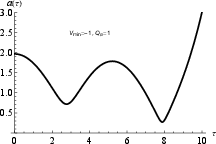
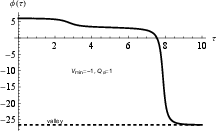
Figure 8: Double-stem wormhole, with two bounces in the scale factor; right panel shows the scalar traversing a potential barrier between each bounce.
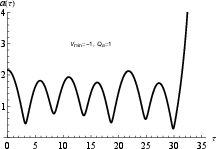
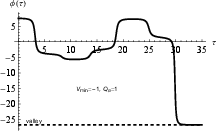
Figure 9: A six-stem wormhole, with correspondingly oscillatory behavior; such solutions exist only for sufficiently high initial energy.
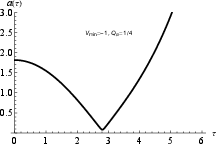
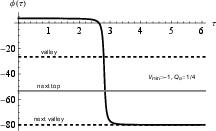
Figure 10: Wormhole interpolating across two barriers. The trajectory exhibits the field's evolution over two hills before settling.
The No-Boundary Limit and Topological Transition
In the small charge limit, a thin-wall approximation is justified analytically and numerically:
- The width of the stem, characterized by amin, shrinks with fractional powers of Qa or Qm0.
- The wall region carries negligible action in the limit; the gravitational path integral thus smoothly transitions to a sum over disconnected geometries: a no-boundary instanton and a background AdS/Minkowski region.
- The dynamics of the friction term Qm1 elucidate the rapid transition of the scalar field.
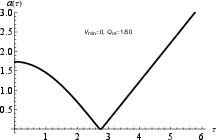
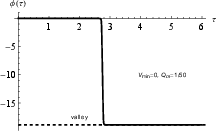
Figure 11: The small-charge (thin-wall) limit: a magnetic wineglass wormhole with vanishing stem thickness and abrupt field interpolation.
Theoretical and Practical Implications
The principal implication is the existence of a continuous family of tunneling solutions, parametrized by charge, interpolating between wormholes and no-boundary instantons. In the path integral for quantum gravity, these solutions contribute with weight Qm2; maxima are reached for vanishing charge, i.e., for universes beginning precisely at the top of the potential, with homogeneous initial data suitable for extended inflation. The universality is independent of asymptotic vacuum energy. This result underscores a nontrivial interplay between topology change, path integral saddles, and initial conditions for cosmology.
Wineglass wormholes with sub-Planckian rim sizes and their multi-stemmed generalizations open questions about negative modes, quantum stability, and couplings to more realistic matter content. Furthermore, their role in the AdS/CFT correspondence and the factorization of the gravitational path integral remains to be fully elucidated, especially in the zero-charge regime where disconnected geometries dominate.
Conclusion
This work establishes the deep connection and universality between wineglass wormhole solutions and no-boundary instantons in the quantum creation of inflationary universes. The analysis covers both asymptotically flat and AdS spacetimes, introduces exotic multi-stem solutions, and rigorously explores the small-charge, thin-wall regime where topological transitions occur. The results reinforce the perspective that quantum gravity must admit the sum over topologies, with significant practical consequences for understanding inflationary initial conditions, the nature of gravitational instantons, and the landscape of possible universes.
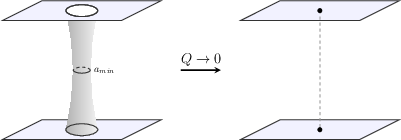
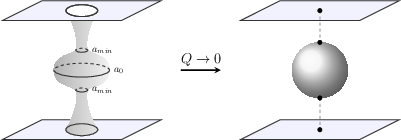
Figure 12: In the zero-charge limit, ordinary wormholes shrink away leaving disconnected regions (upper panel), while wineglass wormholes leave behind a disconnected no-boundary (de Sitter) instanton (lower panel).
Reference:
"Birth of Inflationary Universes via Wineglass Wormholes and their No-Boundary Relatives" (2605.10548)

