- The paper introduces a novel confidence-ordered iterative denoising strategy that unifies autoregressive and non-autoregressive reranking to capture bidirectional inter-item dependencies.
- It employs a Semantic Fusion Layer and Latent Pool Selection to aggregate semantic tokens and validate candidate items, enhancing list-wise modeling.
- Experiments on Amazon Books, MovieLens-1M, and industrial datasets show significant gains in Precision, NDCG, and MAP over state-of-the-art baselines.
UniRank: A Unified Confidence-Ordered Denoising Framework for List-wise Reranking
Problem Context and Motivation
Modern recommender systems utilize a cascade architecture with sequential retrieval, ranking, and reranking stages. Reranking refines a request-specific candidate pool into an ordered slate to maximize overall user satisfaction by considering inter-item dependencies, diversity, and various exposure effects. Existing neural rerankers fall into two major paradigms:
- Autoregressive (AR) Rerankers: Sequentially generate the slate left-to-right, conditioning later items on earlier ones. This modeling captures inter-item dependency, but errors in early slots have cascading effects, and the left-to-right constraint hampers utilization of full slate context.
- Non-Autoregressive (NAR) Rerankers: Generate all slate positions in parallel, sidestepping error propagation but effectively modeling each slot independently, thus failing to capture exposure dependencies.
This leads to a critical tradeoff between effective dependency modeling (AR, but unstable decoding) and stable, parallel decoding (NAR, but weak contextual modeling). The central research question addressed is whether it is possible to unify the strengths of both AR and NAR paradigms under a single framework, enabling bidirectional inter-item modeling and overcoming fixed-order error propagation.

Figure 1: Comparison of AR, NAR, and UniRank rereanking paradigms. UniRank interpolates between AR and NAR via confidence-ordered iterative denoising with bidirectional context.
Methodology: The UniRank Architecture
UniRank introduces a confidence-ordered iterative denoising framework with a bidirectional slate modeling backbone, unifying AR and NAR as special inference cases. The approach formulates list-wise reranking as masked discrete diffusion over slate positions. The forward process randomly masks positions in the slate, and the reverse (denoising) model incrementally reconstructs the slate by committing the most confident item-slot assignment at each step, conditioning on the current bidirectional context. The number and schedule of prediction steps permit interpolation between fully autoregressive (serial, one slot per step, left-to-right) and fully non-autoregressive (all slots in parallel) regimes.
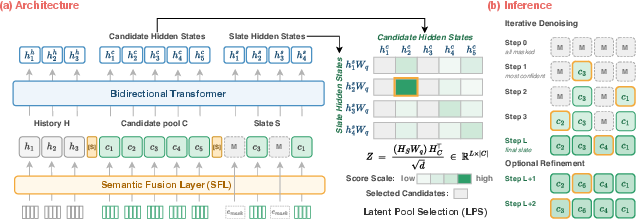
Figure 2: UniRank system overview combining semantic fusion, candidate-pool-constrained denoising, and confidence-ordered iterative generation.
Task Grounded Diffusion (TGD) Interface:
To instantiate diffusion-based listwise reranking for the candidate-constrained setting, UniRank employs two components:
- Semantic Fusion Layer (SFL): Aggregates item semantic tokens—derived via VQ-VAE quantization of pretrained LLM embeddings—into a single item embedding, enabling item-level denoising.
- Latent Pool Selection (LPS): Replaces large-vocabulary token generation with direct scoring and selection within the current candidate pool. Each slate position's hidden state is dot-product scored against the candidate item embeddings, ensuring predictions are valid and directly comparable.
The model is trained with a cross-entropy surrogate over masked positions, featuring optional utility-weighted label reweighting to enable listwise reward alignment or policy-gradient objectives.
Experimental Evaluation
UniRank is evaluated on three datasets: Amazon Books, MovieLens-1M, and a large-scale industrial short-video log. Metrics reported include Precision@L, NDCG@L, MAP@L, and F1@L.
Main Results
Across all datasets and four metrics, UniRank achieves superior results to all baselines, including state-of-the-art AR (GoalRank, GloRank), NAR (NAR4Rec, PRM), Generator-Evaluator, and diffusion-based refinement models (DCDR). Notably, on Amazon Books, UniRank delivers up to 5.43% relative improvement in Precision, 4.35% in NDCG, and 6.44% in MAP over the strongest baseline. Similar consistent gains are observed on MovieLens-1M and industrial data, with statistically significant uplifts in critical online metrics such as average app-time and share-rate in real A/B testing.
Ablations and Model Component Analysis
Ablation studies confirm:
- Semantic Fusion Layer is critical for effective item-level modeling. Its removal yields the largest performance degradation.
- Iterative (multi-step) confidence-ordered denoising improves list quality over single-step NAR; however, performance is not highly sensitive to the number of steps, allowing practical trade-offs.
- Latent Pool Selection substantially improves candidate validity and intra-request item comparison versus open-vocabulary generation.
Denoising and Scaling Insights

Figure 3: Denoising parameter influence—performance improves as denoising step count increases, and confidence-ordered allocation yields further gains.
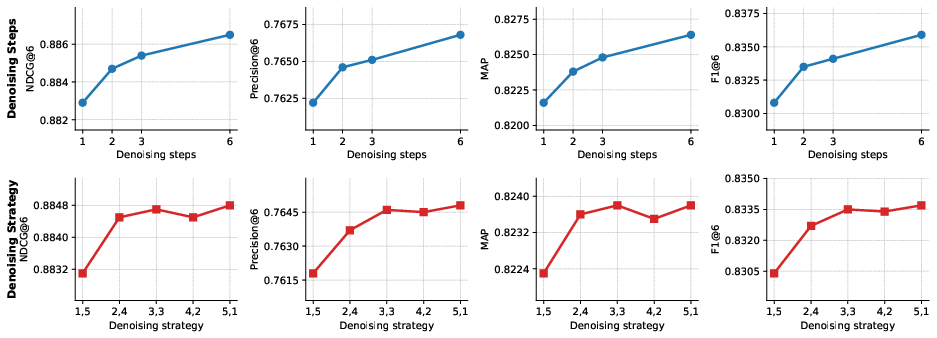
Figure 4: All evaluation metrics benefit from more iterative denoising steps and strategic allocation of easy/hard positions.
Increasing denoising steps yields better metrics, confirming that iterative resolution of the most confident positions allows successive steps to benefit from enriched context. Empirical results indicate rapidly diminishing returns beyond three steps, balancing performance with inference efficiency. Scaling analysis demonstrates consistent gains up to a moderate parameter scale, after which overfitting emerges due to data limitations.
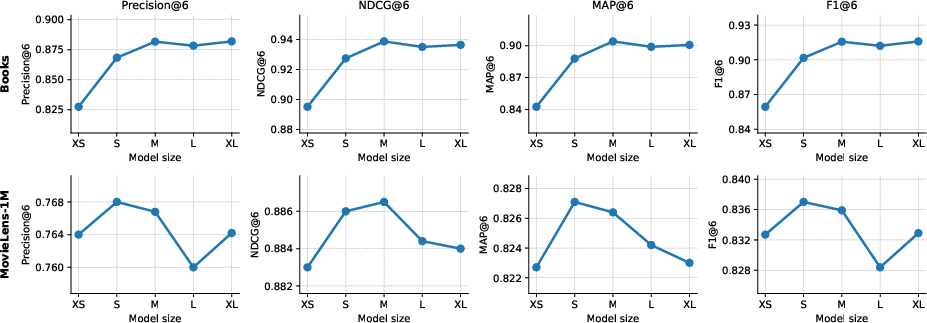
Figure 5: Scaling results—a rise-then-fall trend as model size increases, with sweet-spot at moderate parameter counts.
Practical and Theoretical Implications
Practically, UniRank can directly substitute for AR or NAR rerankers in industrial systems, immediately improving engagement metrics without needing upstream pipeline modifications. The architecture's modularity allows system designers to select the denoising schedule appropriate for latency and throughput requirements while maintaining superior modeling of bidirectional inter-item dependencies.
Theoretically, UniRank demonstrates that generative reranking need not be constrained by left-to-right or parallel independence structures; masked denoising with adaptive commit order enables flexible dependency modeling and robustness. Furthermore, the TGD interface elegantly aligns the diffusion process with the domain constraints of candidate-pool reranking, setting a pattern for future generative frameworks in structured prediction constrained domains.
Future Directions
Extensions may include joint optimization of upstream retrieval with diffusion-based reranking, or feedback-loop architectures where UniRank scores propagate to candidate generation. Application of the confidence-ordered iterative denoising paradigm to other permutation-structured outputs—such as combinatorial optimization or diverse summarization—represents a fruitful avenue. Efficient scaling and hybridization with large sequence models for massive candidate pools are also promising.
Conclusion
UniRank provides a unified, confidence-ordered denoising framework for reranking that generalizes AR and NAR methods, achieves bidirectional dependency modeling, and delivers strong empirical improvements on benchmark and industrial datasets. The introduction of the TGD interface ensures item-level, candidate-constrained generation. Evidence from comprehensive experiments and ablations highlights the framework as a viable new standard for list-wise reranking in recommender systems, with immediate deployment impact and theoretical generality (2605.10527).