- The paper demonstrates that monolayer TMDCs can exhibit tunable orbital and spin Nernst effects through carrier doping and spin-orbit coupling modulation.
- It employs both a low-energy valley model and a full tight-binding approach to quantitatively estimate Nernst conductivities in insulating and metallic regimes.
- The study finds that metallic TMDCs like NbS₂ show robust orbital responses with conductivities significantly exceeding the spin-related effects.
Introduction and Context
This paper provides a comprehensive theoretical investigation of the orbital Nernst effect (ONE) and spin Nernst effect (SNE) in monolayer 2H-phase transition metal dichalcogenides (TMDCs), focusing on the representative systems MoS₂ (insulating) and NbS₂ (metallic) (2605.10033). It demonstrates that TMDC monolayers constitute a highly tunable platform for realizing both effects, with distinct mechanisms for the orbital and spin channels, and offers predictions for their experimental detection and future utilization in caloritronic and orbitronic devices.
Theoretical Framework: Valley Model and Tight-Binding Approach
The authors employ two complementary frameworks:
- Valley Model: A low-energy analytical model near the K/K′ valleys, capturing the essential Berry curvature physics relevant for low doping or near the band extrema.
- Full-Brillouin-Zone Tight-Binding Model: Material-specific tight-binding Hamiltonians—parametrized from first-principles—describe MoS₂ and NbS₂ across the Brillouin zone, enabling quantitative estimates of Nernst conductivities in both insulating and metallic regimes.
The valley model Hamiltonian explicitly incorporates the absence/presence of spin-orbit coupling (SOC) and provides closed-form analytical expressions for OHC, SHC, ONC, and SNC, highlighting their dependence on the Fermi level and SOC strength.
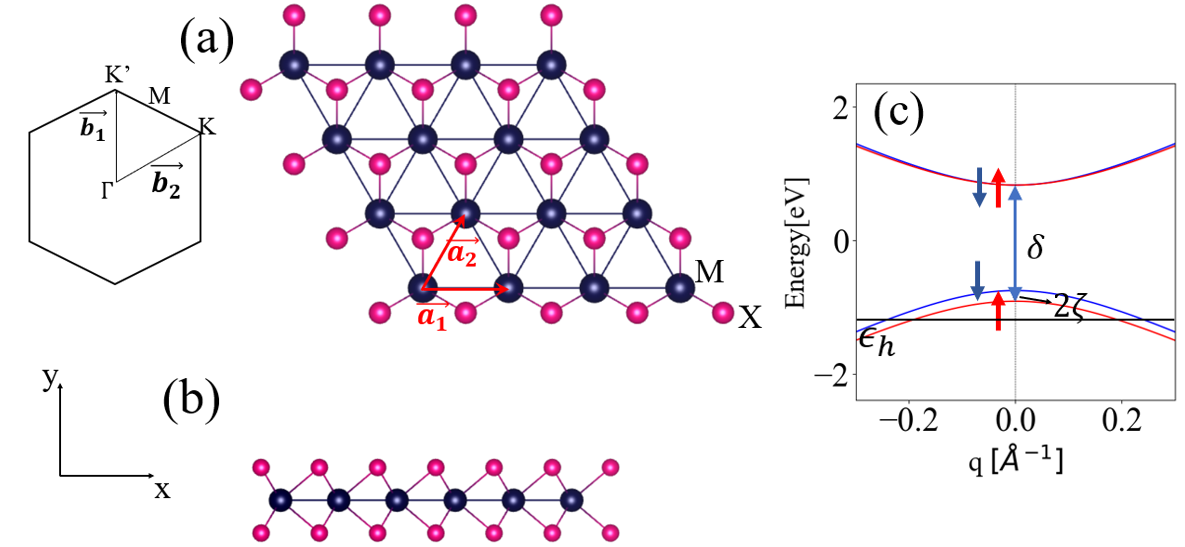
Figure 1: Crystal structure and valley band structure of monolayer MX₂ TMDCs, showing inversion symmetry breaking and valley-contrasting physics.
Physical Mechanisms and Analytical Results
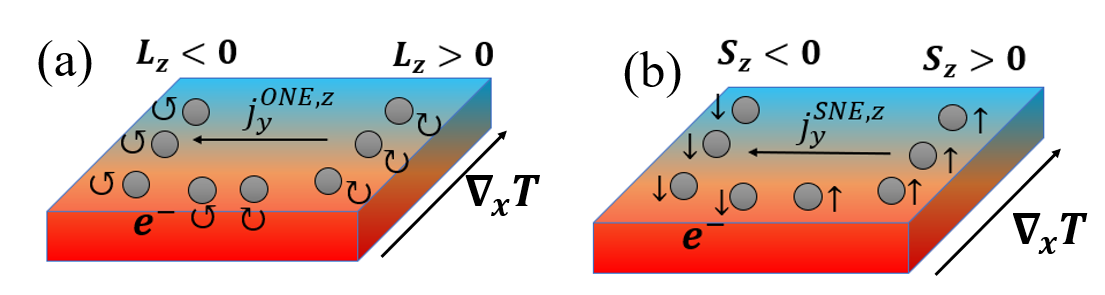
Orbital and Spin Nernst Effects: These phenomena correspond to transverse charge-neutral flows of orbital and spin angular momentum, respectively, induced by a longitudinal temperature gradient. The key findings are:
Numerical Results for MoS₂ and NbS₂
The tight-binding calculations quantitatively establish several strong claims:
- MoS₂ (Insulating TMDC):
- OHC is nonzero throughout the band gap, but ONC is strictly zero at intrinsic (undoped) Fermi energy and only arises upon substantial doping.
- The ONC magnitude is larger upon electron doping (due to Berry curvature at Γ), and tightly linked to band structure details.
- NbS₂ (Metallic TMDC):
- Both OHC and ONC are finite at the Fermi energy without any doping. The ONC, in particular, can reach values of order 102 in normalized units, much larger than the SNC.
- The magnitude of ONC generally exceeds SNC by an order of magnitude or more.
- A sign change in ONC as a function of energy (doping) is observed, directly corresponding to the sign of underlying orbital Berry curvature.
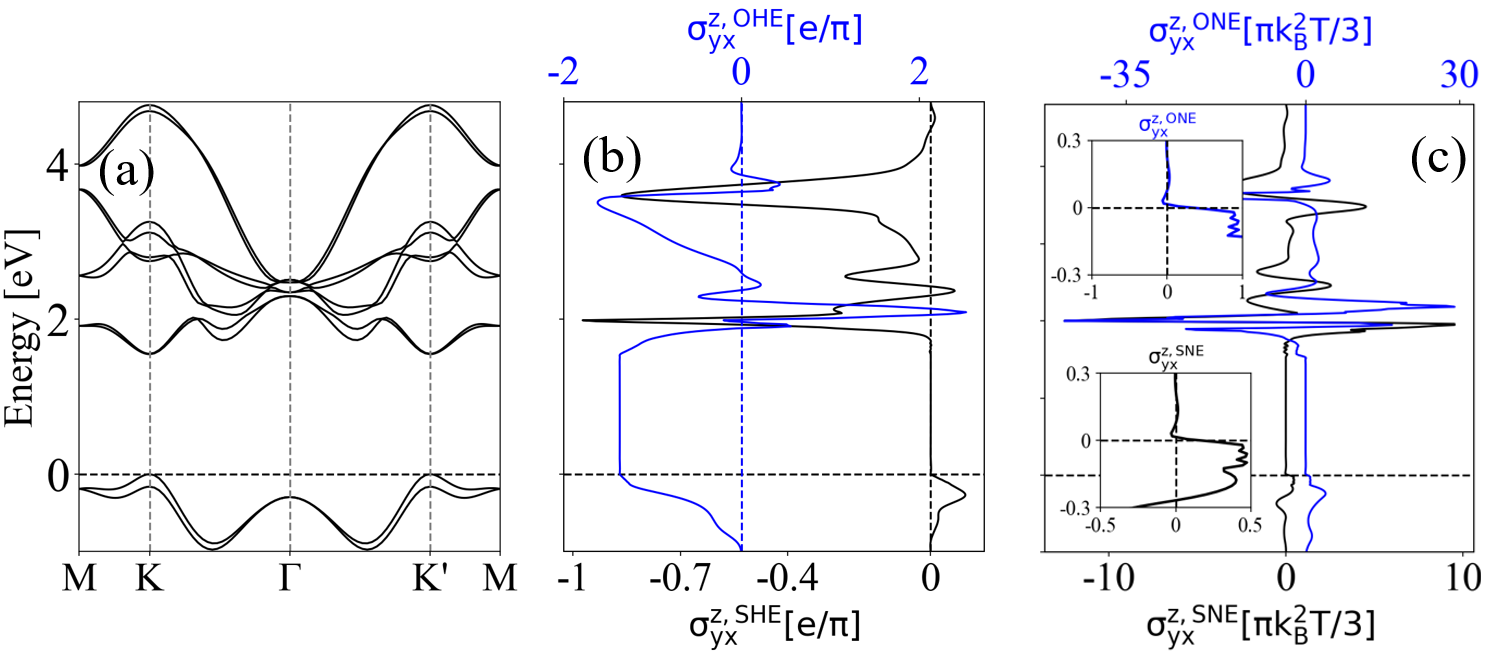
Figure 3: Orbital and spin Hall and Nernst conductivities in MoS₂ as a function of energy. ONC is zero at the Fermi energy but becomes sizeable outside the gap.
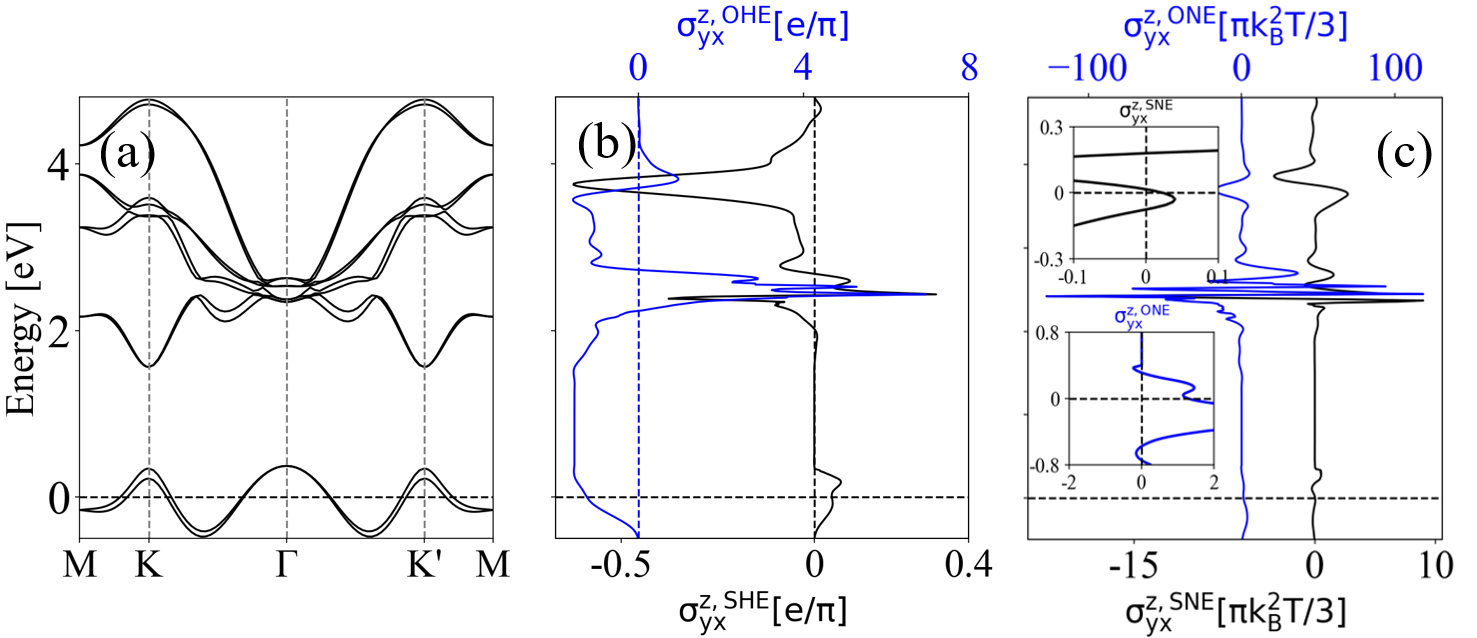
Figure 4: Orbital and spin Hall and Nernst conductivities in NbS₂; metallicity ensures finite ONC and SNC at the Fermi level, with strong dependence on the SOC.
Berry Curvature Analysis
The Berry curvature distribution at the Fermi level is the microscopic origin for both Nernst responses:
- MoS₂: Berry curvature is sharply peaked at K, K′0 (for holes) and K′1 (for electrons), with the orbital component much stronger than the spin component.
- NbS₂: While orbital Berry curvature peaks around valleys, the immediate K′2, K′3 regions are unoccupied due to the Fermi level position; nevertheless, regions near the Fermi surface exhibit substantial orbital Berry curvature.
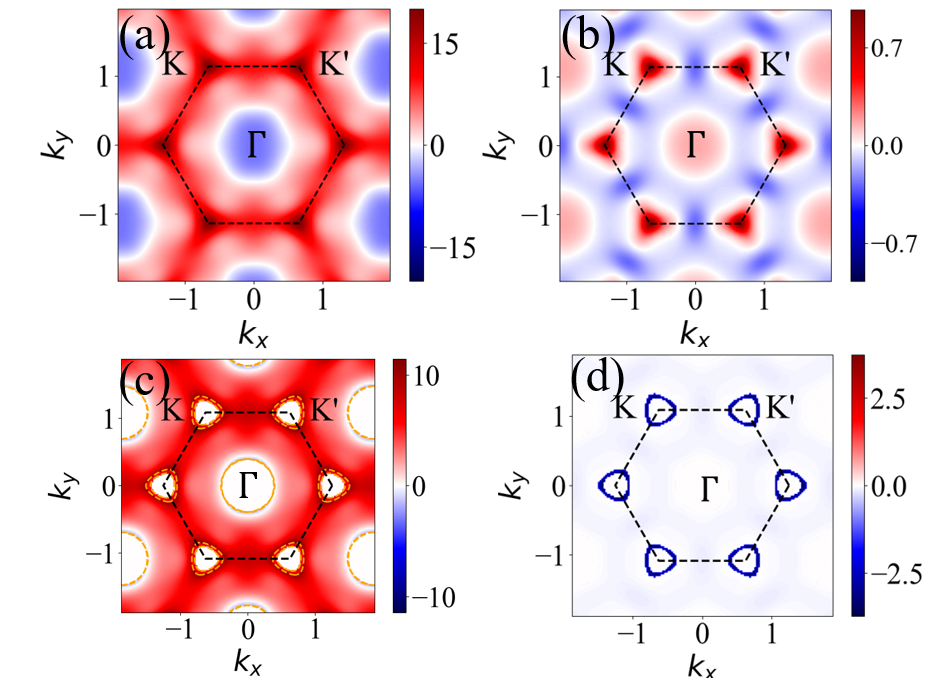
Figure 5: K′4-space distribution of orbital and spin Berry curvature for MoS₂ (top) and NbS₂ (bottom); Berry curvature hotspots determine the sign and magnitude of conductivities.
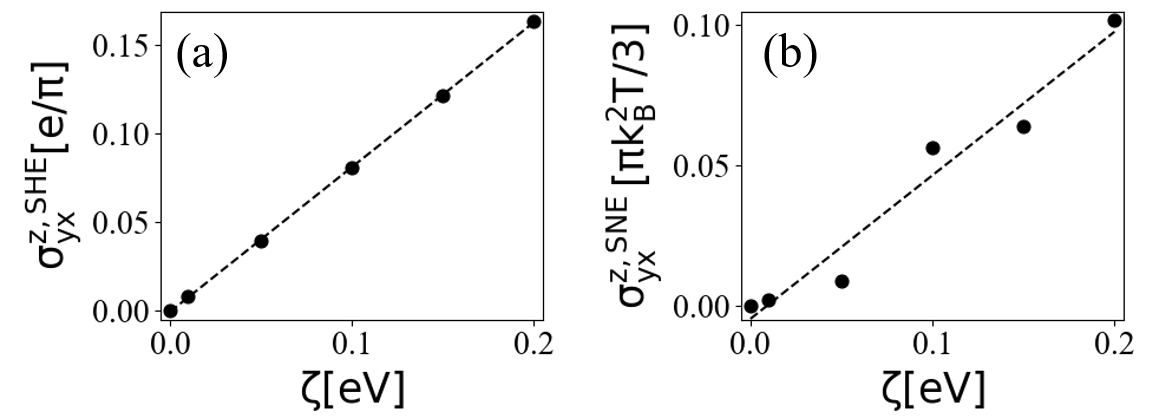
Figure 6: Linear dependence of SHC and SNC on SOC strength K′5 in NbS₂, confirming analytical scaling predictions.
Experimental Proposal
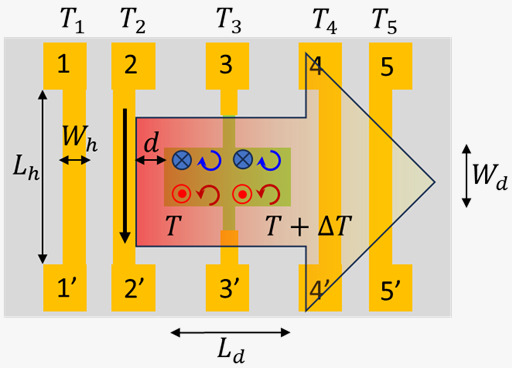
A Hall-bar experimental geometry is proposed for direct detection via MOKE (magneto-optic Kerr effect). The setup leverages the edge accumulation of spin (SNE) and orbital (ONE) magnetization, with the following measurement scheme:
Implications and Outlook
Theoretical Significance
- Establishes a clear separation of orbital- and spin-driven thermal transport mechanisms in 2D TMDCs.
- Demonstrates that orbital Nernst responses can be engineered even in systems with negligible SOC, provided metallicity is present, which dramatically widens material design space versus spin-based devices.
- Highlights the tuning capability of doping/gate voltage for ONC/SNC, predicting practical pathways for device integration.
Practical Relevance
- The possibility to harness both orbital and spin Nernst effects for energy harvesting, i.e., conversion of waste heat to information-carrying orbital/spin currents.
- TMDCs, with their easily accessible 2D structure, chemical tunability, and strong Berry curvature effects, are identified as ideal candidate materials.
- The MOKE-based detection scheme should be broadly applicable for mapping edge magnetizations in 2D materials.
Future Directions
- Exploration of other metallic TMDCs (e.g., TaS₂, NbSe₂) with heavier transition metals and stronger SOC for larger SNCs.
- Investigation of extrinsic effects (e.g., disorder, temperature dependencies) on ONC/SNC in realistic environments.
- Integration of ONC/SNC effects into functional devices for spin-orbitronic and caloritronic applications, potentially in combination with optical or gate-driven control.
Conclusion
This study presents a detailed, predictive account of the orbital and spin Nernst effects in 2D TMDCs, displaying strong evidence that both effects can be selectively engineered via SOC and carrier doping. The findings underscore the centrality of orbital Berry effects in future 2D electronics and caloritronics, motivating further theoretical and experimental efforts in orbitronics and beyond.