- The paper demonstrates a reduction of a bulk–surface model, revealing explicit geometry-induced pulse dynamics that underlie cell polarization.
- It employs singular perturbation analysis and Green's function techniques to link domain curvature and bifurcation behavior with wave-pinning stability.
- Finite element simulations validate the analytical predictions, confirming geometry-dependent transitions in localized pulse formation.
Geometry-Induced Pulse Dynamics in Bulk–Surface Reaction–Diffusion Systems for Cell Polarization
Introduction
This work investigates the interplay between cellular geometry and polarity-pattern formation by analyzing a bulk–surface reaction–diffusion system relevant for cell polarization (2605.10006). The primary model addresses mass-conserving bistable reactions with differential localization: active species on the cell membrane (surface) and inactive species in the cytosol (bulk). The authors focus on the formal derivation and analysis of reduced dynamics for localized pulse solutions under explicit geometric influence, providing new insight into how nontrivial cellular shapes can control spatial localization and stability of cell polarity regions.
The governing system is a coupled bulk–surface reaction–diffusion system, in which u describes the surface (membrane) concentration and v the bulk (cytosol) concentration. The reactions are mass-conserving and bistable, mimicking Rho GTPase dynamics. Reactions at the surface drive active/inactive conversion, and the cytosolic species exchanges with the membrane via dynamic boundary conditions. The conservation law is a central feature: total mass integrated over both compartments remains constant. Geometry appears nontrivially, as v is defined in the domain's interior Ω, while u lives on the boundary Γ=∂Ω.
The authors leverage singular perturbation analysis to reduce the PDE system to ODEs for the pulse half-width w(t) and center position s0(t), accurately resolving dynamics on two timescales:
- Wave-Pinning Timescale (t=O(1)): Complex surface reactions with mass redistribution rapidly form a sharply localized pulse of width w∗, while the pulse position remains frozen.
- Metastable Drift Timescale (v0, v1): The established pulse undergoes very slow motion, with geometry-dependent drift toward stationary points dictated by the domain.
The slow drift dynamics is shown to be a gradient flow for a geometry-dependent potential v2, which is determined by the Neumann Green's function of the domain — directly linking the pulse motion to underlying geometry (curvature, connectedness, topological features).
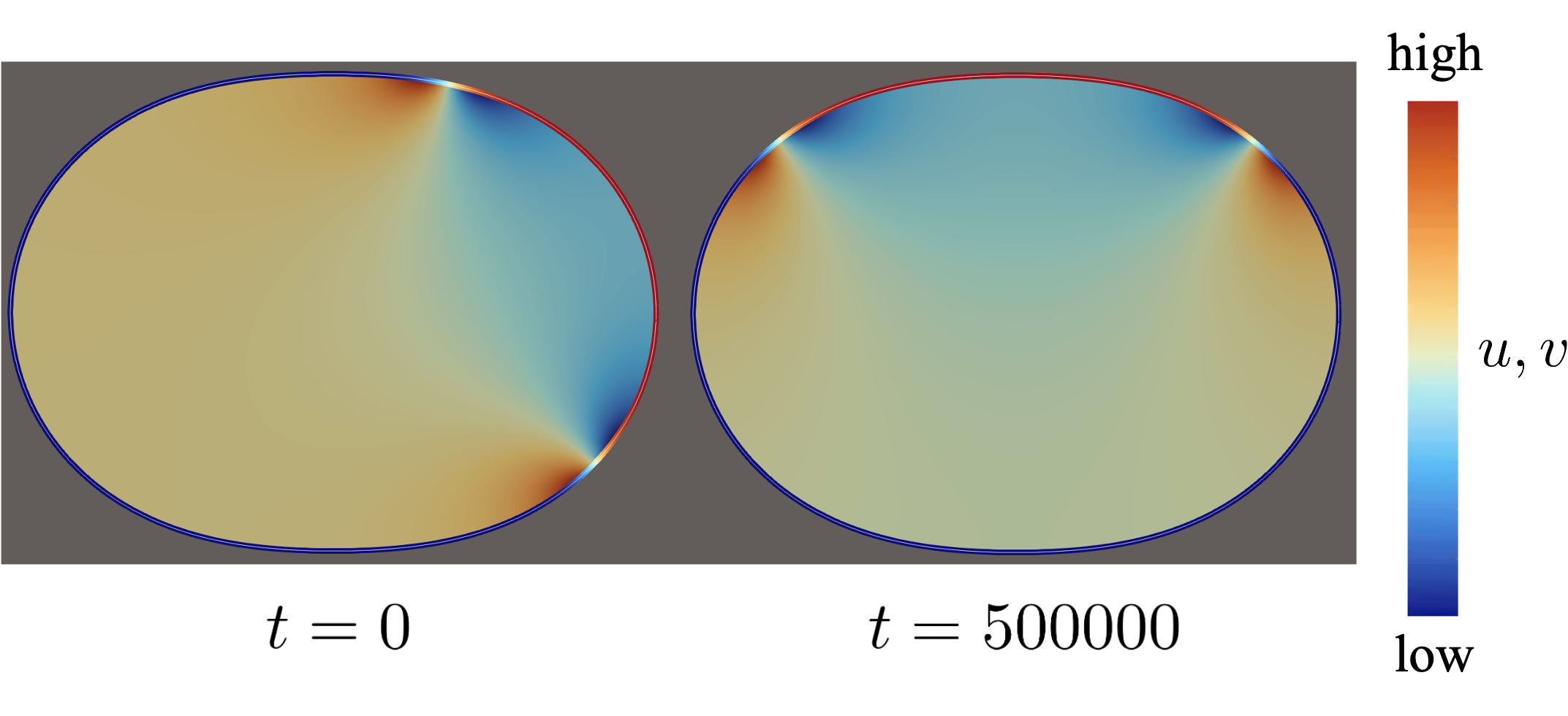
Figure 1: Slow dynamics of a pulse solution of the bulk–surface system illustrating the metastable geometry-induced drift.
Geometry-Dependent Potential and Green's Function Analysis
A pivotal contribution is the explicit reduction of the slow pulse drift to gradient descent in a scalar potential function v3, where geometry enters through both local curvature and global features via the Neumann boundary Green's function. The pulse center's evolution satisfies:
v4
where v5 can be calculated explicitly for domains that are conformal images of simple reference domains (such as the unit disk or annulus) using analytical and computational Green's function machinery.
This framework is then specialized to two classes of model domains:
- Dumbbell-shaped domains: Parameterized by a deformation parameter v6 that interpolates between a disk and two tangent disks, capturing convex to non-convex geometries.
- Perforated disks: Disks with off-center holes, representing simply- and doubly-connected asymmetric geometries.
In both cases, the analytical complexity is managed by conformal mapping techniques, reducing the computation of v7 to integrals involving conformal derivatives and periodic functions on the canonical domains.
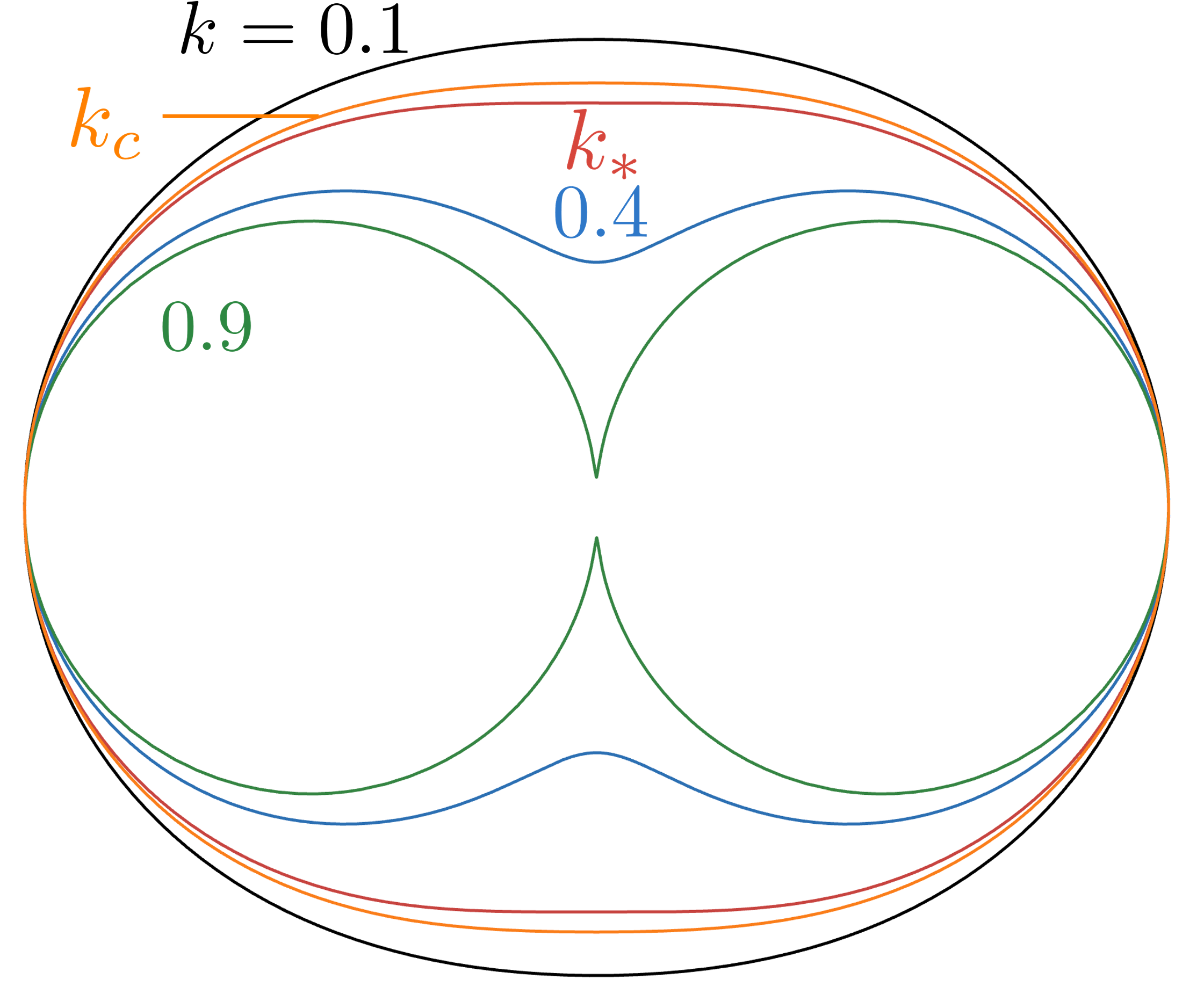
Figure 2: Dumbbell-shaped domains for varying v8, illustrating symmetric and asymmetric geometries.
Bifurcation Analysis and Pulse Position Selection
For each domain type, the critical points (local minima and maxima) of v9 are precisely characterized. Nontrivial bifurcation behavior emerges as domain shape parameters are tuned:
- Dumbbell Domains: As v0 increases, a subcritical pitchfork bifurcation is observed. For small v1, only symmetric positions are stable; for large v2, nontrivial stationary points arise in the neck region.
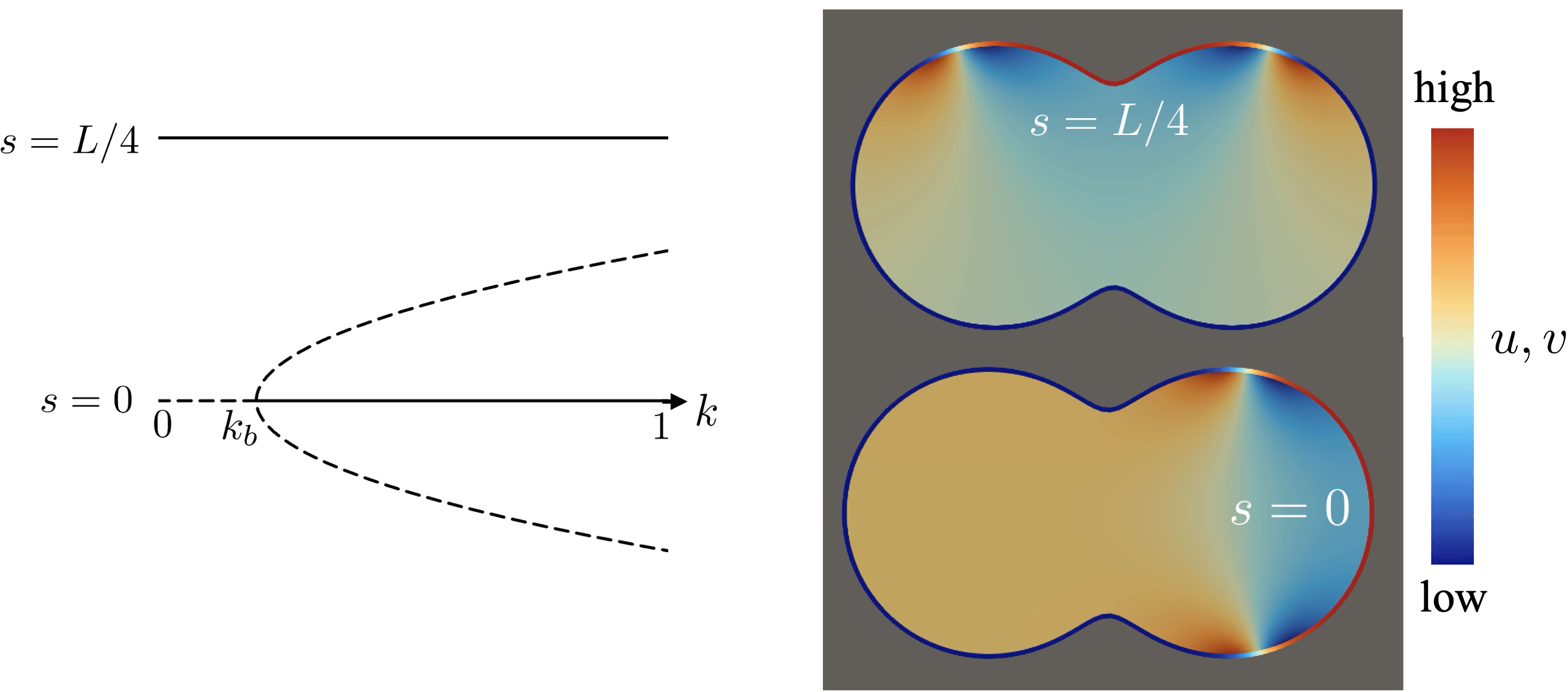
Figure 3: Schematic of the pitchfork bifurcation in pulse position in the dumbbell domain as a function of geometric parameter v3.
- Perforated Disks: Varying the displacement v4 of the hole (eccentricity) induces a supercritical pitchfork bifurcation, creating stable pulse positions away from high-symmetry points. The range of admissible pulse half-widths (controlled by total mass and reaction kinetics) and geometric parameters modulates bifurcation thresholds.
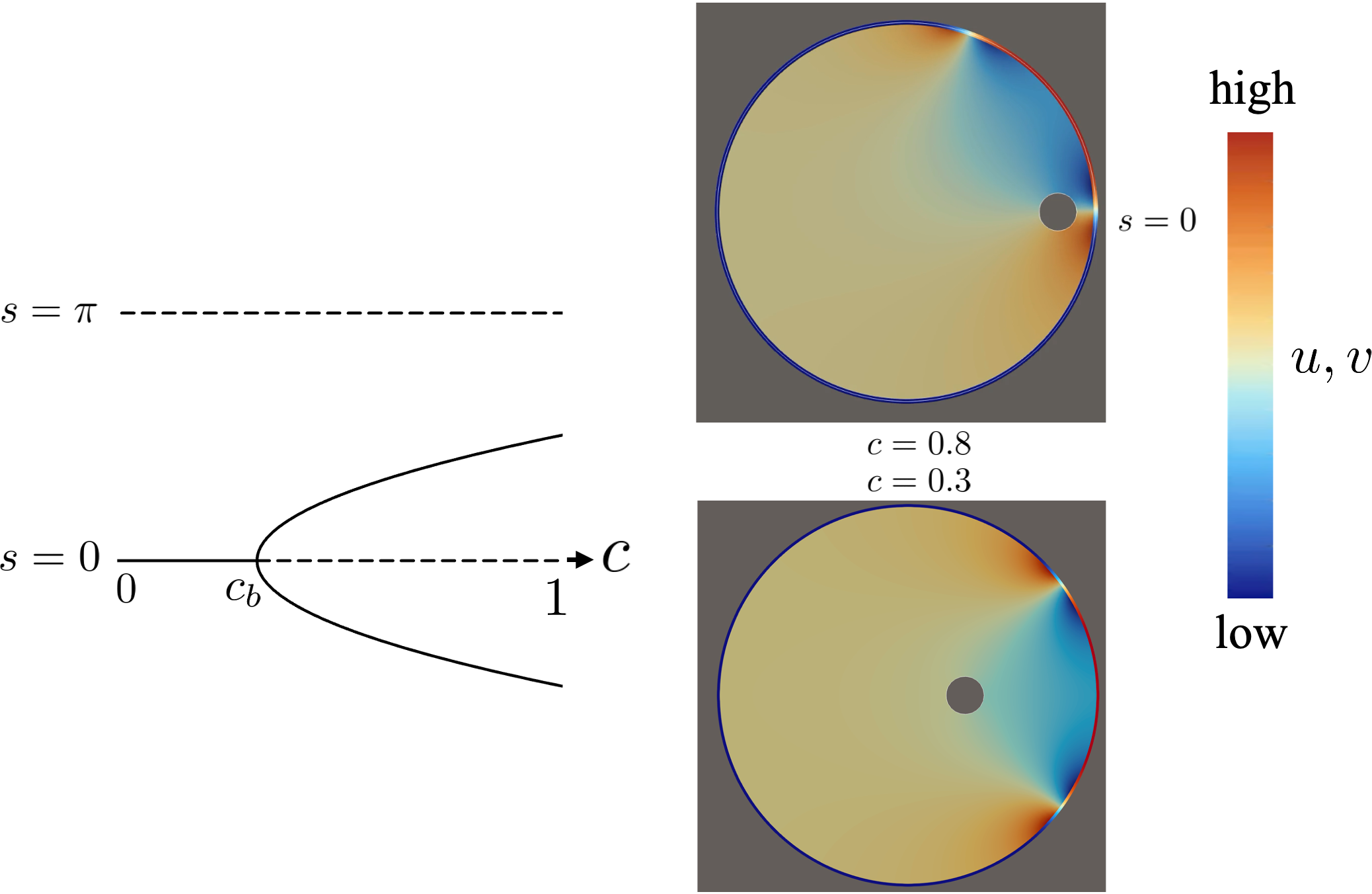
Figure 4: Schematic diagram of the pitchfork bifurcation in the perforated disk scenario as a function of hole eccentricity.
Numerical simulations confirm and visualize the theoretical predictions, with pulses localizing at or drifting toward the critical points of v5 depending on initial conditions and geometric regime.
Computational Implementation and Numerical Results
The theory is supported by finite element simulations using the bulk–surface finite element method and predictor–corrector time stepping, confirming that pulses indeed stabilize at geometric positions predicted by analysis, and that the full PDE system evolves consistent with the reduced ODEs.
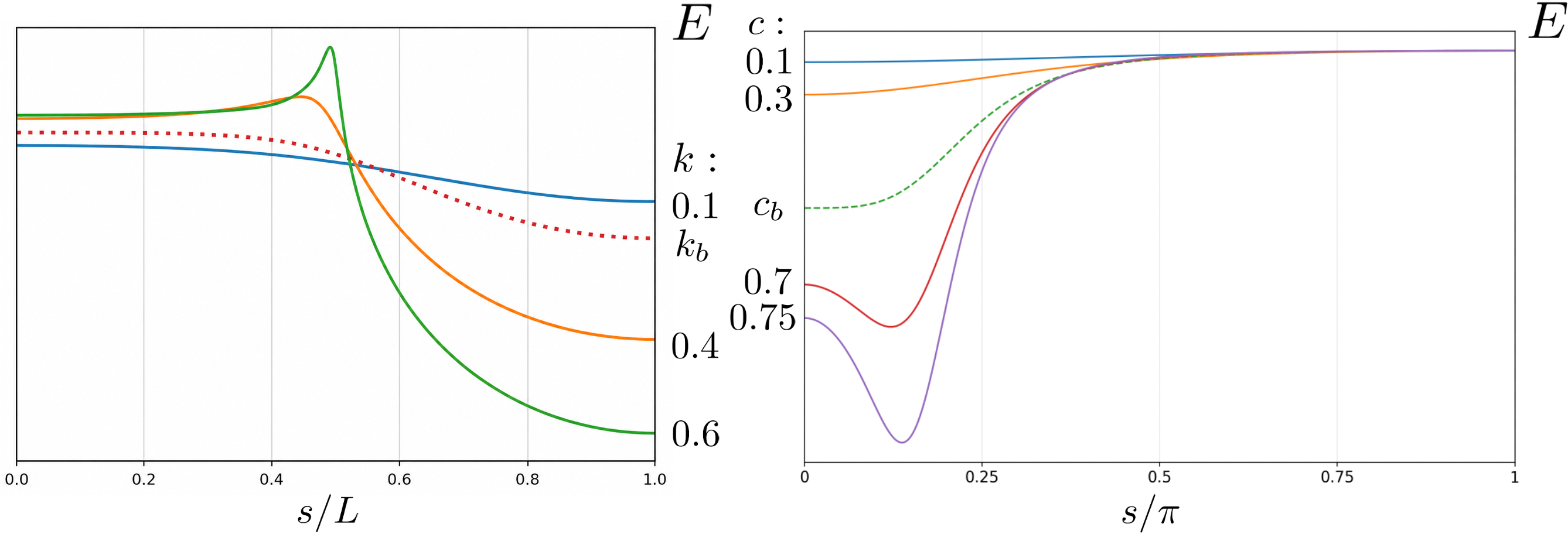
Figure 5: Plot of v6 for the dumbbell domain, showing multiple critical points and illustrating nontrivial pulse equilibria as shape is deformed.
Quantitative agreement between predicted bifurcation diagrams and simulated long-term pulse positions is reported. The simulations highlight sharp transitions in pulse behavior, such as transitions between unique and multiple stable pulse positions under symmetry breaking in both dumbbell and perforated disk geometries.
Implications, Broader Context, and Future Perspectives
This analysis demonstrates that domain geometry, through Green's function-based nonlocality, fundamentally controls wave-pinning and the spatial selection of polarity pulses in bulk–surface bistable systems. Strong claims include the explicit identification of threshold effects: nontrivial equilibria and bistability emerge only when geometric perturbations exceed critical strength (i.e., for v7 or v8 above bifurcation values), and not for weak symmetry breaking. This provides a structural explanation for cell polarity sensitivity to global cell shape — a feature not captured in models lacking spatially resolved bulk-surface separation.
The methodology opens the way for rigorous mathematical studies (spectral analysis, stability theory, nonlinear matching) for even more complex geometries, anisotropic diffusion, or moving boundaries. In applications, these results suggest that direct experimental manipulation of cell shape should yield testable predictions for polarity localization, bistability, or even switching under controlled geometric changes. The approach generalizes to a wider class of systems with dynamic (physically meaningful) boundary conditions, encompassing models in cell migration, mechanobiology, and beyond.
Given the increasing use of DBCs in various multiscale models, the perturbative and Green's function-based reduction framework could see adoption for analyzing nonlocal effects and metastable patterns in bulk/membrane-coupled systems in biophysical and materials contexts.
Conclusion
The paper provides a precise and tractable analytical reduction of geometry-induced slow pulse dynamics in a bulk–surface reaction–diffusion model for cell polarity, revealing the critical role of domain geometry in spatial selection and stability of localized patterns. Explicit formulas for geometry-dependent potentials, supported by simulation and bifurcation analysis, clarify under what conditions cellular shape can engineer robust or multistable polarity. These insights both clarify fundamental mechanisms in biological self-organization and lay groundwork for future rigorous and computational investigations in nontrivial geometries (2605.10006).

