- The paper introduces EMSFD, integrating evidential deep learning with active learning to output both predictions and uncertainty, enhancing synthetic face detection.
- The methodology employs a two-stage process combining spatial and frequency domain analysis with a robust ViT-B/16 backbone for feature extraction.
- EMSFD achieves a 15% accuracy gain and an Expected Calibration Error of 0.052, significantly reducing annotation needs and improving OOD performance.
Evidence-Based Decision Modeling for Synthetic Face Detection with Uncertainty-Driven Active Learning
Introduction
The proliferation of deep generative models, particularly GANs and Diffusion Models, has significantly elevated the fidelity of synthetic facial images, which now frequently outpace human discernment and have been exploited for various malicious uses. Conventional synthetic face detection methods predominantly rely on Softmax-based neural classifiers, yielding only single-point predictions with no model confidence and suffering from pathological overconfidence when presented with out-of-distribution (OOD) samples. Such models cannot accurately identify or express uncertainty regarding OOD data, leading to highly unreliable results in unconstrained environments. Additionally, most existing detectors require extensive manually annotated datasets, restricting their scalability in practical deployment scenarios.
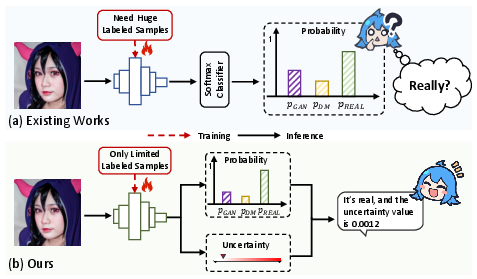
Figure 1: EMSFD contrasts existing detection methods by jointly outputting prediction and uncertainty, integrating uncertainty estimates into an active learning loop to substantially reduce annotation requirements.
Proposal: EMSFD Framework
The paper introduces EMSFD (Evidence-based decision Modeling for Synthetic Face Detection with uncertainty-driven active learning), systematically addressing the overconfidence and annotation inefficiency challenges. The EMSFD architecture fuses evidential deep learning (EDL) with active learning (AL), leveraging the Dirichlet distribution to model class evidence and uncertainty. This not only enhances interpretability and reliability but enables uncertainty-driven data selection during training. The framework incorporates a two-stage, progressive classification: initially, a spatial-domain binary classifier discriminates real versus synthetic faces; subsequently, images classified as synthetic are further analyzed in the frequency domain to attribute the source (GAN or Diffusion Model).
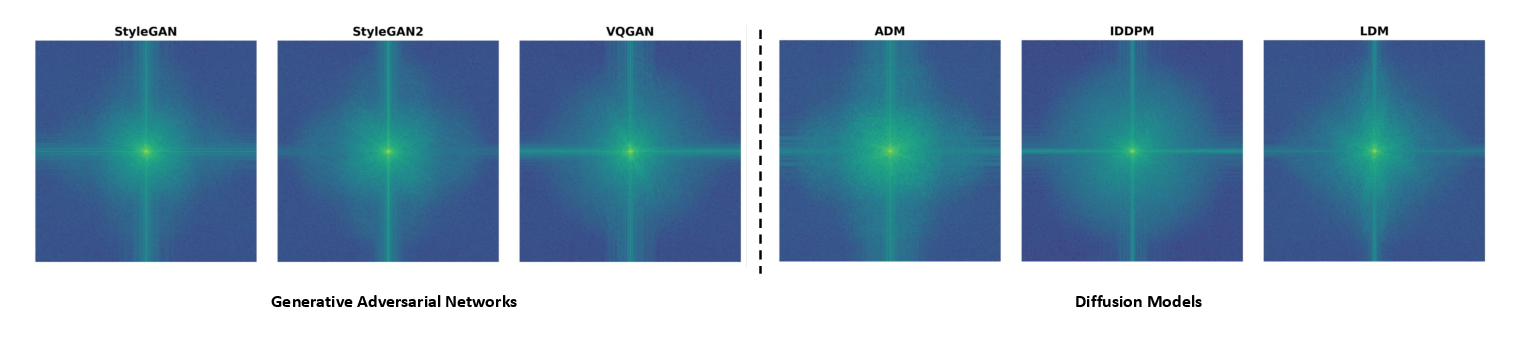
Figure 2: The 2D FFT spectra for various generative models reveal characteristic frequency-domain artifacts, critical for source attribution in the EMSFD's second stage.
The Face Evidence Extraction (FEE) module is fundamental, comprising a frozen backbone (ViT-B/16), linear projection, and an evidence layer. The evidence vector is mapped to Dirichlet parameters, with class probabilities and uncertainty computed accordingly. In frequency-domain analysis, the module decomposes FFT outputs into log-magnitude and phase maps, concatenating channels and adapting patch embedding for ViT input.
Uncertainty-Driven Active Learning
By integrating EDL, EMSFD quantitatively estimates prediction uncertainty. The AL component exploits this uncertainty as the criterion for querying the most informative, uncertain samples from the unlabeled pool, optimizing annotation efficiency and cross-distribution generalization. Each AL round updates the labeled and unlabeled sets by selecting the top-B uncertain samples, enabling iterative model refinement with minimal labeling overhead.
Loss Design and Optimization
The training objective integrates EDL loss (encouraging accurate evidence modeling) and contrastive loss (promoting robust inter-class separation), balanced equally. EDL loss leverages digamma functions applied to Dirichlet parameters, while the contrastive component operates on normalized feature embeddings to maximize class distinctiveness. Optimization uses AdamW with cosine annealing; gradient clipping is applied to stabilize convergence.
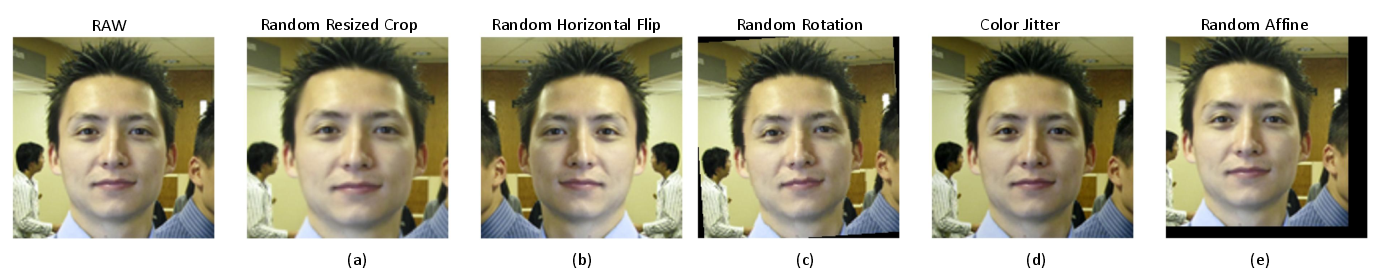
Figure 3: Data augmentation pipeline covers spatial and photometric transformations, enhancing robustness and minimizing overfitting in the EMSFD's backbone.
Experimental Results
EMSFD was benchmarked against several state-of-the-art synthetic face detectors (CNNSpot, DIRE, DeepFeatureX, MDL, etc.) and consistently exhibited substantial improvements, especially in cross-generator OOD regimes. The approach achieved a 15% accuracy gain over SOTA baselines, sustaining high performance on challenging generators such as VQGAN, IDDPM, and LDM. Expected Calibration Error (ECE) for EMSFD remained markedly lower (0.052) than conventional approaches, confirming robust uncertainty calibration. Additionally, the framework maintained superior detection fidelity on emerging architectures (e.g., FLUX.2), demonstrating its generalization capability.
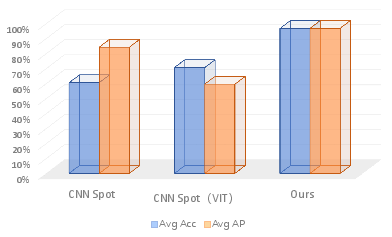
Figure 4: EMSFD consistently outperforms CNNSpot, even when equipped with identical backbone architectures.
Ablative studies validated the criticality of backbone choice (ViT-B/16), activation function (exponential), and loss formulation. The exponential activation stabilized evidence output and accentuated dynamic range, outperforming Softplus and ReLU variants. Where the Softmax-based classifier exhibited increased ECE and diminished accuracy, EMSFD's evidential learning architecture was consistently superior.
Furthermore, t-SNE visualizations confirmed strong clustering and separation of learned features, with uncertainty estimates concentrated at decision boundaries, substantiating both classification effectiveness and interpretability.
Implications and Future Prospects
EMSFD advances the field of synthetic face detection by explicitly modeling uncertainty and integrating AL for data-efficient training. Practically, this improves reliability and trustworthiness of detectors deployed in adversarial, dynamic environments and reduces operational annotation costs, facilitating deployment in resource-constrained scenarios. Theoretically, the framework demonstrates the efficacy of evidential learning and uncertainty-driven AL for open-set recognition and cross-paradigm generalization.
Figure 1: The EMSFD framework’s ability to output uncertainty alongside predictions is pivotal for both interpretability and active learning efficiency.
Future research directions include refining uncertainty estimation algorithms, optimizing sample querying strategies, and extending EMSFD to accommodate increasingly sophisticated synthetic images produced by novel architectures. Enhanced robustness to complex forgeries and adaptive annotation paradigms are anticipated to further consolidate EMSFD's relevance in real-world biometric and multimedia forensics.
Conclusion
EMSFD constitutes a rigorous evidence-based framework for synthetic face detection, resolving key weaknesses of prevailing approaches by modeling prediction uncertainty and minimizing annotation dependency via uncertainty-driven active learning. Empirical results demonstrate substantial performance and calibration improvements across diverse generative models, substantiating both the practical and theoretical merits of the proposed approach. The methodological advances outlined in EMSFD have significant implications for robust, interpretable synthetic face detectors in adversarial settings and open a pathway to scalable, trustworthy AI-driven multimedia forensics.