- The paper demonstrates that local Jahn-Teller distortions stabilize a non-magnetic insulating phase with distinct charge and orbital order.
- It employs a 3D multi-orbital tight-binding model rigorously parameterized using DFT benchmarks to capture electron–phonon and electron–electron interactions.
- Enhanced electron–phonon coupling in the simulations suggests experimental pathways for inducing non-magnetic insulating states in correlated oxides.
Non-Magnetic Insulating Phase Induced by Jahn-Teller Effect in Rare-Earth Nickelates
Introduction and Theoretical Context
The rare-earth nickelates, RNiO3, display an intricate interplay between charge, spin, orbital, and lattice degrees of freedom, evidenced by diverse metal–insulator transitions (MITs) and complex ordering phenomena. The physical origin of the MIT in these materials is debated: whether it is primarily driven by electronic correlations, lattice distortions (notably the octahedral "breathing" and Jahn-Teller [JT] modes), or the emergence of magnetic order. This work presents a detailed construction and ab initio parameterization of a three-dimensional multi-orbital tight-binding (TB) model for RNiO3, systematically incorporating electron-electron and electron-phonon interactions, and critically explores the stability of distinct insulating phases.
The central thesis is that local Jahn-Teller effects can stabilize a non-magnetic insulating phase characterized by both charge and orbital order (CO-OO), in addition to the canonical charge- and spin-ordered (CO-SO) phase, and that the onset of long-range magnetic order is not a necessary precondition for the opening of a charge gap and insulating behavior.
Model Construction, Parameterization, and Ab Initio Benchmarks
The TB model is formulated in a basis of Ni eg orbitals, with explicit inclusion of Coulomb U, Hund's coupling J, hopping thop, electron-phonon couplings to both breathing (gbr) and Jahn-Teller (gJT) modes, and their respective elastic energies. All model parameters are rigorously extracted from DFT calculations within the PBE0r hybrid functional framework, using LuNiO3 as the reference system. Parameter extraction involves direct comparison with DFT-projected density-of-states (DOS) and band structures, benchmarking on-site energies, orbital splittings, charge disproportionation, and breathing-mode amplitudes.
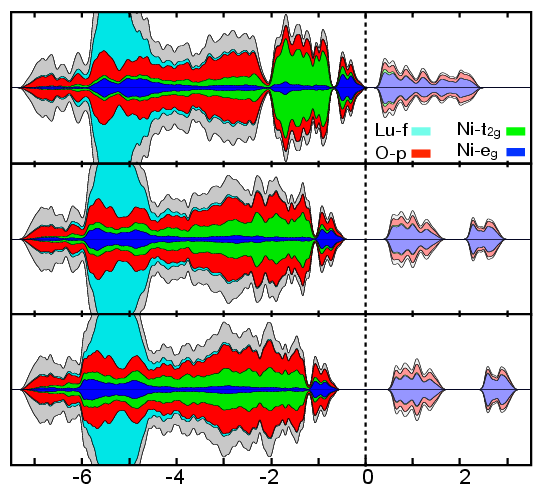
Figure 1: Total DOS of LuNiO3 in the AFM ground state, revealing Ni-d, Lu-f, and O-p contributions for multiple exact exchange admixtures, and demonstrating the dependence of the spectral gap and orbital energetics on the exchange parameter.
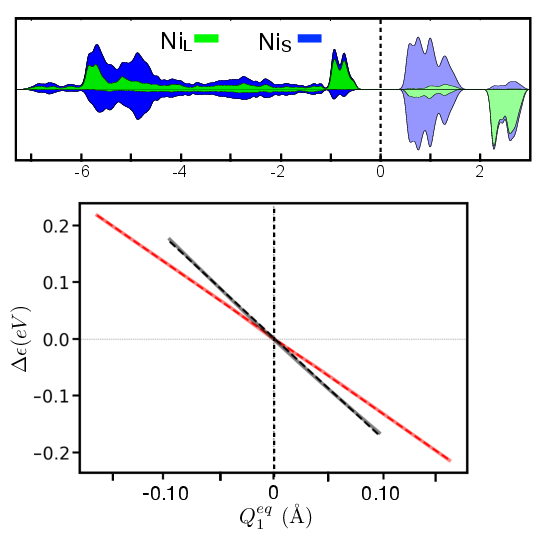
Figure 2: Projected DOS onto Ni30 and Ni31 32 subspaces in the AFM CO-SO state, and the linear shift of orbital energies with breathing distortion amplitude, used to extract 33.
The key extracted ab initio parameters (for 34, consistent with experimentally observed bond disproportionation) are: 35 eV, 36 eV, 37 eV, 38 eV/Å, and an effective electron–phonon energy scale 39 eV. These values place the physical system in a regime where eg0 and eg1 for the relevant range of couplings.
Phase Competition: Local and Extended Models
In the atomic limit, three distinct insulating states compete:
- Uniform JT (orbitally and magnetically polarized, no charge disproportionation): Stable for large eg2 and/or eg3.
- CO-SO (charge/spin order): For small eg4 and moderate Hund's coupling, the system charge disproportionates to Nieg5 (S=1) and Nieg6 (S=0), stabilized by the breathing mode.
- CO-OO (charge/orbital order, non-magnetic Nieg7): When JT gain on the Nieg8 site outweighs Hund’s exchange, both eg9 electrons occupy a single orbital with opposite spins (S=0), leading to orbital but not magnetic polarization.
Crucially, CO-OO is stabilized without invoking magnetic order, as long as U0 is sufficiently large compared to U1.
Going beyond the atomic limit, large-scale 3D TB simulations were conducted with full cooperative lattice relaxation and electronic self-consistency. The ground state under physically extracted parameters is the CO-SO AFM phase, but enhancement of electron-phonon couplings pushes the CO-OO state into metastability and, for strong enough couplings, makes it energetically preferred.
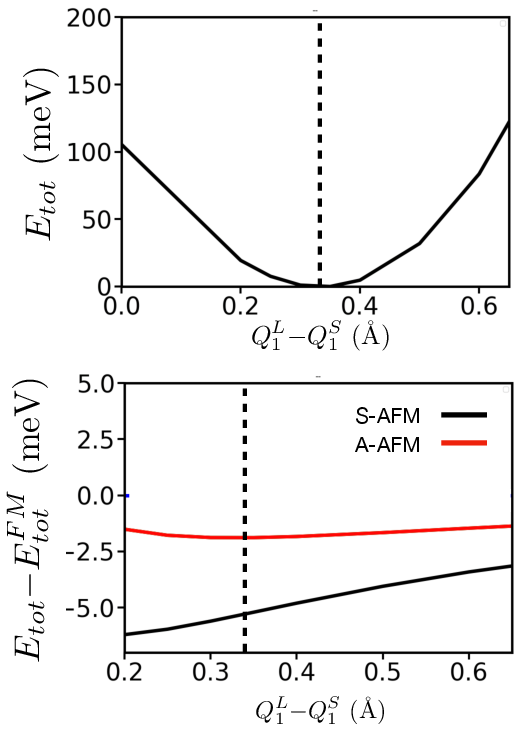
Figure 3: Total energy landscapes from the TB model, with respect to breathing mode amplitude and magnetic ordering, confirming stabilization of AFM CO-SO in close agreement with DFT benchmarks.
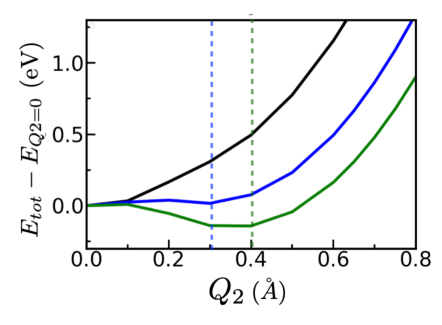
Figure 4: JT-mode dependence of total energy for the uniform JT phase, demonstrating stabilization at large electron-phonon coupling.
DFT and Model Electronic Structures
The calculated electronic density of states for the TB-model CO-SO phase accurately reproduces DFT and experimental benchmarks, with pronounced spin and charge disproportionation and a sizable insulating gap. In the CO-OO state, the system is insulating, with a gap at the Fermi level, but all Ni sites are non-magnetic and exhibit robust U2 orbital polarization.
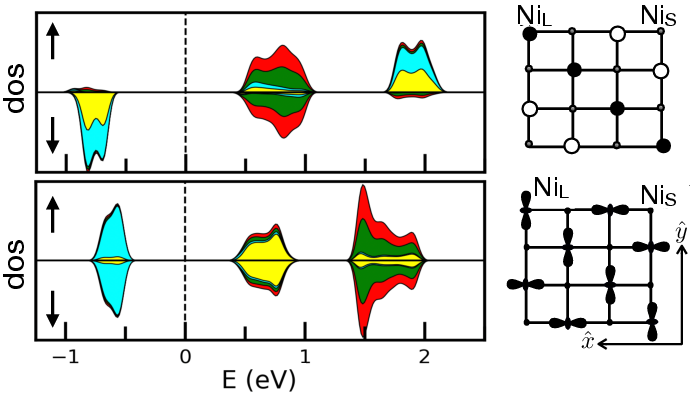
Figure 5: Model-predicted DOS for CO-SO (top) and CO-OO (bottom) phases, showing contrasting spin and orbital polarization; corresponding order patterns are depicted for the U3 plane.
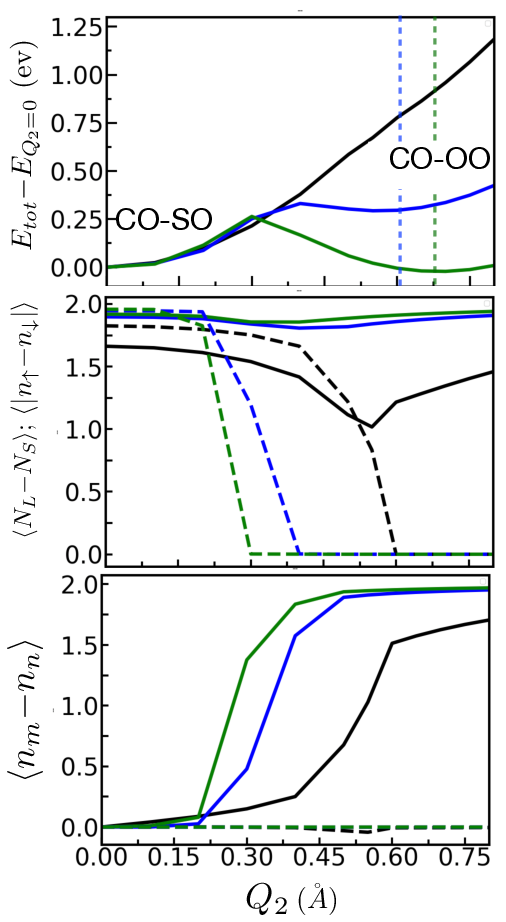
Figure 6: Energy, charge/moment difference, and orbital polarization as functions of JT distortion, illustrating collapse of magnetism and rise of orbital polarization in the CO-OO state for large U4.
A key result is the demonstration that in physically realistic parameter regimes, a local JT effect can stabilize a non-magnetic, charge-ordered, and orbitally polarized insulating phase, even in the absence of long-range magnetic order. This theoretical prediction challenges the prevailing view that the MIT in RNiOU5 is necessarily a magnetically-driven phenomenon.
Implications, Relevance to Experiments, and Prospects
The identification of a non-magnetic CO-OO insulating state, driven by cooperative Jahn-Teller effects in the presence of charge disproportionation, has profound consequences for the understanding of MITs in nickelates and related correlated oxides. Experimental observations in small-bandwidth RNiOU6 already show U7, inconsistent with a magnetism-driven MIT. The predicted CO-OO state is theoretically consistent with the existence of a paramagnetic insulating phase with charge order at high temperature.
The model suggests avenues for experimental realization — increasing the electron–phonon coupling via chemical substitution (rare-earth size), epitaxial strain, or even non-equilibrium pathways (ultrafast reduction of U8 using photonic perturbation (Rajpurohit et al., 20 Apr 2026)) could favor the emergence of this non-magnetic CO-OO state. The work further motivates detailed probes of local orbital polarization in paramagnetic insulating nickelates to directly verify the existence of such a phase. If realized, these phases could be exploited in oxide electronics where coupling between charge, orbital, and lattice order, but not magnetism, is desired.
Conclusion
This study provides a rigorous ab initio-parameterized theoretical framework for understanding the MIT and ordering phenomena in rare-earth nickelates. It establishes, both analytically and numerically, the stability of a non-magnetic insulating phase — characterized by charge and orbital order — induced by the Jahn-Teller effect. The phase does not require the condensation of long-range magnetic order to drive the MIT, contrary to the standard paradigm. This result not only deepens the fundamental understanding of RNiOU9 and correlated oxides, but also suggests new routes for the design and control of functional non-magnetic Mott insulators through lattice engineering and non-equilibrium manipulation.
(2605.09713)