- The paper introduces a systematic construction of symmetric Sudoku puzzles using tilings from perfect and diameter perfect codes under the Lee metric.
- It mathematically characterizes puzzle symmetries and enumerates valid grids, classifying them into inequivalent solution classes based on symmetry group actions.
- A human-like solver evaluates game difficulty via logical deduction, demonstrating varied challenge levels from easy to hard in practice.
Symmetric Sudoku-Type Games via Perfect and Diameter Perfect Codes
Theoretical Framework and Motivation
The paper "Symmetric Sudoku-Type Games from Perfect Codes" (2605.09617) introduces a codified methodology for constructing Sudoku-like puzzles possessing intrinsic symmetries, grounded in the mathematical structure of perfect codes and diameter perfect codes under the Lee metric. The classical 9×9 Sudoku possesses a preponderance of symmetry due to its uniform subgrid partitioning, which supports both theoretical analyses and solver strategies. However, most variants, including jigsaw Sudoku, lose such symmetry, impairing both combinatorial investigations and algorithmic tractability.
Perfect codes, by their nature, partition the ambient space into disjoint balls of appropriate radius, directly mirroring the subgrid constraints in Sudoku. By leveraging the tiling property of Lee distance perfect codes and diameter perfect codes, the authors generate palette grids that encode symmetric block constraints. The construction thereby generalizes Sudoku while retaining the fundamental symmetries and combinatorial richness essential for mathematical analysis.
Construction Details: Sudoku from Codes
The palette grid is central to encoding subgrid constraints. For a code C⊆Zn2, palette entries are distributed such that each codeword's associated ball or anticode defines the constituent cells of a single subgrid. This construction ensures that Sudoku grids orthogonal to these palette grids will satisfy analogs of the original row, column, and block constraints.
For instance, a 5×5 Sudoku over Z52 is constructed from a $1$-error-correcting Lee distance perfect code, and an 8×8 Sudoku analog uses a $3$-diameter perfect code over Z82. The symmetry group actions—rotation, reflection, and translation—are analyzed and leveraged to classify solution grids up to equivalence.
The action of the symmetry group G on Sudoku grids is depicted, illustrating how rigid motions generate orbit classes within the set of valid solutions.
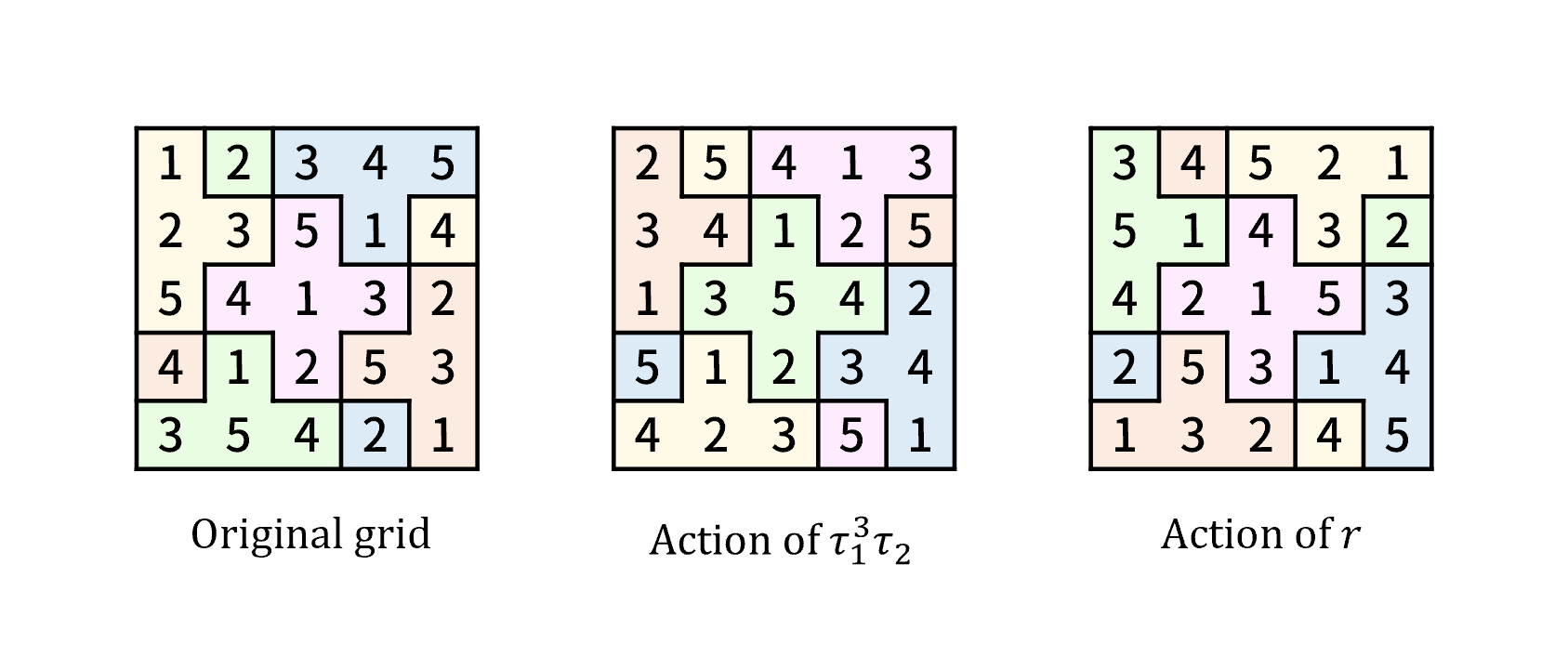
Figure 1: Action of G on a Sudoku grid exemplifies symmetry-preserving transformations among solution grids.
Enumeration and Equivalence Classification
The analysis covers exhaustive enumeration of valid Sudoku solution grids for both the C⊆Zn20 and C⊆Zn21 constructions:
- For the C⊆Zn22 Sudoku, C⊆Zn23 valid grids are identified, partitioned into C⊆Zn24 inequivalent classes under relabeling.
- For C⊆Zn25 Sudoku, two constructions yield C⊆Zn26 and C⊆Zn27 inequivalent solution classes, respectively.
Classifications utilize the orbit-stabilizer theorem under actions of the appropriate symmetry group, with detailed breakdowns of class sizes and structural properties.
Examples of minimal Sudoku configurations (those with the minimum set of clues ensuring uniqueness) are presented, highlighting how these constructions allow for rigorous analysis of clue minimality.
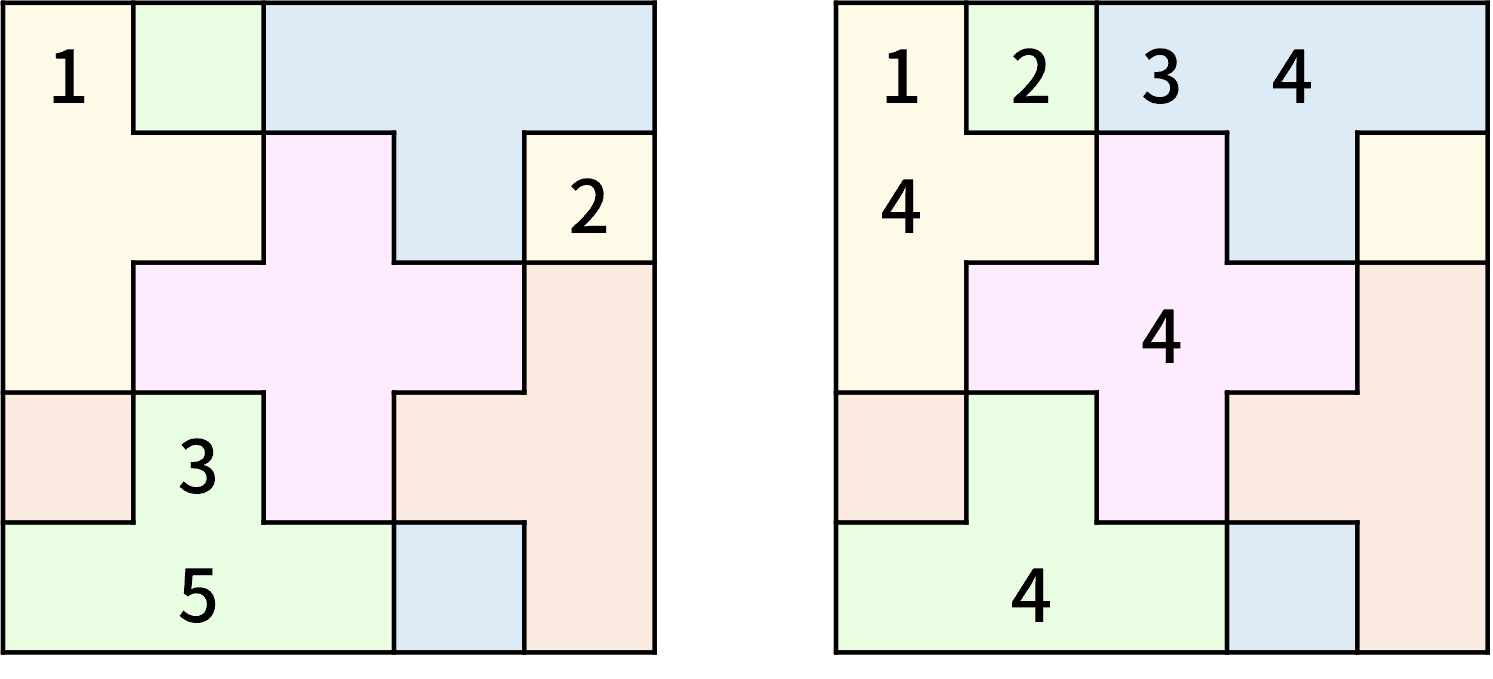
Figure 2: Examples of minimal Sudoku puzzles derived from a perfect code over C⊆Zn28, illustrating minimal clue placements.
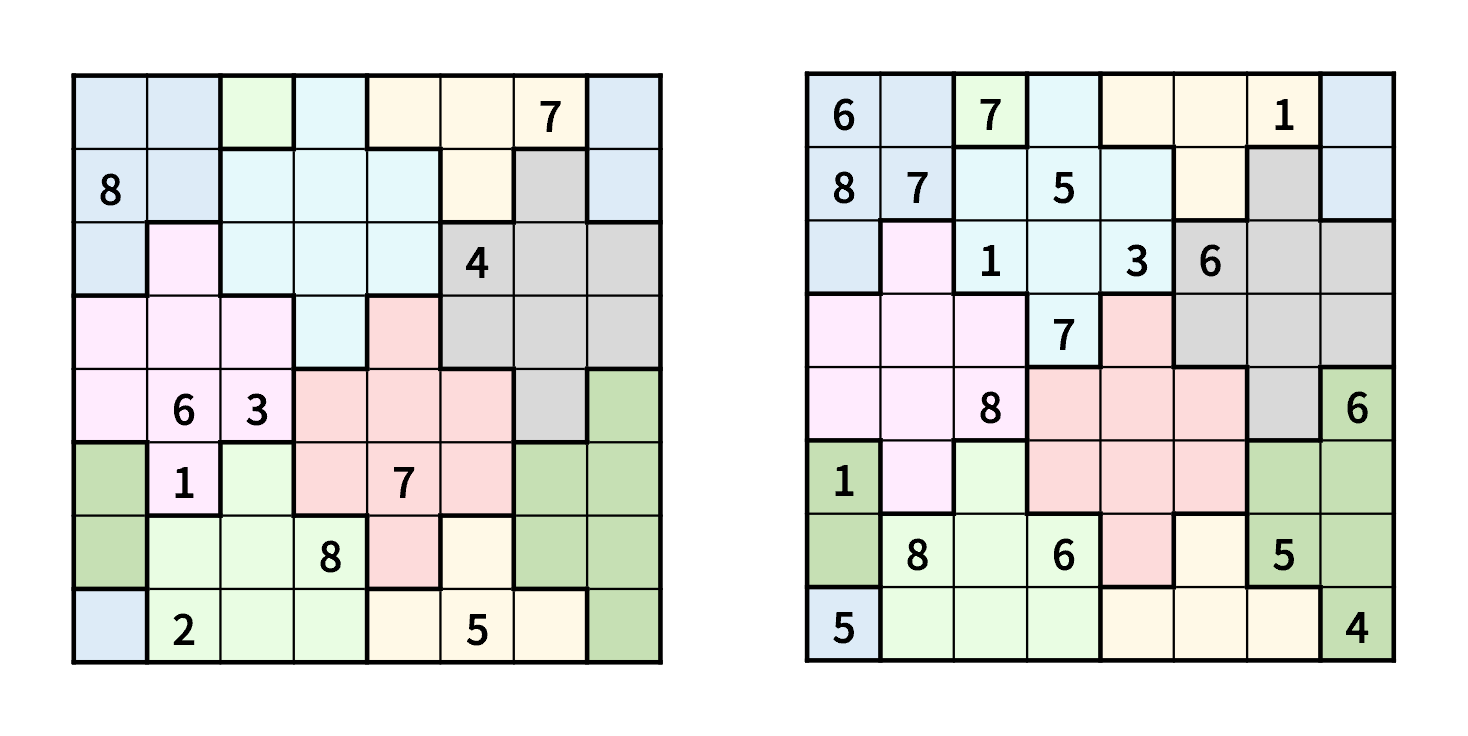
Figure 3: Minimal Sudoku examples from diameter perfect codes over C⊆Zn29, demonstrating analogs to classical minimal puzzles.
The palette grids for the 5×50 construction (Case I and II) are shown, underscoring the combinatorial diversity of block structuring resulting from different code generators.
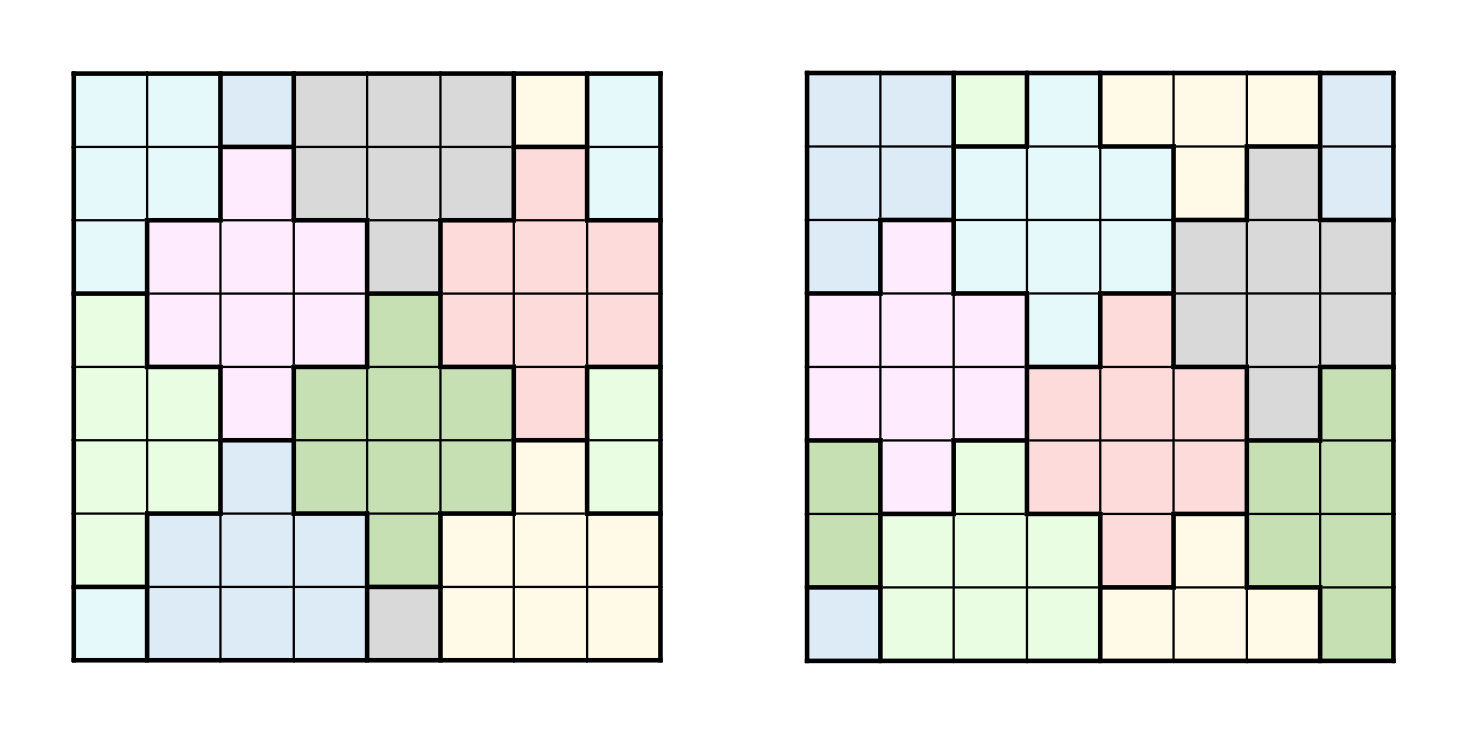
Figure 4: Palette grids 5×51, 5×52 visualize subgrid boundaries induced by diameter perfect codes over 5×53.
Practical Game Analysis and Difficulty Metrics
To evaluate practical playability, a human-like solver is implemented, mimicking basic logical deduction typical of human solvers (Naked Single and Hidden Single techniques, augmented by trial-and-error for harder puzzles). Difficulty is quantified by the number of insertions beyond the count of blank cells, forming a "difficulty score." The classification is as follows:
- Easy: score 0
- Medium: score in 5×54
- Hard: score 5×55
The 5×56 Sudoku generated from perfect codes demonstrates varied difficulty profiles, with the majority falling into the easy or medium categories, but with a significant subset achievable only via trial-and-error, indicating genuine challenge and diversity.
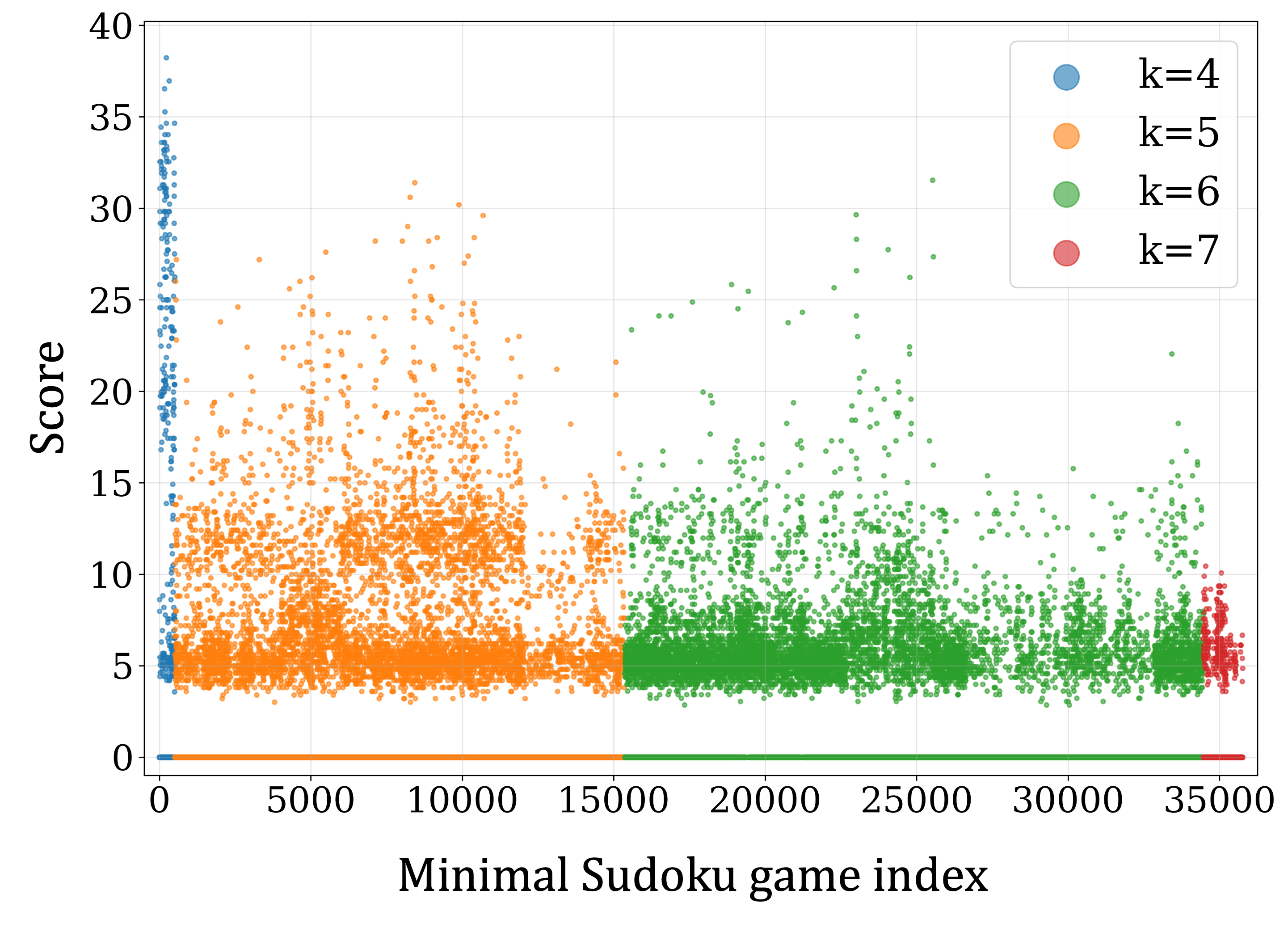
Figure 5: Difficulty score distribution for 5×57 minimal Sudoku; scores encapsulate required logical insertions for solution.
Implications and Future Directions
This synthesis bridges coding theory and combinatorial design, establishing a new class of symmetric Sudoku-type games amenable to both mathematical treatment and practical gameplay. The representation of block constraints through code tilings offers explicit structural control and enables systematic enumeration, equivalence classification, and analysis of minimal clues.
The practical implications include:
- Generation of Sudoku analogs with well-controlled symmetry and block structure, facilitating algorithmic and combinatorial studies.
- Provision of diverse game difficulties, making the puzzles viable alternatives for both recreational and analytical contexts.
- Direct applicability to computational methods for generating and classifying Sudoku-type puzzles.
Theoretical implications suggest that the codified approach can be extended to other metrics (e.g., Mannheim, rank-metric), and alternative rings, possibly yielding novel puzzle paradigms. The inherent symmetry may enable new progress in understanding uniqueness, minimal clues, and algorithmic hardness in Sudoku and its combinatorial variants.
Conclusion
The paper rigorously establishes a systematic methodology for constructing symmetric, mathematically tractable Sudoku-type games using perfect codes and diameter perfect codes in the Lee metric. The enumeration and equivalence analysis provide tight structural characterization, while experimental assessment with solvers demonstrates practical viability and challenge diversity. The construction presents a versatile platform for further exploration, both in combinatorics and recreational mathematics, with potential for broad extensions across coding theory and puzzle design.

