- The paper derives analytic one- and two-loop expressions for non-factorisable electroweak virtual corrections in single-resonant processes using the pole approximation.
- It demonstrates an iterative structure of soft-photon exchanges and shows how light-fermion loop insertions shift the effective coupling.
- The work establishes a resummation framework applicable to high-precision collider phenomenology, relevant for processes like Drell–Yan and e⁺e⁻ scattering.
Non-factorisable Electroweak Virtual Corrections to Single-Resonant Processes
Introduction and Motivation
Precise electroweak (EW) calculations for resonant processes are essential for interpreting current and future collider data with high accuracy. Single-resonant processes, such as 2→2 fermion scatterings mediated by vector bosons (W±, Z), play a central role in testing the Standard Model and searching for new physics via subtle deviations. The overwhelming complexity of fully off-shell multiloop amplitudes necessitates approximations that retain the dominant physics in the resonant regime. The pole approximation (PA) provides such a structured simplification by expanding around the complex mass pole of the resonance, systematically separating factorisable and non-factorisable contributions, and retaining essential finite-width and interference effects. The non-factorisable corrections, driven by soft-photon exchanges between production and decay stages (and/or the resonance), are of particular interest due to their potential to induce nontrivial distortions in kinematic distributions and to impact precision phenomenology, especially in the context of future high-luminosity and electron-positron colliders.
Structure of Corrections in the Pole Approximation
The PA enables an organisation of higher-order virtual corrections into gauge-invariant categories:
- Factorisable corrections: Computable via polarised EW form factors for production and decay subprocesses, involving only the resonance's on-shell matrix elements.
- Non-factorisable corrections: Arise from the exchange of soft-photons between the initial/final-state fermions and/or the resonance, encapsulating quantum interference effects that cannot be attributed to independent subprocesses.
At one-loop, non-factorisable corrections are universally soft and wide-angle, driven by photon exchanges connecting production and decay stages or the resonance itself. This is illustrated schematically in four diagram classes:

Figure 1: One-loop non-factorisable corrections classified according to photon exchange between initial/final states and the resonance.
Corrections to the resonance propagator, including self-energy insertions and mixing effects, contribute non-trivially, particularly in the context of UV renormalisation:

Figure 2: One-loop resonance propagator corrections arising from various photon-mediated diagrams.
At two-loop order, the classification becomes richer, partitioned into factorisable, factorisable ⊗ non-factorisable, and genuine two-loop non-factorisable classes. The topology and region analysis via the method of regions is essential for correctly separating power-suppressed (e.g., collinear) contributions and isolating the dominant soft regions:
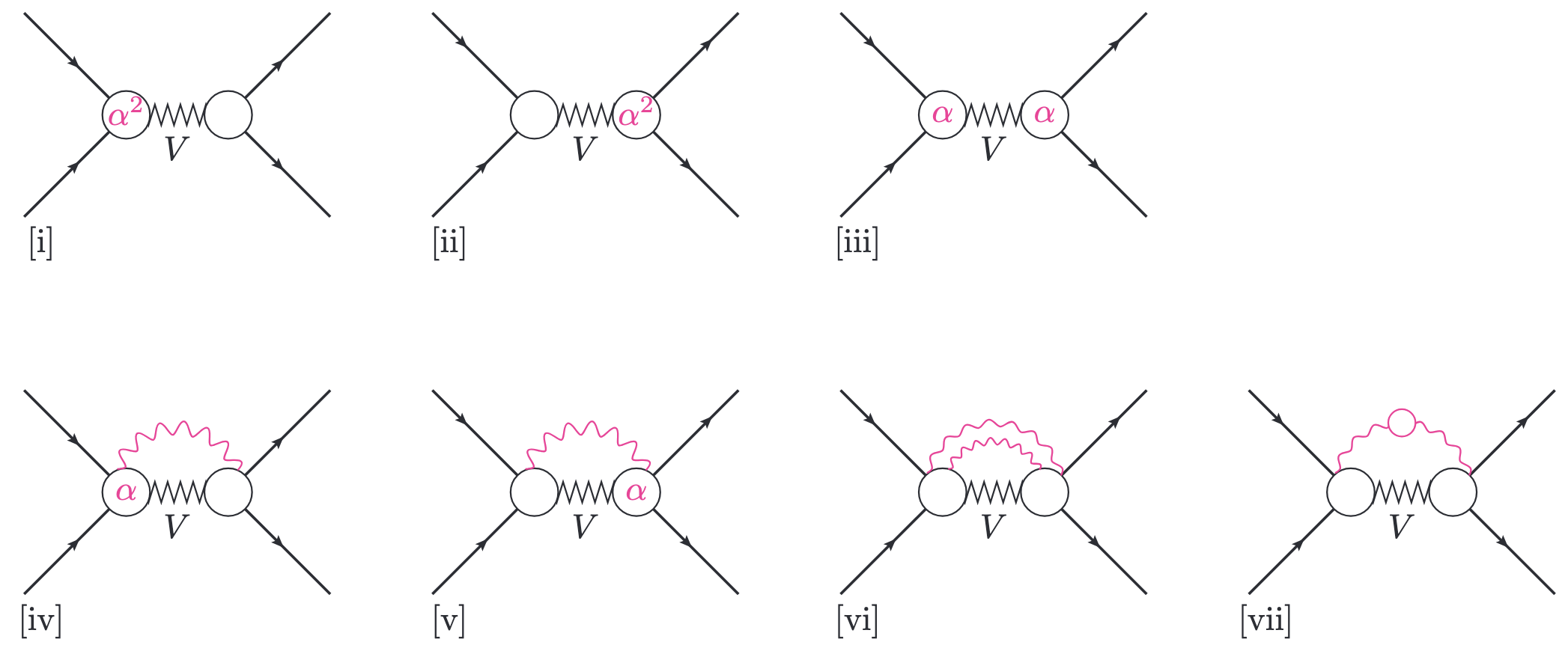
Figure 3: Taxonomy of two-loop corrections: two-loop factorisable, factorisable ⊗ non-factorisable, and genuine non-factorisable classes.
Representative two-loop non-factorisable diagrams include double soft-photon exchanges and diagrams with photon self-energy/bosonic insertions:
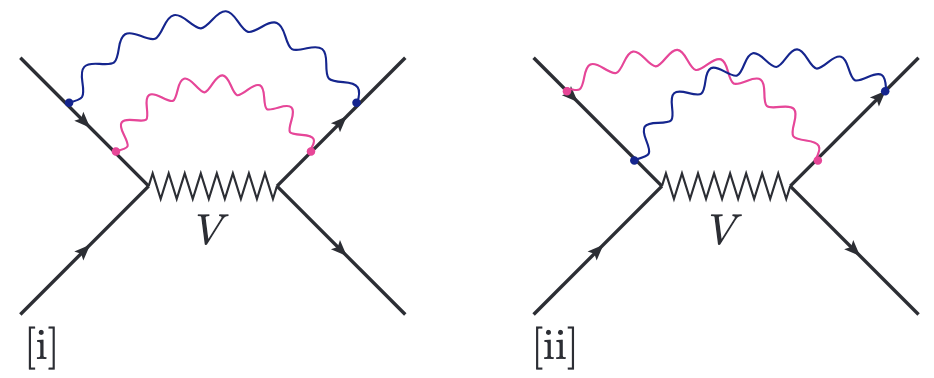
Figure 4: Example of two-loop diagrams exchanging two soft photons between initial and final-state fermions.
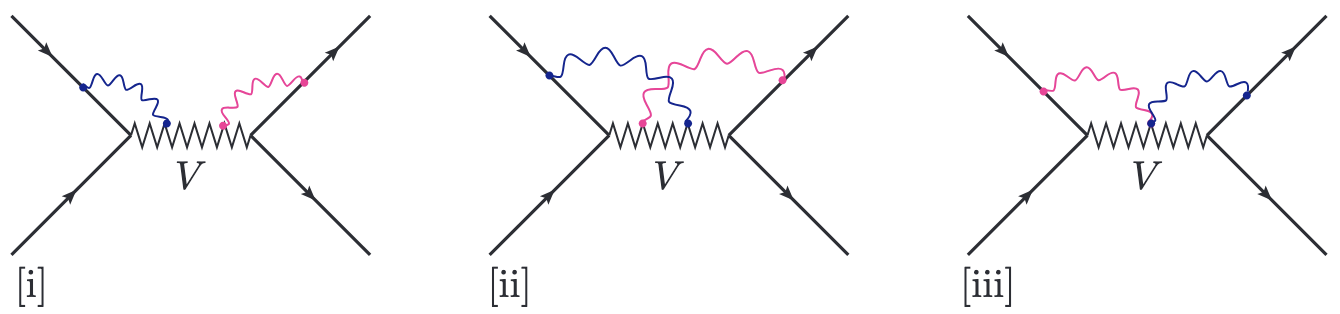
Figure 5: Two-loop diagrams with mixed attachments: one soft photon exchanged between resonance and initial state, and another between resonance and final state.

Figure 6: Diagrams with self-energy insertion in the soft photon propagator, relevant for light-fermion loop contributions.
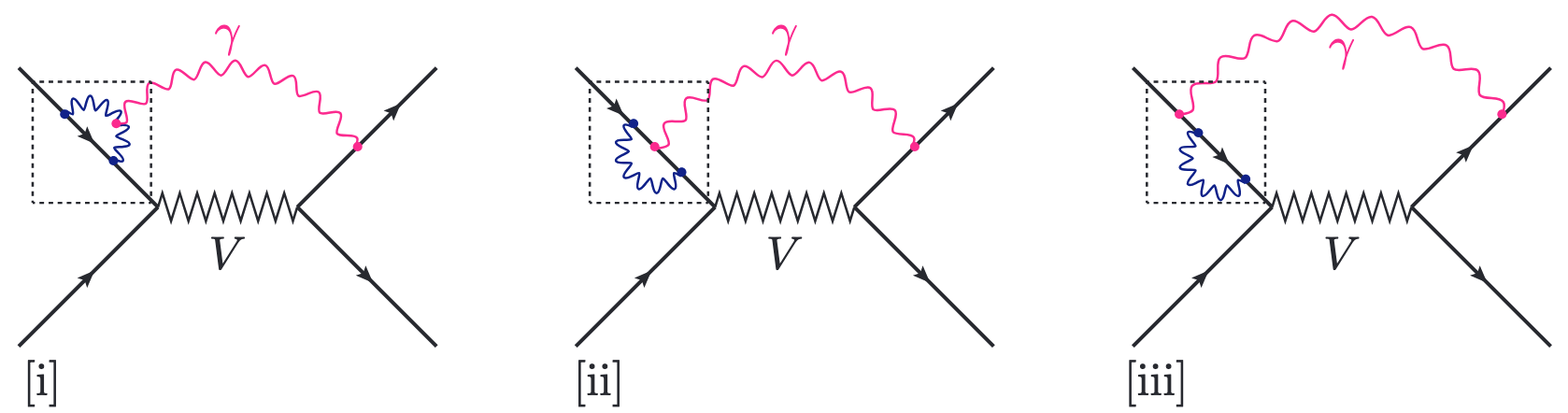
Figure 7: Two-loop diagrams with bosonic corrections to external fermion lines, dressed by soft-photon exchange.
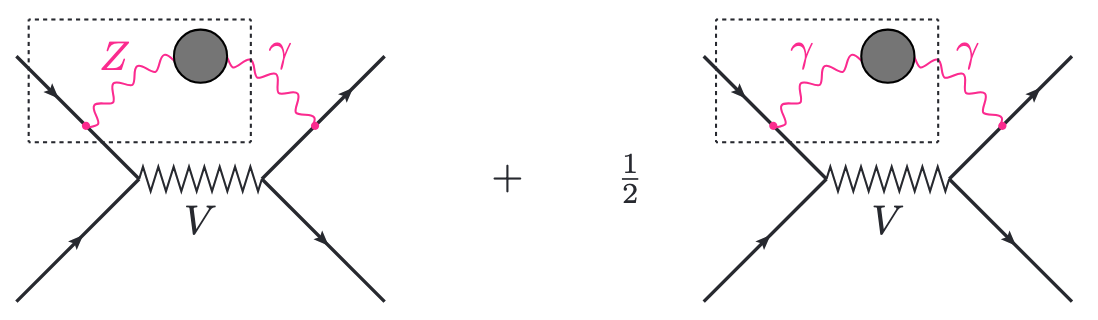
Figure 8: Diagrams representing Zγ mixing and photon self energy insertions.
By employing the method of regions and systematically analysing the leading power in the resonance width, the authors derive explicit expressions for the genuine two-loop non-factorisable virtual corrections. A central finding is that, after decoupling heavy degrees of freedom, the two-loop non-factorisable contributions are expressible as an iterative structure involving the one-loop correction, plus a new term proportional to light-fermion loop insertions in the soft-photon propagator. The core formula encapsulating this result is:
δnf⊗nf(2)=2Γ[1+2ϵ]2Γ[1+4ϵ](δnf(1))2
showing explicit iteration up to an ϵ-dependent overall factor in dimensional regularisation, consistent with soft wide-angle emission and emission factorisation.
For diagrams involving light-fermion insertion, the two-loop correction introduces a non-trivial dependence on photon momentum and can be recast as a shift in the effective coupling:
α(l2)≡α0(1+4πα0SϵA(ϵ)ϵβ0(−l2μ02)ϵ)
This analytic structure ensures that massless fermion loops yield genuinely new contributions not reducible to simple iterations of the one-loop result; their effect is naturally included by dressing the one-loop correction with the effective running coupling.
The UV renormalisation, performed in the MS-scheme for the charge and OS-scheme for the resonance, results in cancellation of superleading divergences and a renormalised two-loop amplitude where heavy degrees of freedom (e.g., W±0 bosons, heavy fermions) are properly decoupled.
Infrared Structure and All-Order Factorisation
A rigorous analysis of infrared (IR) singularities confirms the expected cancellation of higher-order poles and the preservation of the soft nature of non-factorisable corrections. The amplitude’s IR structure matches that predicted by the subtraction operator formalism, and the poles are precisely those anticipated for soft wide-angle photon exchange.
A key implication is the conjectured all-order structure: genuine multi-loop non-factorisable corrections can be resummed, with the W±1-loop correction given by
W±2
The result is an exponentiating soft factor in Laplace space, naturally mapped to resummation of large logarithms in W±3 arising from the resonance’s finite width, leading to the proposed resummation formula:
W±4
where W±5 is the hard (factorisable) component, and W±6 is the exponentiating soft (non-factorisable) function.
Numerical and Analytical Features
The explicit expressions for one- and two-loop corrections, including the Laurent expansion coefficients, identify the logarithmic dependence on the resonance width and the impact of massless and massive fermion loops. The light-fermion contributed term, proportional to the QED W±7 function, is shown to be responsible for genuine new infrared logarithms at two-loop and beyond. Charge conservation ensures maximal cancellation and correct scaling of the IR singularities, and the heavy degrees of freedom are shown to decouple at the amplitude level via finite renormalisation.
Implications, Applications, and Extensions
The formalism and results provide a basis for constructing approximate two-loop EW amplitudes for critical processes such as Drell-Yan lepton-pair production and W±8. The results enable phenomenologically robust predictions in the high-resonance limit, allowing future colliders (FCC-ee, HL-LHC) to leverage theoretical accuracy commensurate with experimental needs.
The findings have practical implications:
- Resummation techniques: The iterative structure is amenable to all-order resummation, relevant for finite-width logarithms and threshold effects.
- Precision phenomenology: Non-factorisable corrections, though subleading in inclusive rates, significantly affect differential observables, necessitating their inclusion in high-precision SM and new physics studies.
- Extensions to QCD: The structured, universal soft analysis provides guidance for analogous computations involving gluons, where self-interaction and color correlations add complexity.
- Multi-resonance scenarios: While the present analysis is strictly for single resonances, the methodology sets the stage for future investigations of processes with nontrivial resonance interplay.
Conclusion
This work establishes the analytic and iterative structure of non-factorisable EW virtual corrections in single-resonant processes within the pole approximation, showing that two-loop corrections exponentiate the one-loop contribution plus a new light-fermion-induced term. Dimensional regularisation and amplitude-level factorisation are leveraged to achieve explicit analytic results, confirming the universality and exponentiation of the soft wide-angle photon exchanges at all orders. The detailed treatment of IR and UV issues ensures the results are applicable to benchmark precision processes, with future developments anticipated for multi-resonant and QCD-dominated scenarios.
References
[Non-factorisable electroweak virtual corrections to single-resonant processes, (2605.09444)]