- The paper introduces SuperMeshNet, a complementary learning framework that leverages both paired and unpaired data to achieve high-resolution predictions from low-resolution simulations.
- It integrates dual MPNN models with kNN-based upsampling and specialized node/message centering to handle irregular mesh topologies effectively.
- Experimental results demonstrate up to 90% reduction in HR data usage while maintaining low RMSE and reliable downstream physical predictions.
Semi-Supervised Neural Super-Resolution for Mesh-Based Simulations: An Expert Summary
Introduction and Motivation
Mesh-based numerical simulations, such as FEM and FVM, are foundational in computational science for solving PDEs with high fidelity. However, high-resolution (HR) simulations are expensive due to the computational cost scaling with mesh density. Neural network-based super-resolution offers an appealing path to achieve HR predictions from low-resolution (LR) data, but standard supervised approaches require ample HR ground truth, a bottleneck in many realistic scenarios.
Existing alternatives, including fully unsupervised methods and physics-informed architectures, either suffer from poor generalization across irregular meshes or demonstrate inferior accuracy relative to HR-supervised baselines. The landscape lacks semi-supervised approaches that can bridge the HR data bottleneck without loss of accuracy, especially with architectures naturally suited to processing irregular graph-structured (mesh-based) data.
The goal is to learn a mapping from LR mesh simulation output, ul, defined on mesh Ml, to HR simulation results, uh, defined on a finer mesh Mh. The challenge is to minimize reliance on paired LR–HR data, Nh, while maximizing accuracy over the entire mesh, especially in regimes where Nh≪N and N is the total number of LR samples.
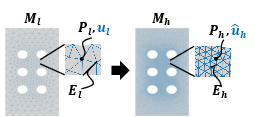
Figure 1: Problem setting for super-resolution from LR to HR simulation outputs on irregular meshes.
Complementary Learning Framework
The proposed framework, SuperMeshNet, introduces complementary learning, a semi-supervised regime leveraging both a small set of paired LR–HR data and abundant unpaired LR samples. This is achieved by joint training of two distinct but complementary message passing neural network (MPNN) models:
- Primary model (Fθ): Directly predicts u^h given ul.
- Auxiliary model (Ml0): Predicts the difference of HR outputs (Ml1) given pairs of LR samples (Ml2), with differences interpolated across mesh mismatches via Ml3NN-based schemes.
The mutual supervision arises because the predictions from one model are used to form pseudo-labels for the other, thus allowing the framework to indirectly supervise HR prediction even on unpaired LR samples.
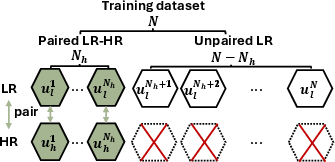
Figure 2: Semi-supervised data regime, with green hexagons as paired samples (LR–HR) and white hexagons as unpaired LR samples, enabling significant reduction in HR labeling.
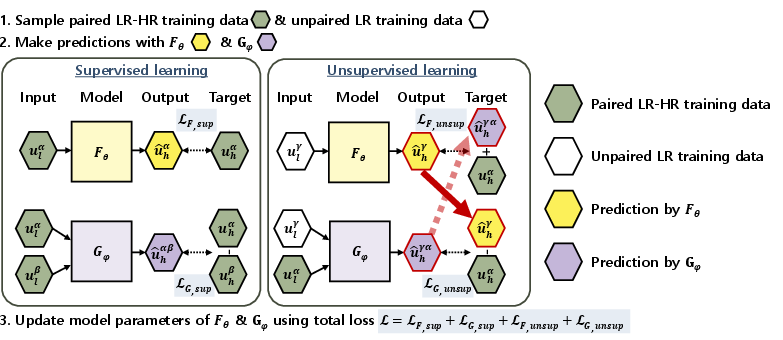
Figure 3: Overview of complementary learning workflow: paired data is used for supervised loss while unpaired LR samples contribute via cross-model pseudo-labels.
This approach differs from classical co-training, which suffers from confirmation bias due to the similarity of redundant models. Here, the distinction between inter-resolution and intra-resolution mappings enforces orthogonality in the model errors, amplifying the information gained from mutual pseudo-labeling.
Model Architecture
The backbone leverages MPNNs (including GCN, SAGE, GAT, GIN, Graph Transformer, and MeshGraphNet variants), accommodating variable mesh topology. The Ml4 model is an encoder–MPNN–upsampler–decoder structure. The upsampling is realized in both physical and latent spaces, with Ml5NN interpolation projecting features between meshes. Ml6 closely shares extractor components with Ml7 but specializes in mapping differences between input pairs.
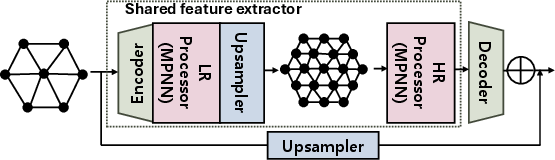
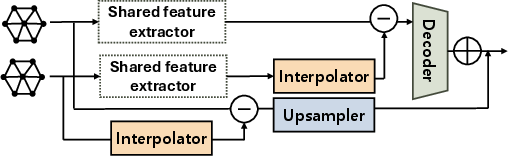
Figure 4: Model architecture of Ml8, combining graph-based encoding, message passing on LR, upsampling, HR message passing, and decoding/aggregation.
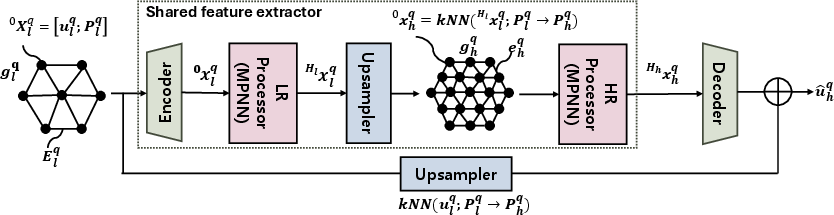
Figure 5: Schematic overview of the primary model Ml9 for LR-to-HR mesh mapping.

Figure 6: Schematic overview of the auxiliary model uh0 for difference mapping between HR outputs.
A distinctive engineering contribution is the use of node-level centering and message-level centering as architectural inductive biases. These involve subtraction of the global mean from node embeddings or aggregated messages, shown to improve training dynamics and generalization in the context where global mean information is not critical (e.g., super-resolution, versus norm prediction).
Experimental Evaluation
Data Regimes and Benchmarks
Validation covers both synthetic FEM/CFD simulation datasets and real-world geometry/time-dependent PDE benchmarks, embracing a spectrum of geometric complexity and non-stationarity.
Key findings from quantitative comparison:
Super-Resolution Quality and Error Analysis
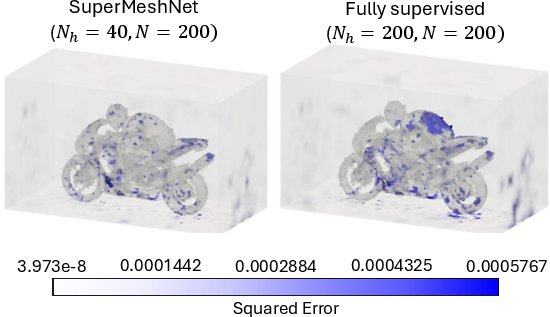
Figure 8: Comparison of pointwise squared error (pressure field) between SuperMeshNet and fully supervised model on real-world motorbike geometry; errors with SuperMeshNet are lower, most notably in physically meaningful regions.
Downstream statistics such as drag and lift coefficients exhibit relative errors <2% for drag and moderate for lift, attributable to low ground-truth magnitude, confirming the physical reliability of the predictions.
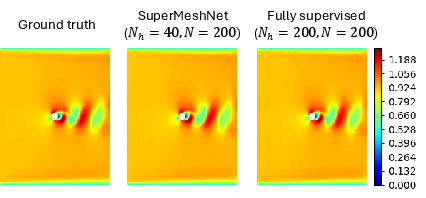
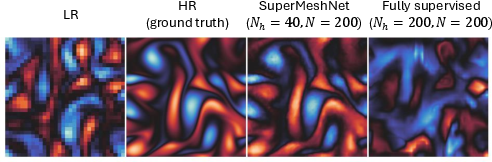
Figure 9: Visual fidelity of flow field predictions for time-dependent PDE data, showing close agreement of SuperMeshNet predictions (with less HR data) with HR ground truth and full-supervision baselines.
Ablation and Benchmarking
Ablations reveal that both complementary learning and inductive biases are essential: neither alone enables surpassing the full-supervision baseline with limited HR data. SuperMeshNet also consistently outperforms state-of-the-art semi-supervised regression approaches (e.g., Mean-Teacher, UCVME, TNNR) in both accuracy and computational efficiency.
Key ablation results:
- Removing centering increases loss landscape roughness and worsens optimization.
- For tasks intrinsically reliant on global means (e.g., norm prediction), centering degrades performance—highlighting task-dependence.
- On large-scale, multimillion-node 3D datasets, the framework remains performant, attesting to scalability.
Mechanistic Insights: uh4NN Interpolation and Data Selection
uh5NN interpolation in latent and output space is central for aligning features across spatially inconsistent meshes (Figure 10), enabling difference modeling and cross-model pseudo-labeling. The method remains efficient up to large mesh sizes.
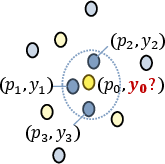
Figure 10: uh6NN weighted interpolation for value transfer between source and target meshes with differing topology.
A noteworthy empirical finding is that HR data selection exerts a marked effect on performance: maximizing training set LR–HR distributional similarity (e.g., via kernel herding) achieves the lowest RMSE, suggesting possible intersection with active learning and optimal experimental design.
Theoretical and Practical Implications
Theoretical:
- The work demonstrates the unique strength of non-redundant (complementary) semi-supervised architectures in regression settings, especially on structured graph domains. The modeling framework formalizes a mutual supervision mechanism with minimized error correlation, facilitating more informative pseudo-label propagation.
- Inductive biases tailored to the characteristic structure of the task (removal of unnecessary global mean) can yield strong improvements, challenging generic normalization dogma.
Practical:
- Substantially reduced HR data dependency enables application of surrogate models in resource-constrained settings (e.g., rare or expensive physical experiments, or extreme-scale simulation regimes).
- The method is MPNN-agnostic and generalizes across mesh type, PDE and physics domain.
Future Directions:
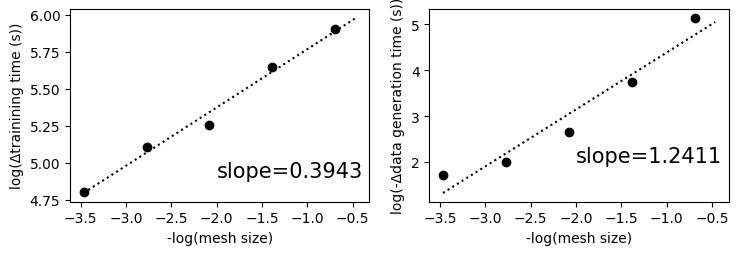
- The computational overhead for training may be offset for large enough meshes, but further optimization of mutual supervision schedules and interpolation strategies is warranted.
- Data selection strategies (e.g., active, diversity-based, or physics-aware sampling) can amplify HR sample efficiency.
- The extension of complementary learning to regimes with strong nonlinearity or bifurcation remains open, as mutual pseudo-labeling may face stability challenges in such cases.
- While SuperMeshNet is designed for mesh-based surrogates, the underlying complementarity paradigm could be adapted to other scientific regression contexts, including spatiotemporal forecasting and operator learning.
Conclusion
SuperMeshNet establishes a new paradigm for HR data-efficient neural PDE super-resolution in mesh-based simulations. By leveraging a complementary model design for mutual supervision and inductive bias-aware MPNN architectures, it systematically outperforms full-supervision baselines when HR data is limited. The approach is validated across multiple domains and mesh topologies, with strong evidence supporting both its statistical efficiency and physical reliability. Open challenges include optimizing training cost, HR data selection, and theoretical analysis of error dynamics in mutual supervision. This work positions complementary learning as a foundation for the next generation of data-efficient scientific ML surrogates.