- The paper introduces a reformulation of f(R,T) gravity that preserves energy-momentum conservation by employing an effective energy-momentum tensor.
- Numerical solutions of the modified TOV and tidal equations show that negative coupling values enhance mass and radius while highlighting crust stability issues.
- Realistic equations of state combined with multimessenger constraints determine that only small negative chi values maintain observational compatibility.
Introduction and Theoretical Motivation
The paper "Neutron stars in a conservative f(R,T) gravity" (2605.09206) systematically addresses foundational issues inherent in f(R,T) gravity, particularly concerning universality and energy-momentum conservation. It critiques prior approaches where the trace-dependent gravity sector is reconstructed directly from a microphysical equation of state (EoS), a procedure that undermines theoretical universality and creates degeneracies between gravitational and matter-sector inferences. This degeneracy impedes independent constraints on gravity modifications, especially in neutron star phenomenology, where multimessenger data necessitates precise disentanglement of gravity and microphysics.
To resolve these conceptual limitations, the paper reformulates f(R,T) gravity by introducing an effective energy-momentum tensor. The field equations become Gμν=8πTμνeff, where Tμνeff absorbs the trace-dependent corrections. Conservation ∇μTeffμν=0 emerges naturally via the Bianchi identities, preserving consistency with metric theories and avoiding EoS-dependent gravity sector reconstructions.
The gravitational action considered is f(R,T)=R+2χT, with a fixed matter-geometry coupling constant χ. The effective fluid variables are given as:
f(R,T)0
f(R,T)1
This invertible linear mapping ensures that realistic EoSs, implemented as f(R,T)2, can be directly integrated without compromising the universality of the gravity sector.
The modified Tolman-Oppenheimer-Volkoff (TOV) equations and tidal perturbation equations are expressed in an enthalpy-based form, which is technically superior for numerically stable integration over tabulated EoSs with sharp crust-core transitions.
Theoretical and Observational Constraints on Coupling Parameter
The allowed values for f(R,T)3 are tightly bounded by:
- Theoretical Consistency: NEC and DEC enforce f(R,T)4 and f(R,T)5, respectively.
- Hydrostatic Regularity: The correction terms, strongly dependent on f(R,T)6 (where f(R,T)7 is the sound speed), demand that f(R,T)8 avoids singular regimes as f(R,T)9 in the crust, selecting negative values as the viable branch.
- Astrophysical Constraints: Multimessenger observations force f(R,T)0, with viable solutions only for mildly negative f(R,T)1.
Effective Equation of State and Stiffening Mechanism
The geometric-matter coupling produces an effective stiffening in the EoS; for negative f(R,T)2, f(R,T)3 is systematically higher at fixed f(R,T)4, enhancing the star's resistance to gravitational collapse.
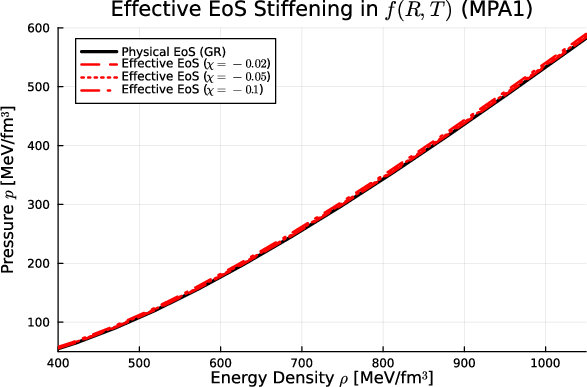
Figure 1: Effective EoS stiffening for the MPA1 model for different coupling strengths, showing significant stiffening for negative f(R,T)5.
This stiffening manifests across all nuclear models studied, reflecting a systematic upward shift in the effective EoS curves.
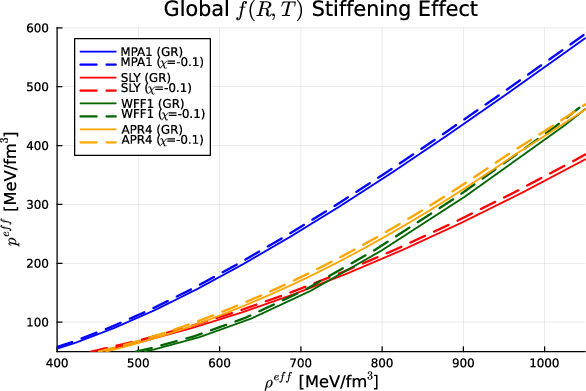
Figure 2: Global stiffening effect across various nuclear models (MPA1, SLY, WFF1, APR4), comparing GR to f(R,T)6.
Mass-Radius Relations and Impact of Realistic Crust
Numerical integration of the modified TOV equations reveals that negative f(R,T)7 increases both radius and maximum neutron star mass. However, the f(R,T)8 scaling causes artificial runaway inflation in the crust for sizeable f(R,T)9, a pathology only mitigated by imposing a numerical floor on f(R,T)0 during integration. Hence, the mass-radius enhancement is strictly regulated by crust physics.
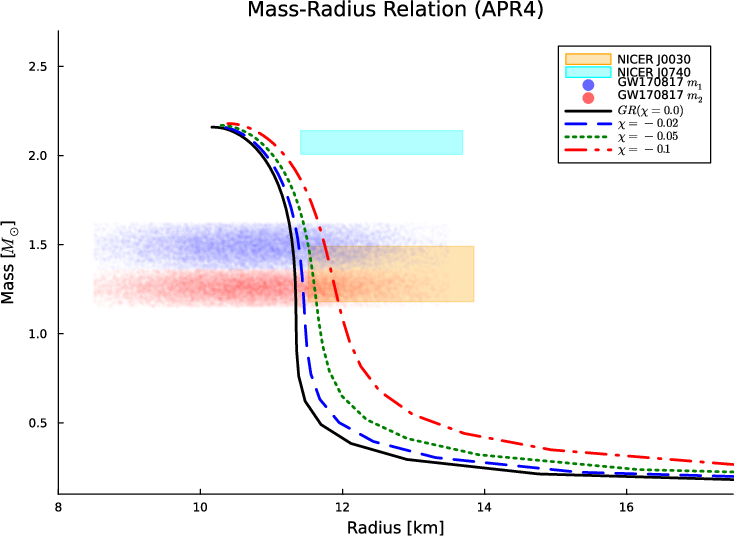
Figure 3: Mass-radius relation for the APR4 equation of state, showing the effect of negative f(R,T)1 compared to GR and compatibility with multimessenger constraints.
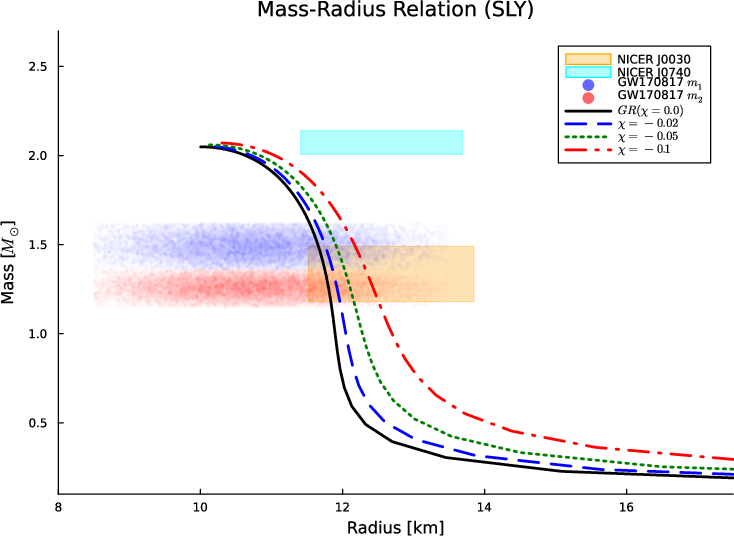
Figure 4: Mass-radius relation for the SLY equation of state. SLY aligns best with current radius constraints for mild negative coupling.
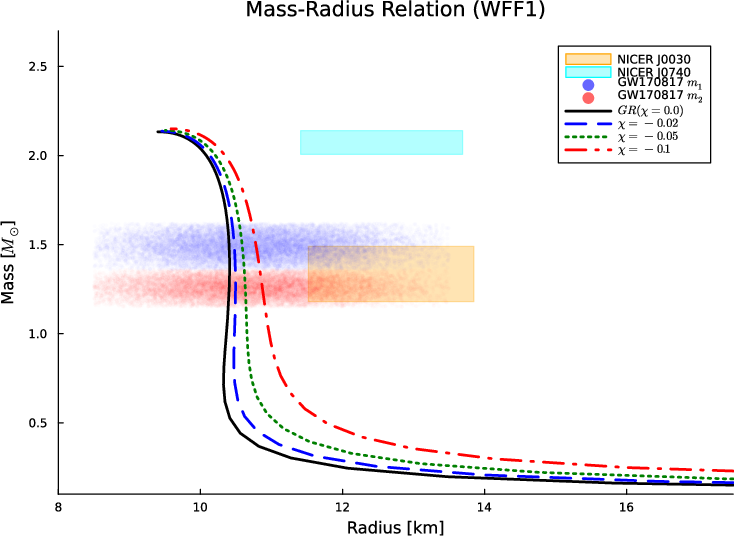
Figure 5: Mass-radius relation for the WFF1 equation of state, systematically producing lower radii and marginal compatibility.
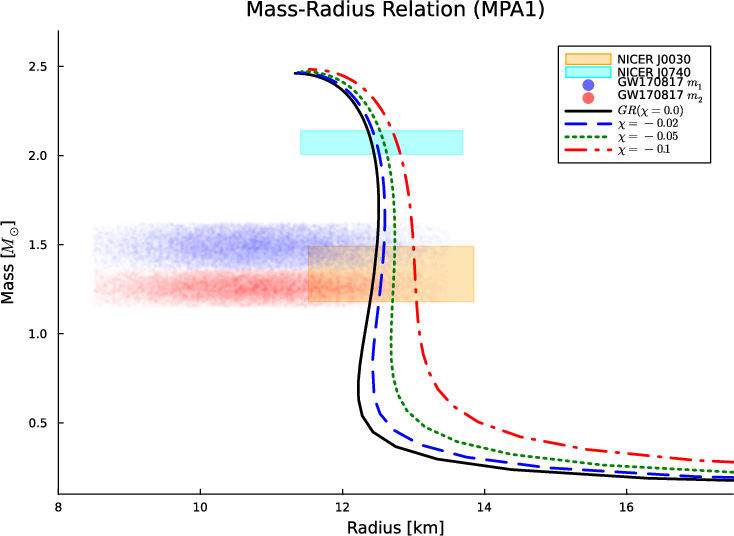
Figure 6: Mass-radius relation for the MPA1 equation of state. Strong negative f(R,T)2 drives tension with radius and tidal bounds.
The separation between different f(R,T)3 values is most pronounced in the low-mass regime, where the crustal sound speed is minimal and geometric corrections are maximized. Stiff EoSs (e.g., MPA1) quickly violate multimessenger radius and tidal constraints when f(R,T)4 becomes significantly negative.
The tidal deformability f(R,T)5 reveals the impact of effective stiffening. As f(R,T)6 becomes more negative, f(R,T)7 curves systematically shift upward, especially for stiff EoSs.
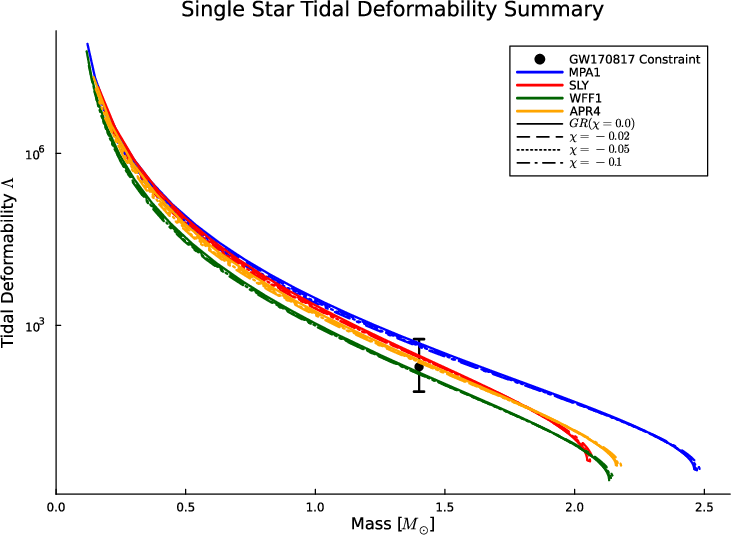
Figure 7: Dimensionless tidal deformability f(R,T)8 as a function of mass for APR4, SLY, WFF1, and MPA1; negative f(R,T)9 increases deformability and may violate GW170817 bounds.
The binary tidal parameter space (Gμν=8πTμνeff0 vs. Gμν=8πTμνeff1) provides a stringent intersection with LIGO/Virgo GW170817 data.
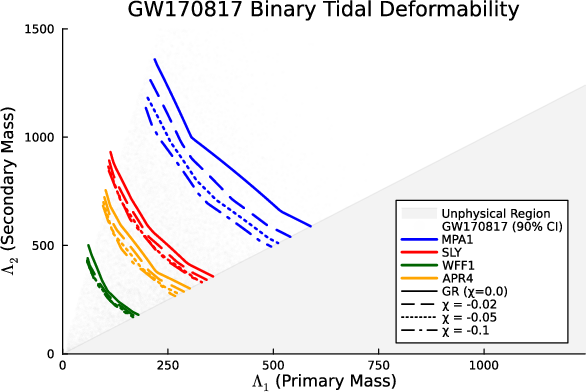
Figure 8: Binary tidal deformability tracks for studied EoSs; negative Gμν=8πTμνeff2 moves models outside the GW170817 credible region, especially for stiff EoSs.
Soft EoSs can accommodate negative Gμν=8πTμνeff3 for maximal mass compatibility, but increasing tidal deformability rapidly violates observational bounds, especially for stiff EoSs; thus, only small negative Gμν=8πTμνeff4 are permitted.
Implications and Future Perspectives
By decoupling the gravitational sector from the microphysical EoS, the conservative Gμν=8πTμνeff5 formulation preserves universality and enables direct, multimessenger tests of gravity modifications. The findings demonstrate that viable modifications are tightly restricted to perturbative deviations from General Relativity, with negative Gμν=8πTμνeff6 producing slight mass and radius enhancements but risking unphysical crust inflation and observational incompatibilities.
Practically, viable Gμν=8πTμνeff7 neutron stars require realistic tabulated EoSs, especially accurate modeling of crust physics, as simplified polytropic models omit the dominant instability mechanism. Theoretically, the approach resolves the critical gravity-matter degeneracy hampering rigorous inference from neutron star observables.
Future developments in AI-aided astrophysical modeling may leverage this formalism to perform robust Bayesian inference on gravity parameters, provided multimessenger systematics and realistic EoSs are employed. Further exploration in other compact object environments—such as strange quark stars or binary mergers—could extend constraint domains for Gμν=8πTμνeff8 gravity but will similarly depend on matter sector realism and careful handling of sound-speed pathologies.
Conclusion
The reformulation of Gμν=8πTμνeff9 gravity in terms of an effective energy-momentum tensor eliminates EoS-dependent degeneracies and preserves theoretical universality. Numerical solutions employing realistic EoSs and multimessenger constraints show that Tμνeff0 models are viable only for minute negative Tμνeff1, with mass-radius and tidal deformability effects tightly bounded by crust physics and observational data. The methodology establishes a robust framework for modified gravity tests with neutron stars, emphasizing the necessity of realistic microphysical modeling and comprehensive multimessenger analysis.