Enhanced quantum capacity thresholds from symmetry
Abstract: The quantum capacity captures the value of a quantum channel for transmitting quantum information, establishing the fundamental limits on quantum communication. In spite of its central role in quantum information theory, the quantum capacity of most channels is unknown, with wide gaps between the best upper and lower bounds. Even deciding whether a channel has nonzero capacity -- finding its capacity threshold -- is difficult. In this paper we report significant increases in the capacity thresholds of two prototypical noise models: the depolarizing channel and Pauli channels. In the case of the depolarizing channel, this is the first improvement in 18 years, giving a bigger increase beyond the hashing bound than all previous improvements combined. Our starting point is the representation theoretic framework recently proposed by Bhalerao and Leditzky (2025) to compute coherent information for special permutation invariant states. We generalize their framework to the full symmetric subspace, which allow us to optimize coherent information over rank two states in that space. A representation theoretic calculation shows that exponentially many Kraus operators of the channel annihilate the symmetric space, corresponding to a massive decrease in environment entropy for states on the symmetric space compared to the maximally mixed state. This explains the enhanced coherent information as a manifestation of degeneracy for the resulting codes.
Paper Prompts
Sign up for free to create and run prompts on this paper.
Top Community Prompts
Explain it Like I'm 14
Overview
This paper is about sending fragile quantum information (qubits) through a noisy connection and still getting it back safely on the other side. The authors focus on a basic question: for a given kind of noise, how much noise can we tolerate and still communicate some quantum information? This “how much” is called a capacity threshold.
They show how to raise this threshold for two important kinds of noise: the depolarizing channel (which “scrambles” a qubit at random) and general Pauli channels (which apply random X, Y, or Z flips). For the depolarizing channel, this is the first improvement in 18 years and larger than all previous improvements beyond the classic “hashing bound” combined. Their key idea is to use symmetry—states that look the same no matter how you swap the qubits—to design better ways to send quantum information.
Key objectives and questions
The paper asks, in simple terms:
- Can we find better ways (better input states/codes) to send qubits through very noisy channels so that the communication rate stays above zero at higher noise levels?
- Do “symmetric” many-qubit states help, and if so, why?
- Can we explain the improvement using a clear principle that tells us what kinds of errors matter?
What they did (methods, simply explained)
Think of sending a message through a crowd playing a noisy game of “telephone.” Some strategies can make your message more likely to survive. The authors explore a strategy based on symmetry:
- Symmetric states: They study many-qubit states that don’t change if you reorder the qubits (like a choir where every singer sings the same note; swapping singers doesn’t change the sound). This is called the “symmetric subspace.”
- Measuring “how much gets through”: They compute a quantity called coherent information. You can think of it as “how much useful signal reaches the receiver minus how much the environment (the noise) learns.” If this number is positive, you can communicate at a positive rate.
- Math toolkit to simplify the problem: Using a branch of math called representation theory (specifically Schur–Weyl duality), they reorganize big matrices into smaller “blocks.” It’s like sorting a huge LEGO pile by shape and color so you can count and assemble pieces more easily. This lets them calculate coherent information much faster and more accurately for symmetric states.
- Searching for the best states: They don’t try every possible state (that would be impossible). Instead, they:
- Focus on simple mixtures of just two symmetric states (rank-2 states).
- Use numerical optimization (a careful, step-by-step search guided by gradients) to find states that give the highest coherent information for each noise level.
- Why symmetry helps (intuition): In their calculations, they find that many different error patterns “look the same” when you use symmetric states. That means the environment can’t tell those errors apart, so it learns less. When the environment learns less, you can keep more of your quantum signal. In math terms, many “Kraus operators” (which describe the different ways noise can act) end up canceling out or acting identically on the symmetric code—this is called degeneracy.
Main results and why they matter
The authors report new, higher capacity thresholds (meaning the channel can be noisier and still allow positive-rate quantum communication):
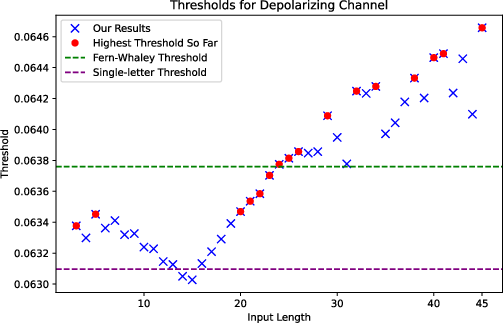
- Depolarizing channel: new lower bound p = 0.064657 (previous best: 0.06376 from 2008).
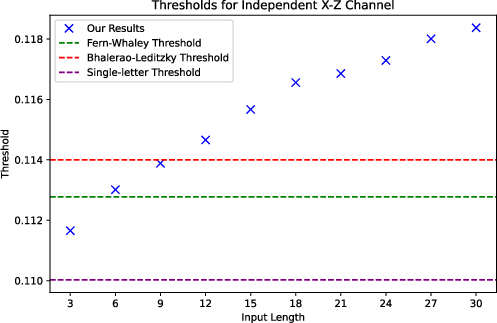
- Independent X–Z channel: p = 0.118371.
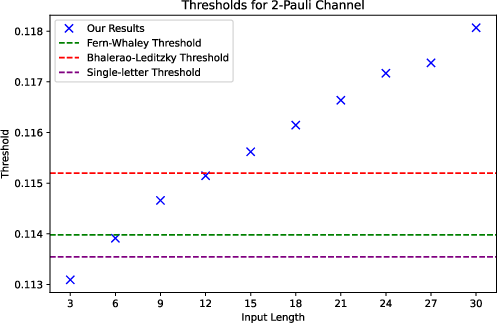
- 2-Pauli channel: p = 0.118067.
Why this is a big deal:
- First improvement for the depolarizing channel in 18 years, and larger than all earlier gains beyond the hashing bound.
- Much shorter block lengths: they achieve their best depolarizing result with just 45 qubits, versus earlier constructions that effectively used around 513 qubits. That’s a gigantic reduction, making these ideas more practical for experiments and simulations.
- The improvements start at relatively small sizes (for example, gains start at 24 qubits for the depolarizing channel), showing symmetry can help early, not only in huge systems.
There’s still room to grow: a known theoretical upper bound for the depolarizing threshold is about 0.08333 (from a no-cloning argument), so the true threshold lies somewhere between 0.064657 and 0.08333.
Why the approach works (the “degeneracy” story)
Errors can happen in many different ways, but if your code treats many of those errors the same, the environment can’t distinguish them. It’s like different wrong notes that, on this specific instrument and song, sound identical to the audience. In that case, the environment “learns” fewer details about your message, and you keep more useful information.
The authors make this precise: for symmetric inputs, a huge number of error operators effectively “vanish” or merge when acting on the code. This massively reduces the environment’s entropy (its uncertainty) compared to what happens for typical, non-symmetric inputs. That reduction boosts coherent information and thus the capacity threshold.
Implications and potential impact
- Design principle: Symmetry is a powerful tool for building practical quantum codes, especially at moderate sizes. You don’t always need gigantic constructions to beat standard bounds.
- Broader applicability: The representation-theory framework can be used for other channels and other symmetric or permutation-invariant codes, offering a general way to tame complex calculations.
- Better understanding: The work clarifies how “degeneracy” (many errors behaving the same on the code) can be intentionally harnessed to raise capacity thresholds.
- Steps toward real systems: Higher thresholds at smaller sizes are encouraging for near-term quantum devices, like early quantum repeaters or protected memories.
In short, by cleverly using symmetry, the authors found simpler, stronger ways to send quantum information through noisy channels—and they set new records while doing it.
Knowledge Gaps
Knowledge gaps, limitations, and open questions
Below is a concise list of what remains uncertain or unexplored in the paper, formulated to guide future research.
- Restriction to rank‑2 symmetric inputs: The optimization is limited to
ρ = 1/2(|ψ0⟩⟨ψ0| + |ψ1⟩⟨ψ1|)with|ψ0⟩, |ψ1⟩in the symmetric subspace. It is unknown whether allowing:- non‑equal mixture weights,
- more than two pure components (higher‑rank states),
- or non‑symmetric (or other
S_n‑irrep) subspaces - could yield higher thresholds.
- Non‑convex optimization without global guarantees: Thresholds are obtained via gradient‑based heuristics for a highly non‑convex objective, with no certification of global optimality. Developing guarantees (e.g., branch‑and‑bound, convex relaxations, global optimization, or certificates of optimality for the returned states) remains open.
- Numerical stability and error bars: The procedure projects small negative eigenvalues onto the probability simplex to correct numerical artifacts, but no rigorous error bounds or sensitivity analyses are provided. Quantifying how these corrections affect the coherent information near the threshold (e.g., ±ε bands) is needed.
- Finite‑blocklength achievability and explicit codes: The results certify positive asymptotic rate via coherent information but do not provide explicit finite‑length code constructions or decoders achieving the reported thresholds. Deriving finite‑blocklength guarantees (rates vs. error exponents) and explicit, efficient encoders/decoders for the identified symmetric codes is open.
- Scalability and complexity: The method requires precomputing
q^2_λ(𝒩(|φ_a⟩⟨φ_b|))across allλ ⊢ nand(a,b), but the computational scaling and memory complexity asngrows are not analyzed. Designing algorithms with provably better asymptotic scaling (or parallelization schemes) to pushnsignificantly beyond 60 is an open task. - Asymptotic behavior with
n: The thresholds continue to improve up ton ≈ 45–60, but the supremum overn(within the considered ansatz) is unknown. Determining whether the threshold converges, whether it continues to increase, or whether it can approach the no‑cloning upper bound (p = 1/12 ≈ 0.08333for the depolarizing channel) is open. - Upper bounds remain loose: No new converse techniques are provided; the best upper bound for the depolarizing channel remains the no‑cloning bound. Developing sharper upper bounds (potentially tailored to symmetric inputs/codes or using representation‑theoretic converses) to narrow the gap is a key open problem.
- Degeneracy explanation is asymptotic and modified: The degeneracy argument relies on a CP map where non‑typical Pauli Kraus operators are removed. It remains to:
- quantify environment entropy reduction for the full, unmodified channel at finite
n, - relate the “annihilating Kraus” picture to representation‑invariant metrics (since Kraus representations are non‑unique),
- and derive quantitative bounds linking this degeneracy to coherent information gains for the actual channel.
- quantify environment entropy reduction for the full, unmodified channel at finite
- Beyond Pauli/depolarizing models: The framework and numerics focus on Pauli channels (depolarizing, independent X–Z, 2‑Pauli). Extending to non‑Pauli noise (e.g., amplitude damping, phase‑amplitude noise, correlated/memory channels) and assessing whether symmetric‑subspace codes retain advantages is unexplored.
- Qudit generalization: All results are for qubit (
d=2) channels usingU(2)representation theory. Extending to qudit Pauli channels (d\>2) withU(d)/GL(d)irreps (and assessing computational feasibility and threshold gains) is open. - Code structure and implementability: The optimal states are symmetric‑subspace mixtures but not explicit stabilizer or LDPC codes. It is unknown how to realize these codes with efficient circuits, fault‑tolerant implementations, or syndrome‑based decoders, and whether structured code families can approximate the found optima.
- Relationship to other capacities: The impact of these inputs on private capacity, entanglement distillation, or superactivation phenomena is not investigated. Whether the same symmetric‑subspace states yield improvements for these tasks remains an open question.
- Sensitivity to basis choices and optimization initialization: The choice of a tensor‑power basis
{|φ_i⟩^⊗n}is made to minimize condition number, but the dependence of outcomes on this choice (and on optimization initializations/random seeds) is unquantified. Providing robustness analyses and systematic basis/initialization selection strategies (e.g., spherical designs) is an open direction. - Analytical characterization of optimal states: There is no analytical description of the optimal symmetric inputs (e.g., mixtures of specific Dicke states or angular momentum eigenstates). Finding structure theorems or sufficient conditions for optimality within the symmetric subspace would make the results more interpretable and generalizable.
- Combining symmetry with other code families: It is unknown whether hybrid constructions (e.g., embedding symmetric‑subspace encodings into concatenated or LDPC frameworks) could further boost thresholds while retaining efficient decoding.
- Extending beyond 2‑dimensional codespaces: The analysis focuses on 2‑dimensional codespaces within the symmetric subspace. Whether larger‑dimensional symmetric codespaces (still concatenable with random coding) can further improve thresholds is unaddressed.
- Threshold regions vs. single point estimates: Reported thresholds are defined at the point where coherent information crosses zero with small positive values (≈1e‑7). Characterizing the neighborhood (e.g., slope, width of p‑intervals yielding positive coherent information) and providing uncertainty bands would strengthen claims.
- Links to converse/achievability dualities: The observed degeneracy raises the question of converse limits accounting for “effective environment rank” or “restricted Choi rank on codespace.” Developing such converses, and achievability schemes that exploit these properties explicitly, remains open.
- Correlated or adversarial noise: Robustness of the discovered symmetric‑subspace codes to small deviations from the Pauli model (e.g., coherent errors, calibration drifts, weak correlations) has not been evaluated.
- Reproducibility and benchmarking: While code is provided, systematic benchmarking (number of restarts, variance across runs, time to solution, dependence on hyperparameters) is not reported. Establishing standardized benchmarks and reproducibility protocols would help validate and extend the results.
Practical Applications
Immediate Applications
These applications can be pursued now using the paper’s methods, code, and findings.
- Symmetry-aided capacity analysis software for Pauli/depolarizing channels (software, academia, industry)
- Use case: Compute coherent information and positive-capacity thresholds for qubit Pauli channels at modest block lengths (n ≈ 12–60) using the provided representation-theoretic method and code.
- Value: Replaces month-long Monte Carlo searches with hours-to-days of deterministic computation; enables rapid exploration of code ideas and noise regimes.
- Potential products/workflows:
- A Python library or CLI (“Symmetric-Subspace Capacity Analyzer”) that ingests channel parameters (pI, pX, pY, pZ) and returns I_c, thresholds, and candidate rank-2 symmetric inputs.
- Integration with Qiskit/Cirq/Pennylane for channel-adapted code prototyping.
- Assumptions/dependencies: Channel must be well-modeled by a memoryless Pauli (or Pauli-twirled) model; results are lower bounds; coherent-information achievability relies on concatenation with random (hashing) codes and hence assumes large-block asymptotics, with no efficient decoder guaranteed.
- Hardware and network benchmarking against “beyond hashing” thresholds (quantum communications, quantum networking)
- Use case: Experimental teams assess if their links (e.g., depolarizing noise p) fall below new positive-capacity thresholds (e.g., depolarizing p ≈ 0.064657 at n=45; independent X–Z p ≈ 0.118371 at n=30; 2-Pauli p ≈ 0.118067 at n=30).
- Value: Sets more accurate performance targets for links, repeaters, and device calibration, especially when block lengths are limited.
- Potential workflows:
- Characterize noise (QPT or gate set tomography), Pauli-twirl if needed, compare to threshold; select coding strategy accordingly.
- Assumptions/dependencies: Accurate noise characterization; applicability of Pauli approximation; finite-size effects may differ from asymptotic claims; hardware must reliably prepare/measure symmetric states.
- Rapid code discovery in the symmetric subspace (R&D, academia)
- Use case: Search for permutation-invariant input states that maximize coherent information for a given channel using gradient-based optimization as described.
- Value: Identifies promising encodings at small-to-moderate n without constructing huge concatenated repetition codes.
- Potential tools/workflows:
- A “code-search engine” that outputs candidate Dicke-basis (or tensor-power) superpositions, with export to circuit synthesis (e.g., Dicke state preparation circuits).
- Assumptions/dependencies: Optimization is non-convex and may find local optima; circuit synthesis for symmetric states adds overhead and can reduce the net benefit in practice.
- Education and training modules on Schur–Weyl duality in coding (education)
- Use case: Course labs or tutorials showing how symmetry block-diagonalizes channels and reduces entropy of the environment, linking degeneracy to capacity gains.
- Value: Bridges abstract representation theory with tangible performance gains in quantum communication.
- Dependencies: Availability of teaching code/notebooks; students need exposure to basic QECC and channel theory.
- Benchmark datasets and test harnesses for channel-adapted QECC research (academia, standards/R&D consortia)
- Use case: Curated threshold tables and example input states for n up to ~60 for depolarizing and Pauli channels to compare new algorithms, decoders, and circuit constructions.
- Value: Common yardsticks for reproducibility and fair comparisons across labs and toolmakers.
- Dependencies: Community agreement on noise models and metrics; maintenance of open repositories.
Long-Term Applications
These require further research, scaling, or engineering to realize in practical systems.
- Channel-adapted QECCs with efficient decoders exploiting degeneracy (software, quantum communications/computing)
- Vision: Families of permutation-invariant or symmetry-exploiting codes with practical decoders (e.g., message-passing, ML-aided, or algebraic decoders) that approach coherent-information rates at finite n.
- Impact: Bridges the gap between random-coding achievability and deployable, efficiently decodable schemes for links, repeaters, and memories.
- Dependencies: New decoding algorithms; circuit-efficient state preparation; robust performance under non-Pauli/correlated noise.
- Symmetry-aware quantum repeater and entanglement distillation protocols (quantum networking)
- Vision: Repeater stacks that incorporate symmetric codes as outer encodings to reduce environment entropy and improve distillable entanglement at realistic error rates and block sizes.
- Impact: Reduces hardware fidelity requirements or increases reach/rate of quantum networks.
- Dependencies: Repeaters with memory lifetimes compatible with preparing/processing symmetric blocks; integration into NetSquid/SeQUeNCe-level simulators and control software; assessment under loss and non-Pauli errors.
- Hardware-level symmetry engineering for channel alignment (hardware, device physics)
- Vision: Device control/compilation strategies that align effective noise with symmetries exploited by the codes, e.g., via dynamical decoupling, randomized compiling, or tailored gate sets that make the Pauli/twirled approximation accurate and beneficial.
- Impact: Systematically increases the fraction of Kraus operators that “annihilate” the codespace, lowering environment entropy and boosting achievable rates.
- Dependencies: Advanced calibration and control; verification that symmetrization does not increase effective noise too much; co-design with code synthesis.
- Compiler-level synthesis of symmetric-code circuits (software toolchains)
- Vision: Automated pipelines that take target channel parameters and synthesize circuits to prepare/encode rank-2 symmetric-subspace inputs, including Schur transforms or Dicke-state preparation optimized for particular hardware backends.
- Impact: Lowers the barrier to deploying channel-adapted encodings in NISQ and early FTQ devices.
- Dependencies: Gate-level cost models; circuit optimization; transpilation co-designed with hardware constraints and error models.
- Standards and benchmarks for “beyond hashing bound” channel performance (policy/standards)
- Vision: Industry groups adopt capacity-threshold benchmarks (at finite block lengths) for link certification and procurement, supplementing average gate fidelity metrics.
- Impact: More relevant acceptance criteria for quantum communication components and services.
- Dependencies: Consensus on representative noise models; translation to practical test procedures; alignment with regulatory and interoperability frameworks.
- Extending symmetry-based capacity tools beyond Pauli noise (academia, software)
- Vision: Representation-theoretic coherent-information computations for broader, physically motivated noise (amplitude damping, dephasing with leakage, correlated errors), possibly via approximate block-diagonalization or learned surrogate models.
- Impact: Makes channel-adapted coding practical for real devices whose noise departs from Pauli assumptions.
- Dependencies: Mathematical extensions of the framework; scalable numerics; validation on experimental data.
- Cross-fertilization with fault-tolerant architectures (quantum computing)
- Vision: Use insights about degeneracy and environment entropy reduction to design or tune code families (e.g., LDPC-like or bosonic codes) and syndrome processing that perform better under symmetric/Pauli-like hardware noise.
- Impact: Potentially lower overhead for logical qubits or improved thresholds in specialized regimes.
- Dependencies: Clear linkage between channel capacity gains and computation-oriented thresholds; compatibility with fault-tolerant constraints (stabilizer measurements, locality).
Notes on feasibility across applications:
- The paper’s improvements are mathematically rigorous lower bounds and provide concrete numerical methods and code, but practical deployment requires bridging to constructible codes with efficient decoding and implementable circuits.
- The gains assume memoryless Pauli-like channels; in practice, noise may be correlated or non-Pauli, though Pauli twirling and randomized compiling can often bring models closer to Pauli at the expense of increased effective error rates.
- Preparing large symmetric states (n ≈ 24–60) with high fidelity is currently challenging and hardware dependent; benefits must be weighed against preparation overhead and additional errors from encoding circuits.
Glossary
- Additivity: Property where an information measure over multiple channel uses equals the sum over single uses; in classical channels, mutual information is additive. Example: "This property is called additivity of the maximum mutual information for a channel."
- Bell basis: The orthonormal basis of two-qubit maximally entangled states, often diagonalizing Pauli channels’ Choi matrices. Example: "Note that is a matrix which is diagonal in the Bell basis with diagonal entries ."
- Choi matrix: The matrix representing a quantum channel via its action on half of a maximally entangled state, used to derive Kraus operators. Example: "For uses of the channel, the Choi matrix is ."
- Coherent information: Quantum analog of mutual information used to characterize achievable quantum communication rates through a channel. Example: "the coherent information of acting on the input is defined as"
- Commutant: The set of operators commuting with a given group action; central to Schur–Weyl duality. Example: "The commutant of the action of on "
- Complementary map: The channel mapping to the environment outputs of a Stinespring dilation, used to quantify environment entropy. Example: "the rank of the corresponding complementary map is exponentially smaller"
- Completely positive map (CP map): A linear map that remains positive when tensored with the identity on any ancilla system; the mathematical form of quantum channels. Example: "when we consider the CP map obtained by removing all the non-typical Pauli Kraus operators"
- Degeneracy: Code property where different errors act identically on the codespace, reducing environment distinguishability. Example: "as a manifestation of degeneracy for the resulting codes."
- Depolarizing channel: A canonical noise model that replaces a qubit with the maximally mixed state with some probability, symmetrically over Pauli errors. Example: "In the case of the depolarizing channel, this is the first improvement in 18 years"
- Dicke basis: An orthonormal basis for the symmetric subspace labeled by Hamming weight, useful for permutation-invariant states. Example: "To easily represent states in the symmetric subspace, we will use the Dicke basis."
- Entanglement fidelity: A measure of how well a channel preserves entanglement with a reference, used in analyzing code performance. Example: "permutation invariant operators were used in the context of entanglement fidelity and superactivation"
- Environment entropy: Entropy of the environment system in the channel’s Stinespring dilation; lower values can enhance coherent information. Example: "corresponding to a massive decrease in environment entropy for states on the symmetric space"
- Gelfand–Tsetlin basis: A canonical orthonormal basis for certain group representations (e.g., U(d)), indexed by patterns or SSYTs. Example: "Using the SSYTs, it is possible to obtain an orthogonal basis for called the Gelfand-Tsetlin basis"
- Hashing bound: Achievable rate given by coherent information using random coding, serving as a baseline for capacity thresholds. Example: "giving a bigger increase beyond the hashing bound than all previous improvements combined."
- Hook’s length formula: A combinatorial formula that counts standard Young tableaux of a given shape. Example: "The number of SYTs for a given is given by the Hook's length formula"
- Irreducible representation (irrep): An indecomposable representation that cannot be expressed as a direct sum of smaller representations. Example: "where is an irrep of (called Specht modules) and is an irrep of "
- Kraus operators: Operators in an operator-sum representation of a quantum channel capturing its action via E(ρ)=∑ᵢ Aᵢ ρ Aᵢ†. Example: "exponentially many Kraus operators of the channel annihilate the symmetric space"
- No-cloning argument: A proof technique using the impossibility of perfect cloning to upper bound quantum communication capabilities. Example: "an upper bound of can be established using a no-cloning argument"
- Pauli channels: Noise channels that apply Pauli operators probabilistically; include depolarizing and related models. Example: "two prototypical noise models: the depolarizing channel and Pauli channels."
- Permutation invariant codes: Codes supported on subspaces invariant under qubit permutations, often simplifying analysis via symmetry. Example: "Permutation invariant codes have also been explored previously in the context of error correction"
- Purification: An embedding of a mixed state into a larger Hilbert space as a pure state; used in defining coherent information. Example: "where is a purification of "
- Quantum capacity: The maximum asymptotic rate (qubits per channel use) for reliable quantum communication through a channel. Example: "The quantum capacity captures the value of a quantum channel for transmitting quantum information"
- Quantum error correcting code: A scheme that encodes quantum information to protect it from noise, enabling reliable transmission. Example: "it captures the optimal performance of a quantum error correcting code adapted to the channel's noise model."
- Representation theory of the symmetric group: Study of how S_n acts on vector spaces, enabling decomposition into irreps and symmetry-based computations. Example: "using representation theory of the symmetric group to compute the threshold for permutation invariant codes."
- Schur transform: A unitary that maps computational bases to Schur–Weyl decomposition bases, separating multiplicity and irrep spaces. Example: "a common notation is to use the unitary operation called the Schur transform"
- Schur–Weyl duality: A duality relating commuting actions of U(d) and S_n on tensor powers, yielding a joint decomposition into irreps. Example: "Moreover, Schur-Weyl duality \cite{fulton2013representation, etingof2011introduction} tells us that the action of spans the commutant of "
- Shannon entropy: Classical entropy measure H(p) used when aggregating block-diagonal weights in entropy calculations. Example: "where is the vector formed by the coefficients and is the Shannon entropy."
- Semi-Standard Young Tableaux (SSYT): Fillings of Young diagrams with nondecreasing rows and increasing columns, indexing certain U(d) irreps. Example: "It is possible to parametrize the basis elements of using Semi-Standard Young Tableaux (SSYTs)"
- Specht modules: The irreducible representations of the symmetric group, indexed by partitions (Young diagrams). Example: "called Specht modules"
- Standard Young Tableaux (SYT): Fillings of Young diagrams with 1..n increasing across rows and down columns, indexing S_n irreps. Example: "It is possible to parametrize the basis elements of using Standard Young Tableaux (SYTs)"
- Stabilizer code: A quantum error-correcting code defined by an abelian subgroup of the Pauli group; supports efficient encoding/decoding. Example: "using a random stabilizer code can attain positive rate"
- Symmetric group : The group of all permutations on n elements, whose action organizes tensor powers via Schur–Weyl duality. Example: "We will be interested in the following actions of the symmetric group "
- Symmetric subspace: The subspace of (Cd){⊗n} invariant under all permutations of tensor factors. Example: "the full symmetric subspace"
- Superactivation: Phenomenon where combining zero-capacity channels yields positive capacity. Example: "entanglement fidelity and superactivation"
- Threshold problem: Determining the largest noise parameter at which positive quantum capacity is achievable. Example: "Finding the highest at which positive rate is possible is called the threshold problem."
- von Neumann entropy: Quantum entropy S(ρ)=−Tr(ρ log ρ) used in defining coherent information. Example: "and is the von Neumann entropy."
- Weyl’s dimension formula: A formula giving the dimensions of U(d) irreps indexed by partitions. Example: "The number of SSYTs with entries in is given by the Weyl's dimension formula"
- Young diagram: A graphical representation of a partition used to index irreps of S_n and U(d). Example: "These partitions can be represented using a Young Diagram"
- Young–Yamanouchi basis: An orthonormal basis for Specht modules (S_n irreps) built from SYTs. Example: "Using the SYTs, it is possible to obtain an orthogonal basis for called the Young-Yamanouchi basis"