- The paper introduces a solvable theory for spherical Boltzmann machines, detailing equilibrium phase transitions via random matrix theory.
- The paper employs dynamical mean-field theory to derive exact high-dimensional training dynamics and non-equilibrium phase transitions.
- The paper demonstrates how sampling temperature tuning, double descent, and tempered-posterior effects optimize generative performance in energy-based models.
Spherical Boltzmann Machines: Solvable High-Dimensional Theory of Learning and Generation in Energy-Based Models
Introduction and Background
The paper "Spherical Boltzmann machines: a solvable theory of learning and generation in energy-based models" (2605.09031) presents an in-depth analytic framework for energy-based models (EBMs) in high dimensions, focusing on the Spherical Boltzmann Machine (SBM). The SBM serves as a theoretically tractable archetype for EBMs, defined by a quadratic energy function on the N-dimensional hypersphere, with the energy landscape shaped by a symmetric weight matrix W. Unlike prior analyses, the SBM is here considered as a trained model on structured data rather than a purely random system, allowing the authors to address fundamental questions about learning dynamics, equilibrium structure, and generative capability.
The work synthesizes random matrix theory and dynamical mean-field theory (DMFT) to provide explicit solutions for both equilibrium and out-of-equilibrium properties. The study resolves nontrivial aspects of training—such as the formation and condensation of eigenmodes, double descent in generative performance, optimal sampling temperature, and the impact of posterior tempering—within a unified large-N analytic scaffold. The theoretical predictions are validated numerically and found to qualitatively extend to standard generative architectures.
Equilibrium Structure and Phase Transitions
The equilibrium distribution of the SBM, in the limit of well-mixed sampling (ν→∞), is analytically tractable by mapping weight-space integrals to a Coulomb gas problem over the eigenvalues of W. The central finding is a succession of phase transitions in the learned spectrum of W, controlled by the regularization parameter γ and posterior temperature η.
When K data modes are present, the bulk of the spectrum obeys the Wigner semicircle law, while up to K top eigenvalues may detach and align with the data covariance structure, as determined by force balance between the HCIZ integral (aligning to data) and the partition function-derived repulsion (favoring isotropy). These detached modes can coalesce and trigger sample condensation, resulting in "condensed" and "non-condensed" regimes distinguished by macroscopic overlaps between generated samples and principal data directions (Figure 1).
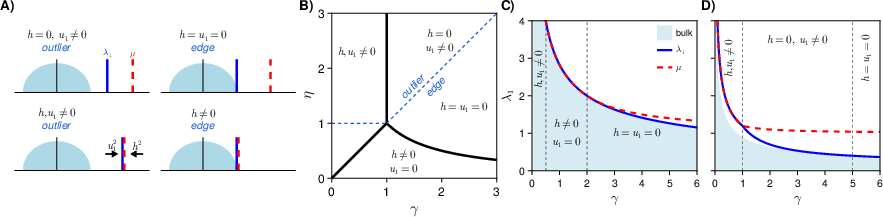
Figure 1: Equilibrium phase diagram (W0): schematic eigenvalue configurations (A), phase boundaries in W1 space (B), and signatures of eigenvalue transitions (C, D).
This phase structure generalizes naturally to higher W2 and to empirical data covariance spectra. The analysis leverages recent results on the large-W3 asymptotics of spherical integrals and the HCIZ framework, enabling fine-grained distinction between phases where samples are isotropic and those where they align with specific data-driven modes.
Training Dynamics via Dynamical Mean-Field Theory
A central contribution is the application of DMFT to derive exact equations for the high-dimensional training dynamics under Langevin and persistent Markov chain (PMC) sampling protocols. The coupled evolution of W4 and persistent samples W5 is projected, in the W6 limit, to a closed set of equations for spectral order parameters, overlaps, two-time correlators, and responses.
This analysis reveals a quantitatively precise detachment cascade of the largest eigenvalues and the subsequent onset of condensation in the learning trajectory (Figure 2). Critically, the training schedule's sampling rate W7 induces a non-equilibrium phase transition: below a critical W8, the model can remain trapped far from equilibrium, with persistent PMC chains failing to equilibrate and resulting in biased estimation of the negative phase gradient.
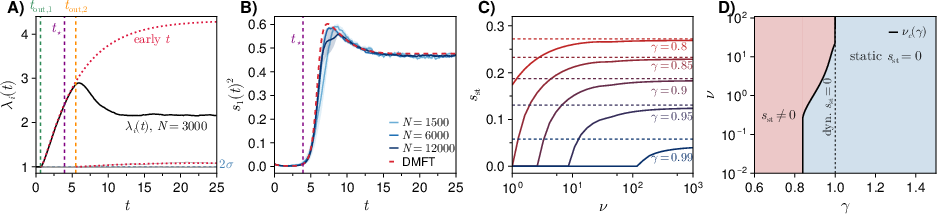
Figure 2: Training dynamics—trajectories of leading eigenvalues and order parameters from both large-W9 DMFT and finite-N0 Langevin simulations demonstrate non-equilibrium transitions, the emergence of condensation, and the impact of the sampling rate.
The presented DMFT framework constitutes the first analytically closed theory for trained EBM dynamics at scale (beyond early-training and random weight approximations), and it clarifies how out-of-equilibrium effects degrade model quality unless appropriately mitigated by high sampling rates or early stopping strategies.
Teacher–Student Generative Scenario and Theoretical Phenomena
A core strength of the theory is in providing analytic expressions for the generative performance of the SBM in a teacher–student setting. The authors evaluate forward and reverse Kullback-Leibler (KL) divergences for both typical trained students and Bayesian-posterior predictive generation. This leads to explicit formulas for cross- and self-entropy of generated samples, illuminating several phenomena of substantial practical relevance:
- Sampling Temperature Tuning: Post-training adjustment of the sampling temperature (N1) can nontrivially improve sample fidelity by compensating for entropy mismatches, "rescuing" data-aligned modes that are under-expressed at standard settings. The optimal N2 depends on the phase of the trained model and can activate previously silent modes, as delineated by the phase diagram boundaries.
- Double Descent: The reverse KL as a function of regularization N3 exhibits a pronounced double-descent structure (Figure 3): a first minimum within the condensed phase (model aligned with the teacher), a sharp rise at the threshold to uncondensed regimes, and a subsequent decline attributable to random anisotropy in the model's bulk. The theory provides closed-form expressions for transition thresholds and the location of local minima/maxima.
Figure 3: N4 phase diagrams and double descent in generative KL divergence highlight the separation between condensed and uncondensed regimes, as well as the existence of an optimal regularization.
- Tempered Posterior Effects: Ensemble generation by posterior-predictive averaging, with a "tempered" posterior (i.e., Bayes posterior at temperature N5), can outperform both the standard Bayesian average and MAP estimation, especially in under- or over-regularized scenarios (Figure 4). The analytic phase diagrams specify when the optimal posterior temperature is "warm" (N6), "cold" (N7), or degenerate (MAP limit).
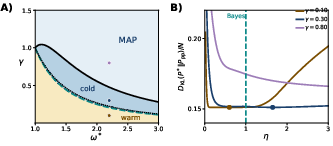
Figure 4: Regions of N8 where warm or cold posterior tempering achieves optimal reverse KL under posterior predictive sampling, highlighting the nontrivial effect of global hyperparameters.
- Out-of-Equilibrium Dynamics: When training is performed at subcritical sampling rate N9, the model can exhibit characteristic overshooting of eigenvalues and suppression of data overlaps, leading to persistent biases that only early stopping or increased PMC computation can resolve—predicted analytically and confirmed in finite-ν→∞0 simulations.
Validation and Empirical Extension Beyond SBM
The predicted phenomena are not unique to the SBM. Systematic numerical validation in standard generative architectures—Potts Boltzmann machines on protein MSAs, normalizing flows, RBMs, autoregressive belief networks, and Bayesian GANs—finds qualitatively consistent evidence for all effects above. Eigenvalue condensation transitions, double descent as a function of regularization, sampling temperature optima, and tempered-posterior performance boosts are observed, confirming the theoretical mechanism is robust and broadly applicable.
Practical and Theoretical Implications
The explicit solvable theory for the SBM provides significant clarity regarding the limits and qualitative behaviors of EBMs in the undersampled, high-dimensional regime. The identification of condensation transitions reveals the core mechanism by which EBMs can or cannot encode and generate structured data. The analytic control of the equilibrium and training dynamics articulates under which hyperparameter and protocol regimes the model will fail to capture data modes, succumb to spurious anisotropy, or generate overly uniform samples.
In practice, this motivates:
- Careful tuning of sampling temperature at generation time to optimally express the learned structure.
- Posterior tempering and ensemble strategies to move beyond the limits of either strict Bayesian averaging or MAP fitting.
- Cognizance of non-equilibrium pathologies induced by persistent-sampling training dynamics, highlighting the need for either high sampling rates, multi-chain approaches, or algorithmic early stopping.
Theoretically, the paper's methods set a new standard for analytic tractability in high-dimensional generative modeling, complementing existing results in discriminative learning and matrix inference.
Conclusion
This study establishes a unified, exactly solvable theory for learning and generation in the high-dimensional limit of EBMs, elucidating the spectral mechanisms of learning, the emergence of condensation transitions, implications for generalization, and regimes where standard training algorithms can introduce hard-to-detect biases. The analytic predictions for phenomena such as double descent, temperature tuning, and tempered-posterior performance are substantiated both within the SBM and across more complex generative models. The results provide rigorous guidance for the design and interpretation of learning algorithms and evaluation protocols in generative modeling, with clear implications for future developments in AI systems utilizing EBMs.