- The paper introduces a resource-theoretic framework for continuous-variable coherence using physically motivated, random momentum kick dephasing channels.
- It formulates new coherence measures, including relative-entropy and Hilbert–Schmidt dephasing losses, which address challenges from non-normalizable position eigenstates.
- The framework links theoretical coherence quantifiers with experimental observables in interferometry, enabling practical certification through threshold witnesses.
Resource Theory of Coherence in Continuous Position Basis via Measurement-Induced Dephasing
Introduction and Motivation
This work develops a rigorous resource-theoretic framework for quantum coherence directly in the continuous position basis, centering on the operational consequences of measurement-induced dephasing. In contrast to the well-understood discrete setting, where the notions of coherence, incoherent states, and free operations are mathematically straightforward, the continuous-variable domain exhibits a range of nontrivial obstacles due to the non-normalizability of position eigenstates, the absence of a bona fide dephasing projector, and the ill-definedness of diagonal states. The authors construct a consistent framework based on completely positive trace-preserving (CPTP) channels characterized by random momentum kicks—operationally equivalent to finite-resolution position measurements—thereby connecting physically realizable decoherence processes with the quantification of spatial coherence.
Limitations of Discrete-Basis Resource Theories in the Continuum
Traditional resource theories of coherence, as formalized in finite dimensions, are based on three key ingredients: the set of diagonal (incoherent) states, the class of free operations (MIO, IO, SIO, DIO), and the coherence monotones satisfying strict axioms. The extension to infinite-dimensional, continuous-variable systems poses serious challenges:
- Non-normalizability of position "eigenstates": {∣x⟩} are generalized functions and do not reside in the Hilbert space.
- Ill-defined basis dephasing: Naive generalization of projective dephasing ρ↦∫dx∣x⟩⟨x∣ρ∣x⟩⟨x∣ leads to divergences (δ(0) terms) and does not yield a valid quantum channel on trace-class states.
- Absence of normal incoherent states in the fixed-point set: For physically relevant dephasing kernels, the only fixed point in the space of normal states is the zero operator.
- Breakdown of idempotency: Physically motivated position dephasing channels produced by random momentum kicks are not projectors; repeated application further suppresses off-diagonal components rather than leaving the state invariant after one action.
These properties fundamentally distinguish the continuous-variable coherence resource theory from its discrete analogs.
Measurement-Induced Dephasing: Random Momentum Kick Channel
The work proposes a physically motivated dephasing map, Δg, arising from the unconditional back-action of a finite-resolution position measurement. Operationally, such measurements are modeled by the von Neumann interaction Hamiltonian H=λX^S⊗P^M, with the system and pointer prepared in normalizable wavepackets. The unconditional output (after averaging over readout) has the form:
Δg(ρ)=∫dpg~(p)eipX^/ℏρe−ipX^/ℏ,
where g~(p) is the probability distribution describing random momentum kicks imparted to the system (determined by the meter's momentum spread), and its characteristic function g(ξ)=∫dpeipξ/ℏg~(p) encodes the kernel. In position representation:
[Δg(ρ)](x,y)=g(x−y)ρ(x,y),
where ∣g(ξ)∣<1 for ρ↦∫dx∣x⟩⟨x∣ρ∣x⟩⟨x∣0 for smooth pointer (meter) wavefunctions.
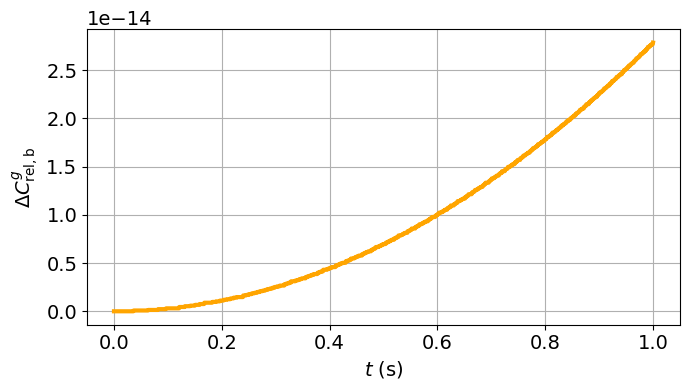
Figure 1: Time dependence of the lower-bound expression for the relative-entropy dephasing loss, shown relative to its initial value for a Gaussian wavepacket evolving in a gravitational potential.
The dephasing channel thus leaves diagonal elements invariant and continuously suppresses spatial coherence at scales set by the resolution (spread of ρ↦∫dx∣x⟩⟨x∣ρ∣x⟩⟨x∣1). Key consequences include:
- The set of fixed points, ρ↦∫dx∣x⟩⟨x∣ρ∣x⟩⟨x∣2, contains no nonzero trace-class operators for physically admissible (regular) kernels.
- Resource-theoretic coherence, therefore, is not a notion of proximity to diagonal states, but rather quantifies the disturbance induced by physically realizable dephasing.
Coherence Quantifiers: Relative-Entropy and Hilbert–Schmidt Dephasing Loss
Relative-Entropy Dephasing Loss
Defined by
ρ↦∫dx∣x⟩⟨x∣ρ∣x⟩⟨x∣3
where ρ↦∫dx∣x⟩⟨x∣ρ∣x⟩⟨x∣4 is the quantum relative entropy, provided support conditions are met. This measure satisfies:
- Faithfulness: strictly positive for all physical states due to the empty fixed-point set.
- Monotonicity and strong monotonicity under the class of dephasing-covariant CPTP maps (ρ↦∫dx∣x⟩⟨x∣ρ∣x⟩⟨x∣5).
- Convexity and additivity on product systems.
- For pure states,
ρ↦∫dx∣x⟩⟨x∣ρ∣x⟩⟨x∣6
but, crucially, does not reduce to the entropy of the dephased state since ρ↦∫dx∣x⟩⟨x∣ρ∣x⟩⟨x∣7 is not idempotent.
Hilbert–Schmidt (ρ↦∫dx∣x⟩⟨x∣ρ∣x⟩⟨x∣8) Dephasing Loss
Defined as
ρ↦∫dx∣x⟩⟨x∣ρ∣x⟩⟨x∣9
- Convex and experimentally transparent (computable from the kernel), but fails monotonicity and strong monotonicity under δ(0)0.
- For two-mode superpositions (e.g., two-path interference), this measure quantifies the coherence decay due to the channel at a given separation.
Threshold Witnesses and Interference Visibility
Because the fixed-point set is empty, standard witness operators lose operational meaning. The paper introduces threshold witnesses for finite coherence—bounded Hermitian operators δ(0)1 separating states with δ(0)2 from those with δ(0)3. Using the two-mode sector and the Hilbert–Schmidt quantifier, the relevant threshold for interface visibility δ(0)4 is
δ(0)5
so sufficient visibility at separation δ(0)6 certifies more than δ(0)7 amount of δ(0)8-coherence (where δ(0)9 is path separation and Δg0, the coherence kernel at that separation). This directly relates resource-theoretic coherence to operational observables in interference experiments.
Illustration: Gaussian Wavepacket in a Gravitational Potential
An explicit example is provided: a minimum-uncertainty Gaussian wavepacket of width Δg1 and mass Δg2 evolves under a Newtonian potential, subject to a Gaussian random-kick dephasing channel with spatial coherence scale Δg3 set by the meter momentum spread. The resulting relative-entropy dephasing loss and Hilbert–Schmidt loss are computed as functions of the time-evolved wavepacket width Δg4:
Δg5
Δg6
As the wavepacket spreads, the amount of position-basis Δg7-coherence grows, quantifying the capability of continuous-variable systems to sustain coherence under physically motivated environmental monitoring. Figure 1 displays the temporal growth of relative-entropy dephasing loss for experimentally relevant parameters, directly demonstrating the dynamical interplay of coherence, spatial delocalization, and measurement-induced decoherence.
Theoretical and Practical Implications
- This framework solidifies the operational definition of coherence resources in continuous variables, justifying the focus on disturbance-based measures in the absence of nontrivial fixed points.
- The resource-theoretic structure remains valid in the continuum only when grounded in physically realizable channels.
- Relative-entropy dephasing loss emerges as the canonical quantifier, both for its strong monotonicity and faithfulness, and for its operational interpretability in interferometric settings.
- Threshold witnesses enable practical certification in experiments, especially in matter-wave interferometry, double-slit setups, and situations where spatial resolution of environmental monitoring can be controlled or inferred.
The mathematical architecture (e.g., absence of idempotent, trace-preserving dephasing projectors; the non-existence of normal incoherent states) will constrain generalizations to fields such as relativistic or non-Markovian open-system dynamics.
Conclusion
The study provides a robust and physically motivated resource theory of position-basis coherence for continuous-variable quantum systems, centered on CPTP dephasing channels realized by random-momentum (measurement-induced) disturbances. It systematically demonstrates the failure of finite-dimensional resource-theory analogs, constructs suitable coherence monotones, and links theoretical and operational aspects through experimental witnesses and explicit dynamical examples. This framework paves the way for further foundational, experimental, and theoretical analyses of quantum coherence in the continuum.

