Bipartite temporal Bell inequality for squeezed coherent state of inflationary perturbations
Published 8 May 2026 in gr-qc | (2605.08428v1)
Abstract: We investigate the role of the bipartite temporal Bell inequality, an analogue of the spatial Bell inequality, in probing the quantum imprints of primordial perturbations when the initially chosen Bunch-Davies vacuum is replaced by a coherent state. Although it is based on the same principles of locality and realism, its primary advantage lies in the fact that it does not require two distinct set of observable for its construction. Instead, measurements performed on a single component of the pseudo-spin operator at different times are sufficient. Consequently, it is particularly well suited for cosmological scenarios, where observational constraints typically allow access to only one component of the pseudo-spin operator. Assuming a coherent state as the initial condition, we derive an analytical expression for the expectation value of the bipartite temporal Bell operator and demonstrate the absence of temporal Bell violation in such a scenario. Interestingly, the results for squeezed coherent state is found to differ - albeit slightly - from those of squeezed vacuum state for large values of the squeezing parameter. This suggests that the ability to distinguish among different initial states of primordial perturbations does not rely on the violation of temporal Bell inequality. Furthermore, the dependence of the temporal Bell inequality on a purely imaginary phase factor of the wave function appears to be an unique feature, which is entirely absent in the context of spatial Bell inequalities.
The paper shows that bipartite temporal Bell inequalities remain within classical bounds in squeezed coherent states, highlighting a non-violation even in a quantum regime.
The analysis employs gauge-invariant quantization and operator disentanglement to evaluate unequal-time pseudo‐spin correlators under the GKMR prescription.
The results reveal that time-dependent phase factors in the squeezed coherent state normalization suppress temporal quantum correlations, offering a diagnostic for distinguishing initial conditions.
Bipartite Temporal Bell Inequality for Squeezed Coherent States of Inflationary Perturbations
Introduction and Motivation
This work rigorously addresses the role of bipartite temporal Bell inequalities in probing quantum features of primordial inflationary perturbations, specifically in scenarios where the Bunch-Davies (BD) vacuum is replaced by a squeezed coherent state as the initial condition (2605.08428). The analysis is motivated by foundational questions in primordial cosmology: Are violations of Bell-type inequalities, typically signatures of quantum non-locality, present in the quantum fluctuations originating in the early universe? Can these violations distinguish non-standard initial states such as coherent or squeezed coherent states from the canonical BD vacuum? The relevance is underscored by the operational difficulties in cosmological contexts, where only a single component of pseudo-spin operators is generally accessible and measurements are constrained temporally rather than spatially.
Theoretical Framework: Temporal and Bipartite Temporal Bell Inequalities
Classical Bell inequalities, notably the spatial Bell–CHSH, demarcate correlations admissible under local realism. Quantum states—especially entangled ones—can violate these classical bounds. Temporal Bell inequalities, and more generally, bipartite temporal Bell inequalities, extend these tests to correlations between measurements separated in time rather than space, modifying locality assumptions to incorporate principles like non-invasive measurability.
The bipartite temporal Bell scenario analyzed here considers a bipartite Hilbert space with operators S^k,S^−k, with measurements conducted at different times ti. Importantly, this structure is uniquely suitable for inflationary cosmology, where probe accessibility is constrained in phase space. The Bell operator is constructed from two-point pseudo-spin correlators evaluated at unequal times, and, under standard realism and locality assumptions, it is bounded by 2 classically. Quantum mechanics, in specific dynamical contexts, can raise this bound to the Tsirelson value 22.
Quantization of Inflationary Perturbations: Squeezing and Coherent States
After reviewing gauge-invariant quantization (Mukhanov–Sasaki variable), the work analyzes the time evolution of general two-mode states under the cosmological Hamiltonian. Standard inflationary theory selects the BD vacuum, which the dynamics squeeze into a two-mode squeezed vacuum. The novelty here is the systematic development for a squeezed coherent state, with explicit expressions for the evolved wavefunction in quadrature representation, including both the squeezing parameters (rk,ϕk,θk) and the coherent amplitude (αk,α−k).
Key analytic steps include projecting the time evolution operator onto a basis of creation/annihilation operators via disentanglement into squeezing and rotation operators, leading to a normalized, displaced Gaussian state with phase factors reflecting both squeezing and coherent displacement.
Formalism for Bipartite Temporal Bell Inequality Evaluation
Unequal-time pseudo-spin correlators are evaluated using the Gour-Khanna-Mann-Revzen (GKMR) prescription for dichotomic pseudo-spin operators in continuous-variable systems. Due to the non-commuting nature of unequal-time operators, the authors adopt projective measurement definitions, ensuring real-valued and operationally meaningful correlators.
The expression for the temporal Bell operator expectation involves nontrivial multidimensional integrals over coherent-state parameters and functional dependence on both squeezing and displacement parameters. A detailed computational strategy for extracting these correlators, including exact treatment of normalization and phase factors, is demonstrated.
Numerical Results in De Sitter Inflation
The analysis is specialized to de Sitter inflation, allowing all squeezing parameters to be expressed in terms of conformal time, further reducing the variable space and enabling explicit evaluation of Bell operator expectation values as functions of physical parameters.
The primary numerical finding is:
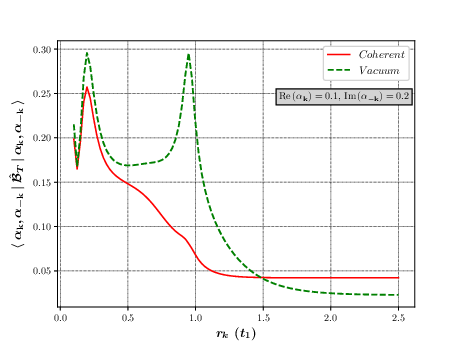
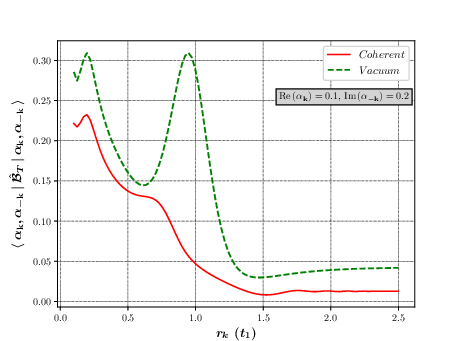
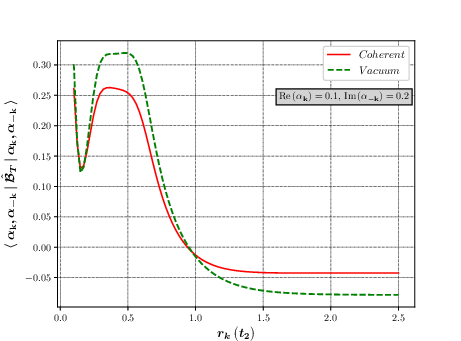
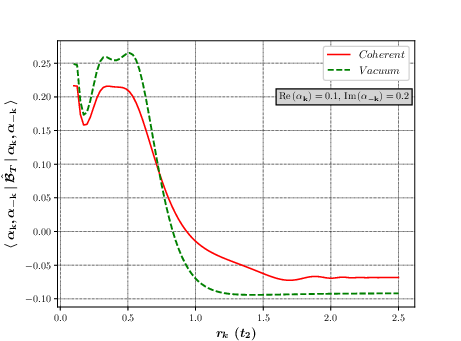
The bipartite temporal Bell inequality is not violated for the squeezed coherent state, for any accessible value of the parameters. This is in contrast with known violations in spatial Bell inequalities for certain squeezed states, and underscores a qualitative difference in temporal versus spatial quantum correlations for cosmological scenarios.
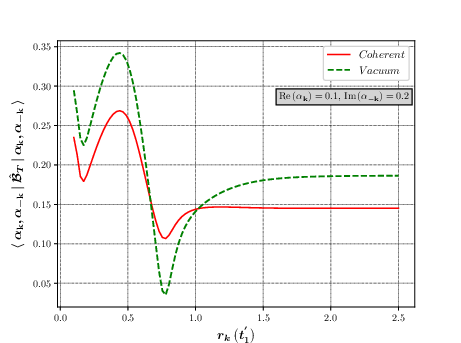
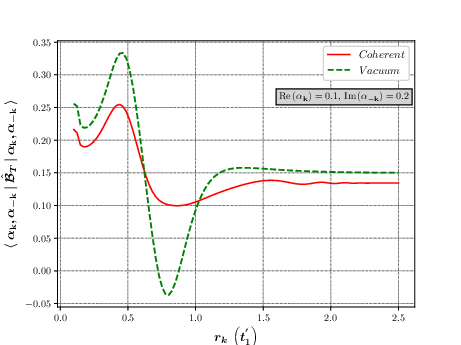
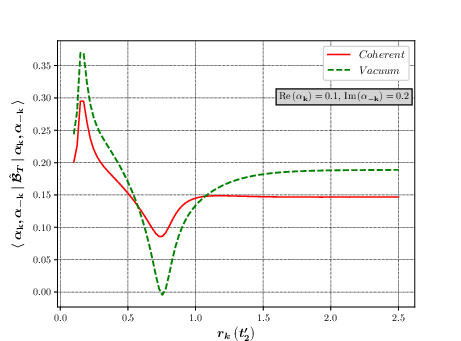
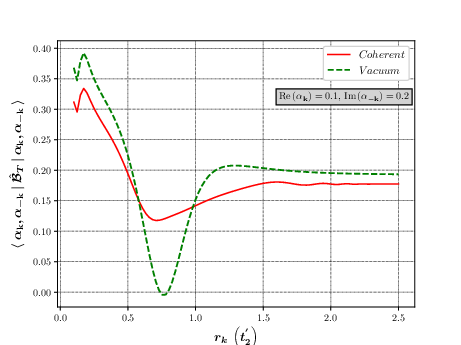
Figure 1: Bipartite temporal Bell operator as a function of squeezing parameters rk(tj), with fixed coherent amplitudes, illustrating the convergence of expectation value to sub-classical bounds in all considered regimes.
An important technical observation is the explicit contribution of a purely imaginary, time-dependent phase factor in the squeezed coherent state normalization to the temporal correlation functions. This dependence is entirely absent in traditional (spatial) Bell scenarios, highlighting a unique signature of the temporal construction.
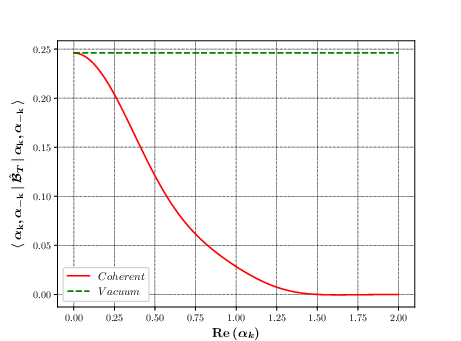
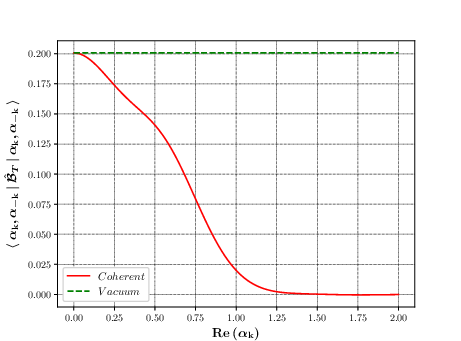
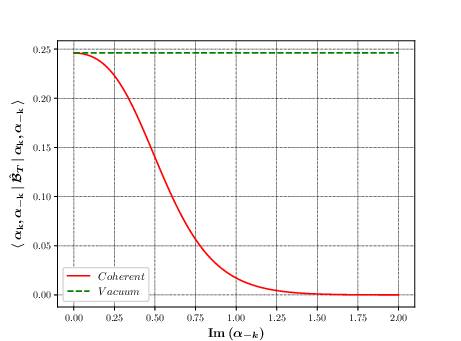
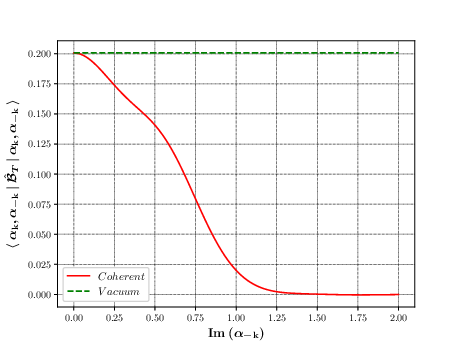
Figure 2: Bipartite temporal Bell operator versus real/imaginary part of the coherent amplitude, at fixed squeezing, showing robustness of non-violation and mild parameter dependence.
Numerically, for large squeezing (late-time or long-wavelength limit relevant at the end of inflation), the expectation value of the Bell operator asymptotes to zero, indicating strong suppression of quantum temporal correlations. This suppression is distinct, and the limiting value remains slightly but measurably different from that of the BD vacuum/squeezed vacuum, thus providing a subtle but operational diagnostic for initial state discrimination—even absent any outright Bell violation.
Implications and Outlook
Cosmological Interpretation
The results show that temporal quantum correlations in inflationary perturbations, as measured by the bipartite temporal Bell operator, undergo decoherence and classicalization during dynamical evolution, precluding violations that would signal robust quantum non-locality in the accessible "post-inflationary" universe. Nevertheless, the precise value and parameter dependence of the operator's expectation can, in principle, distinguish between initial conditions—even when classicality emerges at the level of inequalities.
Quantum Foundations
The explicit role of phase factors tied to measurement times, and their absence in spatial Bell inequalities, suggests further subtleties in the quantum–to–classical transition in cosmology, and in the operational status of "quantumness" beyond Bell violation itself. The work shows that non-violation should not be interpreted as an indicator of classical initial conditions, but as reflecting deeper structural aspects of quantum measurement in cosmological settings.
Future Directions
Reformulation of the entire analysis in terms of real-space observables and connection to CMB data.
Detailed studies of the impact of environmental decoherence, including the quantum-to-classical transition, on the fate of temporal correlations and their possible (suppressed) violations.
Extension of the formalism to interacting (non-Gaussian) inflationary scenarios and alternate initial states beyond coherent and BD vacuum.
Conclusion
This study demonstrates that, for inflationary perturbations initialized in squeezed coherent states, bipartite temporal Bell inequalities are never violated, even though the underlying state remains quantum. The structure and time evolution of temporal correlations are sensitive to phase factors unique to the temporal context, absent in spatial correlations. By evaluating the actual expectation value of the Bell operator rather than solely searching for violations, residual distinctions between initial quantum states can be operationally accessed. These findings point to the nuanced interplay between quantum measurement, cosmological dynamics, and the emergence of classicality, warranting further investigation both theoretically and observationally.
“Emergent Mind helps me see which AI papers have caught fire online.”
Philip
Creator, AI Explained on YouTube
Sign up for free to explore the frontiers of research
Discover trending papers, chat with arXiv, and track the latest research shaping the future of science and technology.Discover trending papers, chat with arXiv, and more.