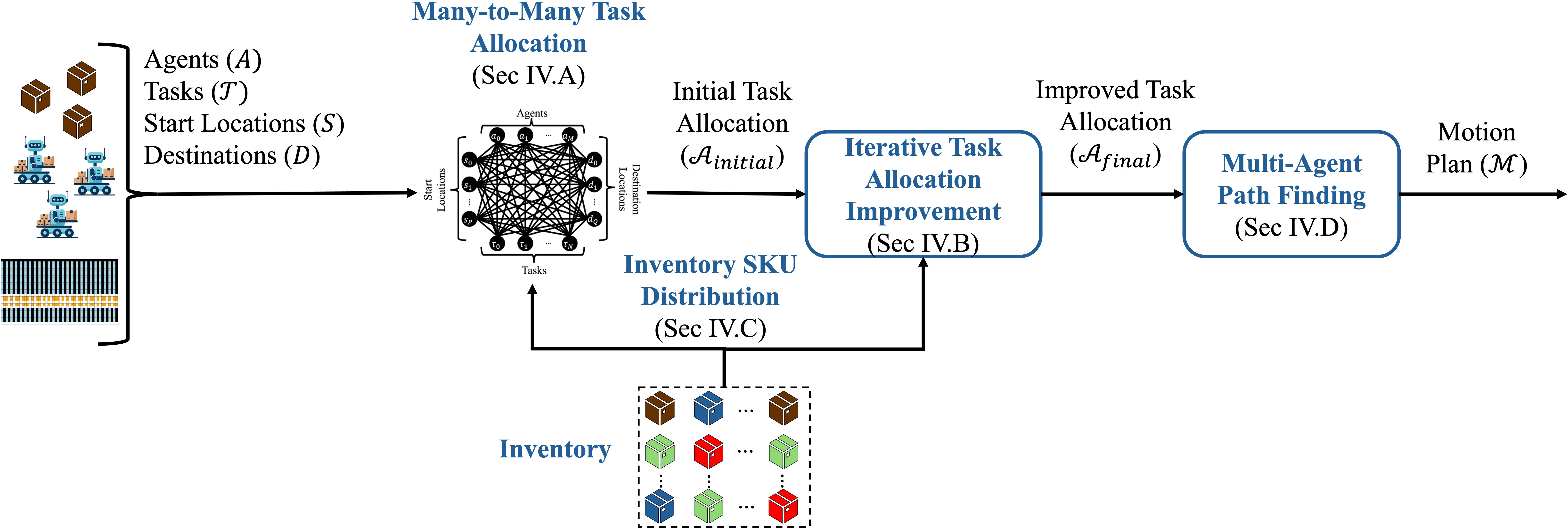
- The paper presents a many-to-many MAPD algorithm (M2M) that significantly improves task throughput compared to one-to-one methods.
- It employs a 4D cost tensor decomposition and a Large Neighborhood Search method to achieve efficient, real-time task allocations.
- Empirical results show robust performance even in high-density warehouse settings, with up to 6% increased throughput over baselines.
Many-to-Many Multi-Agent Pickup and Delivery: A Comprehensive Analysis
Introduction
This work addresses the task allocation and path planning problem for multi-robot systems in automated warehouses under the generalized Many-to-Many Multi-Agent Pickup and Delivery (M2M-MAPD) setting. Unlike traditional MAPD formulations—where each agent is assigned a single task with fixed pickup and delivery locations (one-to-one)—the M2M-MAPD problem more accurately reflects warehouse realities: agents must select among multiple source and destination locations for each SKU, jointly with task and agent selection, resulting in a four-dimensional assignment problem which is NP-hard.
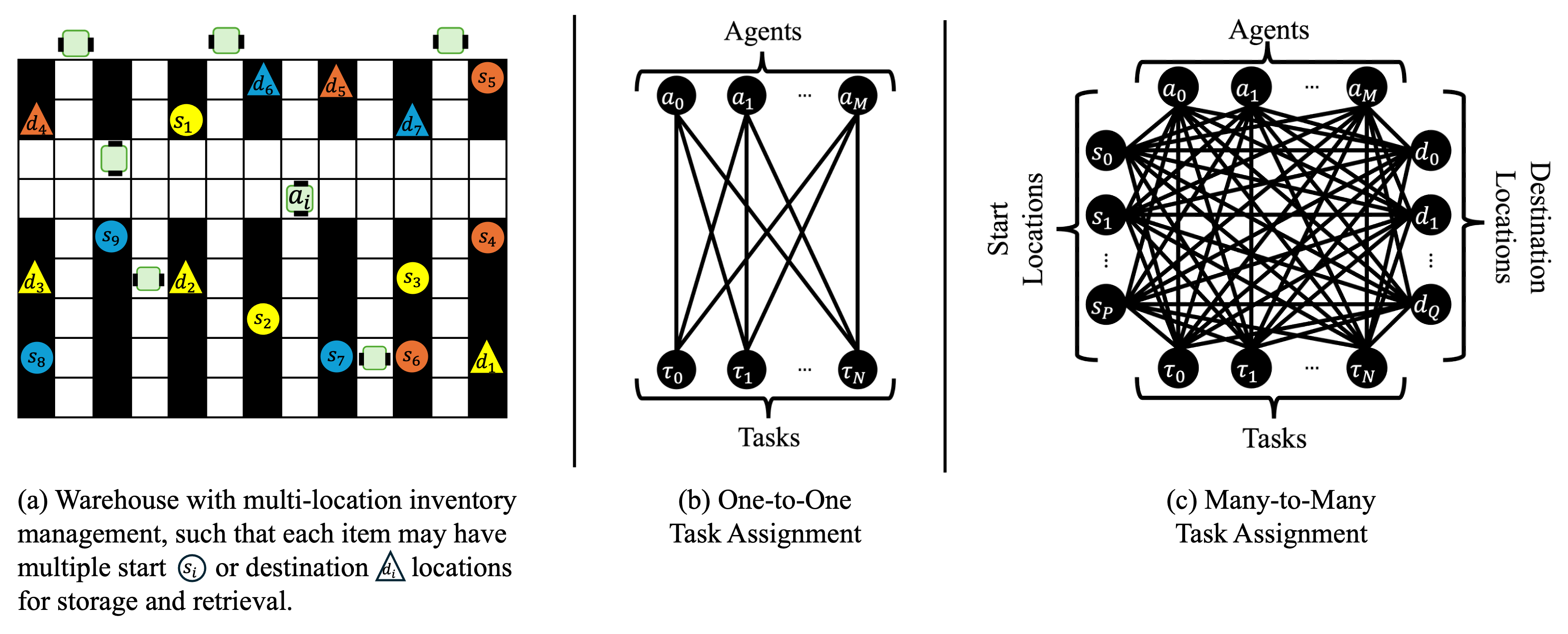
Figure 1: (a) Multi-location inventory management as typically found in warehouses. (b) Prior methods focus on one-to-one allocation, limiting performance. (c) The proposed Many-to-Many MAPD explicitly reasons over agents, tasks, and multiple source/destination locations, yielding significant task throughput gains.
The core contribution is an algorithm—M2M—that computes many-to-many task allocations efficiently for large-scale online systems, leveraging cost matrix decompositions and an LNS-based improvement loop. A key variant, M2M-wSKU, incorporates SKU spatial distribution into the cost function to improve long-term warehouse rebalancing. Both are evaluated in simulation against the state-of-the-art baseline LNS-PBS adapted for many-to-many contexts. The results empirically demonstrate substantial improvements in task throughput and robustness, especially under high-density conditions.
Related Work Contextualization
Prior MAPD approaches have been dominated by the one-to-one paradigm, typically casting the allocation as a 2D problem and relying on Hungarian assignment or TSP reformulations. Recent work, e.g., LNS-PBS, achieves strong empirical performance, but is fundamentally limited when extended to environments with multiple feasible pickup/delivery sites per item. Traditional extensions for higher-dimensional assignment problems (e.g., generalizations of the Hungarian Algorithm, MILPs, or greedy heuristics) do not scale to warehouse-sized domains and are not suited for online operation. Existing MAPF literature addresses collision-free routing but generally presupposes the allocation is fixed in advance.
The authors position their method at the intersection of online task assignment and MAPF, uniquely solving the four-dimensional assignment and motion planning joint problem at scale, with explicit attention to the temporal evolution and spatial distribution of SKUs.
Given a set of agents, tasks (with multiple possible pickups and deliveries), and a dynamic, obstacle-filled grid environment, the objective is to maximize system throughput (tasks/min) while ensuring computational feasibility (per decision window ≤1s). Each agent is permitted a task sequence of bounded length. The M2M allocation is modeled as a four-dimensional cost tensor C∈RM×N×P×Q, with elements quantifying cost of assigning agent-task-source-destination quadruples, accounting for both feasibility and estimated execution duration.
To make the computation tractable, the authors decompose the tensor into suitable submatrices (CAS,CSD,CTS,CTD), enabling an anytime, greedy assignment procedure for initial allocation. This assignment is then iteratively improved via Large Neighborhood Search (LNS):
The finalized allocation serves as input to the MAPF solver; the authors empirically find that segmentwise PBS outperforms ECBS in their complex, dynamic scenarios.
Simulation and Experimental Setup
Experiments are conducted in simulated 27×50 grid warehouse environments with 40 agents, up to 120 active tasks, and 30 unique SKUs, across three canonical layouts (restricted-aisle, open-top, and open-grid). Each 8-hour experiment is repeated ten times per condition, using throughput, computation time, and scalability as metrics.
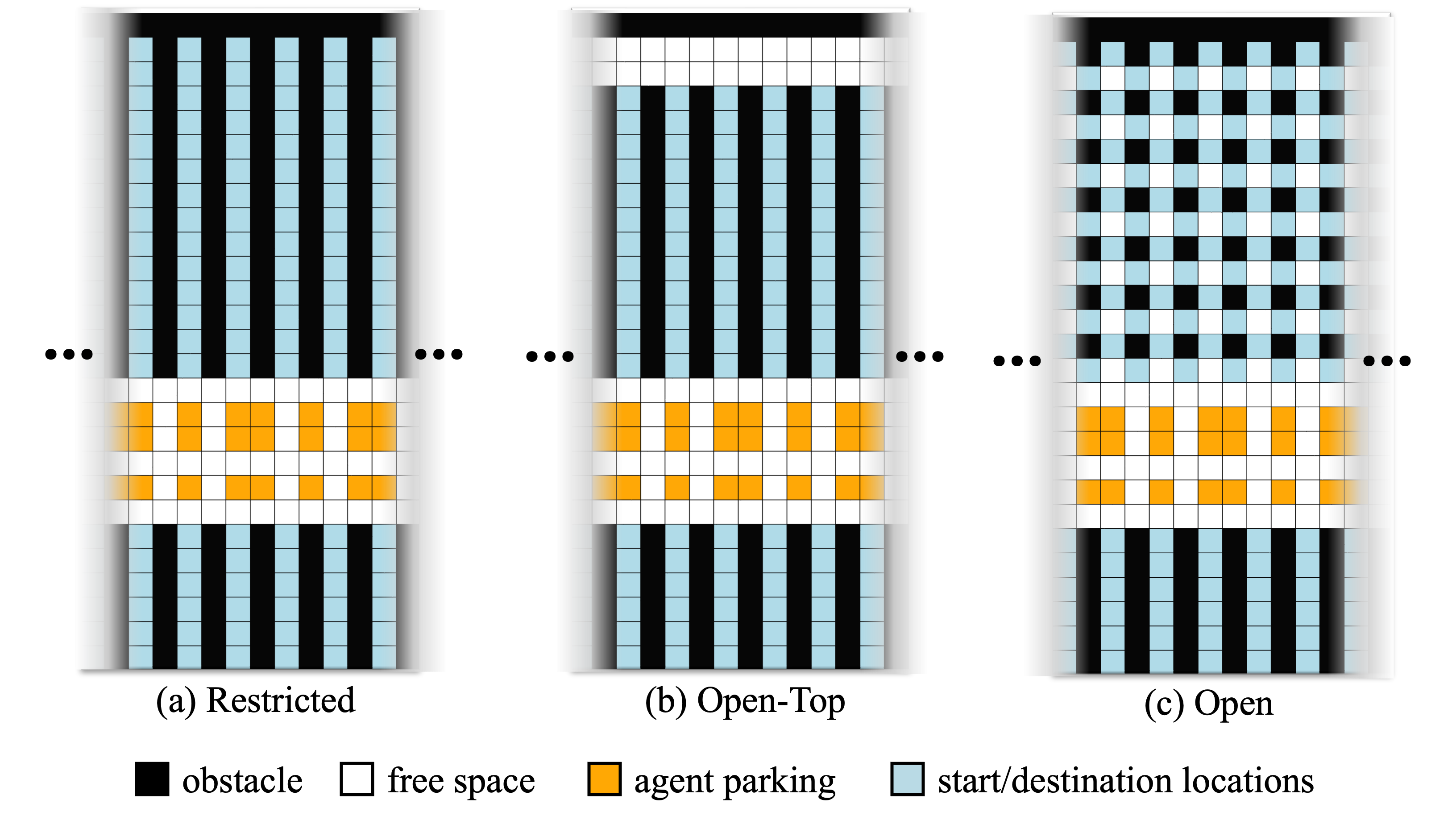
Figure 3: Partial view of the three tested warehouse layouts (restricted, open-top, open); non-obstacle cells are traversable and subject to multi-agent collision constraints.
The M2M and M2M-wSKU algorithms are compared to the LNS-PBS baseline, which is adapted to many-to-many by greedily fixing each (source, destination) pair to minimize local cost—a relaxation that underutilizes the combinatorial richness of the M2M setting.
Empirical Results
Throughput Analysis
M2M surpasses or matches LNS-PBS and M2M-wSKU in task throughput across all tested maps and inventory densities, with maximal differences in restricted and open-top layouts. For example, with 30% inventory density, M2M achieves a 4.95% and 6.13% higher throughput than LNS-PBS in restricted and open-top maps, respectively, totaling several thousand additional completed tasks over 8 hours. Notably, in the open-grid map, where pathing bottlenecks are minimized, M2M and LNS-PBS converge in performance—validating that allocative flexibility confers its greatest advantage under spatial constraints.
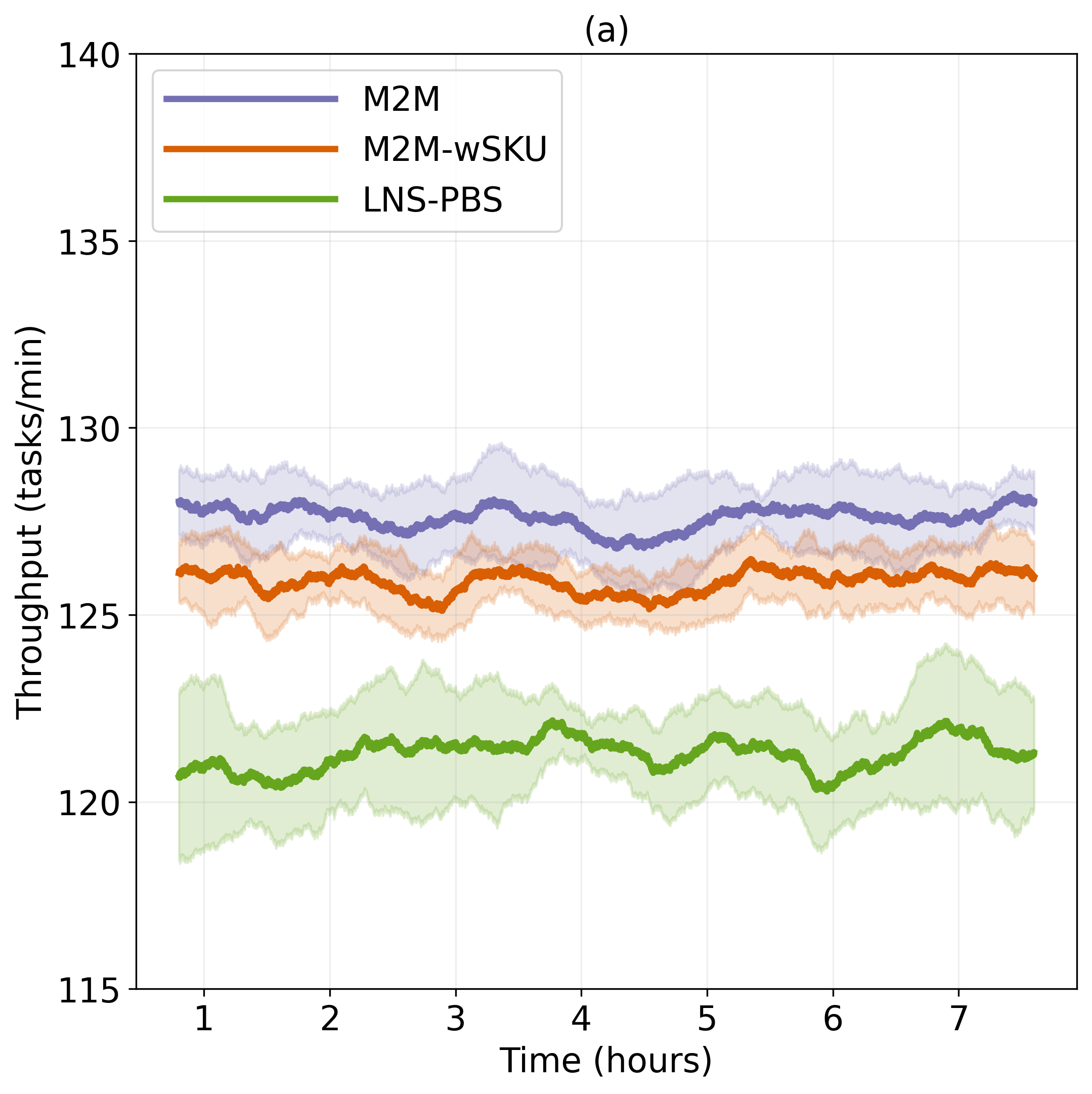
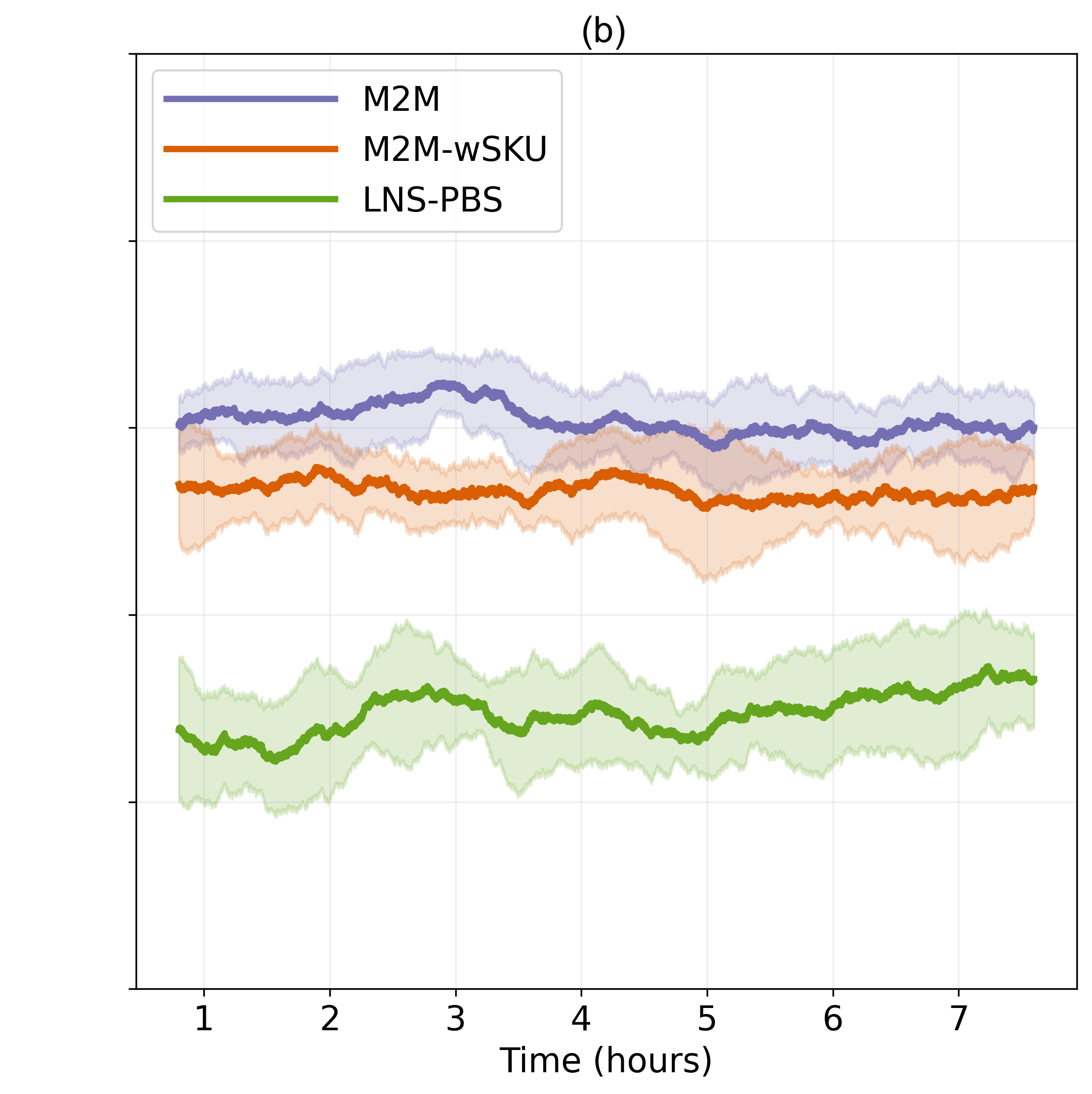
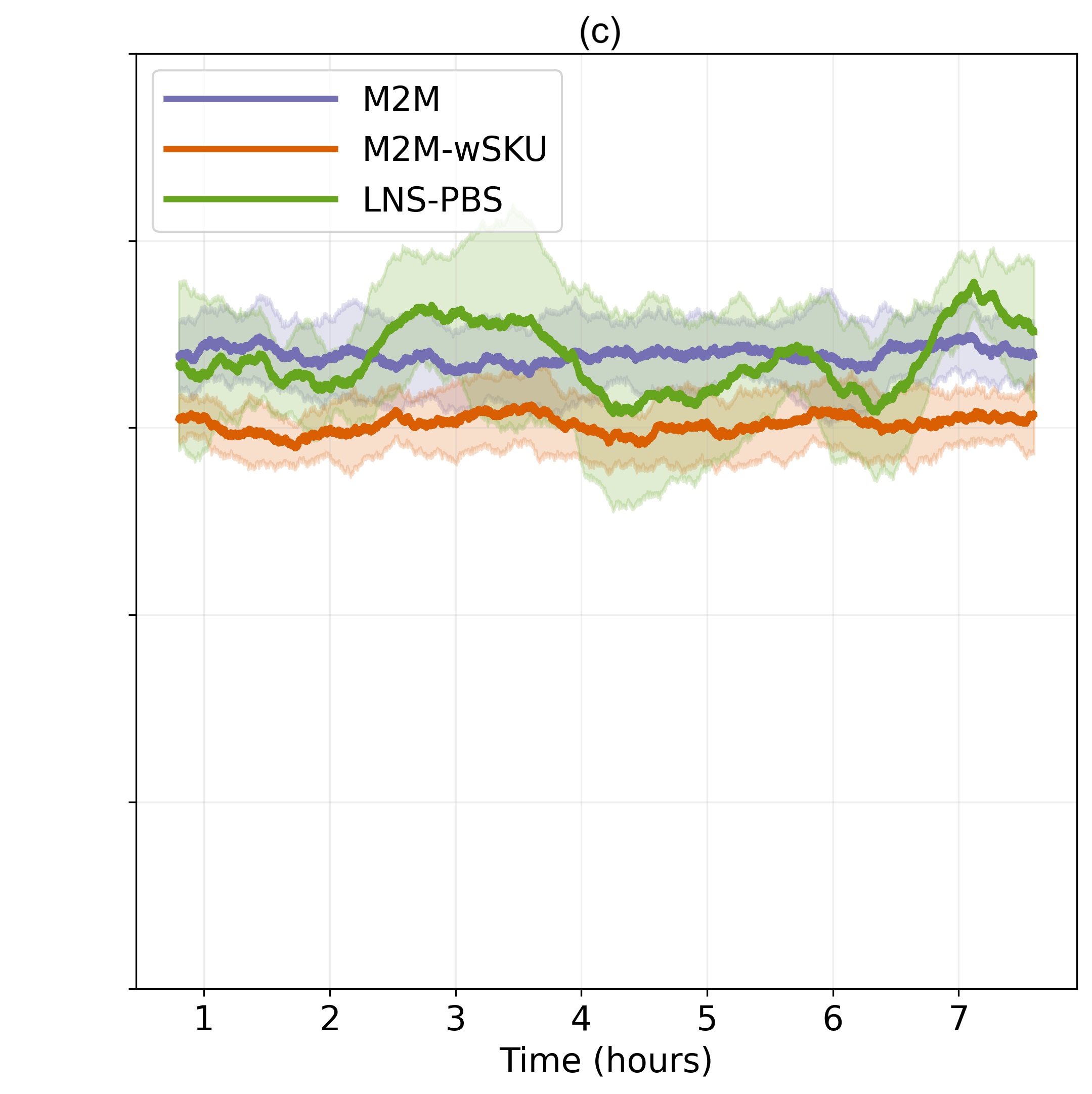
Figure 4: Throughput (rolling mean and standard deviation) across methods and layouts; M2M consistently yields highest mean task completion, especially in constrained topologies.
Inventory Density Sensitivity
M2M maintains robust performance even as warehouse occupancy grows: at 90% density, LNS-PBS suffers a drastic throughput drop (∼39%) due to inflexible, locally optimal allocations that promote congestion; M2M preserves high throughput, completing over 22,000 additional tasks per run at peak density. M2M-wSKU, while outperforming LNS-PBS in high densities, does not surpass vanilla M2M, indicating that aggressive spatial dispersion of SKUs may not be as effective as simple travel-time minimization for short-to-medium horizon throughput.
Computational Efficiency and Scalability
All methods sustain computation times close to the imposed 1s limit per allocation window, with M2M and its variant on par with LNS-PBS. Scalability testing on 27×50 maps demonstrates that M2M handles up to 150 agents and 150 tasks appropriately within the same time frame; for substantially larger maps (61×100), feasibility is maintained up to 50 agents and tasks, with compute time dominated by increased endpoint enumeration.
Implications and Future Directions
The results validate the necessity of solving the full many-to-many assignment problem for realistic warehouse robotics, especially as system size, spatial density, or inventory complexity increases. The M2M framework demonstrates that careful cost matrix decomposition and efficient LNS metaheuristics suffice for online scalability even in high-dimensional assignment spaces. The negligible benefit from explicit SKU dispersion (M2M-wSKU) suggests that for common operational metrics like throughput, minimizing task duration and movement remains a dominant heuristic; however, SKU-aware assignments may still confer long-term benefits for non-throughput objectives, such as maintenance or congestion minimization.
In practical deployments, these findings indicate that logistics operators can realize large throughput improvements by adopting many-to-many reasoning, especially in constrained or heavily utilized facilities. Future research should extend M2M to address dynamic arrival of agents and endpoints, heterogeneous agent capabilities, richer item-specific objectives, congested real-world noise, and richer coordination under uncertainty. Integration with learning-based MAPF and end-to-end policy synthesis may further reduce dependence on explicit combinatorial search as warehouse scales expand.
Conclusion
The M2M and M2M-wSKU algorithms—by explicitly formulating and efficiently solving the Many-to-Many MAPD assignment—demonstrate significant throughput advantages, computational feasibility, and scalability over adapted one-to-one methods in realistic warehouse simulations. The approach's robustness to high density and layout constraints underscores the limitations of legacy assignment pipelines. This paradigm provides a new baseline for online task allocation in multi-agent, multi-endpoint domains, and sets the foundation for further exploration of lifelong multi-agent task and motion planning under combinatorial complexity.