Non-planar corrections in the symmetric orbifold
Abstract: We calculate the non-planar corrections to the anomalous dimensions of certain quarter BPS states in the symmetric product orbifold Sym<sup>N</sup>(T<sup>4). We find that some of the degeneracies in the spectrum for large twist w and large N are lifted by these contributions. We furthermore find signatures of quantum chaos, namely level repulsion and random matrix statistics. This suggests that integrability is only present in the symmetric orbifold in the planar (i.e. large N) limit.
- Beyond the Tensionless Limit: Integrability in the Symmetric Orbifold (2023)
- Non-planar data of $\mathcal N=4$ SYM (2019)
- Hints of Integrability Beyond the Planar Limit: Nontrivial Backgrounds (2009)
- Anomalous dimensions in the symmetric orbifold (2024)
- Non-planar corrections in orbifold/orientifold $\mathcal N=2$ superconformal theories from localization (2023)
- Lifting 1/4-BPS States in $AdS_3\times S^3 \times T^4$ (2021)
- One-Loop Non-Planar Anomalous Dimensions in Super Yang-Mills Theory (2020)
- The large $N$ limit of OPEs in symmetric orbifold CFTs with $\mathcal{N}=(4,4)$ supersymmetry (2019)
- Symmetries of the refined D1/D5 BPS spectrum (2017)
- On non-planar ABJM anomalous dimensions from M2 branes in AdS$_{4}\times S^{7}/\mathbb{Z}_{k}$ (2025)
Summary
- The paper shows that non-planar corrections lift integrable degeneracies in the symmetric orbifold, leading to consistent spectral splittings at order w^0.
- It employs numerical diagonalization of anomalous dimensions to differentiate between bosonic and fermionic quarter-BPS states beyond the planar limit.
- The analysis reveals a transition from Poissonian to GOE level statistics, establishing clear signatures of quantum chaos in the perturbed system.
Non-Planar Corrections and Integrability Breaking in the Symmetric Orbifold
Introduction
The paper "Non-planar corrections in the symmetric orbifold" (2605.06465) provides a detailed analysis of $1/N$ non-planar corrections to the anomalous dimensions of quarter BPS states in the symmetric product orbifold CFT, SymN(T4). This CFT is relevant for the AdS3/CFT2 correspondence at the point dual to tensionless string theory on AdS3×S3×T4 with a single unit of NS-NS flux. The study systematically extends previous planar (large N) analyses, highlighting how the non-planar contributions affect both degeneracy patterns in the spectrum and quantum chaotic properties, elucidating the breakdown of integrability at finite N.
Non-Planar Corrections: Setup and Computational Strategies
The authors focus on perturbing the symmetric orbifold by an exactly marginal operator Φ from the 2-cycle twisted sector. The central observable is the mixing matrix γ~, whose eigenvalues give the anomalous dimensions of certain quarter BPS states. In the planar limit (SymN(T4)0), the spectrum exhibits high degeneracy and phenomena associated with integrability, akin to long spin-chain sectors in 4D SymN(T4)1 SYM, including the existence of an integrable SymN(T4)2-matrix and centrally extended symmetry algebra.
Non-planar corrections, subleading in SymN(T4)3, result from transitions that mix twisted sectors with multi-cycle structure, specifically via three-point functions involving intermediate states created by the action of supercharges on the original BPS sector. These corrections were explicitly computed using conformal perturbation theory, leveraging the structure of symmetric group coverings, and evaluated numerically for twist lengths up to SymN(T4)4.
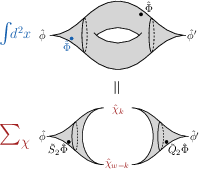
Figure 1: A sketch of the non-planar contributions to the anomalous mixing matrix SymN(T4)5 under the perturbation SymN(T4)6. The corrections are associated with torus-coverings of perturbed two-point functions and map states to multi-cycle twisted sectors.
Lifting of Planar Degeneracies
The main result is that, while the planar spectrum for families of bosonic and fermionic states (specifically, SymN(T4)7 and SymN(T4)8) shows degeneracy at large SymN(T4)9, the inclusion of non-planar corrections lifts these degeneracies, even as 30 increases.
Numerical calculations reveal:
- Planar differences decay as 31: The difference between bosonic and fermionic anomalous dimensions shrinks with increasing 32, consistent with expectations from integrability and the magnon-preserving approximation.
- Non-planar differences persist: The average difference in non-planar corrections remains roughly constant as 33 grows; there is no indication of degeneracy restoration at large twist.
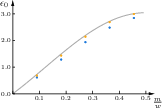
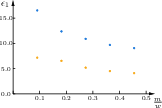
Figure 2: The spectra for the bosonic 34 (blue) and fermionic 35 (orange) states at 36. Left: Planar spectrum, closely following the magnon-approximation dispersion (grey). Right: Non-planar corrections, showing clear deviation and non-degeneracy.
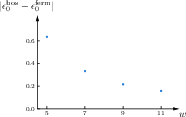
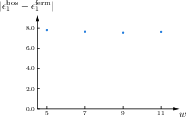
Figure 3: The average bosonic-fermionic difference as a function of 37. Left: Planar spectrum difference decreases for larger 38. Right: Non-planar spectrum difference is insensitive to 39, implying integrability breaking persists for large twist.
These non-planar corrections modify the anomalous dimensions at order 20, and for low-lying eigenstates (which are non-degenerate at planar order), can be obtained by straightforward expectation values of the perturbing operator in the corresponding eigenstates. In situations with degeneracies, the non-planar mixing matrix must be diagonalized within the degenerate subspace.
Mechanisms for Degeneracy Lifting
The paper analyzes, in detail, the structure of the leading non-planar transitions contributing to 21. For both bosonic and fermionic external states, the dominant contributions arise from magnon-number preserving transitions and, notably, a variety of three-magnon (and some higher-magnon) intermediate states. The nature and multiplicity of such intermediate states are structurally distinct between bosonic and fermionic cases, with bosonic (fermionic) cases possessing more (fewer) dominant three-magnon transitions. This asymmetry feeds into the observed spectral splitting.
The difference in dominant contraction types (including subtle effects related to 22 charges and the combinatorics of covering space maps) means that there is no mechanism that would enforce persistence of degeneracy in the full non-planar-corrected spectrum, barring nontrivial dynamical coincidences—which are not observed numerically.
Quantum Chaos and Level Statistics
A significant part of the analysis concerns diagnosing quantum chaos via level statistics. In the planar theory, the spectrum is highly degenerate and the unfolded level spacing distribution obeys Poisson statistics—a hallmark of integrable quantum systems.
Addition of non-planar corrections collapses degeneracies and introduces level repulsion. The authors systematically analyze the level spacing statistics within formerly degenerate subspaces:
- Bosonic case: Non-planar corrections lead to statistics deviating from Poisson but not reaching full Random Matrix Theory (RMT) universality classes (GOE/GUE/GSE). The averaged gap ratio interpolates between the Poisson and GOE values.
- Fermionic case: The unfolded level spacing for non-planar-corrected eigenvalues shows striking agreement with the GOE Wigner surmise, consistent with time-reversal invariant chaos.
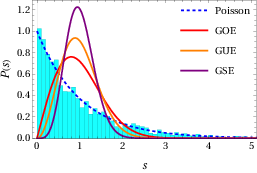
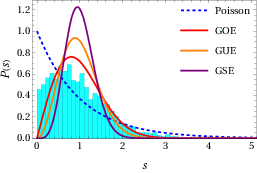
Figure 4: The probability distribution 23 of unfolded level spacings for planar (left) and non-planar (right) bosonic spectrum at 24. Planar: Poisson. Non-planar: clear level repulsion, partial GOE signature.
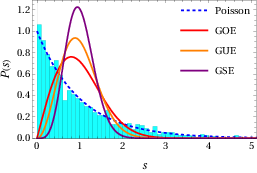
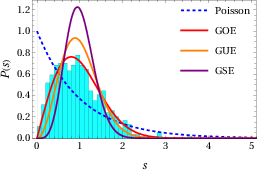
Figure 5: The unfolded level spacing distribution for fermionic spectrum. Planar: Poisson. Non-planar: strong level repulsion, consistent with GOE RMT ensemble.
These results provide robust spectral evidence that non-planar (25) effects not only lift degeneracies but also convert the dynamics from integrable to quantum chaotic, even at relatively small twist 26.
Implications and Outlook
The results demonstrate that the symmetric orbifold CFT, when deformed by exactly marginal perturbations corresponding to R-R flux, exhibits full integrability only in the strict planar (27) limit. 28 corrections break this integrability by lifting degenerate spectra and inducing quantum chaos, as evidenced by RMT-type statistics in the level spacing of anomalous dimensions.
Practical implications include a rigorous understanding of how quantum chaos emerges in holographic CFTs as one departs from special points in moduli space, and insight into the microphysics of black hole-like chaos for states well below the black hole threshold.
Theoretical implications include:
- Non-planar corrections as the driver for breakdown of higher-spin symmetry and associated spectral regularities;
- The connection between non-planar effects, wrapping corrections, and the general breakdown of Bethe ansatz solvability for finite 29;
- The match between level statistics and RMT predictions observed previously in gauge theories and quantum gravity models with black hole duals.
This analysis suggests that a universal phenomenon exists in holographic systems: integrability is an artifact of large symmetry in the strict 3×0 limit, generically lost at finite 3×1, with quantum chaos as the emergent typical behavior.
Conclusion
The authors provide compelling technical and numerical evidence that non-planar corrections in the symmetric orbifold CFT break planar integrability by lifting the degeneracies of quarter BPS states. This effect persists to large twist and is accompanied by signatures of quantum chaos in the spectrum, diagnosed via RMT statistics. These findings concretely establish that the symmetric orbifold, while tractable and integrable in the planar limit due to its higher-spin symmetries, is generically non-integrable and quantum chaotic when non-planar dynamics are included.
The results offer a precise microscopic demonstration of the chaotic-to-integrable transition driven by large symmetry enhancement at special points in holographic moduli spaces and will have significant impact on further studies of non-planar dynamics, BPS chaos, and the statistical features of stringy holographic CFTs.
Paper to Video (Beta)
No one has generated a video about this paper yet.
Whiteboard
No one has generated a whiteboard explanation for this paper yet.
Paper Prompts
Sign up for free to create and run prompts on this paper.
Top Community Prompts
Open Problems
We haven't generated a list of open problems mentioned in this paper yet.
Continue Learning
- How do the non-planar corrections quantitatively influence the spectral splitting of quarter-BPS states?
- What role do magnon-preserving transitions play in the integrability breakdown of the symmetric orbifold?
- How does the numerical approach validate the emergence of quantum chaos in the non-planar regime?
- What implications do these findings have for our understanding of holographic duality in AdS/CFT?
- Find recent papers about non-planar corrections in orbifold CFTs.
Tweets
Sign up for free to view the 1 tweet with 5 likes about this paper.