- The paper demonstrates that even strong higher-order interactions may remain invisible when using standard pairwise modeling on abundance time series.
- It employs a five-step simulation and linear fitting pipeline to compare true higher-order dynamics with inferred pairwise models across low- and multispecies systems.
- Results highlight the need for experimental manipulation and independent data to reliably detect higher-order effects and avoid misinterpretation of ecological interactions.
Higher-Order Interactions in Ecology Can Be Hidden in Plain Sight
Introduction and Motivation
The ecological literature has increasingly emphasized higher-order interactions (HOIs), i.e., non-additive effects arising when the impact of two or more species on a focal species cannot be decomposed into independent pairwise terms. The applicability of HOIs has been explored both empirically and theoretically across ecosystems with an interest spanning stabilizing community dynamics, capturing indirect effects, and reflecting mechanistic complexity beyond pairwise Lotka-Volterra (gLV) models. Despite broad interest, an unresolved issue is whether HOIs can be genuinely inferred from abundance time series, particularly under the idealized conditions of complete, noise-free, densely-sampled data and correct model structure. This paper presents a conceptual and computational analysis showing that, contrary to prevailing intuition, HOIs can often be structurally “invisible” in abundance time series, undermining mechanistic identifiability and potentially leading to misguided ecological interpretations (2605.06301).
Methodological Framework
The authors formalize these issues in the context of second-order (i.e., quadratic) Lotka-Volterra systems, incorporating both linear (pairwise) and quadratic (higher-order) interaction terms. The methodology proceeds by:
- Integrating higher-order Lotka-Volterra dynamics with known interaction structure to generate synthetic abundance time series.
- Estimating per capita growth rates from these series.
- Fitting these rates, restricted to the long-term attractor, to a hyperplane via linear least squares, thus inferring an effective pairwise model.
- Integrating this inferred pairwise gLV model from the same initial conditions.
- Comparing both dynamics (trajectories and attractors), and the inferred versus true interaction coefficients.
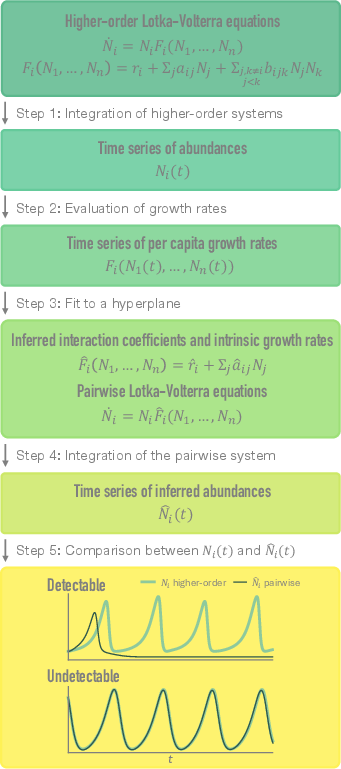
Figure 1: Workflow to assess whether higher-order interactions are detectable from abundance time series.
This five-step pipeline interrogates mechanistic identifiability: can the presence of HOIs be deduced solely from time evolution of abundances, or can pairwise models always be made to fit observed data, thus masking high-order structure? The methodology is systematically applied to low- and higher-dimensional systems.
Results: Detectable and Undetectable HOIs
Low-dimensional Systems
First, the authors analyze three-species ecological modules, focusing on predator-prey-competitor motifs with variable competitive interactions and the addition of explicit HO terms with nontrivial relative weights (θ∼0.18). They demonstrate two scenarios:
- System 1 (Detectable HOIs): The pairwise approximation cannot reproduce key qualitative features such as the nature of the attractor (e.g., limit cycle vs fixed point) nor the time course of species abundances, indicating that HOIs imprint detectable dynamical signatures. This situation allows mechanistic discrimination based on time series alone.
- System 2 (Undetectable HOIs): The pairwise fit replicates the full time evolution and asymptotics of the higher-order system with extremely high fidelity (ρi≈0.99 for all i), despite substantial higher-order coupling. However, inferred pairwise parameters can mischaracterize actual ecological interactions, e.g., reversing the perceived direction of predation or competition.
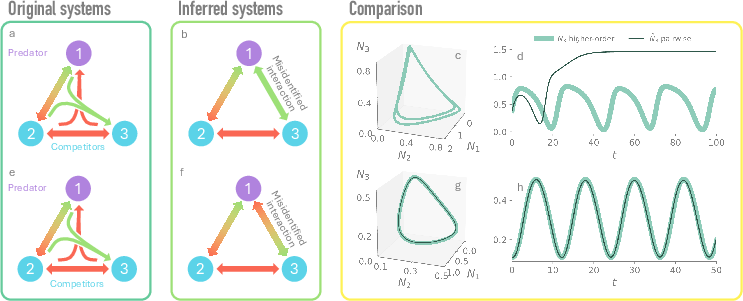
Figure 2: Examples of detectable (system 1) and undetectable (system 2) higher-order interactions, showcasing how inferred pairwise dynamics can either fail or succeed to mimic HOI systems, with crucial consequences for ecological interpretation.
Multispecies Systems
The phenomenon generalizes to more complex systems. For a structured seven-species food web involving multi-trophic predation and competition, the same pipeline yields a pairwise fit that virtually overlays the higher-order time series (ρi>0.99999 for all species), with quantitatively and sometimes qualitatively altered inferred parameters. The fitted pairwise network introduces spurious links and misassigns interaction signs across multiple species, which could substantially mislead ecological inference if not carefully scrutinized.
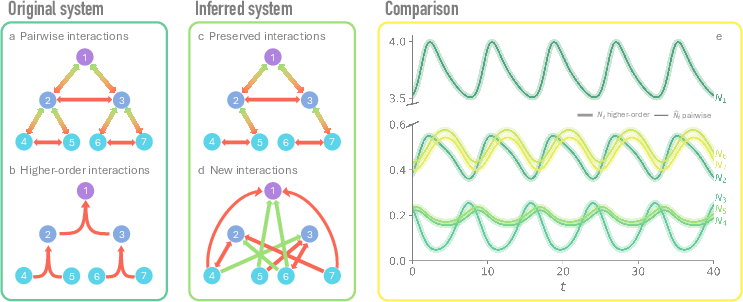
Figure 3: In a multispecies system, the pairwise approximation closely tracks abundance dynamics but significantly alters inferred interaction structure, leading to spurious or misidentified links and misinterpreted ecological roles.
These cases delineate a taxonomy of failure modes: HOIs can be categorically undetectable (dynamically indistinguishable) from time series unless they induce unique dynamic behaviors irreproducible by pairwise models.
Mathematical Analysis: Limits of Local Linearization
A critical analytic contribution is the demonstration that standard sensitivity analyses based on the system Jacobian are insufficient for HOI detection. The presence of HOIs in the underlying dynamics only guarantees changes in the local Jacobian along some trajectories, but the converse does not hold; higher-order terms may not induce any change in the sign or even magnitude of Jacobian elements accessible via observed time series. The required invariant is encoded in the Hessian of per capita growth rates: only if all mixed second derivatives vanish (for distinct species indices) can HOIs be ruled out. Thus, detection or exclusion of HOIs demands explicit access to higher-order differential information along abundance trajectories, a practical impossibility in most empirical systems even with high-resolution data.
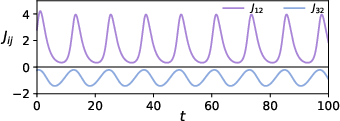
Figure 4: Analytical dissection reveals Hessian matrices—rather than local Jacobians—are the necessary objects for rigorous HOI detection.
Implications for Ecological Inference and Experimental Design
These findings fundamentally restrict empirical strategies that attempt to infer mechanistic interaction structure from time series data alone, including state-of-the-art statistical and machine learning approaches. Further, they expose a tension between prediction and explanation: even if a pairwise model replicates observed abundance dynamics (superior fit by canonical criteria), the mechanistic content and explanatory utility may be spurious. Parameter inference is shown to be structurally non-identifiable—a property also encountered in complex network theory and systems biology—unless augmented by orthogonal information.
This limitation implies that robust detection of HOIs must leverage experimental manipulation—such as response surface designs manipulating triple or higher-order species combinations—or independent mechanistic knowledge, e.g., life history or trait data, that escapes reduction to effective pairwise terms. However, the combinatorial explosion of the experimental design space with system size rapidly exhausts feasibility for exhaustive characterization.
Consequences for Theory and Further Directions
From a theoretical perspective, the paper’s results resonate with recent work on model reducibility, data-driven reconstruction of higher-order network structure, and the practicability of “lumping” high-order effects into pairwise approximations in evolutionary game theory, complex networks, and dynamical systems [e.g., (Llabrés et al., 8 Jan 2026); (Lacasa, 25 Feb 2026); (Peixoto et al., 18 Feb 2026)]. There is an urgent need to systematize which classes of HOI models admit such reductions, and to mathematically characterize the phase space boundaries where dynamic equivalence breaks down—that is, where time series evidence for HOIs is robust.
Furthermore, these findings re-illuminate Occam’s razor in a mechanistic context: simplicity in model fitting does not equate to explanatory adequacy. In this view, the inclusion of higher-order terms in dynamical models must be justified not solely by improved fit but by auxiliary evidence for mechanistic necessity.
Conclusion
This work establishes that HOIs can remain “hidden in plain sight”—structurally undetectable via high-resolution time series of abundances—even when they shape ecological outcomes. This non-identifiability is both theoretically robust and empirically consequential, as it warns against naïve inference from pairwise models regardless of goodness-of-fit. A rigorous route to HOI detection requires integration of independent data sources, expanded experimental manipulation, and careful attention to the distinction between dynamic replication and mechanistic explanation. The mathematical results further direct future research in ecological dynamics and statistical inference, both in the theory of model reduction and in the construction of protocols for mechanistic discovery (2605.06301).

