- The paper directly observes the Dirac magnon winding at the K-point in CrI3 using high-resolution inelastic neutron scattering.
- It quantifies a T² thermal softening of magnon energies with power-law exponents that corroborate interacting spin-wave models.
- The findings establish CrI3 as a prototypical 2D ferromagnet for exploring topologically nontrivial magnon behavior and thermal interaction effects.
Winding Feature and Thermal Renormalization of Dirac Magnons in CrI3
Introduction
The emergence of topological bosonic excitations in two-dimensional (2D) van der Waals magnets has established a fertile platform for exploring quantum magnetism and nontrivial band topology. CrI3, a 2D honeycomb ferromagnet, is a particularly salient system due to its robust ferromagnetic order persisting down to the monolayer limit and its capacity to host Dirac magnons—the magnetic analogs of Dirac fermions in graphene. Inelastic neutron scattering (INS) is the canonical probe of magnonic band topology, but previous measurements in CrI3 were hindered by mosaic sample quality insufficient to resolve subtle topological signatures, such as the magnon intensity winding at the K-point of the Brillouin zone.
This work addresses those deficiencies by leveraging high-quality, coaligned CrI3 single crystals. The primary contributions are the direct observation of the Dirac magnon winding feature around the K-point and a comprehensive quantitative investigation of the temperature-induced renormalization of the magnon spectrum, with both experimental results and analysis resolving longstanding questions in the topological magnonics field.
Experimental Approach
State-of-the-art chemical vapor transport growth produced high-quality CrI3 crystals, which were carefully characterized via X-ray Laue diffraction and magnetization measurements. The INS experiments were conducted on the SEQUOIA spectrometer at ORNL, with nearly 0.7 g of coaligned crystals strained ∼1% to maximize reciprocal space coverage and resolution. Spectra were acquired along high-symmetry directions using incident energies optimized for both high-flux and high-resolution operation.
Magnon Dispersion and Topological Winding at the K-point
The measured magnon dispersion along the [H,H] direction at 5 K clearly resolves the Dirac magnon gap at the 30-point (energy 3112 meV), consistent with theoretical and prior experimental expectations. Critically, the gap magnitude—322 meV—is robust to perpendicular momentum integration width, and unaffected by the application of modest in-plane strain.
Analysis of constant-energy momentum cuts reveals contrasting intensity distributions above (14 meV), near (12 meV), and below (10 meV) the Dirac gap. At 14 meV, intensity concentration forms around the 33-points outside the first Brillouin zone, while at 10 meV the pattern shifts inside, yielding a phase-shifted angular dependence in the intensity around the 34-point. Quantitatively, the intensity follows a cosine dependence on the winding angle, with a distinct phase shift between energies above and below the Dirac gap, unambiguously establishing the topological winding feature predicted for Dirac magnons.
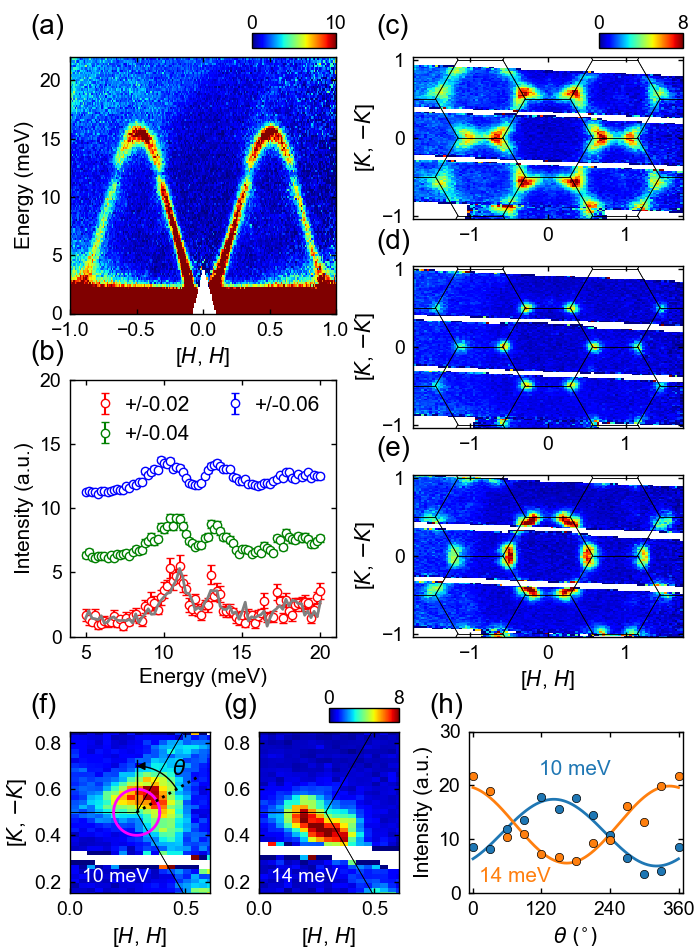
Figure 2: INS spectra and analysis highlighting the magnon winding feature and Dirac gap at the 35-point in CrI36.
This momentum-space texture demonstrates not only the existence of Dirac magnons but directly reveals the internal phase structure of magnon eigenvectors—providing an experimental fingerprint of topological magnon bands inaccessible to earlier, lower-quality measurements.
Temperature Evolution and Magnon-Magnon Interaction Effects
The temperature dependence of the magnon spectrum was mapped via energy-momentum slices connecting equivalent 37 points up to 80 K. At low temperatures (10 K), magnons exhibit sharp, well-defined dispersions. Approaching and surpassing the Curie temperature 38 K, the magnons become increasingly broadened and soften considerably; by 80 K, well above 39, the spectral features are overdamped and lose quasiparticle coherence.
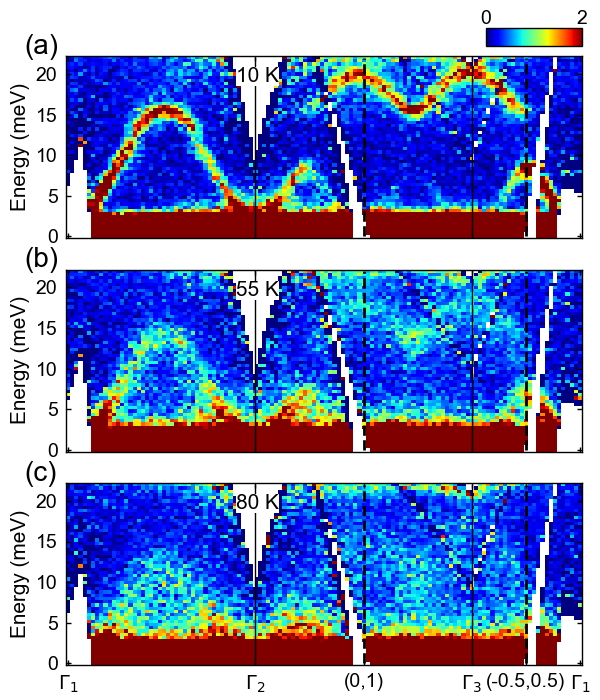
Figure 1: INS spectra showcasing the sharpness and progressive broadening/softening of magnon modes across the ferromagnetic transition.
Detailed evaluation of magnon peak energies as a function of temperature at representative wavevectors reveals a consistent 30 softening:
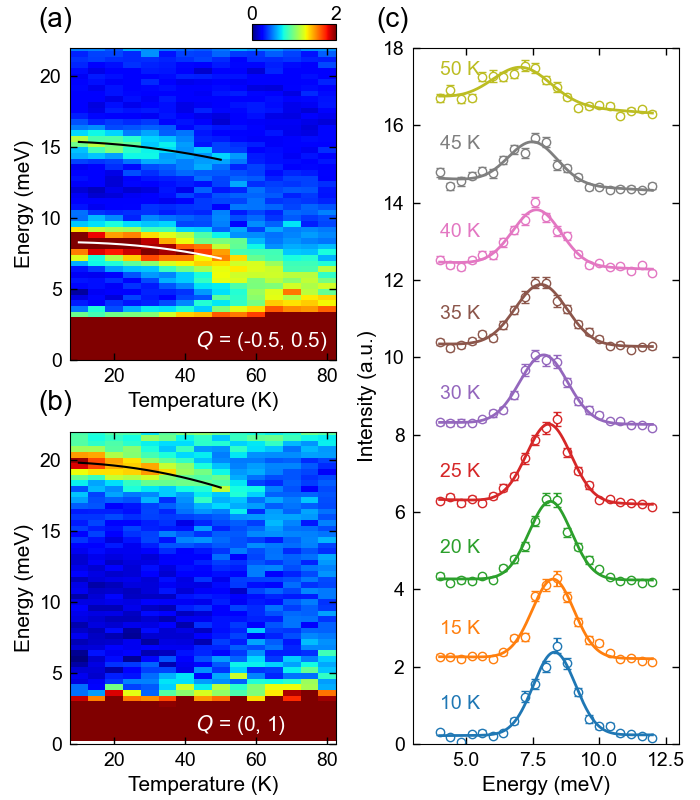
Figure 3: Thermal renormalization of magnon energies and linewidths, fit to 31 power-law forms, indicative of strong magnon-magnon interactions.
The extracted power-law exponents 32 for different magnon branches are 33, 34, and 35, matching predictions from interacting spin-wave models [PershogubaPRX2018]. The data imply that magnon-magnon interaction effects dominate the thermal renormalization, especially close to 36, and confirm that both topological and interaction-induced features coexist in this platform.
Implications and Prospects
This work completes a rigorous experimental characterization of Dirac magnons in CrI37, providing simultaneous verification of both the phase-winding feature around the 38-point and the 39-dependent softening of magnon branches with increasing thermal occupation. These results substantiate the theoretical modeling of honeycomb ferromagnets as Dirac magnon systems with strong magnon-magnon interactions and set a benchmark for future studies of temperature-driven topological and interaction phenomena in 2D magnetic materials.
On a practical level, the experimental identification of these features in a canonical van der Waals magnet underlines the feasibility of magnonic devices exploiting topological protection and interaction-controlled tunability. From a theoretical perspective, the findings bridge the gap between model predictions for topological bosonic excitations and experimentally measurable neutron-scattering signatures.
Looking ahead, further explorations can focus on the interplay of external stimuli (strain, pressure, magnetic/electric fields) with magnon topology, the role of higher-order interactions and noncollinear spin textures, and the extension to other material platforms—including systems with alternative symmetry classes or additional band degeneracies. Probing non-equilibrium magnon dynamics and the influence of dimensionality reduction to monolayer/heterostructure devices are particularly promising directions.
Conclusion
Through high-resolution inelastic neutron scattering on optimized CrIK0 single crystals, this work achieves direct observation of the Dirac magnon winding feature at the K1-point and quantifies the K2-renormalization of magnon energies due to magnon-magnon interactions. These results conclusively establish CrIK3 as a prototypical host of topologically nontrivial magnons and provide a foundational experimental reference for studying bosonic band topology and interactions in 2D quantum magnets.