- The paper presents an iterative neural method that recasts high-dimensional PIDE solving as recursive regression tasks, enabling global solutions for nonlocal terms.
- It employs an expectation-free operator and directional differentiation to reduce computational complexity, achieving low mean absolute errors even in 100 dimensions.
- Validated on both linear and nonlinear PIDEs, INEUS outperforms traditional PINNs and BSDE-based methods, offering scalable solutions for finance and control applications.
INEUS: Iterative Neural Solver for High-Dimensional PIDEs
Introduction and Context
The paper presents INEUS, an iterative neural method for solving high-dimensional, potentially nonlinear partial integro-differential equations (PIDEs). Traditional mesh-based numerical techniques, such as finite differences and elements, exhibit exponential complexity growth with the state-space dimension, resulting in severe computational intractability for high-dimensional PIDEs. Neural network-based techniques have demonstrated promise in overcoming these limitations, particularly Physics-Informed Neural Networks (PINNs) and BSDE-based approaches; however, current methods either struggle with nonlocal terms (in PINN-based formulations) or fail to provide global solutions (in BSDE-based methods). The INEUS framework effectively combines the strengths of both paradigms to enable meshfree, globally valid solutions for high-dimensional PIDEs with improved efficiency and scalability.
Methodology: Recursive Neural Regression for PIDEs
The INEUS algorithm recasts the PIDE-solving task as a sequence of recursive regression problems, utilizing expectation-free targets based on single-jump sampling. Consider the generic PIDE:
∂tu+F(t,x,u,∇xu,∇x2u)+I(t,x,u)=0
where I comprises nonlocal jump terms of the form
I(t,x,u)=λ(t,x)Eν[ℓ(u(t,x+γ(t,x,E))−u(t,x))]
INEUS introduces the expectation-free operator Gξ, which replaces explicit integral evaluation with single-jump sampling:
Gξ(t,x,e,u)=u(t,x)+ξ[∂tu(t,x)+F(⋯)+λ(t,x)ℓ(u(t,x+γ(t,x,e))−u(t,x))]
The neural network parameters are updated by iteratively minimizing the regression loss:
θ(k+1)=θargminE[(uθ(Y)−Gξ(Y,E1,uθ(k)))2]
where (Y,E1) jointly sample space-time and jumps. The hPINN architecture is used to enforce boundary and terminal conditions via hard constraints, as in:
uθ(t,x)=A(t,x)+B(t,x)vθ(t,x)
where B(t,x) smoothly vanishes on the boundary.
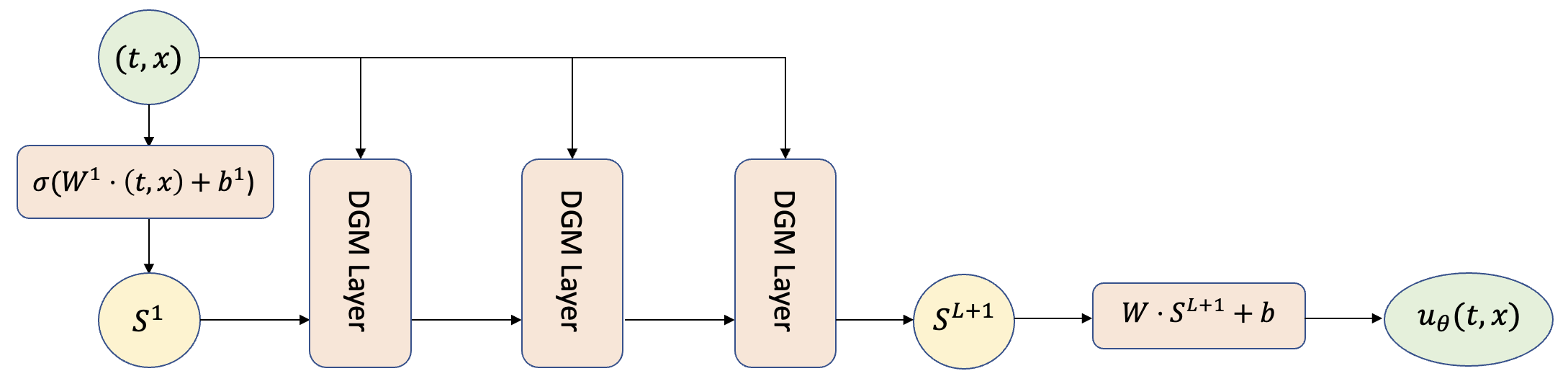
Figure 1: DGM architecture of the neural network uθ with I0, exemplifying four hidden layers supporting high-dimensional function approximation.
Theoretical Foundations and Convergence Analysis
The paper rigorously proves that INEUS converges (under suitable assumptions) to the unique solution of linear PIDEs via contraction mapping, grounding the recursion in the Feynman–Kac representation. Fixed points of the recursive regression operator correspond to the PIDE solution, and a relaxed variant (Polyak-type averaging) enhances stability. For nonlinear PIDEs, while the underlying semigroup structure does not directly apply, the algorithm carries over, corroborated by empirical results.
Strong contraction guarantees are provided, quantifying the rate and modulus of convergence, and expansions are derived to control approximation errors. For computational efficiency, directional derivatives are used to reduce the complexity of evaluating second-order differential operators, alleviating the burden of third-order backpropagation in conventional PINN approaches.
Computational and Numerical Results
The numerical evaluation encompasses linear and nonlinear PIDEs of up to 100 dimensions, including quadratic terminal condition cases, nonlinear Hamilton–Jacobi–Bellman equations, and Black–Scholes PIDEs with jump and default risk. Several benchmarks indicate strong quantitative performance:
- For a 100-dimensional linear PIDE with explicit solution:
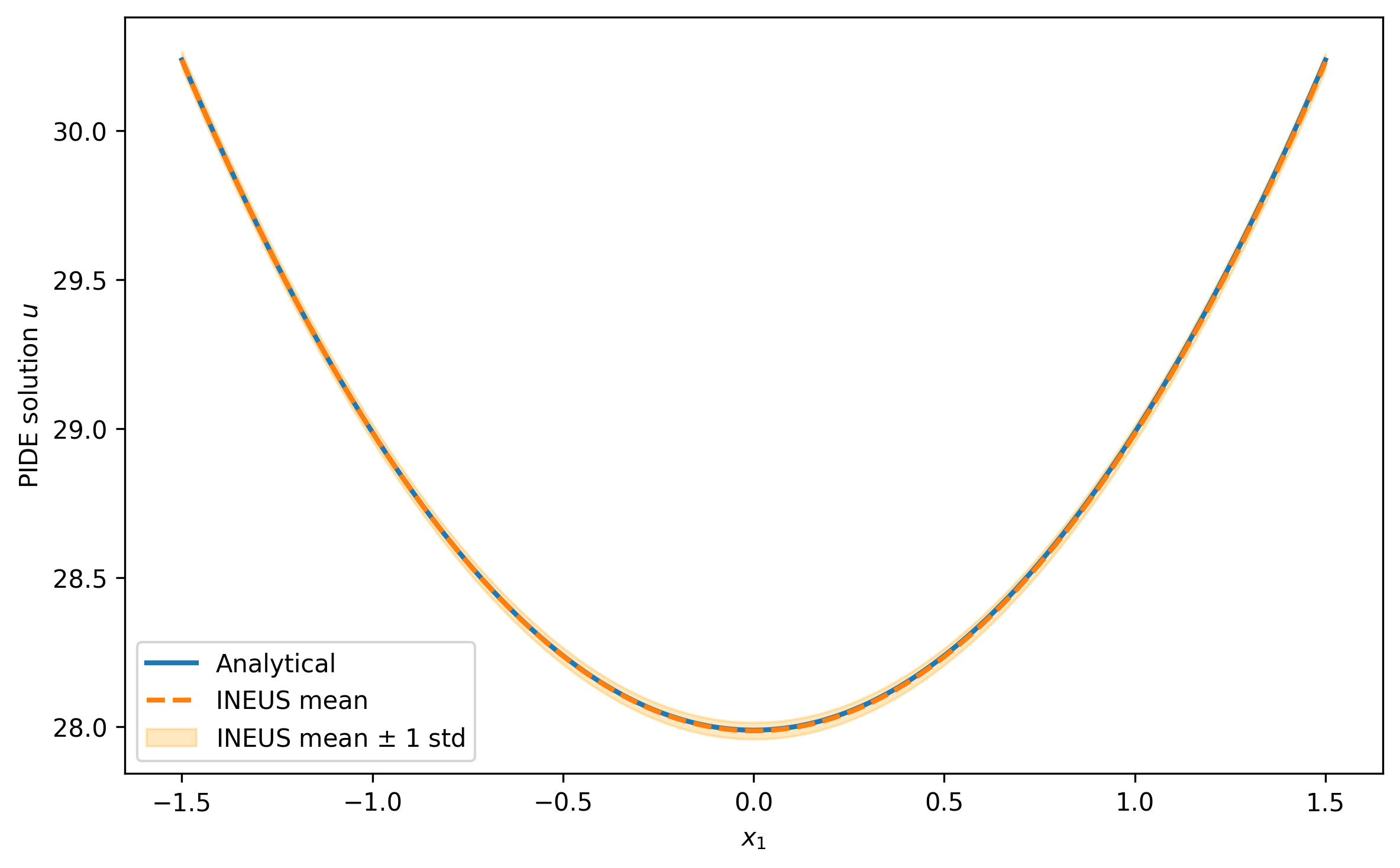
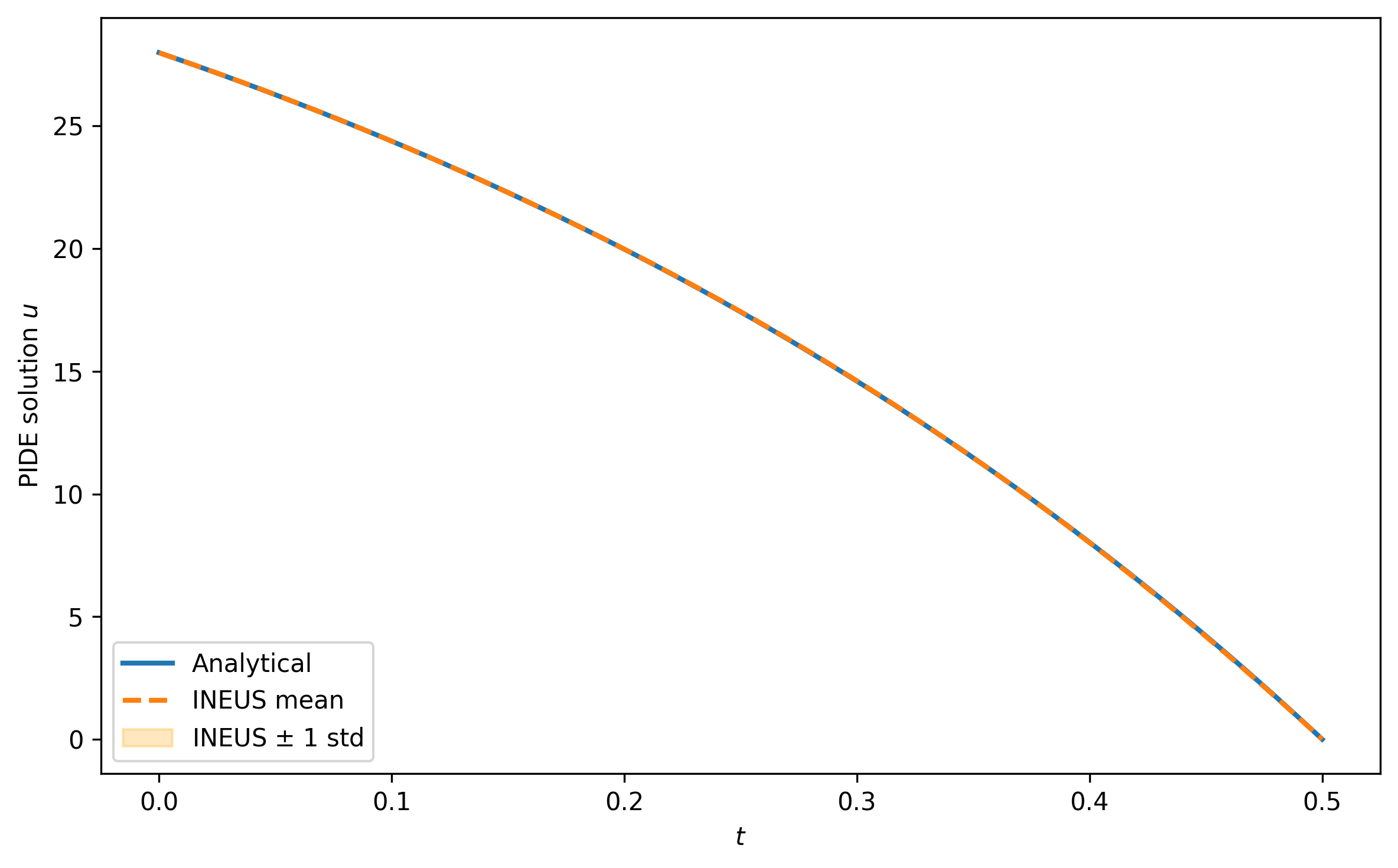
Figure 2: PIDE solution I1 for I2 and I3 for I4, I5; orange denotes INEUS numerical results with uncertainty, blue the analytical solution.
Mean absolute errors (MAE) are consistently low (e.g., MAE I6 in I7), and computation times remain sublinear with dimension, confirming scalability. INEUS outperforms PINN and BSDE-based solvers in both convergence speed and runtime efficiency for local and nonlocal problems:
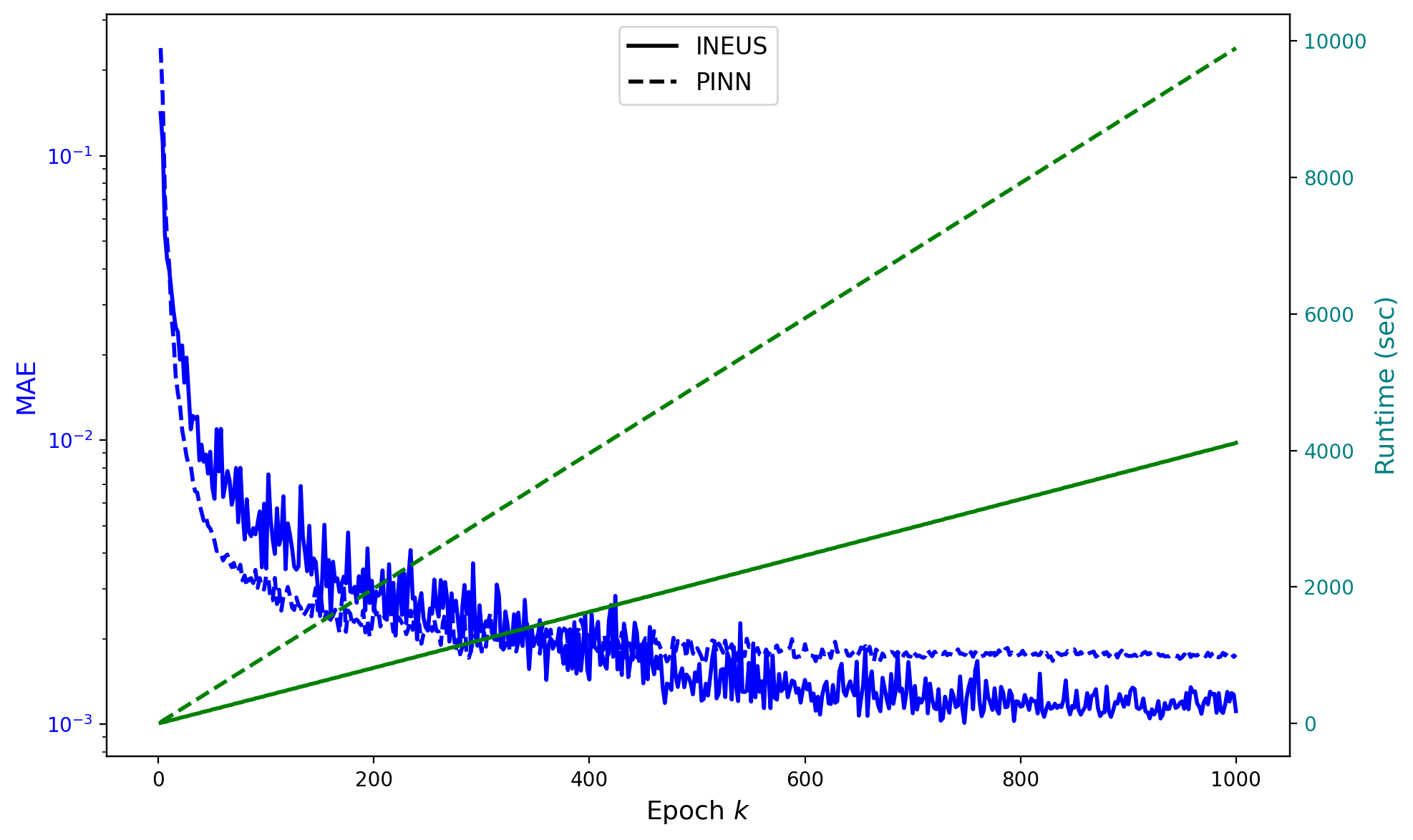
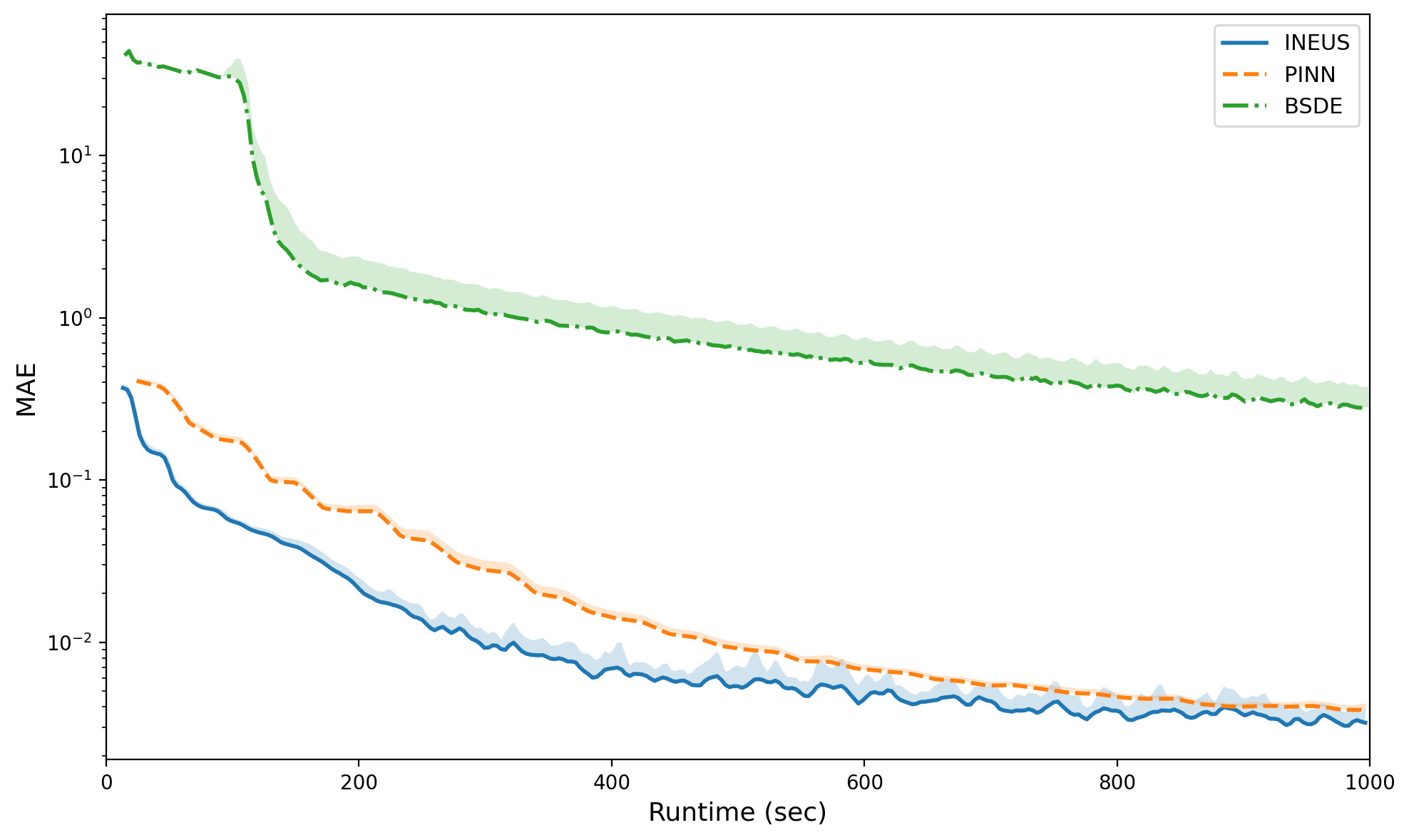
Figure 3: Left panel: comparison of MAE and runtime for INEUS vs PINN in 10-dimensional linear PIDE; right panel: MAE vs runtime for INEUS, PINN, and deep BSDE approaches.
For PDEs and PIDEs without jumps, the recursive INEUS approach achieves lower MAE and significant computational savings compared to residual-based PINNs.
The method is also tested on nonlinear PIDEs with nontrivial terminal and boundary conditions, such as the control-oriented Hamilton–Jacobi–Bellman case and nonlinear Black–Scholes with jumps and default risk. Results consistently show that INEUS retains accuracy and efficiency for global solutions over the full space-time domain.
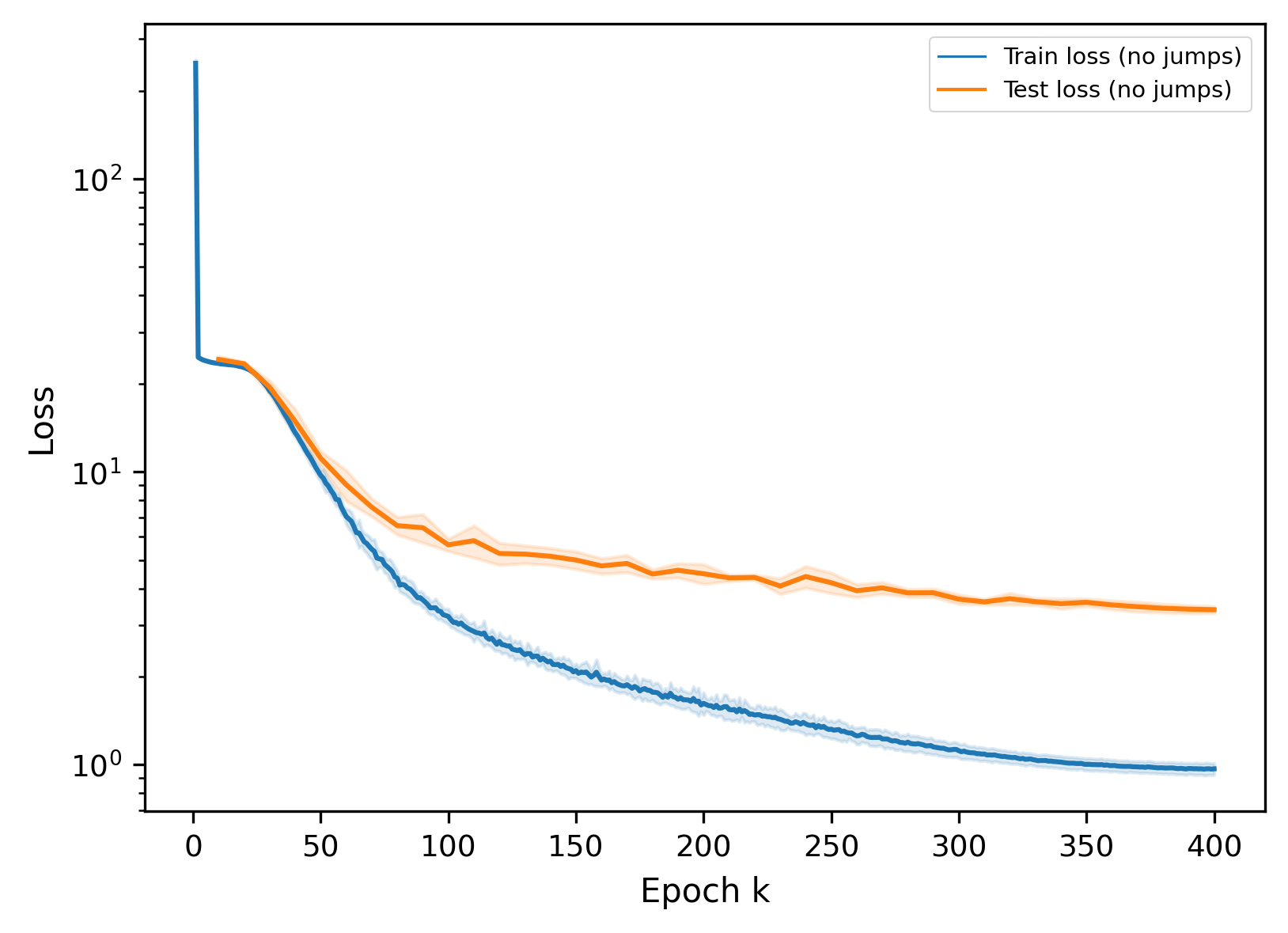
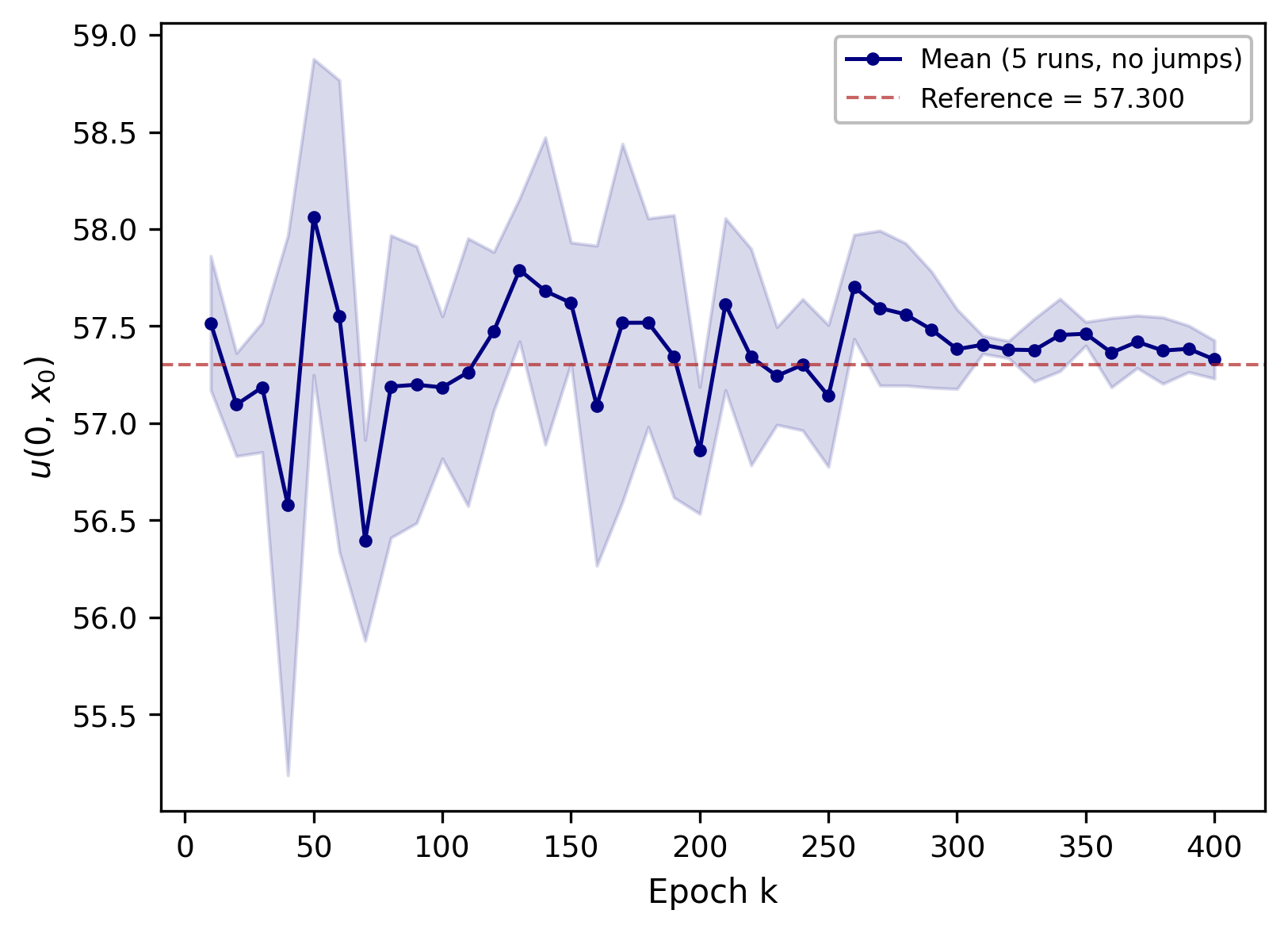
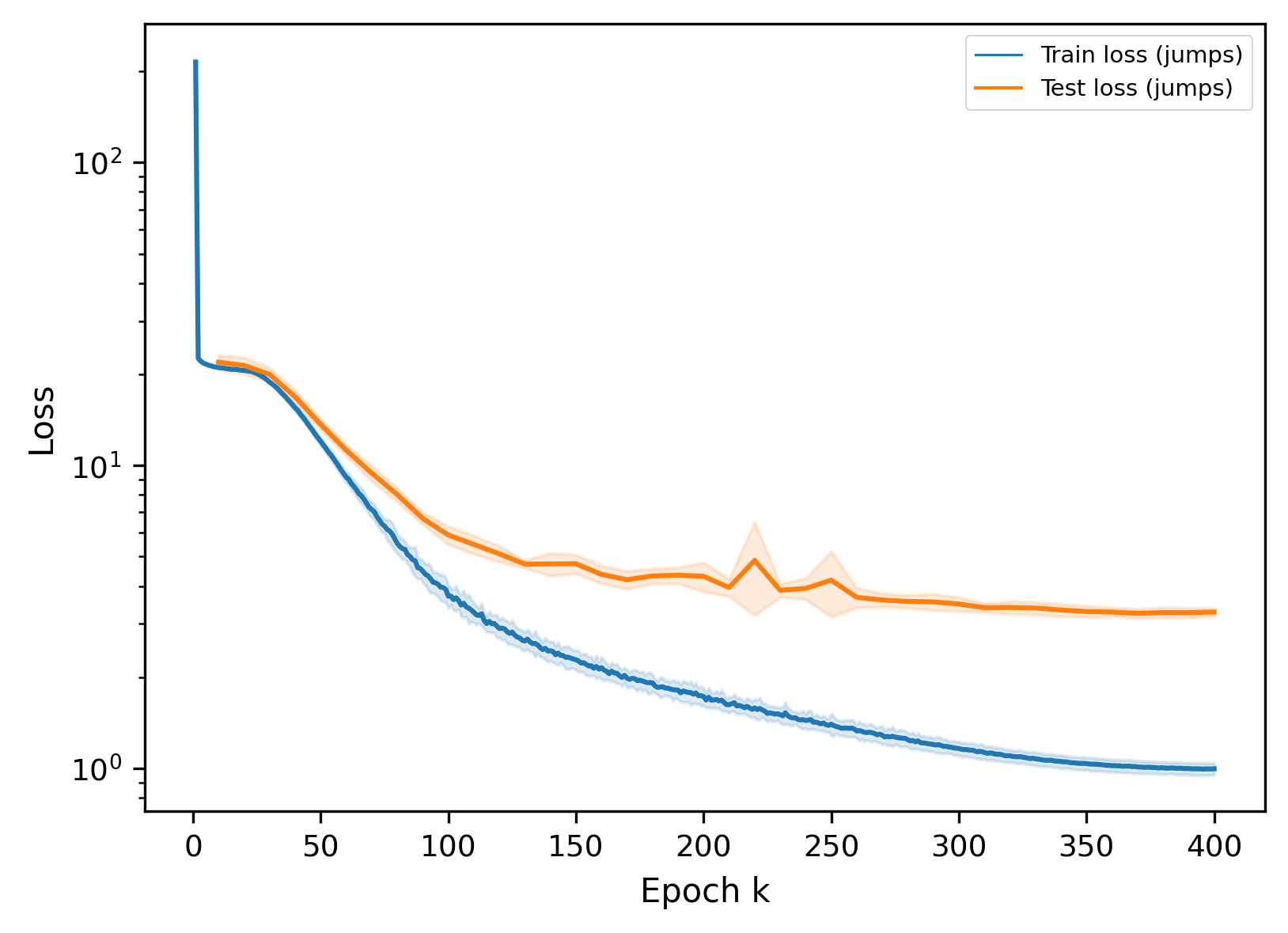
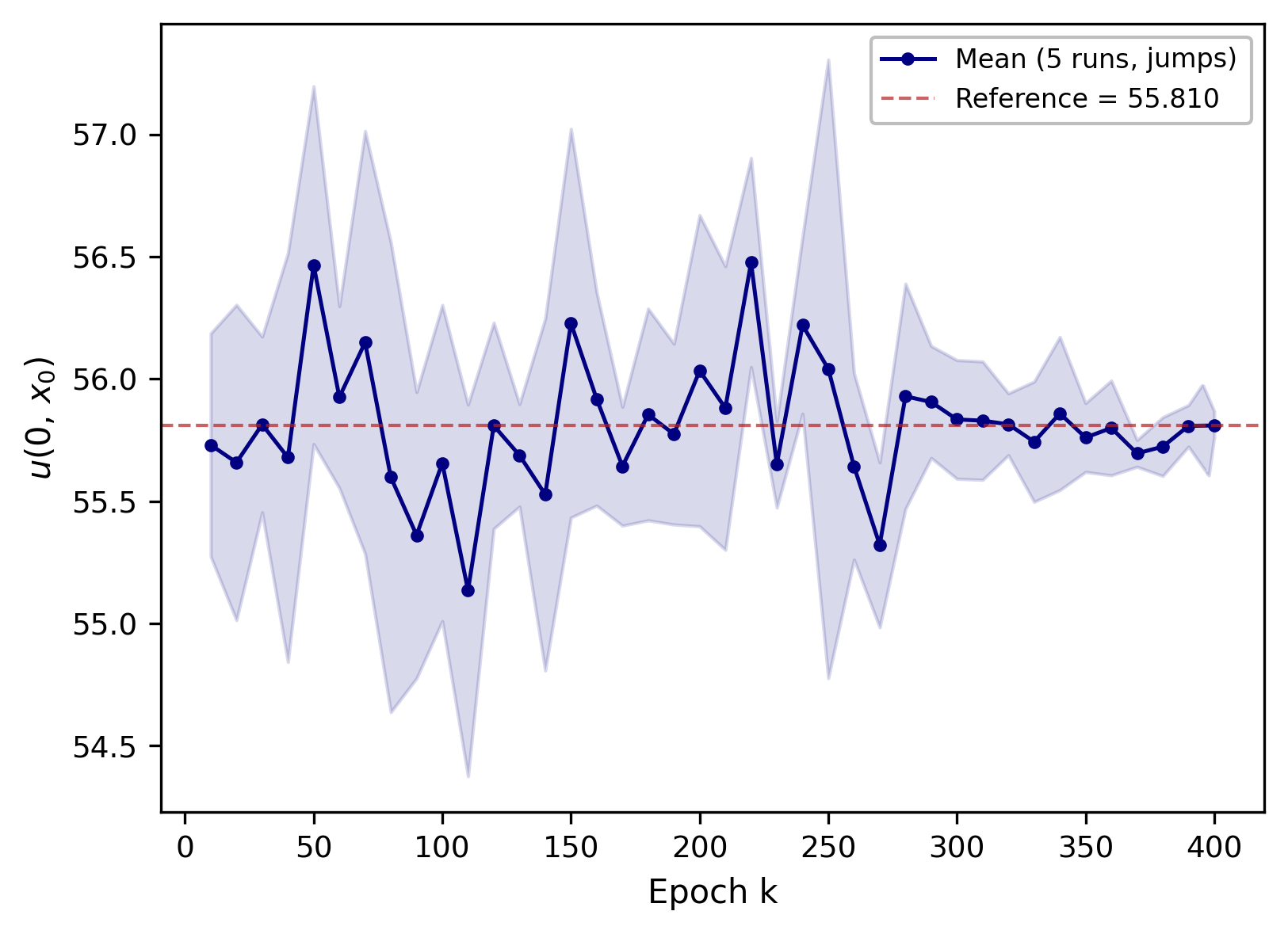
Figure 4: INEUS applied to the 100-dimensional nonlinear Black–Scholes equation, comparing trajectory predictions for diffusion-only and jump-inclusive cases against reference solutions.
Implementation Highlights
- The meshfree training procedure enables avoidance of space-time discretization, vital for high-dimensional scalability.
- Variance control in single-jump sampling ensures that stochastic approximation errors remain commensurate or below those of conventional Monte Carlo estimation, especially with appropriately chosen scaling parameters.
- Directional differentiation reduces computational complexity, making Hessian evaluation tractable for high-dimensional coefficients.
- Empirical robustness with respect to hyperparameters and sampling measures is demonstrated; adaptive sampling (RAD) further improves convergence.
Implications and Future Directions
Practically, INEUS enables efficient, global solution of high-dimensional PIDEs arising in finance, control, and scientific modeling—domains where traditional methods fail due to the curse of dimensionality. Theoretically, the method advances understanding of neural regression solvers for operator equations, revealing contractive mappings and fixed-point behavior underlying generalized neural PDE solvers.
Several promising directions for future research are identified:
- Extension of convergence theory to nonlinear PIDEs without relying on semigroup structures.
- Incorporation of adaptive relaxation strategies and more advanced sampling schemes to enhance stability and accuracy for challenging nonlinear regimes.
- Application to stochastic control, particularly in settings with jump-diffusion dynamics and nonlocal cost functionals.
- Quantification of optimization and neural function approximation errors in practical settings.
Conclusion
INEUS is a meshfree neural solver for high-dimensional PIDEs, combining the global approximation strengths of PINNs with efficient recursive treatment of nonlocal jump terms, leveraging single-point sampling and operator contractivity. It achieves superior computational efficiency and accuracy across linear and nonlinear, jump-inclusive and jump-free cases. Theoretical proofs support convergence for linear problems, while numerical experiments demonstrate scalability to hundreds of dimensions and improvement over existing PINN and deep BSDE methods. The framework provides new avenues for deep learning-based numerical analysis of complex high-dimensional PDEs and PIDEs in practical applications.