- The paper demonstrates that cumulative-goodness free-riding causes exponential gradient attenuation in deep forward-forward networks.
- It introduces three block-local repair methods that restore layer diagnostics, improving deep block separation metrics up to 45×.
- Experimental results on CIFAR-10, CIFAR-100, and Tiny ImageNet show that enhanced layer health does not significantly boost overall accuracy.
Cumulative-Goodness Free-Riding in Forward-Forward Networks
Theoretical Foundations and Diagnosis of Free-Riding
The paper rigorously formalizes and analyzes cumulative-goodness free-riding in Forward-Forward (FF) networks, where each layer is trained via a local goodness criterion without global backpropagation. In cumulative-goodness schemes, later blocks profit from the successful class separation achieved by earlier layers, resulting in exponentially attenuated parameter gradients for deep layers. The centerpiece is Theorem~1, which analytically describes this attenuation: under the softplus FF criterion, the gradient at block d is rescaled by a ratio Rγ that decays exponentially with the accumulated upstream margin. Empirical verification is conducted on CIFAR-10 with multiple γ settings, demonstrating monotonic growth of current-block margin when γ=0 and severe collapse for γ>0—as predicted by theory.
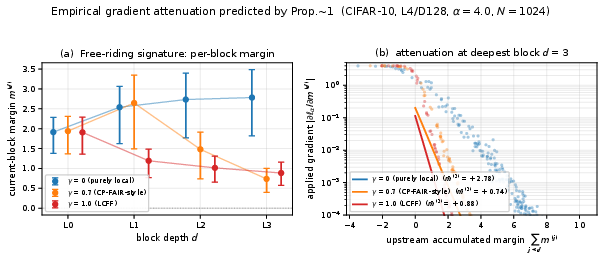
Figure 1: Empirical verification of Theorem~1: cumulative margin-induced attenuation of current-block gradients across γ regimes, validating the exponential decay mechanism.
Three quantitative signatures define the pathology: (1) flat separation—per-layer wrong-label discrimination changes little with depth; (2) loss collapse—deep blocks' losses vanish, indicating no meaningful training signal; and (3) depth saturation—only two blocks capture ≥98% of four-block accuracy across all tested variants.
Remedies: Local Discrimination and Adaptive Gating
To mitigate this pathology, the paper introduces three block-local repairs:
- Strictly local (γ=0): Eliminates cumulative history, forcing each block to discriminate based solely on its own margin.
- Hardness-gated collaboration: Allows cumulative history only for unresolved examples, adaptively gating the contribution depending on prior block separation.
- Depth-scaled discrimination loss: Adds a per-block discrimination term with a weight increasing linearly with depth, thereby enforcing stronger pressure on deeper blocks.
Each remedy is designed to restore per-layer independence diagnostics without cross-block backpropagation, and their theoretical guarantee includes a gradient floor unaffected by upstream margin (Theorem~2).
Empirical Characterization: Accuracy vs. Layer Health
Across CIFAR-10, CIFAR-100, and Tiny ImageNet, all three block-local repairs uniformly enhance layer-separation statistics (layer-health metrics rise by up to 45× in deepest blocks). However, the impact on final classification accuracy is consistently less than one percentage point for non-degenerate settings. Controlled ablation experiments show that architectural and augmentation choices affect accuracy by tens of percentage points, dwarfing the effect of free-riding repairs. For example, γ=0 (local-only) achieves Rγ0 S1 TTA on CIFAR-10, closely matching or exceeding prior strict-FF baselines such as ASGE (Gong et al., 15 Sep 2025)—yet repairing free-riding does not close the gap to BP-trained models.
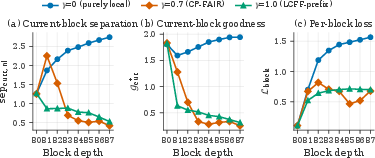
Figure 2: Per-block separation diagnostics across depth for three Rγ1 regimes; strictly local variants maintain high separation deeper, cumulative variants collapse.
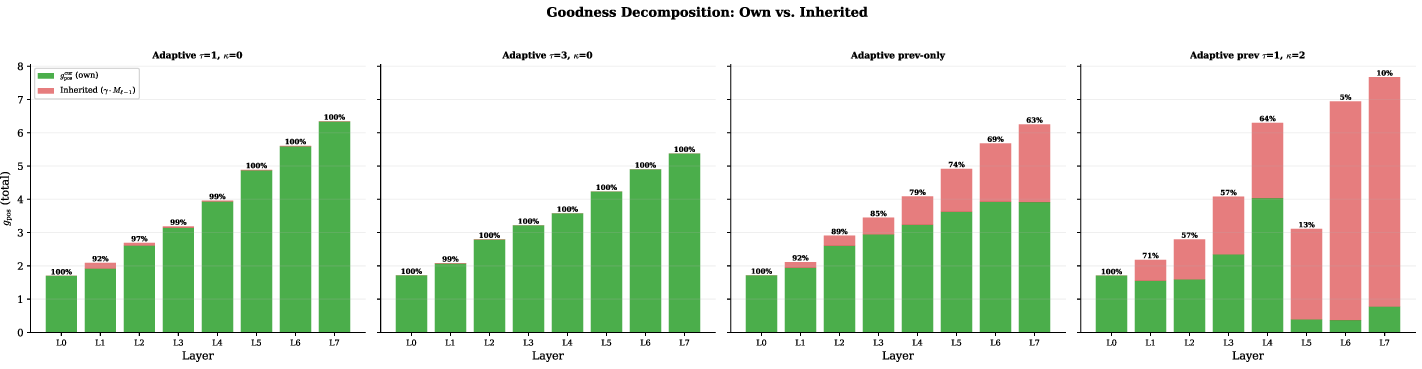
Figure 3: Goodness decomposition at Rγ2 and Rγ3: own vs. inherited block-wise contributions showing increased independence after repair.
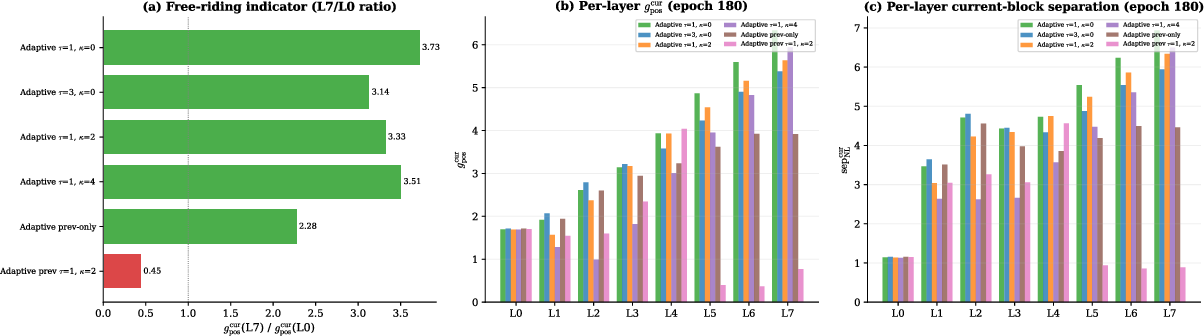
Figure 4: kappa spectrum analysis at Rγ4: depth amplification of anti-free-riding effect.
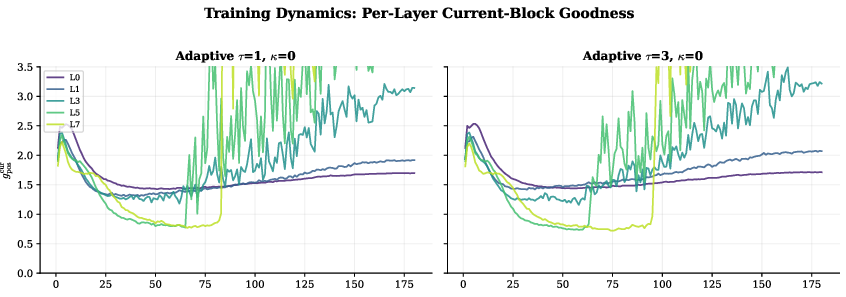
Figure 5: Training dynamics at Rγ5: per-layer goodness evolution showcasing diverging block health across collaboration modes.
Practical Implications and Controlled Ablation
The FF algorithm's efficacy is strongly rooted in architectural co-design and augmentation, not merely in objective function amendments. Naive FF applied to a standard CNN yields only Rγ6 accuracy, whereas an FF-optimized backbone reaches Rγ7. Augmentation is a confound; strong BP-augmentation with the same backbone delivers Rγ8, surpassing FF. The paper's detailed ablation hierarchy ensures the negative result is not contaminated by architectural or augmentation variance.
Block-wise repairs enable healthy layer metrics but do not translate into improved accuracy, a dissociation formalized by Propositions 1 and 2: redistributing block-wise evidence leaves the cumulative margin, and thus predictions, unchanged unless it alters the overall score ordering. Controlled paired-bootstrap analysis on CIFAR-100 shows prediction disagreements between variants remain nearly net-zero in label correctness, with accuracy shifts Rγ9\,pp despite large diagnostic swings.
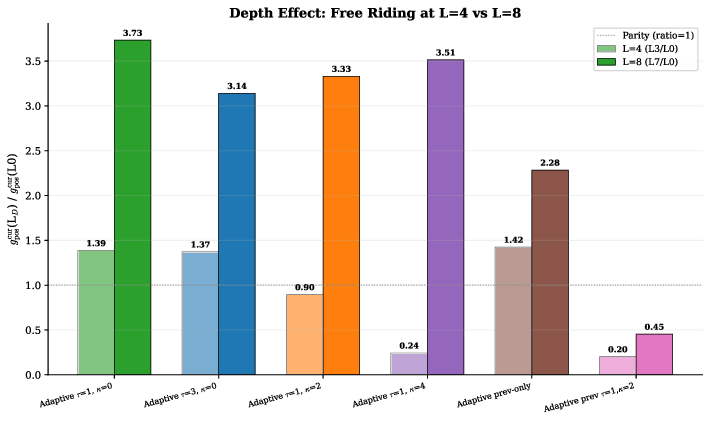
Figure 6: Depth effect comparison, L3/L0 vs. L7/L0 goodness ratio, demonstrating depth amplification of anti-free-riding.
Generalization to Larger Datasets and Deeper Networks
Extension to Tiny ImageNet and CIFAR-100 validates the qualitative separation between layer-health repair and accuracy. Depth amplifies anti-free-riding: at γ0, adaptive gating produces monotonically increasing per-block goodness, breaking the shallow-network gating threshold and enabling deep block specialization. Yet, accuracy remains nearly invariant under these changes, further supporting the central dissociation claim.
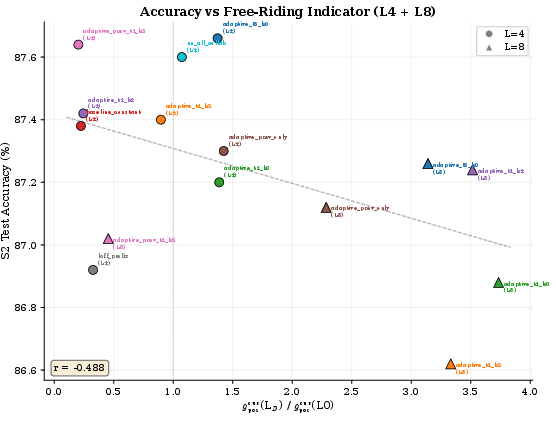
Figure 7: Accuracy vs. free-riding ratio across multiple L4+L8 configurations; only moderate correlation observed, confirming dissociation.
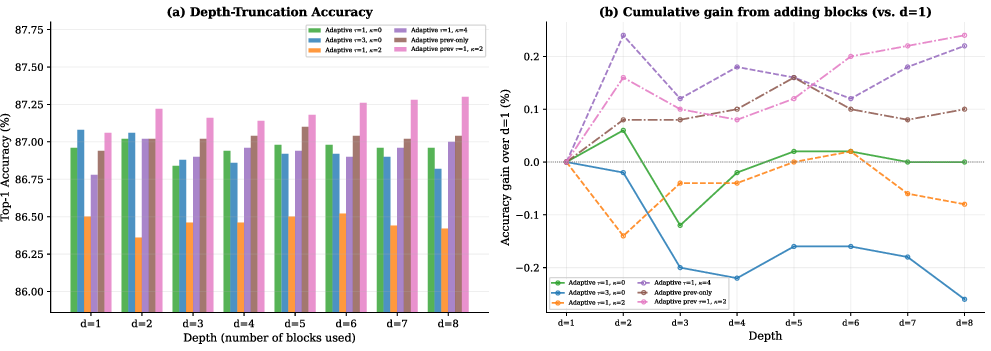
Figure 8: Depth-truncation accuracy: incremental block contributions persist, but repairing free-riding does not materially affect peak accuracy.
Implications for the FF Paradigm and Future Directions
The mechanistic dissociation between layer-health and accuracy narrows the trajectory for further research on FF systems. While cumulative free-riding is a real optimization pathology—exponentially attenuating gradients and starving deep blocks—it is not the dominant bottleneck for achievable accuracy in strict-FF training regimes. This points research toward designing inference rules and representations capable of exploiting redistributed block-wise evidence, rather than focusing exclusively on per-block separation.
The theoretical framework is highly generalizable: the parameter-gradient attenuation applies to any decreasing barrier function, and the diagnosis is relevant for all local-learning schemes where later modules inherit solved subproblems.
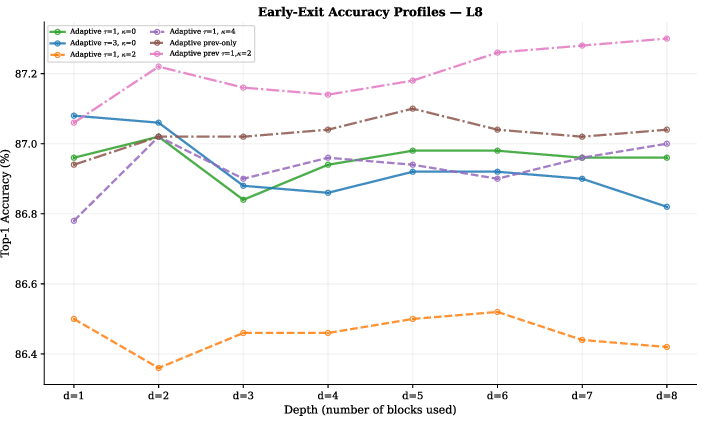
Figure 9: Early-exit profiles: adaptive gating produces strong blocks for efficient early exit.
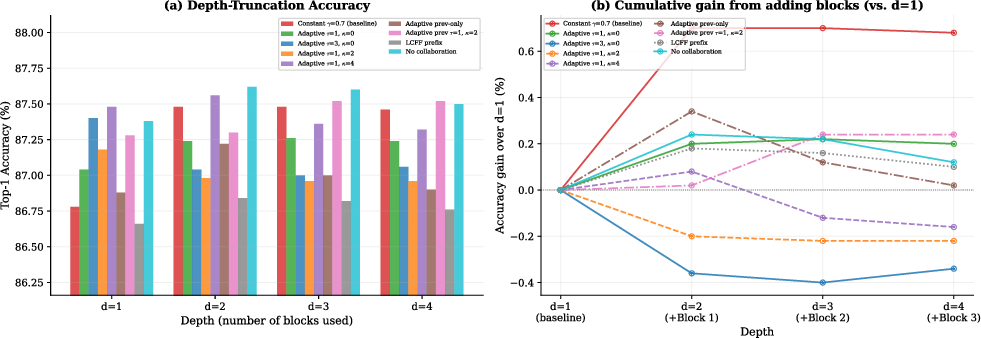
Figure 10: Depth-truncation accuracy: cumulative accuracy remains insensitive to block-level interventions.
Conclusion
Cumulative-goodness free-riding is a rigorously demonstrated and repairable phenomenon in FF networks, arising from exponential gradient attenuation due to upstream margin accumulation. Block-local repairs restore healthy layer metrics with strong theoretical guarantees, but do not impact final accuracy beyond a minimal threshold. The practical and architectural context dominates achievable performance, and repairing free-riding, though mechanistically essential, is not accuracy-dominant. This mechanistic dissociation guides future FF research toward inference and representation designs that materially affect class-score ordering. The claim is scoped to softplus-goodness objectives, Transformer/MoE architectures, and image-domain datasets; further exploration in different local objectives and large-scale settings remains open.

