- The paper introduces a variational circuit compression framework leveraging VFF and QAQC to create shallow circuits for accurate nonadiabatic molecular dynamics simulations.
- It demonstrates hardware-robust fast-forwarding with sustained state fidelity above 0.8 across successive timesteps on a real NISQ device.
- The method reduces gate counts from O(n²) to O(n × l) per quadratic term, balancing substantial circuit depth reduction with controlled observable fidelity.
Variational Compression of Quantum Circuits for Nonadiabatic Molecular Quantum Dynamics
Introduction
The simulation of nonadiabatic quantum dynamics, particularly in molecular systems, is a canonical challenge due to rapidly growing computational costs in both classical and quantum approaches. While product-formula Trotterization permits real-time evolution on quantum hardware, implementing general potential operators—such as those arising in the simulation of vibronic (electron-nucleus coupled) dynamics—incurs quadratic gate and connectivity scaling on binary-encoded qubit registers. This paper introduces and analyzes a variational circuit compression framework for such quantum dynamics simulations, leveraging variational fast-forwarding (VFF) and quantum-assisted quantum compiling (QAQC) to generate tunably shallow and locality-restricted circuits without sacrificing the accuracy of physical observables, specifically reaction rate coefficients in the Marcus electron transfer model.
Quantum simulation protocols for real-time molecular dynamics typically encode spatial wavepackets using binary representations on n qubits, mapping each computational basis to a distinct position grid point. While this grants exponential compression in state space, explicit implementation of potential operators—especially quadratics—scales as O(n2) due to all-to-all requirements in two-qubit controlled phase gates. This is illustrated by the circuit decompositions for quadratic operators:
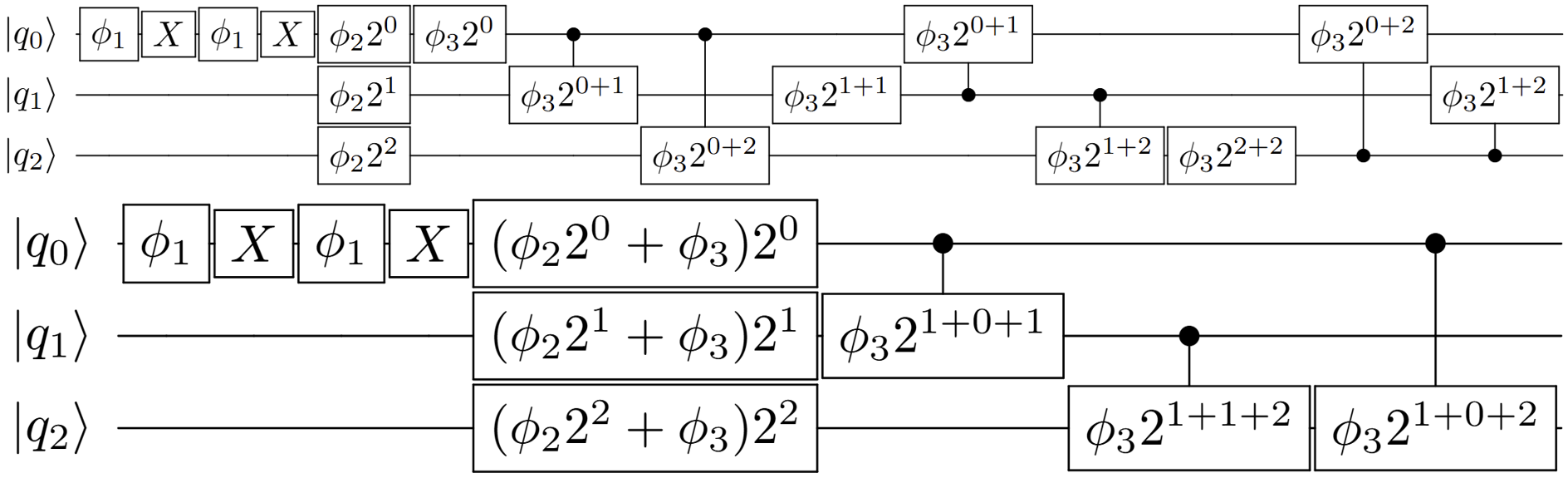
Figure 1: Quadratic operator circuit decompositions on n=3 qubits, highlighting the all-to-all requirement of quadratic terms and potential savings from operator commutativity.
The simulation target is the nonadiabatic Marcus model Hamiltonian, which describes dynamics on two coupled harmonic surfaces relevant for electron transfer processes:
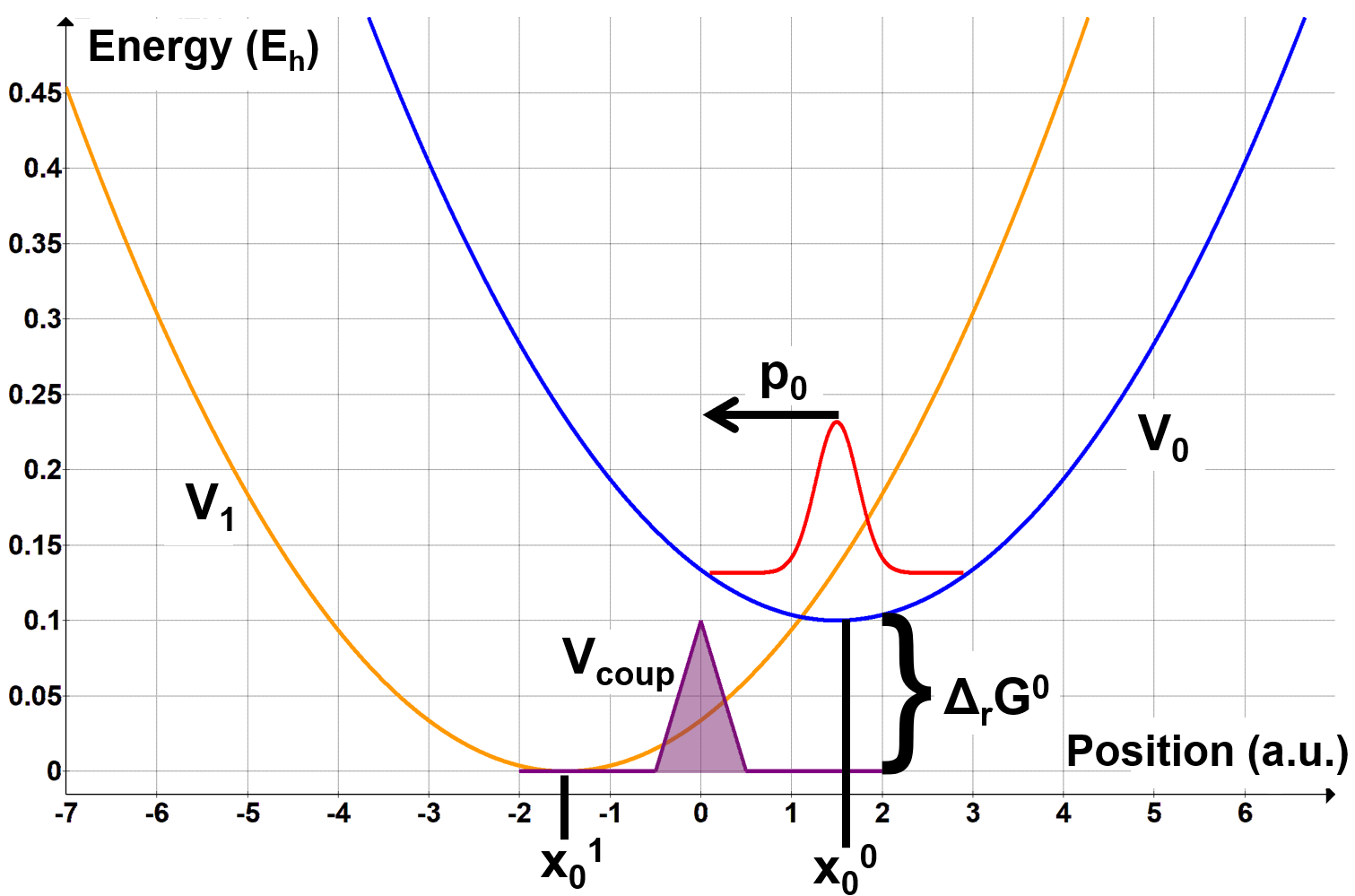
Figure 2: Diagram of the Marcus model with two diabatic harmonic potentials offset by ΔrG0, and a position-dependent coupling between electronic states.
Classically, methods such as MCTDH or TD-DMRG quickly encounter the curse of dimensionality for these problems. Quantum algorithms, if ideally implemented, offer polynomial scaling but face near-term feasibility hurdles due to circuit depth and hardware constraints.
Variational Ansatz Construction and Circuit Compression
The authors employ a variational ansatz inspired by Schur decomposition, which divides a unitary operator U into an eigenvector transformation W and a diagonal operation D, i.e., U=WDW†. For diagonalizable unitaries such as position basis exponentials, D is expanded using Walsh operators:
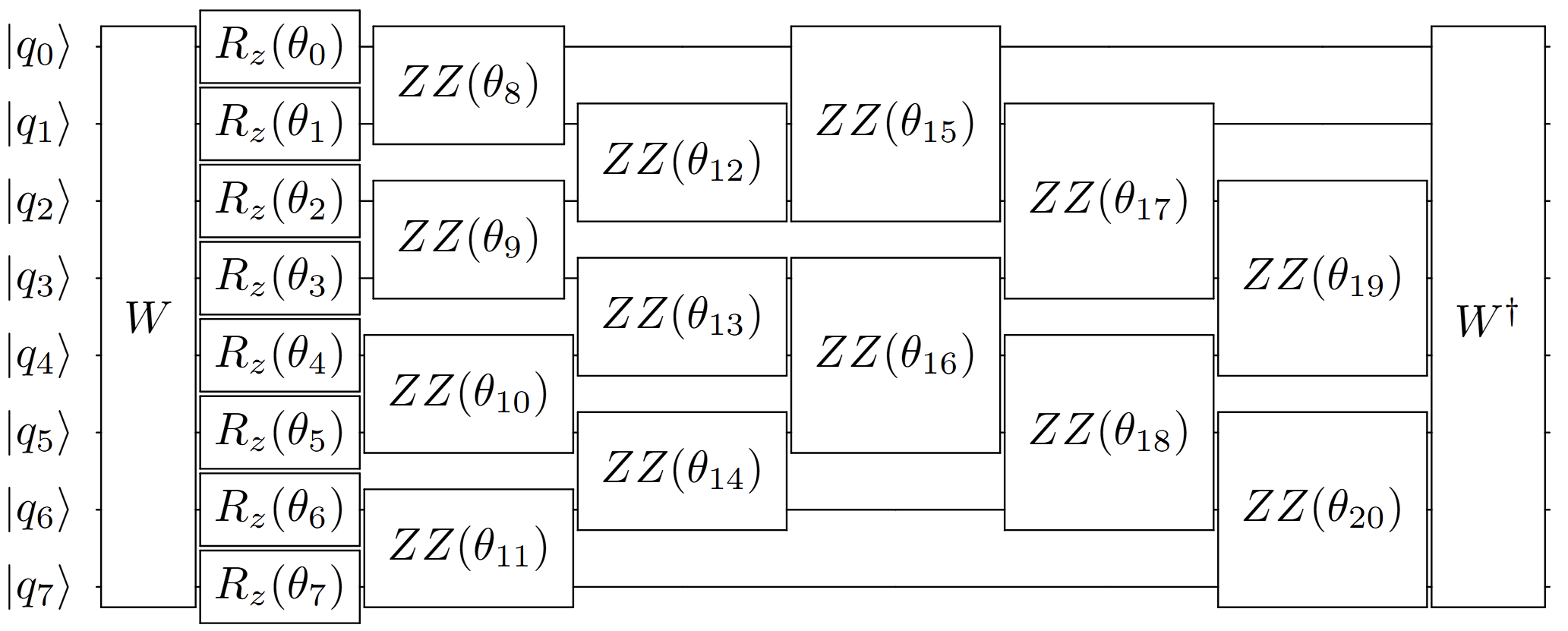
Figure 3: Structure of the l=3-local truncated, Walsh-expanded diagonal ansatz for O(n2)0 qubits, with organization by gate locality.
Key to this scheme is the truncation to O(n2)1-locality, discarding long-range two-qubit (O(n2)2) terms beyond a chosen distance. This truncation compresses circuit depth, especially advantageous on devices with linear or locally connected topologies. The VFF structure further allows for fast-forwarded evolution: once the diagonal generator is optimized for a single timestep, multi-timestep evolution can be performed by simple parameter rescaling, obviating expensive circuit repetitions.
Hybrid Quantum-Classical Optimization
To align the compressed ansatz with the target operator, the framework utilizes QAQC. The cost is measured by the Local Hilbert-Schmidt Test (LHST), which quantifies entanglement fidelity across each qubit pair. The QAQC protocol can be simulated classically for small circuits or implemented directly on hardware, taking advantage of noise resilience through cost function design:
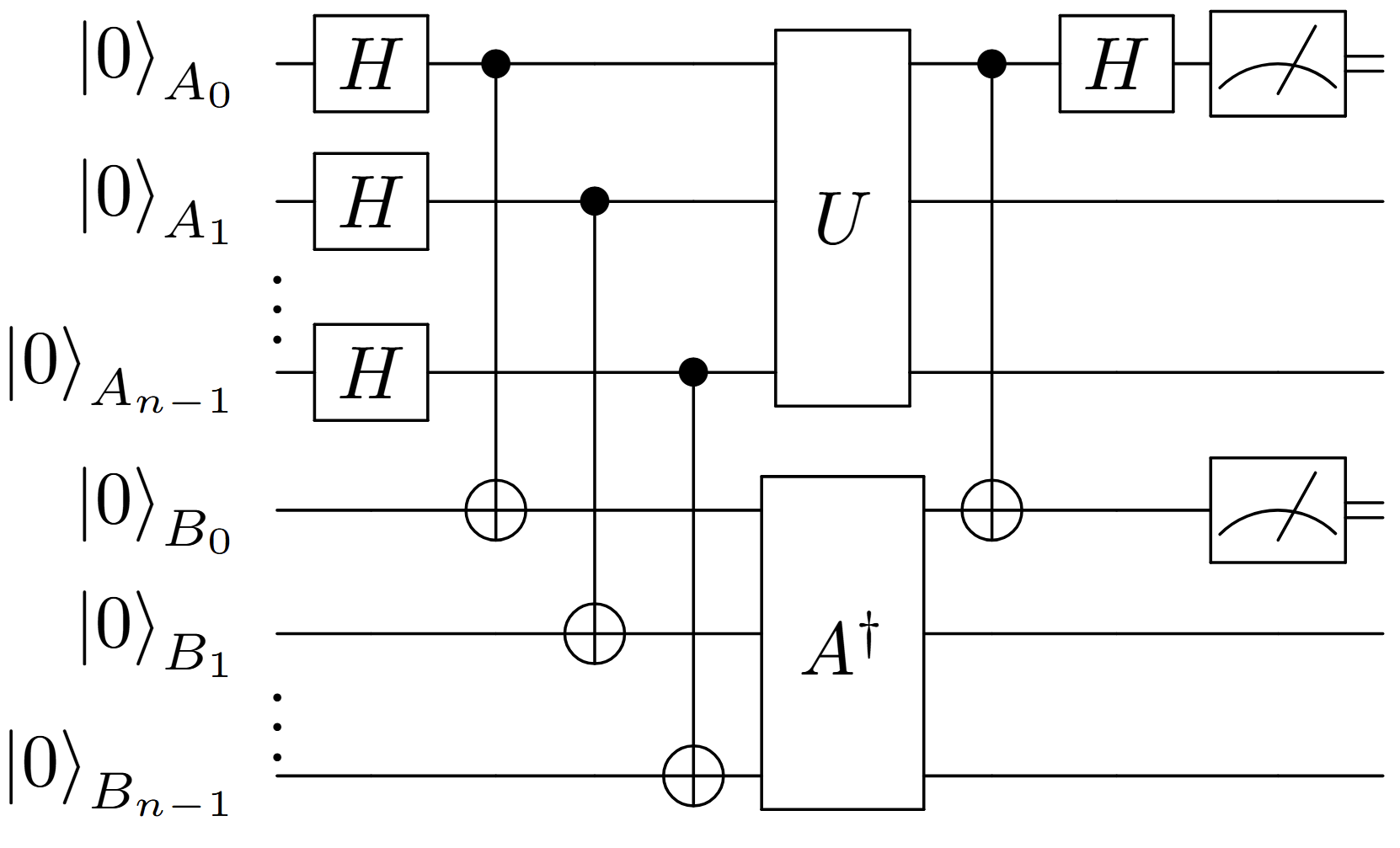
Figure 4: Schematic for the QAQC protocol circuit, preparing Bell pairs and using cost function fidelity as an optimization metric.
The cost function O(n2)3 is strictly minimized only when O(n2)4 and O(n2)5 are equivalent up to global phase, allowing faithful convergence checks. Gradients are evaluated using the parameter-shift rule, and optimizations employ Adam for robustness to local minima.
Fast-Forwarding Demonstration
The authors successfully realize "compressed" fast-forwarding of the kinetic operator on a real NISQ device (O(n2)6). Despite O(n2)7 successive timesteps, state fidelity remains above 0.8, demonstrating hardware-robustness of the O(n2)8 ansatz even for repeated applications and without error mitigation:
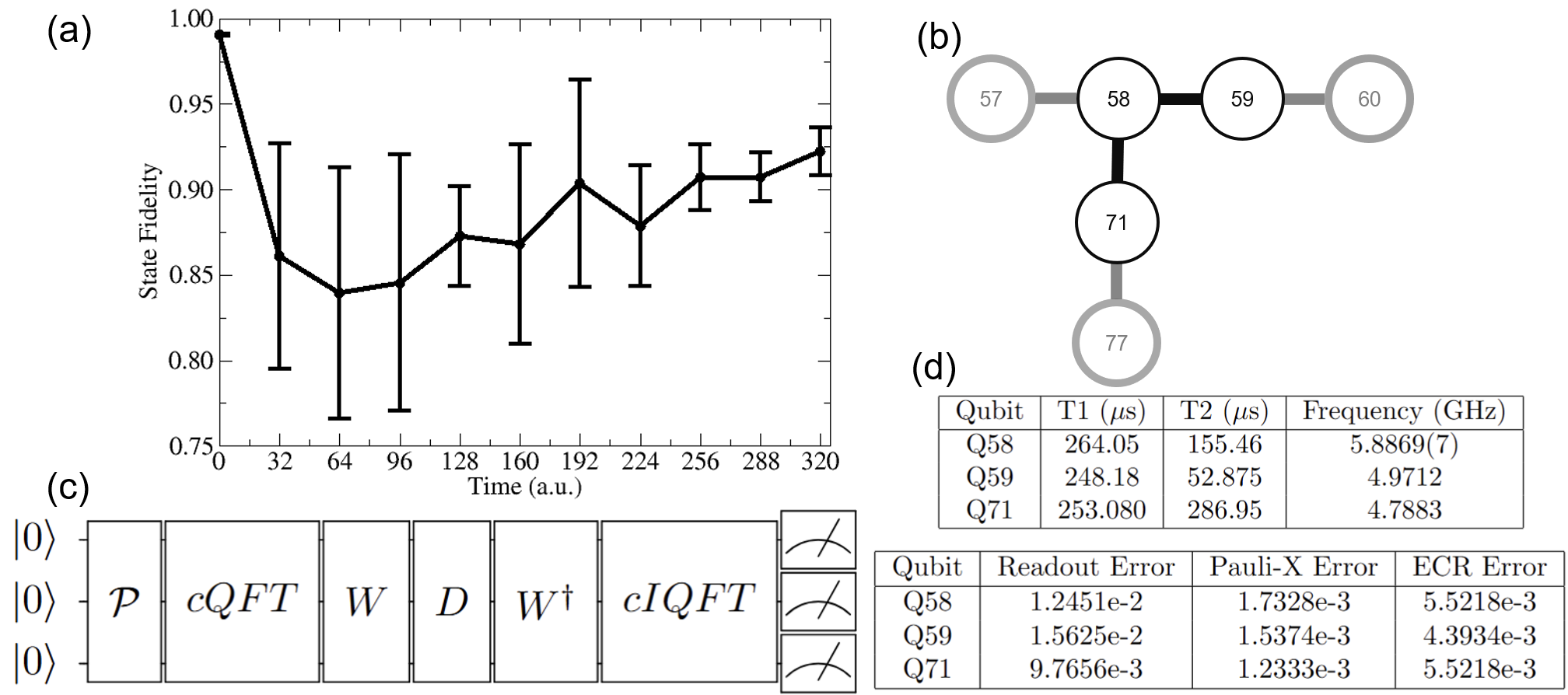
Figure 5: Results from hardware-based fast-forwarding with compressed kinetic operator, illustrating sustained fidelity with number of timesteps.
Optimization Convergence
The scaling behavior of the QAQC optimization reveals that, for quadratic operators, high-fidelity (O(n2)9) compression is achievable at n=30 for linear topology and even lower for ring connectivity, independent of register size for n=31.
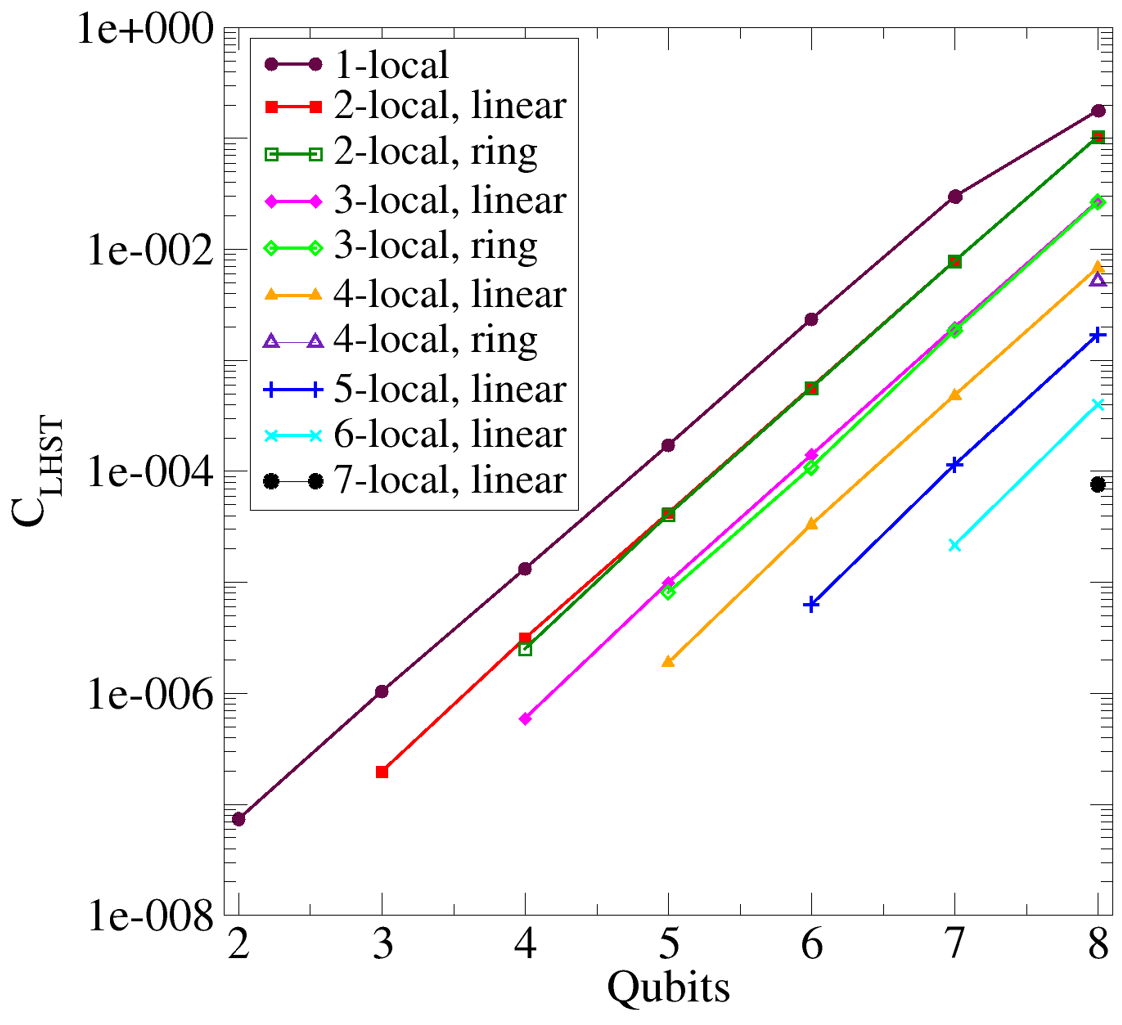
Figure 6: QAQC cost vs. locality n=32 for kinetic operator, with reduced locality requirements yielding exponential gate savings.
Optimization trajectories further confirm that parameter compensation enables low-dimensional effective parameterization—two real parameters suffice for quadratic potentials regardless of n=33.
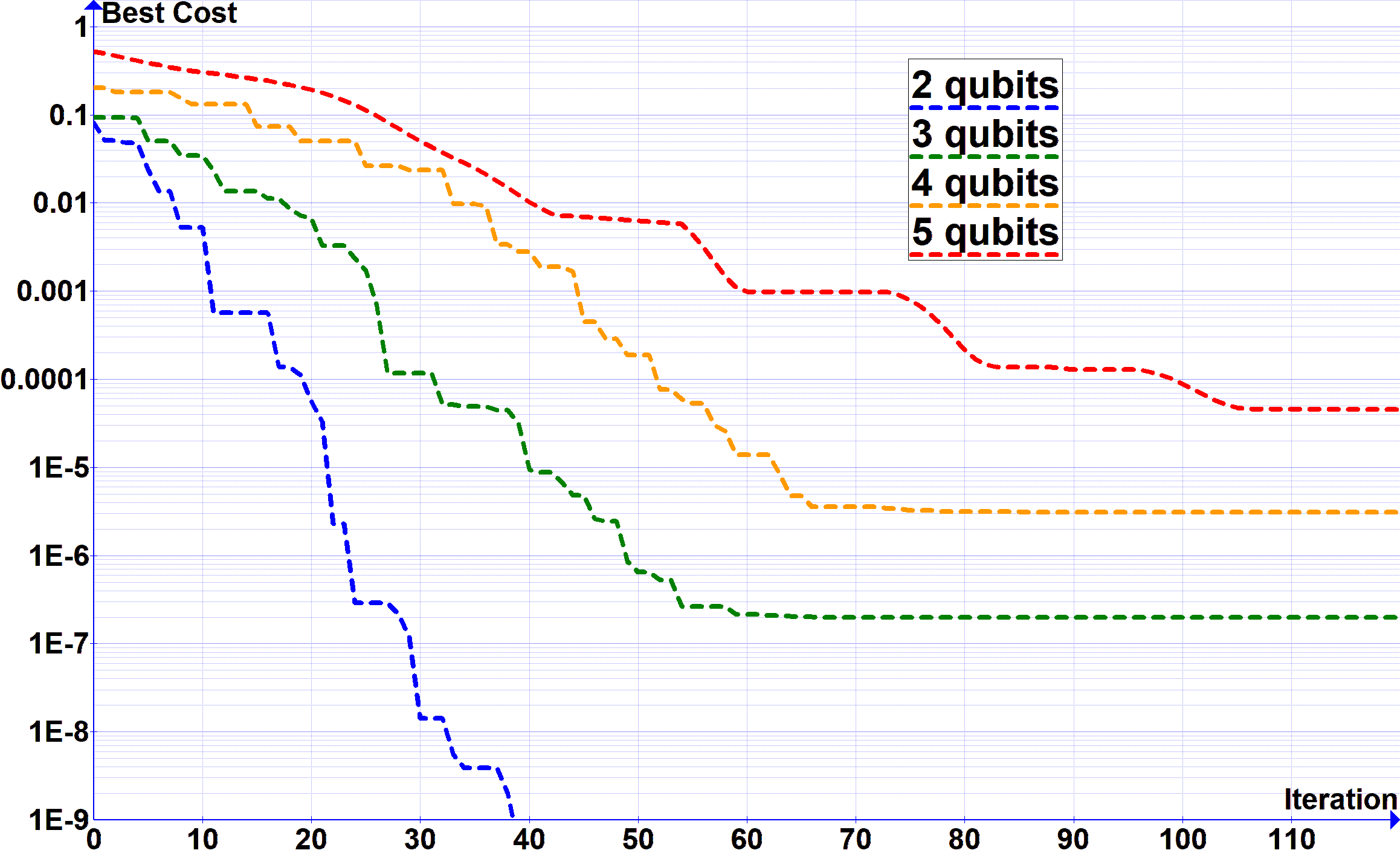
Figure 7: Optimization convergence for 2-local ansatzes, showing cost trajectory and sensitivity to register size.
Reaction Rate Coefficient Recovery
Simulations using compressed (n=34-local) circuits for nonadiabatic Trotter steps, within the Marcus model, yield rate coefficients matching explicit circuit results within the region of peak dynamical rates. However, deviations occur in regimes sensitive to the tails of the spatial distribution, reflecting compounding truncation and Trotter errors.
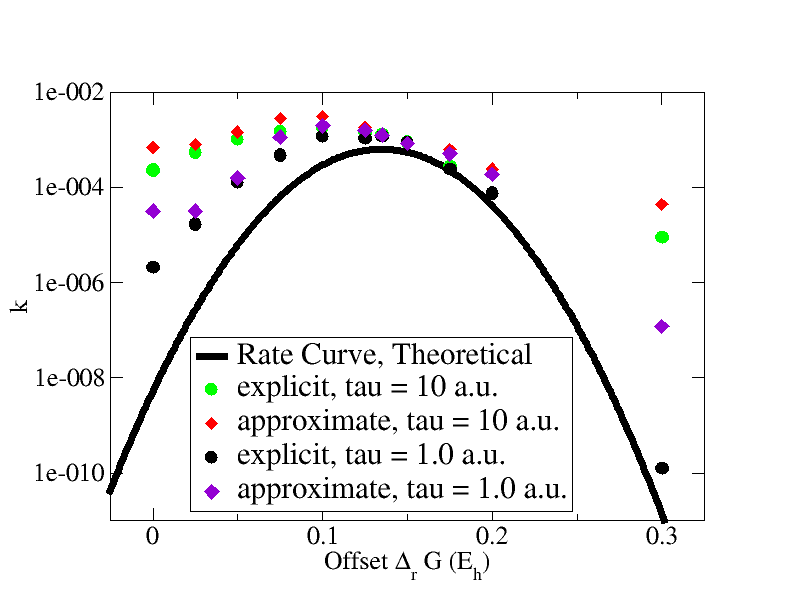
Figure 8: Marcus model rate coefficients computed for explicit and compressed circuits as a function of driving force, compared to theoretical expectation.
Theoretical and Practical Implications
The variational compression protocol supports:
- Tunable circuit depth reduction: Analytical truncation compresses gate count from n=35 to n=36 per quadratic term, with corresponding reductions in total entangling operations.
- Observable preservation: Benchmarked observables (reaction rates) are insensitive to controlled approximations in the operator representation, given careful truncation.
- Hardware adaptation: By optimizing only locally supported gates, circuits are tailored for realistic topologies, minimizing SWAP and routing costs—a critical advantage for current superconducting and trapped-ion devices.
- Extendability: The Walsh expansion can naturally be extended to higher-degree potentials (e.g., anharmonicity), increasing applicability to ab initio molecular surfaces.
Nevertheless, the locality truncation introduces systematic errors, adhering to a tradeoff between circuit depth and simulation fidelity. Compression errors can accumulate over many Trotter steps or in highly non-local potentials. The QAQC optimization avoids barren plateaus due to the constructed ansatz but may encounter scaling challenges for substantially larger systems or higher-degree polynomials.
Comparison to Alternative Strategies
Oracle-based algorithms, including Quantum Signal Processing (QSP) and qubitization, while query-optimal, suffer from exponential ancilla and gate count when the potential operator is a dense diagonal. The variational compression approach operates strictly on the logical space and does not require post-selection or block-encoding, making it more resource-efficient for the relevant classes of Hamiltonians.
Future Directions
Potential extensions include compression of higher-degree polynomial potentials and dense non-diagonal terms, leveraging the flexibility of the VFF ansatz and structured optimization. Integration with error mitigation and eventual fault-tolerant architectures could enable quantum simulations of truly classically intractable systems. Comparative studies with QSP and other advanced Hamiltonian simulation formalisms in the context of emerging hardware will be essential.
Conclusion
This work demonstrates a comprehensive strategy for variational circuit compression in realistic quantum simulation of nonadiabatic molecular dynamics, balancing circuit depth, hardware connectivity, and observable fidelity. The compressed circuits, validated both numerically and via hardware implementation, facilitate scalable and tunable quantum simulations on near-term and future devices. The theoretical framework paves the way for efficient, observable-preserving quantum simulation of complex chemical reactions, with clear directions for generalizing to broader classes of Hamiltonians and more demanding applications.

