Optimal Contextual Pricing under Agnostic Non-Lipschitz Demand
Published 7 May 2026 in cs.LG, econ.EM, and stat.ML | (2605.05609v1)
Abstract: We study contextual dynamic pricing with linear valuations and bounded-support agnostic noise, whose induced demand curve may be non-Lipschitz with arbitrary jumps and atoms. Such discontinuities break the cross-context interpolation arguments used by smooth-demand pricing algorithms, while the best previous method achieved only $\tilde O(T{3/4})$ regret. We propose Conservative-Markdown Redirect-UCB Pricing, a polynomial-time algorithm that combines randomized parameter estimation, conservative residual-grid probing, and confidence-based one-step redirection. Our algorithm achieves $\tilde O(T{2/3})$ optimal regret, matching the known lower bounds of Kleinberg and Leighton (2003) up to logarithmic factors and improving over the previous upper bound of Xu and Wang (2022). Under stochastic well-conditioned contexts, this closes the long-existing open regret gap in linear-valuation contextual pricing under agnostic non-Lipschitz noise distribution.
The paper introduces the CMRUP algorithm, achieving minimax-optimal regret scaling of O(T^(2/3)) for pricing with discontinuous demand noise.
The methodology combines uniform price randomization, residual grid probing, and confidence-based UCB search to estimate linear parameters and manage demand jumps.
Theoretical guarantees and empirical validation confirm that even without smooth demand assumptions, the approach secures optimal performance in contextual pricing.
Optimal Contextual Pricing with Agnostic Non-Lipschitz Demand: Minimizing Regret without Regularity
Problem Formulation and Motivation
The paper "Optimal Contextual Pricing under Agnostic Non-Lipschitz Demand" (2605.05609) addresses contextual dynamic pricing with linear valuations in the presence of fully agnostic, bounded, non-Lipschitz demand noise. This model subsumes valuation distributions with arbitrary jumps and atoms, which invalidate the standard smoothness and interpolation assumptions leveraged by almost all existing algorithms for pricing with censored feedback.
The problem is formalized as follows: At each round, a seller observes a context vector xt∈Rd, posts a price pt∈[0,B], and receives binary feedback ot=1{pt≤yt}, where the buyer’s valuation is yt=xt⊤θ∗+ξt, with an unknown parameter θ∗ and i.i.d. noise ξt that may exhibit point masses and discontinuities. The seller’s goal is to design a learning policy with cumulative expected regret RT (relative to the clairvoyant oracle with full knowledge of θ∗ and the residual noise distribution) that is as small as possible in the time horizon T.
Main Contributions and Algorithmic Structure
The central claim is the first polynomial-time pricing algorithm achieving minimax-optimal, O(T2/3) regret for contextual pricing with linear values and fully agnostic, non-Lipschitz residual demand. This rate exactly matches the best-known lower bound for even non-contextual pricing [kleinberg2003value] and closes a long-standing gap: prior agnostic methods for contextual settings achieved only pt∈[0,B]0 regret [xu2022towards] in the absence of demand smoothness.
The Conservative-Markdown Redirect-UCB Pricing (CMRUP) algorithm integrates three technical ingredients:
Uniform Price Randomization for Parameter Estimation: The linear parameter pt∈[0,B]1 is estimated via least-squares regression from binary responses under uniformly randomized prices. This is feasible due to a key regression identity: the expected binary feedback, when rescaled, is unbiased for the inner product pt∈[0,B]2, as long as contexts are i.i.d. with full rank and the noise is zero mean.
Residual Grid Probing with Conservative Markdown: After estimating pt∈[0,B]3 to error pt∈[0,B]4, the remaining learning is mapped to a univariate grid in the residual (noise) coordinate. When probing grid point pt∈[0,B]5, the algorithm sets price pt∈[0,B]6, with pt∈[0,B]7, ensuring that the realized residual lies within pt∈[0,B]8 on a "good event". The corresponding binary observation deterministically sandwiches the demand between pt∈[0,B]9 and ot=1{pt≤yt}0, for the survival function ot=1{pt≤yt}1.
Confidence-based Redirect UCB Search: For each residual grid point, the algorithm maintains confidence intervals on the estimated purchasing probabilities and computes optimistic upper confidence revenue estimates. It explores a grid point ot=1{pt≤yt}2 directly only while its empirical confidence exceeds the grid scale ot=1{pt≤yt}3; upon tighter confidence, it "redirects" probes to ot=1{pt≤yt}4, which cancels adverse discontinuity effects, incurring only grid-scale price loss per round.
Analysis and Theoretical Guarantees
The regret analysis explicitly decomposes the sources of loss:
Parameter Estimation: Uniform randomization in Stage 1 yields ot=1{pt≤yt}5 whp, using standard linear least squares concentration bounds.
Grid Probing and Jump Discontinuities: The sandwich structure, together with monotonicity, ensures that the only possible bias from discontinuities is bounded above by the adjacent grid jump, and these are summable across indices.
Confidence-bound Accounting: By standard counting arguments, the sum over all confidence intervals and adjacent jump costs incurred during exploration scales as ot=1{pt≤yt}6, where ot=1{pt≤yt}7 is the number of grid points, giving the optimal ot=1{pt≤yt}8 scaling when the grid has size ot=1{pt≤yt}9 and yt=xt⊤θ∗+ξt0.
Lower Bound Tightness: The achieved rate is minimax-optimal without logarithmic dependence on unknown problem parameters, sharp even in the non-contextual setting for price learning with agnostic demand.
Empirical Validation
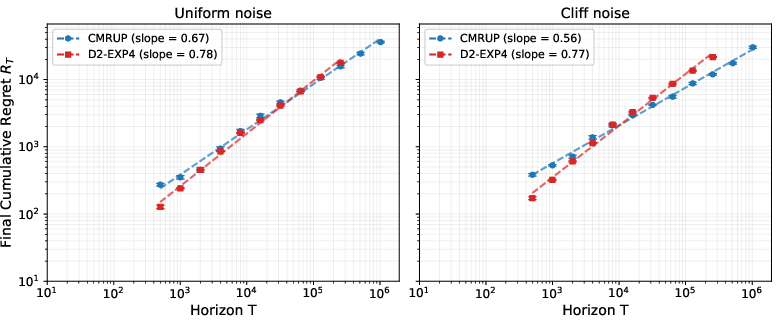
The algorithm is empirically validated against the D2-EXP4 baseline [xu2022towards] using both smooth (uniform noise) and highly non-Lipschitz (cliff noise with an atom) synthetic demand models. Results demonstrate that CMRUP exhibits final cumulative pseudo-regret scaling as yt=xt⊤θ∗+ξt1 consistently, even with severe discontinuities, whereas D2-EXP4 displays higher exponents (yt=xt⊤θ∗+ξt2) and increased variance.
Figure 1: Final cumulative pseudo-regret yt=xt⊤θ∗+ξt3 for CMRUP and D2-EXP4 under smooth and discontinuous contextual-pricing instances, illustrating rate separation and robustness to discontinuity.
The results confirm that CMRUP remains robust to cliff-like or atomic structures in residual demand, with no degradation from discontinuities, validating the algorithm’s design.
Practical and Theoretical Implications
Practical Implications:
The method enables optimal regret minimization for contextual pricing in operational environments where demand discontinuities due to buyer heterogeneity, psychological thresholds, or endogenous shocks are expected.
The algorithm is polynomial time in both yt=xt⊤θ∗+ξt4 and yt=xt⊤θ∗+ξt5, sidestepping the intractability of prior exponential policy-class constructions.
Theoretical Implications:
The result establishes that all forms of regularity (i.e., Lipschitz, log-concave, parametric, or even density assumptions) can be fully dropped from the demand noise, yet the fundamental information-theoretic bound for pricing with censored feedback remains yt=xt⊤θ∗+ξt6.
The work highlights the critical importance of designed probe actions and proper confidence-bounding for handling nonparametric, adversarial noise even in contextual problems.
Bold/Contradictory Claims:
No regularity of the demand curve is needed (other than boundedness and monotonicity) to achieve minimax regret in linear-valuation contextual pricing.
Simple confidence-based index policies can achieve the information-theoretic limit for contextual pricing, even with arbitrary jumps and atoms in the demand function.
Future Directions
Potential advances include:
Extension to adaptive or adversarial context sequences (as opposed to i.i.d. well-conditioned contexts).
Removal of the bounded noise assumption via truncation or concentration for sub-exponential tails.
Incorporation of fairness or group constraints for responsible deployment, exploiting the interpretability of grid-based price-setting.
Algorithmic acceleration and adaptive grid refinement for improved scaling in high-dimensional or real-world deployments.
Conclusion
This work resolves the minimax regret complexity for contextual pricing with linear valuations and fully agnostic non-Lipschitz residual demand, introducing a tractable algorithmic framework that provably overcomes arbitrary demand discontinuities without loss in statistical efficiency. The theoretical analysis, combined with empirical benchmarking, significantly advances the state of the art in dynamic pricing and online learning with censored feedback, providing an actionable foundation for robust real-world pricing systems.