- The paper introduces a Bayesian inverse formulation using diffusion model priors to reconstruct rain fields from Commercial Microwave Link data.
- It demonstrates improved spatial fidelity and uncertainty quantification compared to traditional interpolation and Gaussian Process methods.
- Empirical evaluations on simulated and real-world datasets confirm the method's robustness and practical applicability for hydrological forecasting.
Bayesian Rain Field Reconstruction with Diffusion Model Priors and Commercial Microwave Links
Introduction and Motivation
Rain field reconstruction is central for hydrology, flood early warning, and water resource management. Conventional modalities such as rain gauges (RGs), weather radars, and satellites exhibit trade-offs between spatial coverage, resolution, and economic constraints. Commercial Microwave Links (CMLs), opportunistically repurposed from cellular backhaul infrastructure, offer high-density, near-ground coverage but yield path-integrated, nonlinear measurements. The inverse problem of reconstructing spatial rain fields from CMLs is ill-posed due to aggregation, limited spatial information, and nonlinear attenuation modeled via empirical power laws.
Classical CML reconstruction methodologies simplify each link as a Virtual Rain Gauge (VRG), subsequently interpolating observations (IDW, Kriging, GMZ). This abstraction discards spatial heterogeneity and fails under complex precipitation regimes. Stochastic approaches such as Random Mixing ameliorate some limitations but depend on dense gauge networks and remain computationally prohibitive for large-scale applications.
This paper proposes framing rain field reconstruction from CMLs as a Bayesian inverse problem, employing deep diffusion models (DMs) as expressive, data-driven spatial priors, enabling training-free posterior sampling across a broad family of methods. By explicitly modeling the path-integrated nonlinear CML operator, this approach overcomes interpolation bottlenecks and provides high-fidelity spatial reconstructions.
Rain Field Priors: Gaussian Process vs Diffusion Models
Two priors are contrasted: censored Gaussian Processes (GPs) and DMs. Censored GPs encode non-negativity and spatial correlation but are limited by kernel rigidity, incapacity to capture sharp gradients and multi-scale intermittency, and computational hurdles associated with sampling from high-dimensional truncated distributions. DMs, trained on representative radar-derived precipitation data (OpenMRG), learn spatial regularities, preserve distributional and qualitative structural fidelity, and generate realistic, sparse rainfall samples.
Empirical evaluation shows close alignment between DM-generated rain field statistics and reference samples Figure 1; classifier-based two-sample tests yield accuracy near chance (57%), supporting indistinguishability between generated and real data.
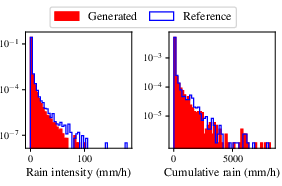
Figure 1: Comparison of rain field statistics between the reference samples and generated samples using the DM prior.
Qualitative visualizations demonstrate DMs preserve sparse, heterogeneous rainfall patterns observed in real data Figure 2.
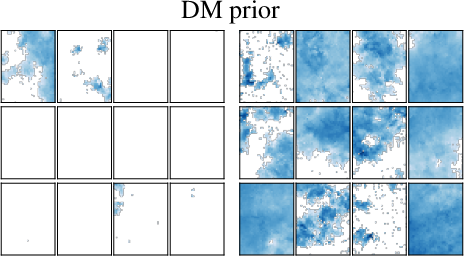
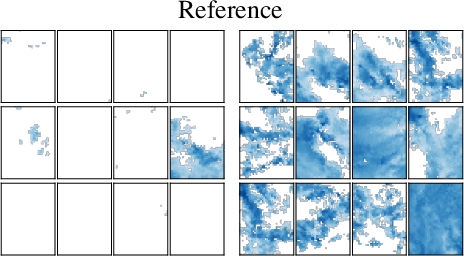
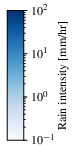
Figure 2: Examples of generated rain fields using the prior DM compared with reference rain fields.
Bayesian Inverse Problem Formulation and Posterior Sampling
The forward operator maps rain field X(s) through a power-law transformation along each CML path Li:
Yi=a∫s∈LiX(s)bdLi+σiZi,
with (a,b) link-specific calibration and additive Gaussian noise.
Discrete approximation leverages Siddon's ray-tracing for intersection length computation, yielding:
Yi=ak=1∑HWΔki[x0]kb+σiZi,
where x0 is the gridded rain field.
The Bayesian inverse problem seeks to sample from:
π0(x0∣y)∝p(y∣x0)p0(x0),
with p0 the DM prior.
Training-free posterior sampling leverages techniques such as Plug-and-Play, Sequential Monte Carlo (SMC), Replica Exchange, and various MCMC-based algorithms to efficiently sample plausible rain fields consistent with CML observations.
Experimental Evaluation and Results
Simulated Experiments: Gaussian Process Benchmark
A 1D linear inverse problem with GP prior offers an oracle posterior. Diffusion samplers are benchmarked on sliced Wasserstein distance and ℓ2 errors of posterior mean and quantiles. TDS achieves the best distributional match and uncertainty quantification, while MGDM delivers minimal mean error but poor calibration for extremes (Figure 3, Figure 4).
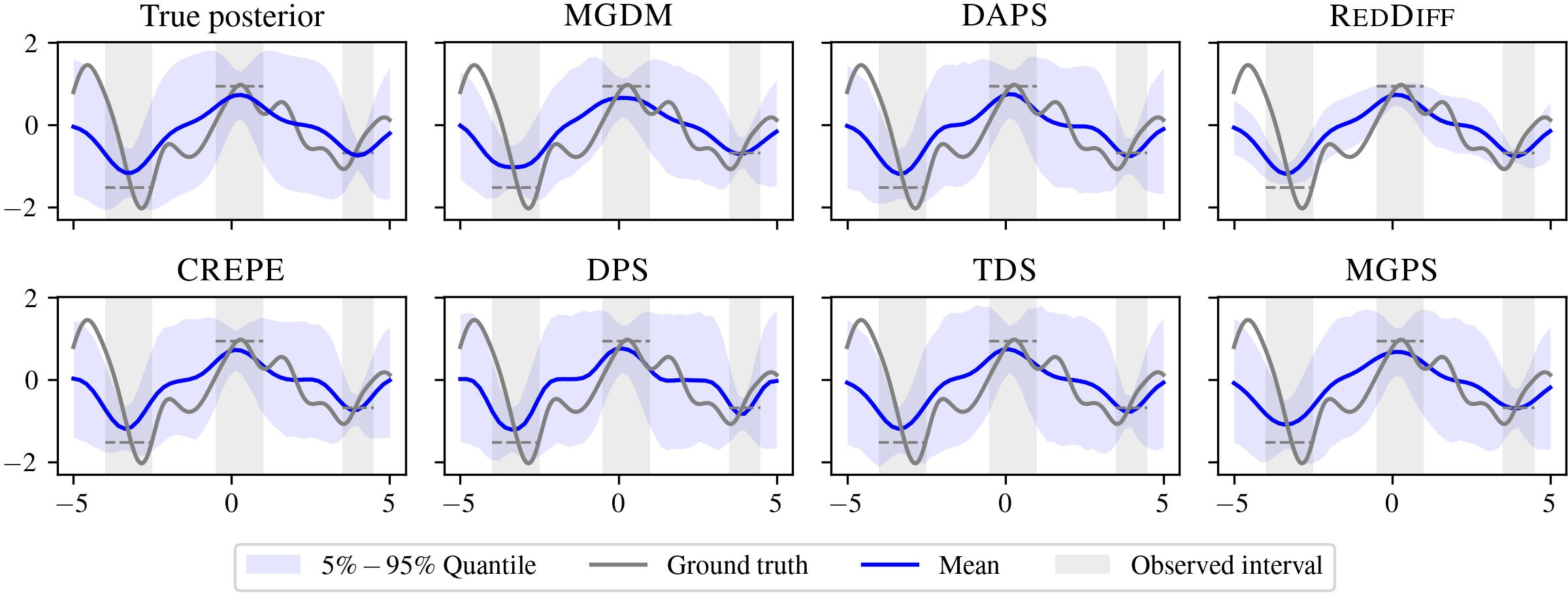
Figure 3: Comparison between the reconstructions of the baselines on the inverse problem with diffusion prior on the setting of GP.
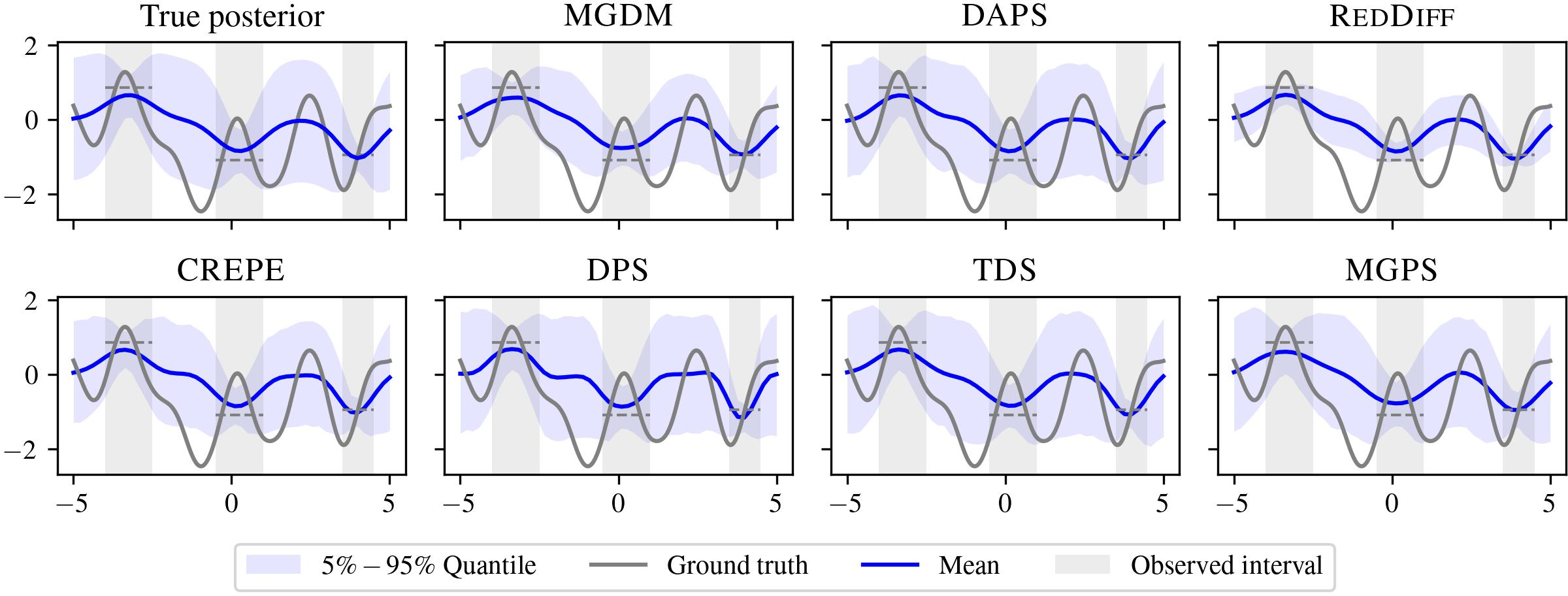
Figure 4: Extended results showing performance of different DM posterior sampling methods.
Real-World Experiments: OpenMRG CML Dataset
On OpenMRG, DM-based reconstructions consistently outperform meteorological interpolation methods across RMSE, PCC, and cumulative rain metrics. Diffusion priors yield notably improved spatial fidelity and uncertainty quantification. The performance advantage is robust under isotropic and heteroscedastic noise models. Qualitative comparisons highlight the superior spatial heterogeneity capture by DM-based approaches (Figure 5, Figure 6, Figure 7).
Figure 5: Comparisons of rain field reconstructions on real CMLs links from OpenMRG. CML networks are depicted in red.
Figure 6: Qualitative comparisons of rain field reconstructions on real CMLs links from OpenMRG dataset on three reconstruction tasks.
Figure 7: Additional qualitative comparisons for three reconstruction tasks on OpenMRG.
Network Geometry and Ablation Studies
Sensitivity analysis demonstrates that increased CML link density and optimized spatial configuration lead to better performance for both traditional and DM approaches. However, under real CML nonlinearities and spatial heterogeneities, DMs, coupled with explicit nonlinear operator modeling, provide the most robust improvement Figure 8.
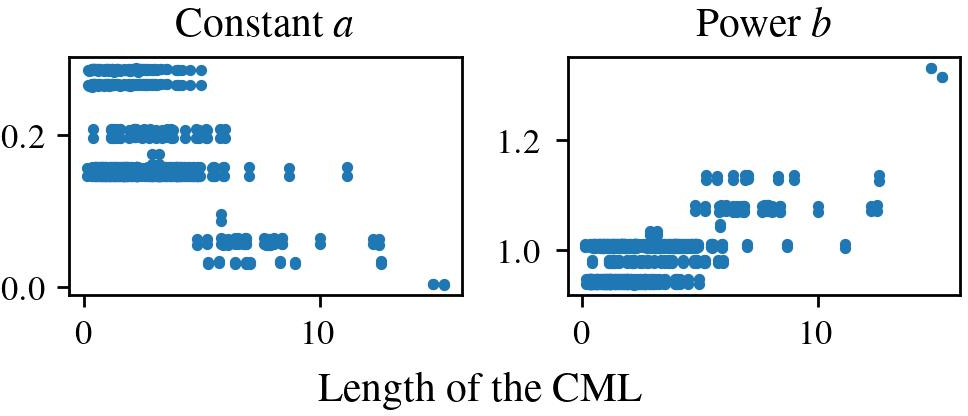
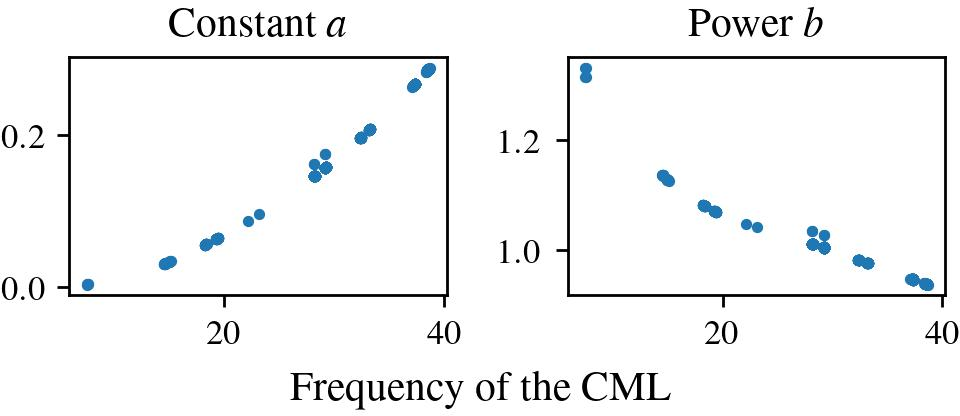
Figure 8: Power-law parameters of the CML as a function of link's length and the frequency on the OpenMRG dataset.
Practical and Theoretical Implications
The fusion of Bayesian inference with expressive diffusion priors and accurate CML forward modeling enables real-time, uncertainty-aware rainfall reconstruction. The method's compatibility with opportunistic sensing infrastructures opens scalable pathways for urban flood monitoring and hydrometeorology. The generation of ensembles enables scenario analysis required in hazard forecasting.
Theoretically, the ability to regularize ill-posed inverse problems with learned spatial priors demonstrates the flexibility and power of modern generative models in geophysical applications. Training-free posterior sampling with DMs sidesteps retraining, providing a modular framework compatible with diverse sensing modalities.
Limitations and Future Directions
Current DM priors are geographically and temporally localized. Adaptation to broader climate regimes and spatiotemporal extension remains necessary. Integrating explicit temporal structure and rigorously assessing distributional generalizability is an open problem. Furthermore, real-time deployment raises privacy and infrastructure-related considerations.
Conclusion
Bayesian rain field reconstruction using diffusion model priors and explicit CML path integration provides substantial gains over classical interpolation and stochastic methods in spatial fidelity, uncertainty quantification, and practical applicability. The proposed framework establishes a robust foundation for future advancements in AI-powered, real-time meteorological sensing and environmental modeling.