- The paper introduces NM-PPG, a novel approach leveraging continuous relaxations and Gumbel-Softmax for adaptive non-myopic feature acquisition.
- It formulates active feature acquisition as a POMDP to balance prediction loss with acquisition costs, enabling instance-wise, context-aware feature selection.
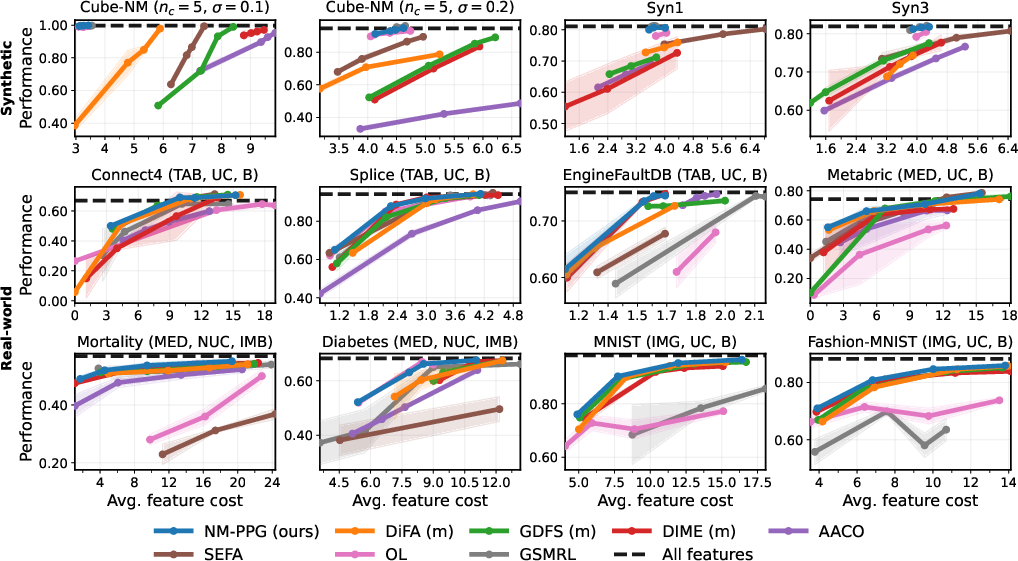
- Empirical results on synthetic and real-world datasets demonstrate NM-PPG’s robust accuracy-cost trade-offs outperforming traditional myopic and RL-based methods.
Non-Myopic Active Feature Acquisition via Pathwise Policy Gradients
The paper "Non-Myopic Active Feature Acquisition via Pathwise Policy Gradients" (2605.05511) develops a principled approach to Active Feature Acquisition (AFA), focusing on settings where features are costly and acquisition strategies must be adaptive and instance-wise. Traditional static feature selection is insufficient because it cannot exploit instance-specific information about which features are informative, especially when informative features vary or are context-dependent. AFA is naturally framed as a Partially Observable Markov Decision Process (POMDP), in which acquisition decisions are sequential and a learner must determine both which feature to acquire next and when to stop acquisition and predict.
The objective is to minimize the expected sum of prediction loss and acquisition cost:
$\min_{\theta}
\mathbb{E}_{\mathbf{x},\mathbf{y}
\mathbb{E}_{\pi_{\theta} [
\ell (f_{\phi}(\mathbf{x}(m_{t_\theta(\mathbf{x})})),\mathbf{y})
+ \alpha c(m_{t_\theta(\mathbf{x})})$
where fϕ is a predictor on masked inputs, πθ is the acquisition policy, mt is the current observation mask, and α controls the trade-off. This formulation is fully general to arbitrary cost structures and permits adaptive, non-myopic sequential acquisition.
Pathwise Policy Gradient Approach
AFA-POMDPs are computationally challenging; prior approaches include model-based, model-free (mainly RL-based), and hybrid techniques. RL-based non-myopic methods optimize long-horizon cost-minimization objectives but suffer from high variance due to score-function methods (e.g., policy gradient theorem), while non-RL approaches use heuristics or jointly informative feature groups and are biased relative to true adaptive cost minimization.
The core contribution is NM-PPG (Non-Myopic Pathwise Policy Gradients), which uses a continuous relaxation of the discrete acquisition process, implemented via Gumbel-Softmax reparameterization. This allows pathwise gradients to propagate through the entire acquisition trajectory rather than a single step. The relaxed acquisition mask (m~t) and conditional feature distribution (r~t) evolve through deterministic dynamics, supporting backpropagation and end-to-end optimization over the policy network.
Hard feature acquisitions are enforced in the forward pass (straight-through rollout), aligning training with test-time deployment, while gradients propagate via corresponding soft masks in the backward pass. Entropy regularization and staged temperature sharpening stabilize optimization.
Algorithmic Framework
NM-PPG is trained on fully observed datasets, split into train/validation/test splits. Each batch proceeds through a staged soft-temperature schedule, wherein the Gumbel-Softmax relaxation sharpens toward the discrete acquisition process as training progresses. The predictor is first pre-trained on random masks, followed by fine-tuning on masks produced by the learned policy rollouts. Early stopping uses validation performance. At inference, the trained policy is evaluated greedily with blocked logits for acquired features.
Empirical Analysis and Numerical Results
NM-PPG is benchmarked against a comprehensive suite of AFA baselines (myopic: DiFA, GDFS, DIME; heuristic non-myopic: AACO, SEFA; RL-based non-myopic: GSMRL, OL) across 12 datasets spanning synthetic, tabular, medical, and image domains, with various cost structures and imbalanced scenarios.
Results demonstrate:
NM-PPG is explicitly consistent with myopic baselines when the dataset structure does not reward non-myopic planning, but outperforms them in presence of joint feature informativeness or contextually expensive features. The approach robustly addresses the relaxation gap that hinders prior continuous relaxations.
Ablation, Acquisition Behavior, and Training Dynamics
Ablation studies confirm the necessity of the straight-through rollout mechanism and entropy regularization; without them, optimization loses stability and alignment with deployment behavior. Acquisition trajectory visualizations (e.g., Cube-NM, Syn1, Syn3) show NM-PPG replicating the optimal context-first policy and adaptive branching based on observed context, in contrast to myopic methods which prefer locally informative but globally sub-optimal features.
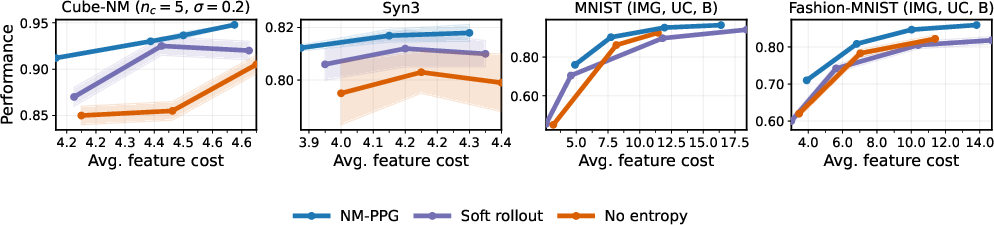
Figure 2: Ablation study comparing NM-PPG with variants lacking straight-through rollouts or entropy regularization; both components are critical for robust performance.
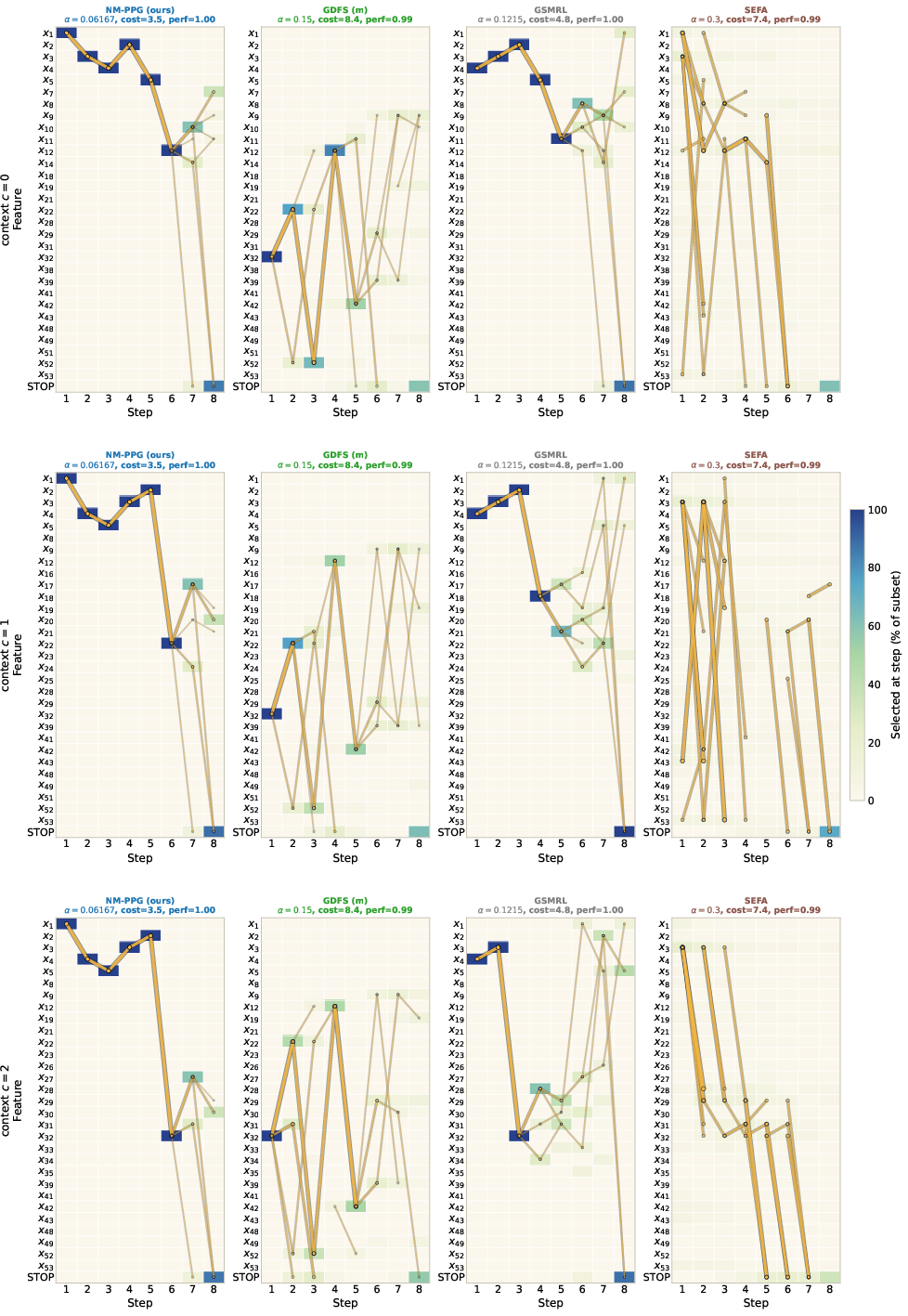
Figure 3: Acquisition trajectories on Cube-NM with nc=5 and σ=0.1, showing NM-PPG consistently acquires context features early and adapts acquisition sequence accordingly.
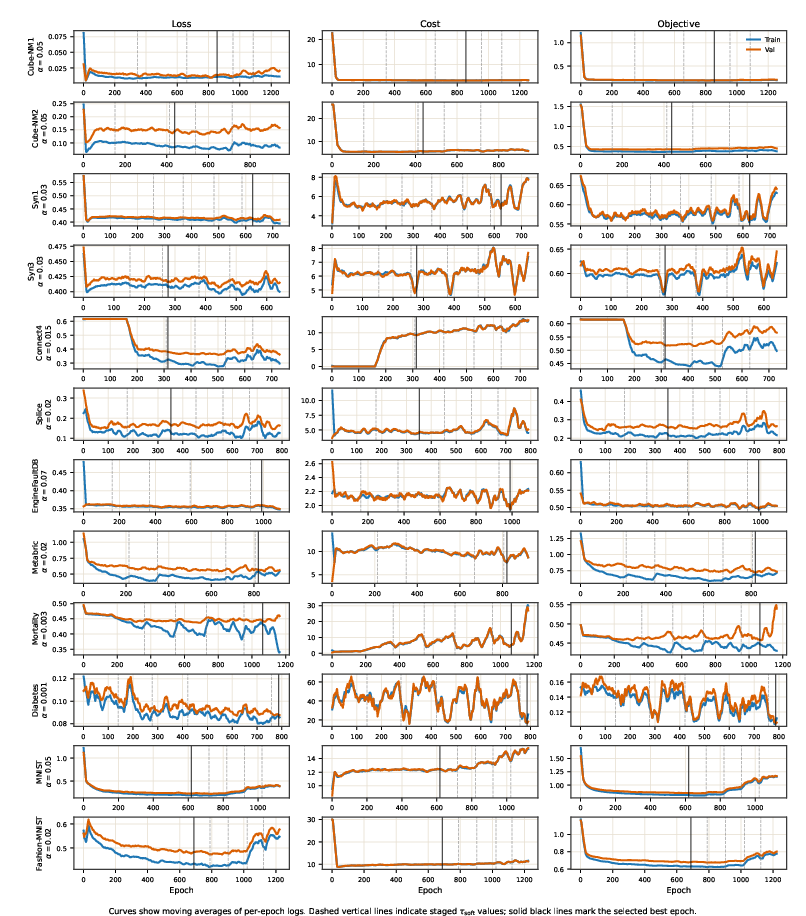
Figure 4: Training curves for NM-PPG, demonstrating stable loss, acquisition cost, and overall objective convergence across staged soft-temperature annealing.
Practical and Theoretical Implications
NM-PPG bridges the gap between principled sequential decision-making and practical, stable optimization in AFA. By enabling pathwise gradients over non-myopic acquisition trajectories and aligning training with deployment, it overcomes critical shortcomings of both RL-based and heuristic non-myopic strategies. Empirical results highlight that model-free, end-to-end non-myopic policy optimization is computationally tractable and practically useful for high-dimensional and heterogeneous cost domains.
Theoretically, NM-PPG matches the optimality conditions of solving the truncated AFA-POMDP, with rigorous guarantees regarding the continuous relaxation. The method naturally generalizes to variable cost, mixed data modalities, and arbitrary loss functions. The approach provides a template for policy-gradient optimization in other sequential decision settings with discrete and costly actions.
Future Directions
Advances may focus on integrating NM-PPG with more flexible, uncertainty-aware predictors for partial observations (e.g., conditional generative models), deeper theoretical analysis of relaxation bias under more challenging regimes, and deployment of NM-PPG in domains with long temporal horizons (e.g., longitudinal health records, active vision). Extensions to structured feature selection, adaptive expert selection, or hierarchical acquisition can further improve performance in real-world settings.
Conclusion
NM-PPG provides a rigorous framework for non-myopic AFA, yielding robust and adaptive acquisition policies that achieve near-optimal accuracy-cost trade-offs across diverse datasets. Its pathwise gradient architecture and straight-through rollout mechanism address both the variance problem of RL-based methods and the bias of heuristic non-myopic approaches. The method demonstrates that non-myopic decision-making can be practically deployed and reliably optimized for active information acquisition in settings with complex cost structures and adaptive feature dependencies.