- The paper demonstrates that extending coin preparations in standard quantum walks yields post-quantum correlations surpassing Tsirelson’s bound.
- It employs discrete-time coined quantum walks and bipartite Bell scenarios to reveal the separation between theoretical existence and practical accessibility of nonlocal correlations.
- Quantitative analysis shows that measurement resolution critically controls accessible nonlocality, as coarse-grained schemes suppress observable violations at larger system sizes.
Operationally Admissible Post-Quantum Correlations in Standard Quantum Walks
Introduction and Context
This paper investigates the feasibility and operational accessibility of post-quantum (supra-Tsirelson) nonlocal correlations within the well-established discrete-time coined quantum walk (DTQW) model, without introducing any modifications to the canonical quantum dynamics. The study is motivated by the distinction between the abstract existence of post-quantum correlations—violations of the CHSH inequality beyond Tsirelson's bound while satisfying the no-signaling principle—and their operational accessibility, i.e., their manifestation under physically realistic measurement constraints. Previous research has extensively explored the structure of quantum and post-quantum correlations [PopescuRohrlich1994, Tsirelson1980, Barrett2005, Brunner2014], but concrete, dynamical realizations within standard quantum systems, compliant with operational requirements, remain scarce.
Framework and Methodology
The system under consideration is a standard 1D DTQW, where a two-level coin is coupled to a walker on a position lattice via a unitary, nearest-neighbor shift. The core novelty lies in extending the set of allowed initial coin preparations to include non-positive Hermitian operators characterized by Bloch vectors with norm ∥r∥>1, thus surpassing the quantum state space. This approach implements the notion of complementarity violation at the preparation level, as discussed in [deOliveira2020Complementarity], while enforcing physical admissibility exclusively on the observed probability tables: all empirically realized joint statistics must be normalized, nonnegative, and no-signaling.
A key aspect of the methodology is the separation of the existence of post-quantum correlations (when optimal, generally nonlocal observables are permitted) from their accessibility under realistic, coarse-grained measurements. This distinction is schematically depicted in the following figure.
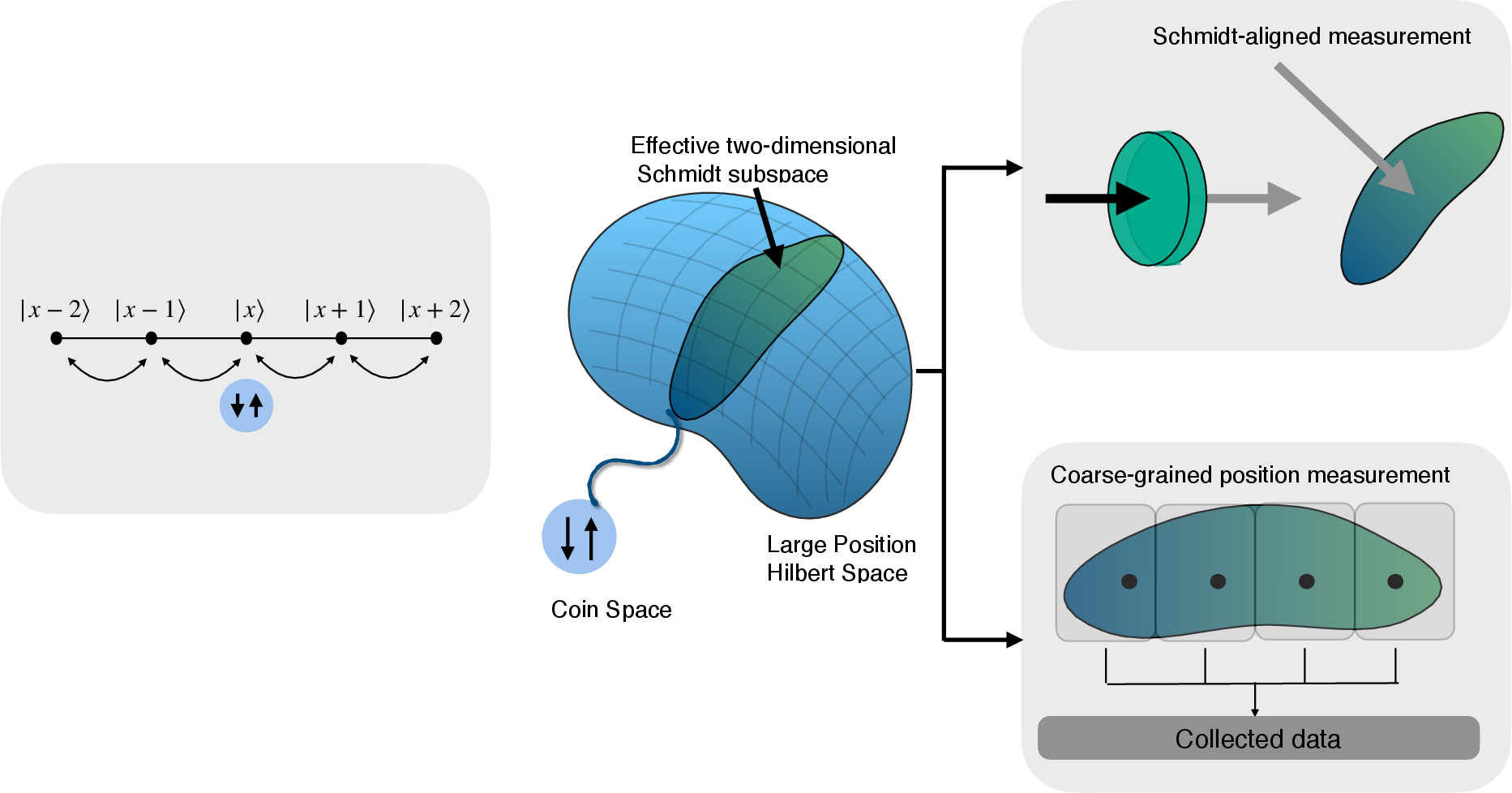
Figure 1: Separation between existence and operational accessibility of post-quantum correlations in a DTQW, illustrating the effective Schmidt subspace structure and the contrast between idealized and coarse-grained measurements.
A bipartite Bell scenario is constructed by allocating the coin measurement to Alice (projective measurements in arbitrary bases) and the walker position measurement to Bob. The analysis considers both Schmidt-aligned (idealized) observables—acting on a dynamically generated two-dimensional subspace—and physically motivated position-based binnings. The CHSH parameter ∣S∣ is computed under admissibility and no-signaling constraints.
Numerical Demonstration of Post-Quantum Correlations
For pure quantum coin preparations (∥r∥=1), the system yields bipartite pure states with Schmidt rank at most two, and the maximum achievable CHSH value is given by the Horodecki criterion [Horodecki1995]. Empirical validation within the standard DTQW at T=60 steps yields a theoretical Smax=2.70, fully consistent with quantum mechanics.
However, for extended, nonpositive coin preparations (∥r∥>1), the system can robustly exhibit operationally admissible post-quantum correlations. Specifically, for ∥r∥=1.45 at T=60, an admissible CHSH value of ∣S∣=3.0810 is registered, accompanied by minimum joint probabilities remaining positive:
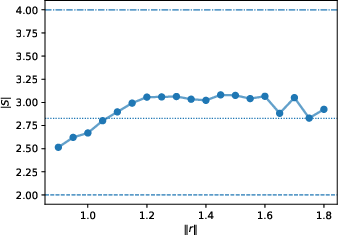
Figure 2: CHSH violation as a function of extended Bloch magnitude ∥r∥ for Schmidt-aligned observables, showing admissible post-quantum (∣S∣0) values.
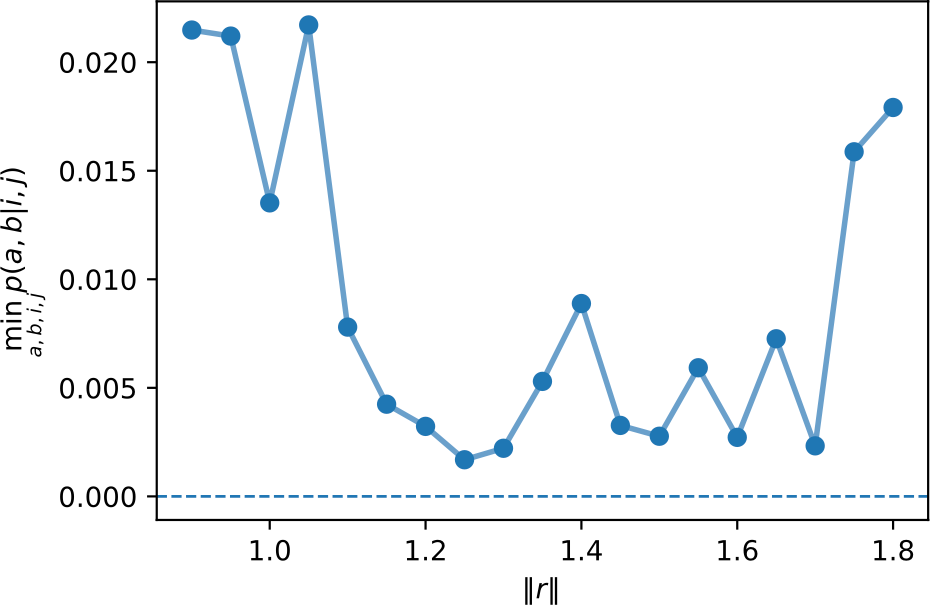
Figure 3: Minimum joint probability across settings, confirming admissibility throughout the extended preparation range.
The walker’s spatial probability profile under these conditions remains unaffected, maintaining the typical ballistic spread and interference structure expected from a Hadamard-walk:
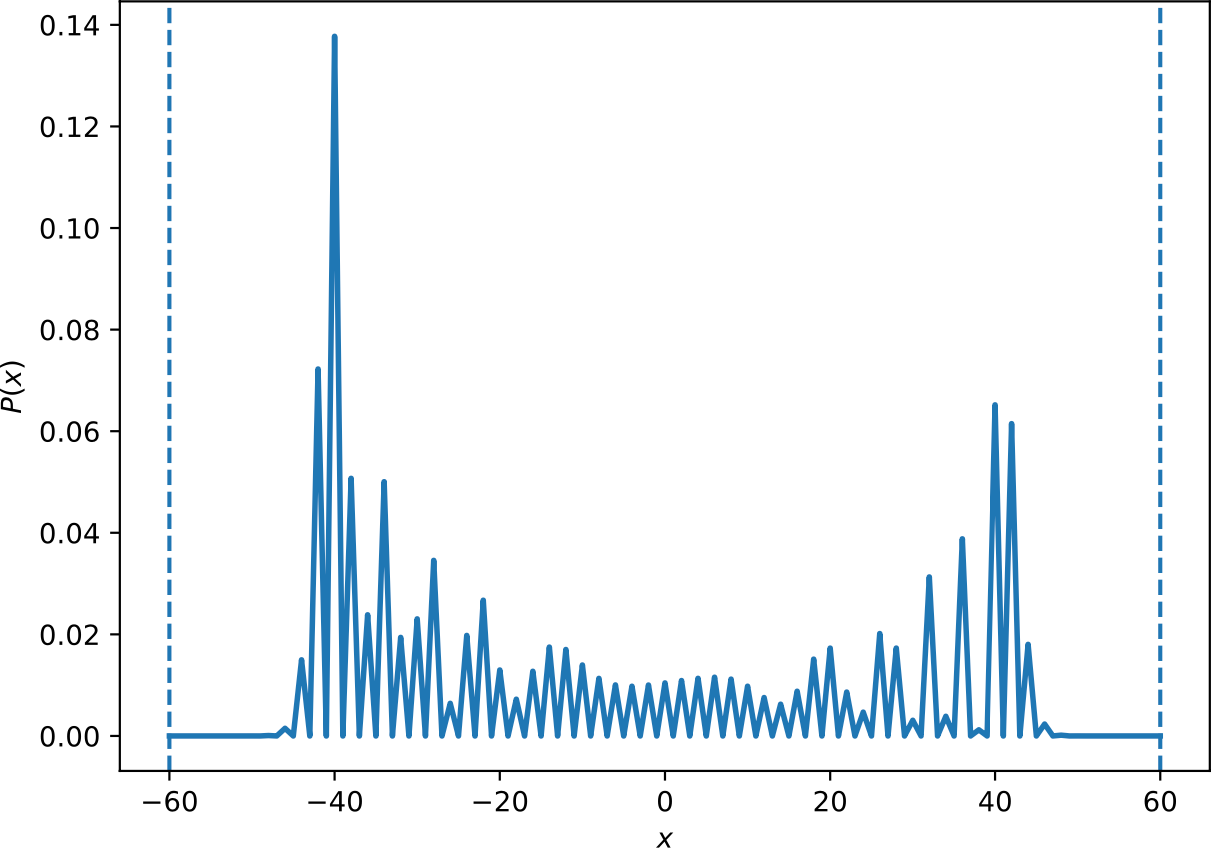
Figure 4: Final-time walker position distribution ∣S∣1 at ∣S∣2 for the post-quantum witness, preserving canonical quantum walk dynamics.
Importantly, the operational realization of such statistics—given the unphysical nature of the preparation—requires a quasiprobability reconstruction protocol using physically accessible coin states, achieved by decomposing the extended operator into a signed mixture of actual quantum states. This imposes a sampling overhead quantified by the ∣S∣3 norm of the decomposition coefficients, ∣S∣4.
Measurement Constraints and Accessibility
Despite the theoretical existence of post-quantum correlations, their observability depends acutely on the available measurement structure. A restriction to experimentally straightforward, position-diagonal coarse-grainings—such as sign binning or single-threshold binnings—severely suppresses accessible nonlocality, even in parameter regimes where the underlying state can support post-quantum correlations. For instance, using such measurements at ∣S∣5 and ∣S∣6 yields ∣S∣7, with all probabilities admissible; no Bell violation is observed.
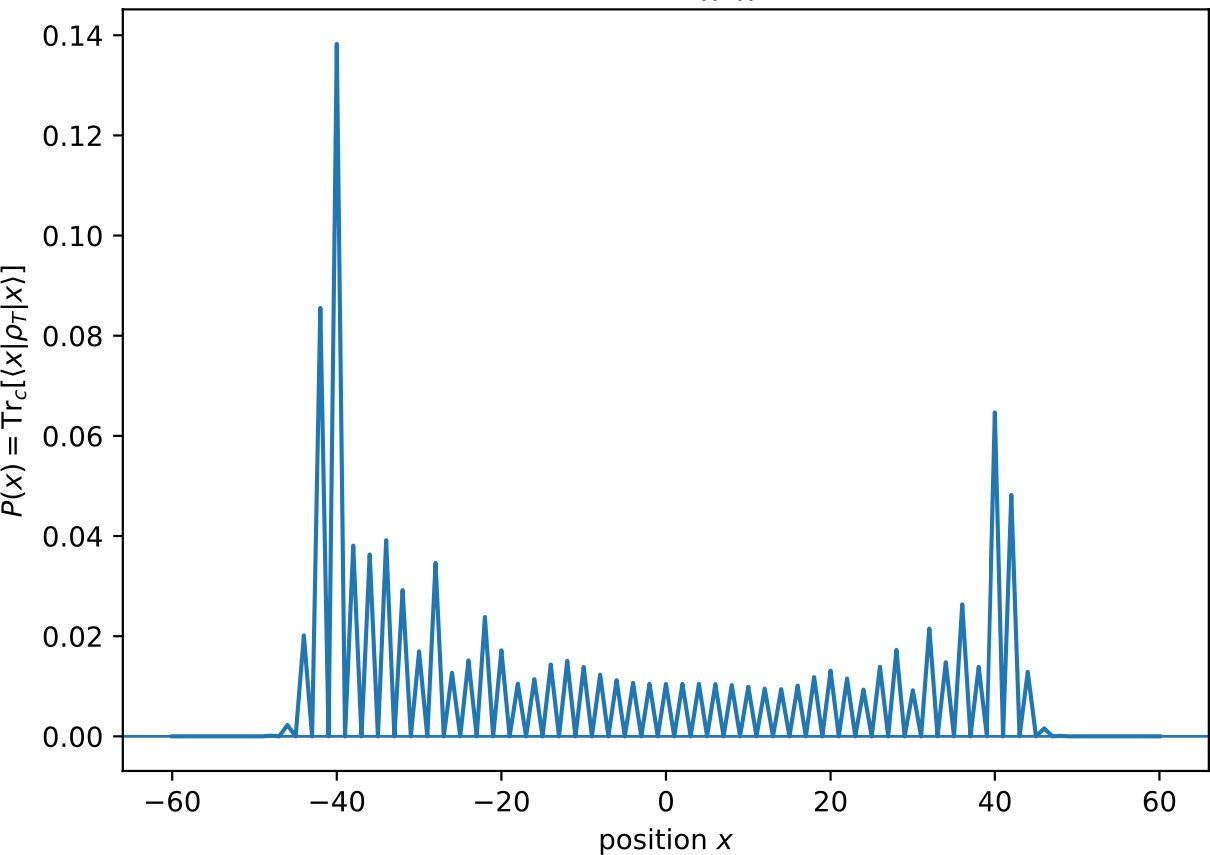
Figure 5: Final walker position distribution for the best coarse-grained witness, displaying standard quantum walk characteristics.
This contrast underscores the fundamentally subspace-localized structure of the effective Bell correlations: the strong nonlocality is concentrated in delocalized Schmidt modes that are inaccessible to simple position measurements.
Finite-Time Analysis and Measurement Resolution Effects
A systematic examination of the CHSH parameter across several walk times, retaining fixed coarse-grained measurement structure, reveals a finite-time regime (∣S∣8) in which violations of the local-bound ∣S∣9 remain robustly accessible. For larger ∥r∥=10, the expanding walker Hilbert space outpaces the static measurement resolution, leading to the obliteration of observable post-quantum effects.
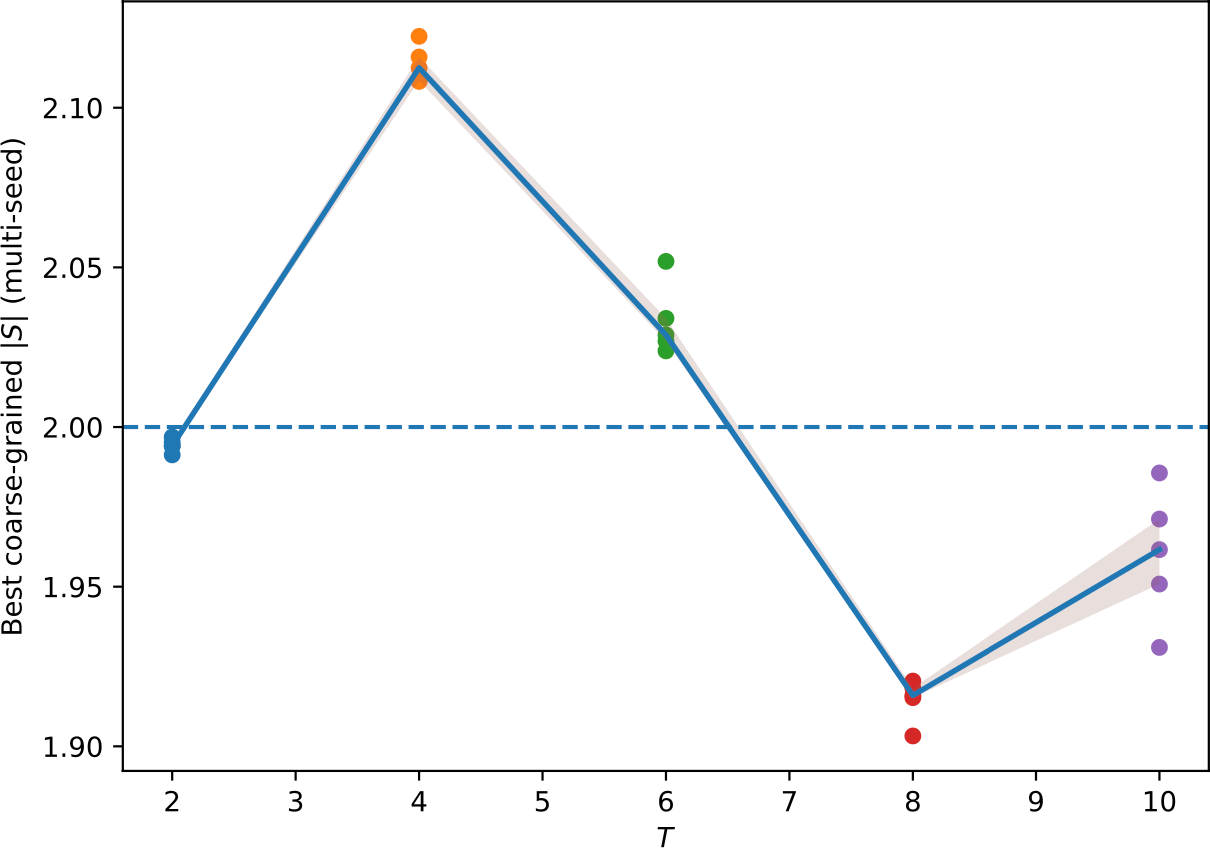
Figure 6: Maximal CHSH value for coarse-grained measurements vs. walk time ∥r∥=11, showing finite-time window with ∥r∥=12.
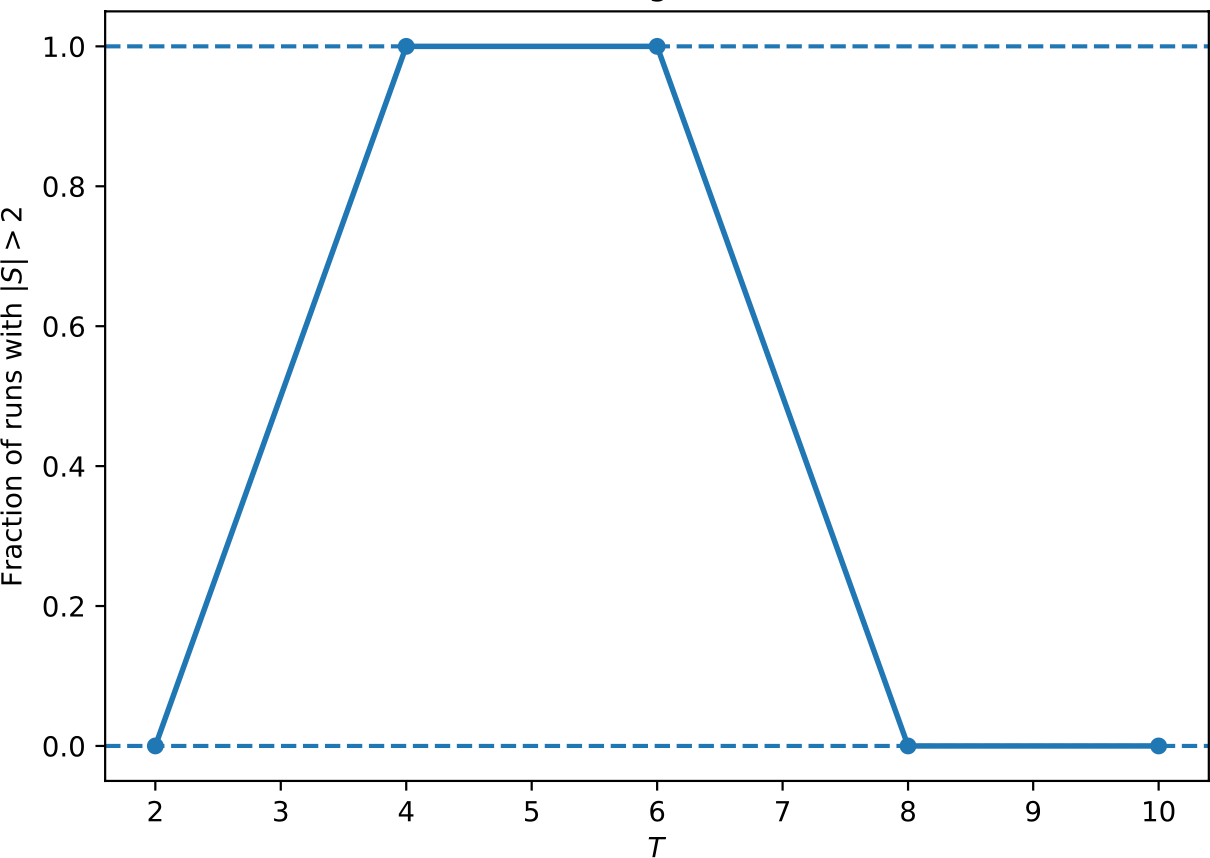
Figure 7: Fraction of admissible trials exhibiting ∥r∥=13 as ∥r∥=14 varies, indicating statistical suppression at large ∥r∥=15 due to Hilbert space growth.
The minimum probability margin across walk times remains operationally acceptable during the finite-time window:
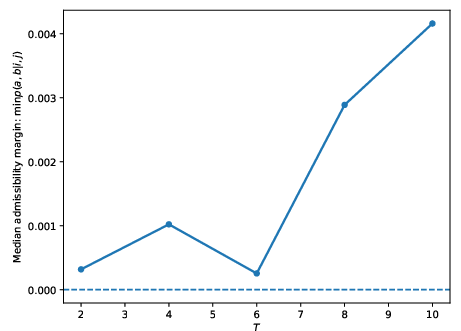
Figure 8: Typical minimal joint probability for the best witnesses across walk times, confirming robust admissibility without postselection.
Operationally, this implies that post-quantum correlations in quantum walks are not mere mathematical artifacts but can, in principle, be observed under suitably matched measurement resolutions and system sizes.
Implications and Future Directions
The demonstrated separation between the theoretical existence and practical accessibility of post-quantum correlations has strong implications for foundational studies and experimental quantum information. In particular:
- Theoretical Perspective: The results support operational frameworks—wherein complementarity rather than positivity is taken as primitive—as effective tools for understanding and simulating post-quantum resources in conventional quantum systems [deOliveira2020Complementarity, Spekkens2008].
- Experimental Perspective: DTQW platforms (photonic, trapped ion, superconducting, etc.) are suitable for emulation protocols relying on classical post-processing of quantum data to reconstruct extended joint distributions. The primary challenge shifts from dynamical engineering to the development and realization of collective or interferometrically resolved measurements approximating the relevant Schmidt-mode projectors.
- Quantum Communication: The practical non-accessibility of strong Bell violations under coarse-grained measurements suggests new constraints for device-independent protocols, quantum cryptography, and resource theory, where measurement resolution, not just quantum state structure, can be limiting.
- Future Work: Further studies could explore adaptive or collective position binning strategies, extend to higher-dimensional coins and walkers, and investigate the interplay between decoherence, measurement-induced transitions, and the persistence of post-quantum signatures [Silberhorn18, Solano2010, Peruzzo2010, Neves2018].
Conclusion
This work provides a rigorous operational demonstration that standard quantum walk dynamics, when interfaced with extended (complementarity-violating) coin preparations, can generate admissible post-quantum correlations exceeding Tsirelson's bound, subject to no-signaling and positivity of observed statistics. However, the accessibility of such correlations is acutely sensitive to the measurement structure: while ideal, Schmidt-aligned observables extract maximal nonlocality, coarse-grained position measurements generally cannot resolve the relevant effective subspace, suppressing observable violations at large system sizes. These findings position DTQWs as a versatile platform for probing quantum-classical boundaries and underscore the fundamental role of measurement resolution in the operational exploitation of nonclassical resources.
Reference: "Operationally Admissible Post-Quantum Correlations from a Standard Quantum Walk" (2605.05477)