Wormholes and the imaginary distance bound
Abstract: Some of the simplest wormhole solutions involve massless scalar fields that take imaginary values. Massless fields can be interpreted as coupling constants in asymptotically flat or asymptotically AdS gravity theories. We argue that wormhole effects imply an imaginary distance bound, an upper limit for the analytic continuation of the theory to imaginary values of these couplings. In string theory examples, we find explicit effects that render the low-energy theory invalid either before or precisely at this wormhole limit. We argue that the existence of such effects enforcing the distance bound is a general feature of string theories containing wormholes. In some cases, the bounds we discuss coincide with the weak gravity conjecture, and with the Kontsevich-Segal-Witten condition on complex metrics.
Paper Prompts
Sign up for free to create and run prompts on this paper using GPT-5.
Top Community Prompts
Explain it Like I'm 14
Plain-English Guide to “Wormholes and the Imaginary Distance Bound”
What is this paper about?
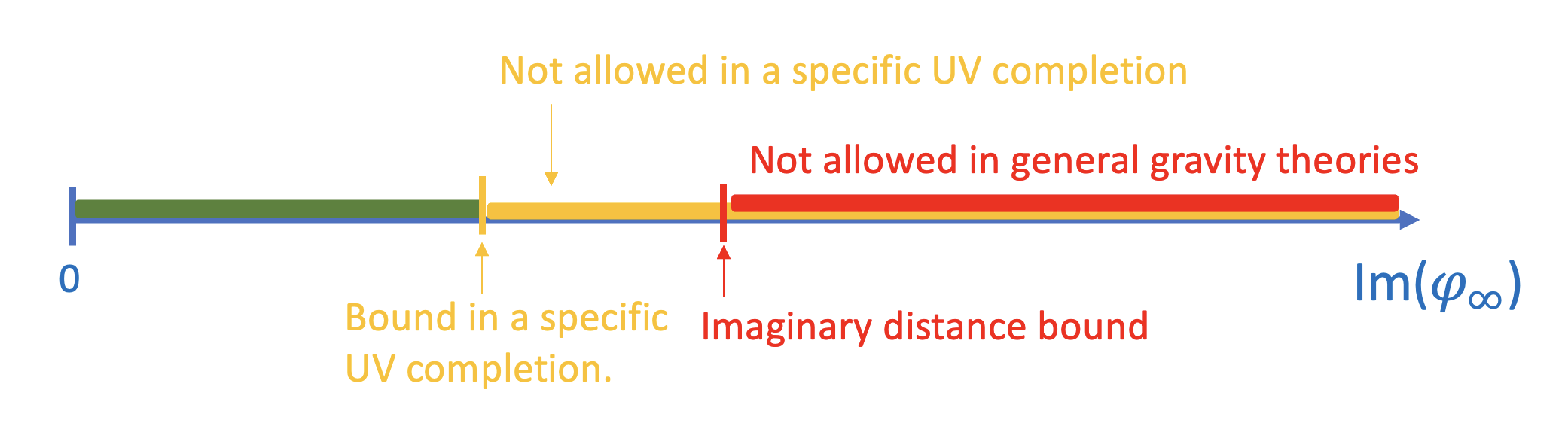
This paper studies special “wormhole” shapes of space that show up when certain fields in gravity (called massless scalar fields) are allowed to take imaginary values. The authors argue that the very existence of these wormholes means there’s a strict limit to how far you’re allowed to move those fields into the imaginary direction. They call this limit the Imaginary Distance Bound (IDB). They then show that in realistic theories like string theory, other effects kick in and make the usual low-energy description break down at or before that limit—so the bound is not just a math curiosity, it’s enforced by physics.
They also explain how this new bound ties into two well-known ideas: the weak gravity conjecture (roughly, “gravity cannot be the strongest force”) and the Kontsevich–Segal–Witten (KSW) condition (a rule for when complexified spacetime shapes still make mathematical sense).
The main questions the paper asks
- If we treat massless scalar fields (which set the “knobs” or coupling strengths of a theory) as complex numbers, how far can we safely turn those knobs into the imaginary direction?
- Do wormholes tell us where that safe region ends?
- In real, UV-complete theories like string theory (i.e., theories that make sense at all energy scales), do other effects appear exactly when we reach that limit, forcing the simple, low-energy picture to fail?
- How is this new limit connected to other big ideas like the weak gravity conjecture and the KSW condition?
How the authors approach the problem (in simple terms)
- Massless scalar fields as “knobs”: In gravity and string theory, there are fields whose far-away values act like adjustable settings of the theory (couplings). Usually these values are real numbers. The authors ask: what happens if we push them into the imaginary direction?
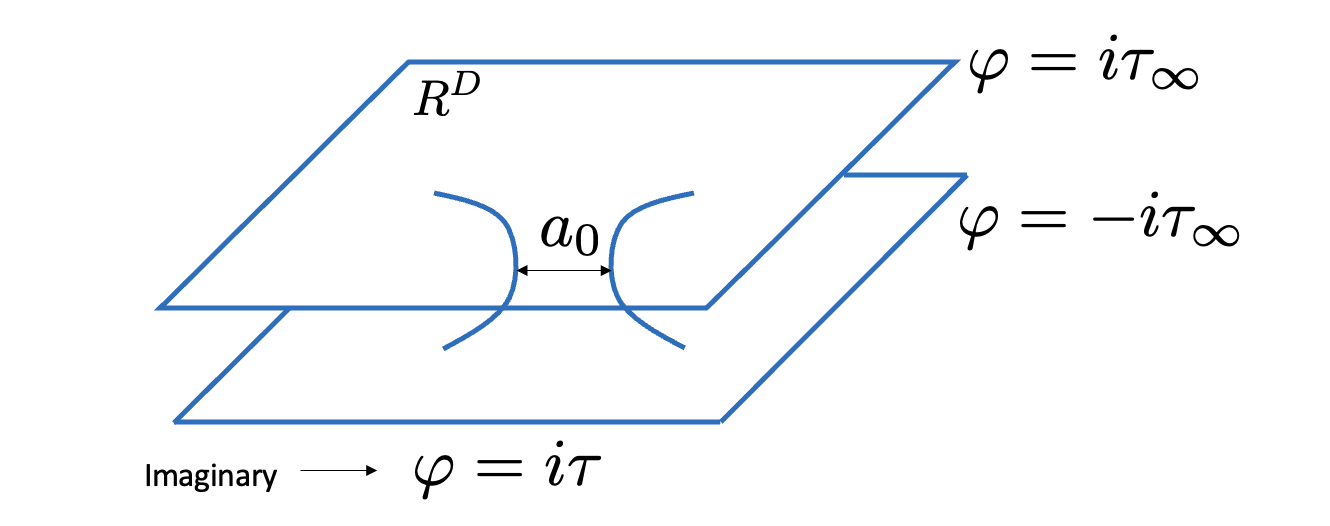
- Euclidean wormholes: They work with a Euclidean version of spacetime (a math trick that makes some calculations easier) and study wormholes—tunnels connecting two far-away regions. In their simplest examples, a wormhole exists only if a scalar field changes by a specific imaginary amount between the two ends.
- Dirichlet problem: They fix the value of the field at each far-away end and search for wormhole solutions that fit. When a solution exists, they look at its action (think of it as a “cost”): in flat space this cost is zero, which signals a dangerous, possibly huge contribution.
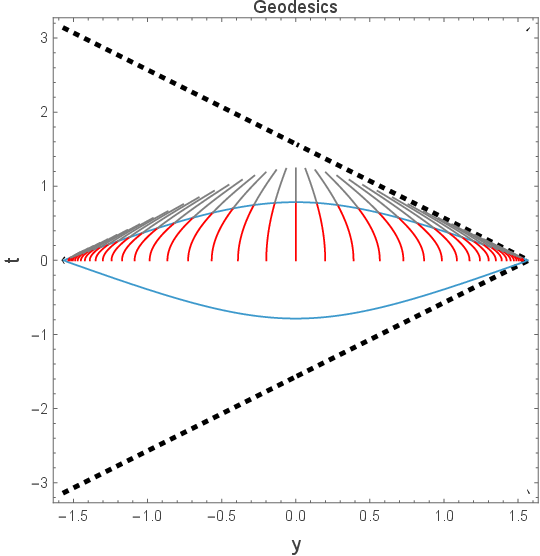
- Moduli space and geodesics: The space of all possible knob settings is called moduli space. The field’s path through that space during a wormhole solution follows the “straightest” possible line (a geodesic). The length of that path, measured in imaginary distance, is the key quantity.
- AdS vs flat space: They analyze both flat space and Anti–de Sitter (AdS) space (common in holography). The details differ, but both give a clear limit on how far one can go in the imaginary direction before trouble.
- Look for “enforcers” of the bound: In string theory, small corrections normally ignored at real values can explode when fields are imaginary (they grow like exponentials). Those exploding corrections tell you: stop, you’ve gone too far.
To explain a technical term with an analogy:
- Analytic continuation: Imagine a ruler marked along the real line. Analytic continuation lets you slide off the ruler into a new, perpendicular direction—the imaginary axis. The authors study how far you can go in that new direction before the map (theory) is no longer reliable.
What they find and why it matters
- A universal limit (the Imaginary Distance Bound, IDB)
- In flat space, there is a precise maximum imaginary distance, call it τ_IDB, that you can move the scalar field away from the real line before the low-energy theory breaks down. The exact number depends on the spacetime dimension D (the paper gives a simple formula).
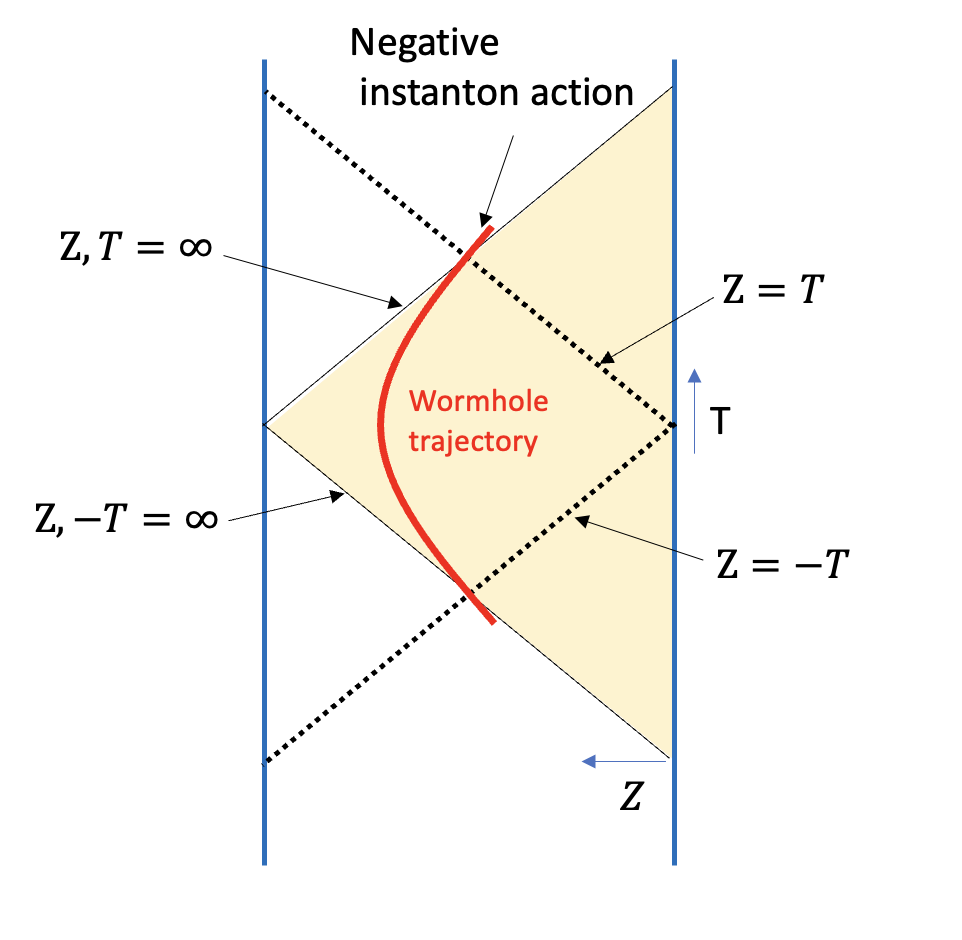
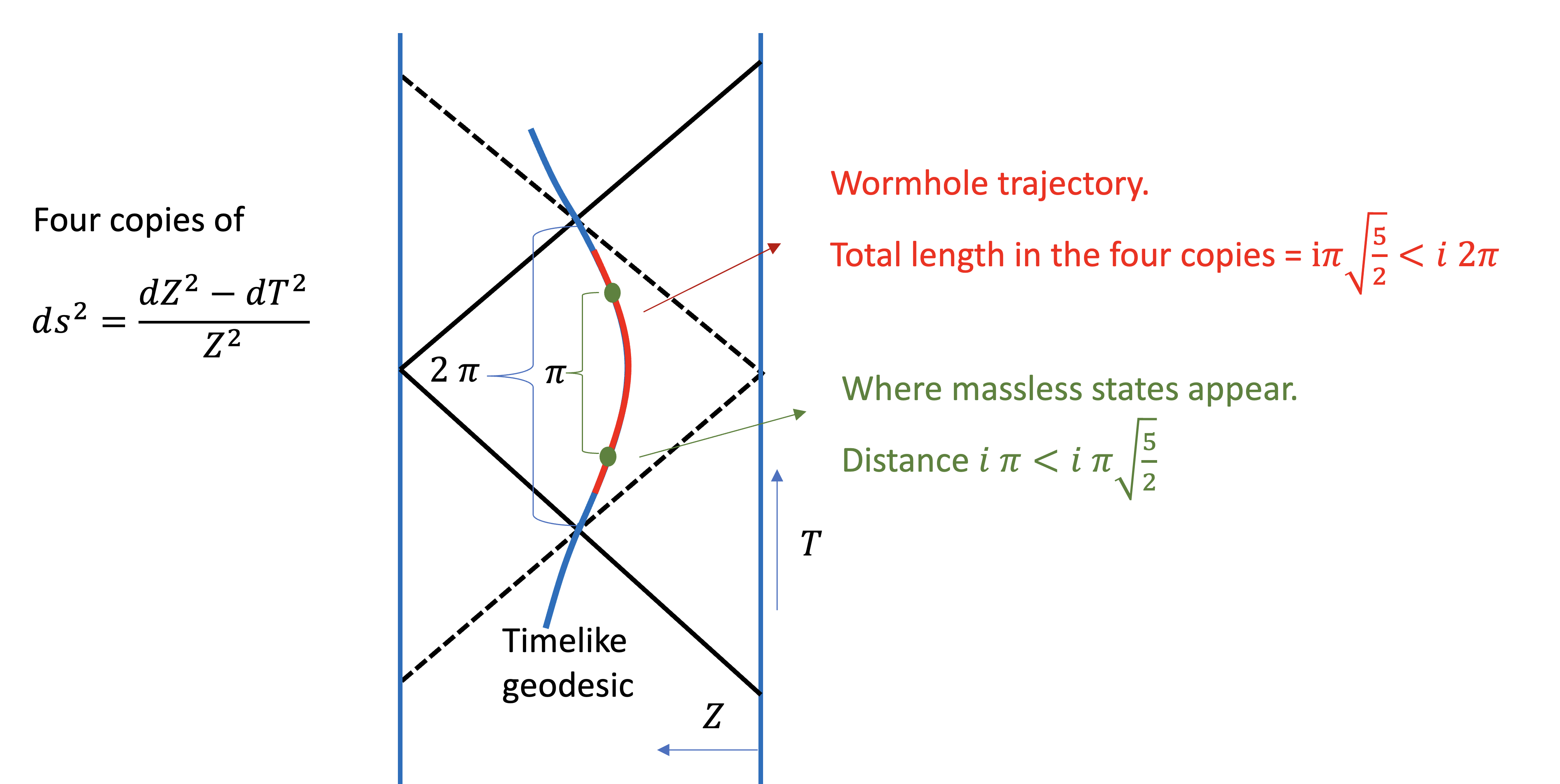
- In AdS space, there’s a similar bound, slightly tighter (smaller), because there exist zero-cost wormholes with flat “slices” inside AdS that already appear at a shorter imaginary distance.
- Why the limit shows up
- Wormholes appear right at the edge: When the imaginary distance reaches the bound, there are wormholes with zero action (zero “cost”), which means their contributions can blow up. That’s a sign your usual calculations are no longer trustworthy beyond that point.
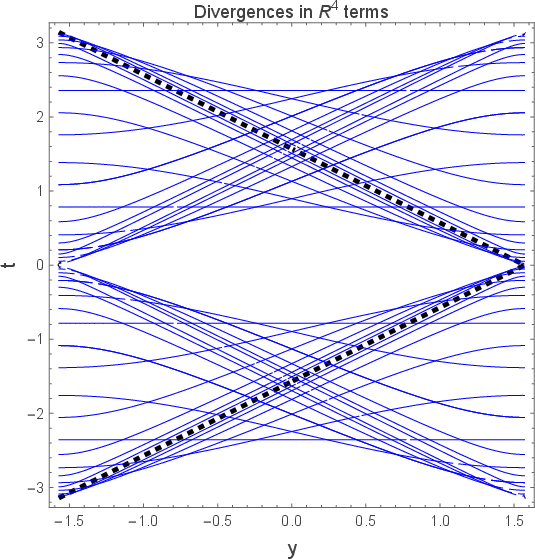
- In string theory, “hidden” effects enforce the bound: Terms that look tiny for real fields—like corrections proportional to something like c * e{i n φ}—can become huge when φ is imaginary (because e{+n·τ} grows fast). The authors show examples where these effects become big at or even before the wormhole limit, forcing the low-energy picture to fail right on time.
- Links to big ideas
- Weak Gravity Conjecture (WGC): When you reduce a higher-dimensional theory that includes electric charges, the wormholes connect to charged black holes. The requirement that some effect beats the wormhole’s contribution lines up with the WGC, which demands that there be particles for which electric repulsion can defeat gravity. In some cases, the IDB and WGC constraints match.
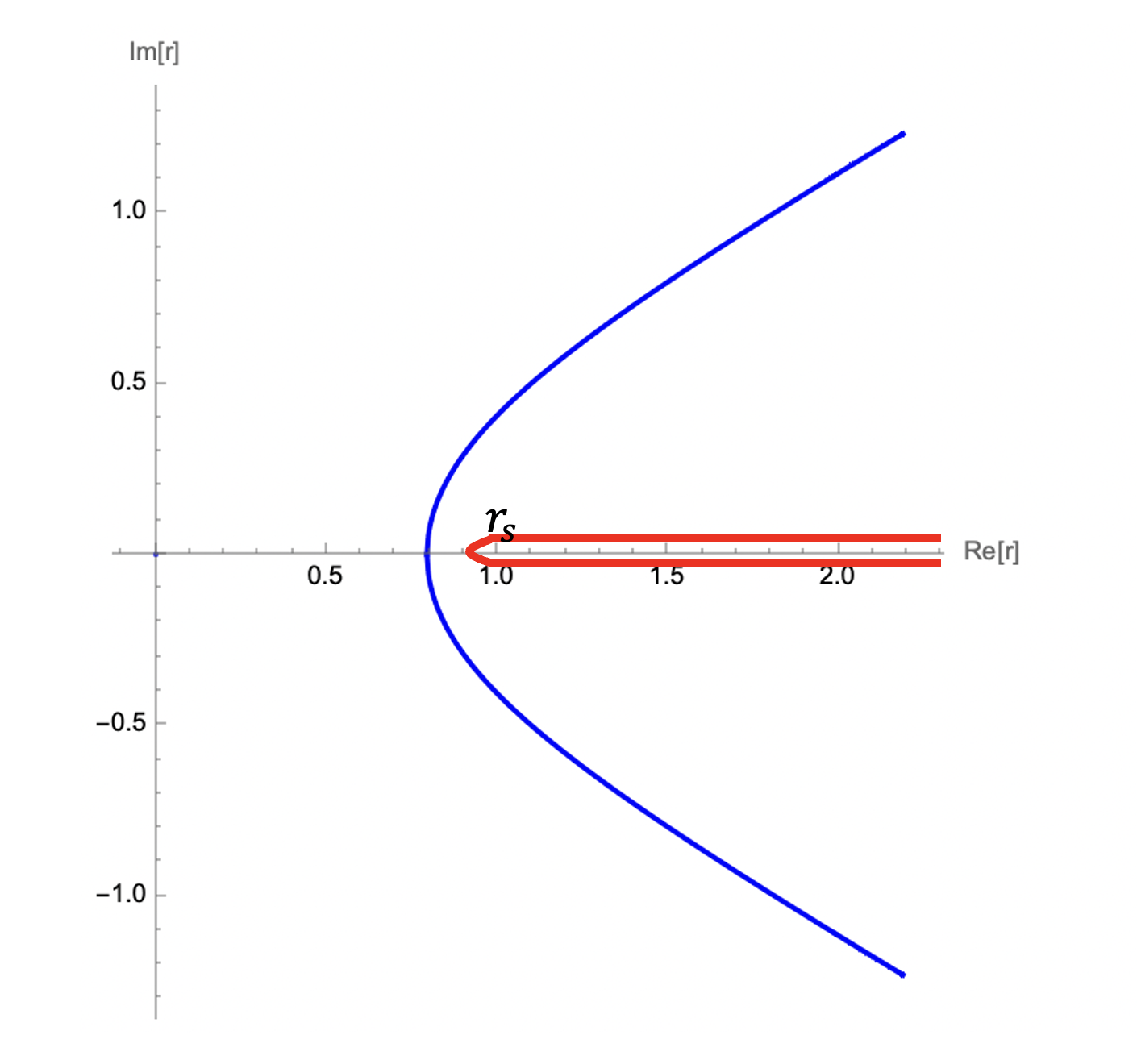
- KSW condition on complex metrics: If you roll up an extra dimension into a circle (Kaluza–Klein reduction), the scalar field is just the size of that circle. The wormhole in lower dimensions is closely related to the higher-dimensional Schwarzschild black hole. In these setups, the IDB becomes the same as the KSW rule that tells you when complex spacetime geometries still make sense. So the IDB generalizes KSW from just the metric to all moduli (all the “knobs”).
- A field-theory cross-check
- In a famous quantum field theory (N=4 super Yang–Mills), pushing a coupling into the imaginary direction makes a certain series of terms stop converging once you pass a clear point—another “natural boundary.” This mirrors the gravity story and supports the idea that there’s a real limit to how far you can go into the imaginary direction.
- A subtlety the authors note
- Some recent work debates whether these wormholes really contribute to the full gravitational path integral (the master formula summing over histories). Even if certain contours exclude them, the same “stop signs” still show up in string theory through those exploding corrections, so the bound is still physically enforced.
What this could mean in the big picture
- A natural boundary for theories: The IDB says you can’t freely “complexify” your theory’s knobs and expect the usual low-energy gravity to keep working forever—there’s a built-in wall. That gives a new kind of constraint on quantum gravity and holography.
- Unifying principles: The way IDB lines up with the WGC and the KSW condition hints that these seemingly different ideas might be faces of a single, deeper rule about consistency in quantum gravity.
- Guidance for model building: If you try to construct new theories or holographic duals by pushing couplings into the imaginary direction, the IDB tells you where you must stop—or include the right corrections that become important there.
- Clarifying wormholes’ role: The paper supports the view that some wormholes are genuine features of UV-complete theories but mainly affect “coarse-grained” (averaged) observables; at the point where they would dominate, other effects usually step in and keep the full theory well-behaved.
In short: Wormholes act like neon signs warning that pushing couplings too far into the imaginary field breaks the usual rules. String theory backs this up by making sure something else goes boom right at that point, enforcing a universal boundary on how far you can go.
Knowledge Gaps
Knowledge gaps, limitations, and open questions
Below is a consolidated list of what remains missing, uncertain, or unexplored in the paper, stated as concrete, actionable gaps for future research:
- Path integral contour ambiguity
- Precisely determine the correct gravitational path-integral contour for the configurations considered and whether the scalar-supported wormholes actually contribute (resolve the tension with alternative prescriptions where they do not).
- Identify contour-independent statements (e.g., bounds derived from non-saddle arguments) or diagnostics that are robust to contour choices.
- General proof of the Imaginary Distance Bound (IDB)
- Provide a rigorous, theory-independent proof that the low-energy theory necessarily breaks down at or before the proposed flat-space and AdS IDBs, beyond semiclassical wormhole heuristics.
- Clarify necessary and sufficient conditions (on spectra, moduli-space geometry, instanton sectors, higher-derivative terms) for the bound to hold.
- Mechanism enforcing the bound in UV-complete theories
- Systematically classify the “intrinsic effects” (e.g., worldsheet/D-instantons, perturbative corrections, complex-metric constraints) that can invalidate the low-energy theory at or before the IDB and quantify their onset across string compactifications.
- Determine whether the breakdown is universally driven by a single dominant effect or depends on model-specific hierarchies.
- Relation to the Kontsevich–Segal–Witten (KSW) bound
- Establish a precise equivalence (or delineate differences) between the IDB and the KSW criterion beyond toroidal reductions and metric moduli; extend to general moduli (non-metric, non-geometric, flux, and bundle moduli).
- Clarify how complex metric constraints and complexified moduli-space geodesic lengths interplay in general reductions, including curved internal manifolds.
- Relation to the Weak Gravity Conjecture (WGC)
- Formulate and prove a unified framework connecting the IDB, WGC, and KSW bounds, including precise assumptions under which the IDB reduces to or implies the WGC in dimensional reductions with gauge fields.
- Test whether sublattice/refined WGC variants have IDB analogs for multi-charge sectors.
- AdS IDB and fixed-charge summations
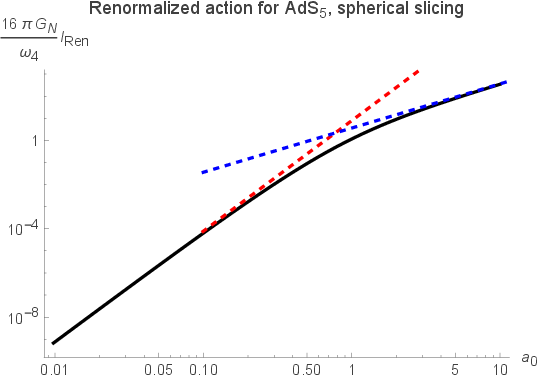
- Replace heuristic/numerical arguments with an analytic derivation of the AdS IDB from first principles, including a controlled evaluation of the fixed-charge wormhole action and one-loop determinants Z1(q).
- Verify convergence criteria for the charge sum in explicit AdS/CFT pairs and identify necessary conditions for divergence at the proposed bound.
- Stability and perturbations
- Analyze linear and nonlinear stability of Dirichlet wormholes (as opposed to the more-studied Neumann/form-field case), including zero-mode structure and backreaction of correction terms that could enforce the bound.
- Determine whether small deviations from the critical imaginary displacement trigger universal runaways in the wormhole size parameter a0 in AdS as suggested by the off-shell potential.
- Multi-field, curved moduli spaces
- Quantify how curvature, singularities, monodromies, and boundaries of moduli space affect the proper imaginary distance and the onset of invalidation mechanisms.
- Characterize when crossing “Poincaré horizons” in complexified moduli space corresponds to benign coordinate artifacts vs. genuine UV pathologies (e.g., instanton actions becoming negative).
- Compact versus non-compact scalars
- Extend the IDB’s precise statement (including units and normalization) to periodic axions with discrete identifications, accounting for large gauge transformations and dual p-form formulations.
- Determine how axion periodicity and instanton charge spectra modify or sharpen the bound.
- Massive fields and potentials
- Assess how the presence of light but massive scalars or moduli-stabilizing potentials changes the bound (e.g., whether the relevant distance remains geodesic, or becomes potential-dependent).
- Study whether metastable AdS or dS vacua respect analogous imaginary-distance limitations.
- Observable diagnostics in AdS/CFT
- Identify boundary CFT observables (e.g., partition functions on curved manifolds, OPE convergence radii, modular properties) that become singular or ill-defined at the AdS IDB and verify in concrete CFTs.
- Determine whether the Zamolodchikov metric alone controls the analytic continuation limit or if operator spectra/control of non-perturbative sectors are equally essential.
- From pairwise divergence to single-sided breakdown
- Replace heuristic arguments (based on Z(p+iτ)Z(p−iτ)) with rigorous bounds/inequalities that demonstrate how pairwise divergence forces breakdown of each individual theory beyond the IDB.
- Clarify the role of coarse-grained vs. fine-grained observables in making wormhole-induced averages precise.
- Quantitative string theory tests
- Provide explicit string backgrounds where the low-energy theory fails precisely at (or strictly before) the IDB and compute the responsible correction(s) in detail, including their parametric scaling with τ and D.
- Map regions of complexified moduli space where various instantons (worldsheet, D-instantons, NS5/M5, KK-monopoles) become actionless and compare their loci to the proposed IDB.
- Numerical vs. analytic control of actions
- Replace numerical evidence for positivity and asymptotics of AdS wormhole actions with analytic proofs valid for all D and all a0.
- Determine the precise large-a0 scaling and subleading corrections controlling the transition between spherical and flat slicing regimes.
- JT gravity and AdS2 limits
- Clarify, in UV-complete embeddings, how negative-action AdS2/JT wormholes avoid dominating observables when complex couplings are not averaged; identify the mechanism suppressing them.
- Derive the precise near-horizon reduction map connecting higher-dimensional IDB statements to AdS2/JT setups with chemical potentials and test the bound there.
- Beyond spherical symmetry and higher topology
- Explore whether non-spherical, multi-throat, or higher-topology wormholes impose stricter or different imaginary-distance constraints.
- Classify all relevant saddles (including non-symmetric ones) that could control the analytic continuation boundary.
- dS space and other signatures
- Formulate and test an analog of the IDB in de Sitter space, where the Dirichlet problem is subtle, or identify obstructions that prevent such a bound.
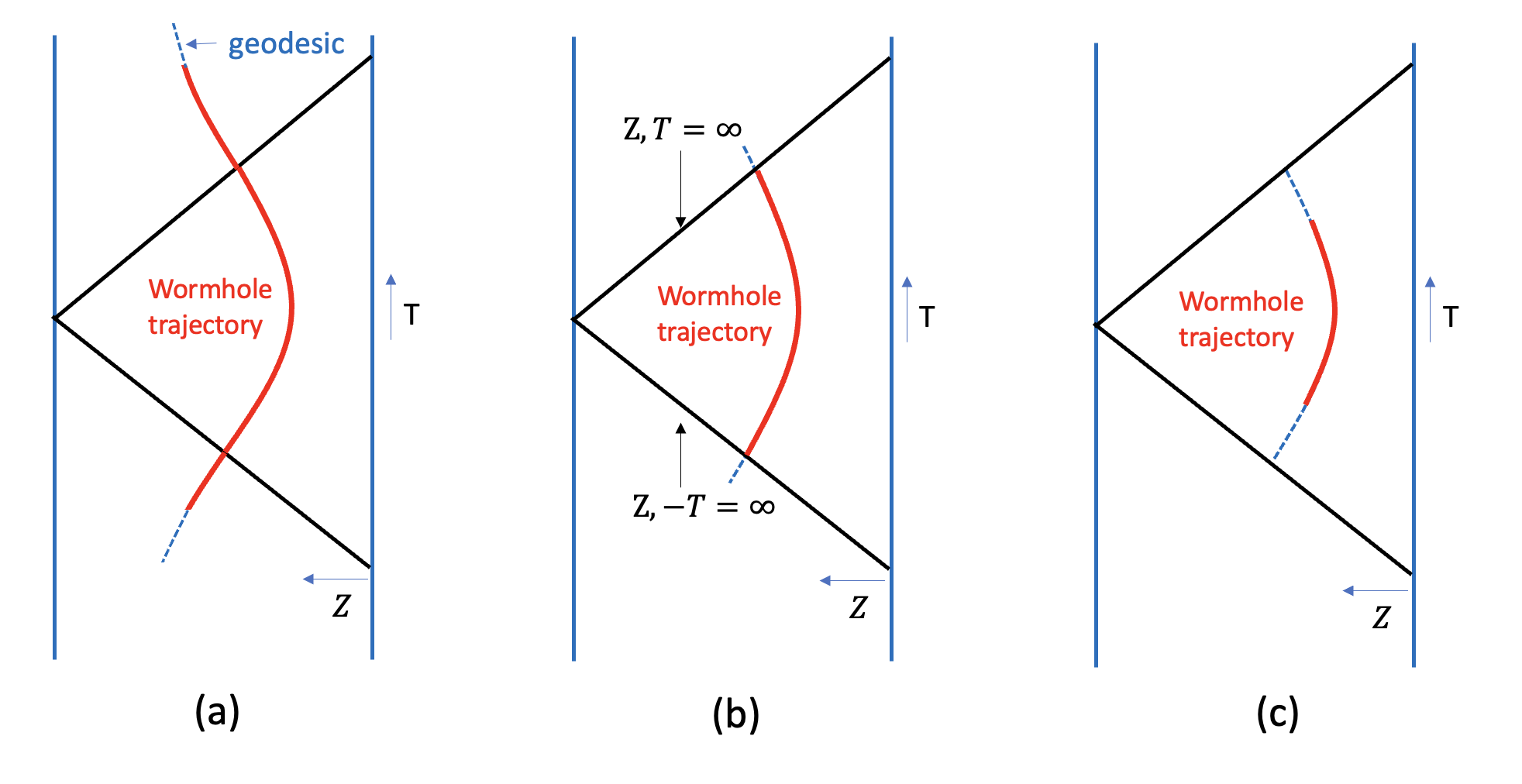
- Investigate Lorentzian continuations (“bubbles of nothing” interpretations) of half-wormholes and their relevance to unphysical complex-coupling deformations.
- Role of averaging over couplings in string theory
- Reconcile the “no fundamental couplings” principle in string theory with wormhole-induced averaging pictures: specify when and how coarse-grained averages emerge and what precise observables they govern.
- Determine whether half-wormhole effects can be rigorously interpreted as setting typical values of non-perturbative corrections in UV-complete theories without literal coupling averages.
- Off-shell formalism and control
- Develop a controlled off-shell framework (including boundary terms and measure) to justify the use of off-shell variations near the critical displacement and quantify loop corrections systematically.
- Evaluate whether higher-derivative corrections can ever dominate near the bound in AdS (finite a0) and modify the inferred constraints.
- Edge cases and dimensional dependence
- Analyze limiting behaviors as D→2 and D→∞ and check continuity/consistency of the bound in these limits.
- Investigate whether mixed compactification schemes (e.g., with warped factors, fluxes, or defects) adjust the D-dependence of the bound or introduce new scales.
- Practical criteria for “natural boundaries”
- Establish general, computable criteria indicating that analytic continuation hits a natural boundary (e.g., |q|=1 in instanton sums) in generic QFT/QG, beyond special integrable examples.
- Provide a dictionary between instanton/defect spectra and the location of the natural boundary in complexified moduli space for broad classes of theories.
Practical Applications
Overview
The paper introduces the Imaginary Distance Bound (IDB), a conjectural upper limit on how far gravitational theories (in flat space and AdS) can be analytically continued into imaginary values of their scalar couplings (e.g., moduli, axions, the dilaton). The bound is motivated by scalar-supported wormhole solutions and by explicit non-perturbative effects (e.g., instantons) that render low-energy effective descriptions invalid at or before the bound. The work also connects the IDB to:
- The Kontsevich–Segal–Witten (KSW) condition on complex metrics (via circle reductions and Schwarzschild/SSS wormholes),
- The Weak Gravity Conjecture (WGC) (via reductions with gauge fields),
- Holography (as a bound on complexified CFT couplings via the Zamolodchikov metric).
Below are practical applications distilled from these findings and methods.
Immediate Applications
These can be deployed now in academic workflows and scientific computing; some also offer near-term guidance for experimental design in adjacent fields.
- IDB as a consistency checker for quantum gravity model building
- Sector: Academia (theoretical high-energy physics, string theory, swampland)
- Use: Apply the IDB to constrain hypothetical compactifications or EFTs by checking whether low-energy theories remain valid under imaginary continuation of moduli/couplings. Acts as a “sanity bound” akin to WGC/KSW, flagging when non-perturbative effects must appear to uphold consistency.
- Workflow/tools:
- Compute geodesic lengths (proper imaginary distance) along complexified moduli-space geodesics using the sigma-model metric h_ab(ϕ),
- Compare to the IDB values (flat space: (π/2)√[2(D−1)/(D−2)]; AdS: (π/2)√[2(D−2)/(D−1)]),
- Cross-check for known instanton corrections (terms like c_n e{i n ϕ}) that would grow as ϕ → iτ.
- Assumptions/dependencies:
- Requires canonical normalization of scalars and reliable knowledge of h_ab,
- Assumes wormhole contributions are on the relevant integration contour (contour debates exist),
- Bound constrains non-unitary, complex couplings (a diagnostic, not a physical deformation).
- Bound on complexified couplings in holographic CFTs
- Sector: Academia (AdS/CFT, conformal field theory)
- Use: Restrict analytic continuation of CFT couplings (Zamolodchikov metric distances) to ensure controlled computations in conformal perturbation theory and to diagnose where nonperturbative effects or divergence of wormhole sums should appear.
- Workflow/tools:
- Compute Zamolodchikov metric and geodesic distances between complexified couplings,
- Check against the AdS IDB threshold before exploring non-Hermitian CFT deformations.
- Assumptions/dependencies:
- Requires an AdS dual or at least a reliable Zamolodchikov metric,
- Effects most meaningful when wormhole sums (e.g., fixed-charge sums) are relevant.
- Practical guardrails for analytic continuation in field theory computations
- Sector: Academia (QFT, lattice/Monte Carlo, resummation methods)
- Use: Use IDB-like boundaries and the |q|<1 criterion (e.g., Vafa–Witten for N=4 SYM on K3) as practical thresholds for analytic continuation of partition functions and instanton-resummed series. Helps select safe domains in complex coupling for numerical and symbolic continuation.
- Workflow/tools:
- In instanton-summed observables, monitor q = exp(−4π²/g² + iθ) and enforce |q|<1 to avoid divergence,
- Use IDB-inspired “distance to instability” diagnostics to steer complex-Langevin/Lefschetz-thimble algorithms away from regions where the low-energy description breaks down.
- Assumptions/dependencies:
- Requires identifiable instanton sectors and control over nonperturbative series,
- Still subject to standard sign-problem caveats and contour choices.
- Diagnostic for when wormhole contributions matter in black-hole thermodynamics
- Sector: Academia (gravity, black holes)
- Use: The relation between scalar wormholes and the Schwarzschild/SSS double-cone provides a criterion to judge when coarse-grained wormhole contributions (e.g., double-cone) may be significant or when they should be subdominant because other effects already enforce the bound.
- Workflow/tools:
- Map Kaluza–Klein reductions onto Schwarzschild geometries,
- Check if the implied imaginary scalar displacement saturates an IDB threshold.
- Assumptions/dependencies:
- Coarse-grained observables only; not all wormhole contributions are expected to affect fine-grained quantities,
- Integration contour/definition of the path integral impacts interpretation.
- Cross-checks against KSW and WGC in reduced theories
- Sector: Academia (string compactifications, swampland program)
- Use: Employ the IDB as a triangulation tool with KSW (complex metric bound) and WGC (charge/instanton dominance) in circle and torus reductions; consistency across these criteria strengthens confidence in model viability.
- Workflow/tools:
- In S¹ reductions, compare the IDB with KSW when scalars come from the metric,
- In reductions with gauge fields, check that matter satisfying WGC exists to beat the wormhole effects near the IDB.
- Assumptions/dependencies:
- Requires accurate dimensional reduction and identification of relevant matter content,
- May depend on UV completion details (stringy instantons, worldsheet effects).
- Research software concepts for moduli-space safety checks
- Sector: Software for scientific research (theoretical physics toolchains)
- Use: Build lightweight libraries that:
- Compute moduli-space geodesics and proper imaginary distances,
- Evaluate IDB/KSW/WGC checks,
- Warn when continuation exceeds safe thresholds.
- Potential products:
- “IDB Checker” Python/Mathematica package,
- “ModuliSpaceLab” with visualization of geodesics and IDB thresholds,
- Plugins for holography/EFT notebooks to validate complexified scans.
- Assumptions/dependencies:
- Requires user-supplied h_ab, D, and instanton data when available,
- Interpretations depend on path-integral contour choices.
- Heuristics for non-Hermitian/PT-symmetric experimental setups
- Sector: Experimental physics (non-Hermitian photonics/quantum platforms)
- Use: Treat IDB-like thresholds as qualitative guidance for where complexified parameters (gain/loss) may drive systems past controllable regimes in analog simulations inspired by gravity.
- Workflow/tools:
- Map target parameter paths to an effective geometry (if available) and avoid long imaginary continuations,
- Use as a “soft bound” when designing analog “wormhole-like” experiments.
- Assumptions/dependencies:
- Heuristic transfer; no direct one-to-one mapping guaranteed,
- Must be validated by platform-specific stability analysis.
Long-Term Applications
These require further theoretical development, UV-complete embeddings, or scalable experimental/algorithmic advances.
- Towards a unified principle linking IDB, WGC, and KSW
- Sector: Academia (quantum gravity foundations, swampland)
- Use: Formalize the conjectured common origin of the three constraints (IDB/WGC/KSW), aiming at a broader no-go criterion for inconsistent EFTs (a strengthened swampland principle).
- Potential outcomes:
- New classification theorems for admissible moduli spaces,
- Predictive constraints for UV completions beyond string theory.
- Dependencies:
- Resolution of path-integral contour ambiguities,
- More examples where nonperturbative effects precisely saturate the IDB.
- Algorithmic advances for the sign problem and contour deformations
- Sector: Scientific computing (lattice QFT, many-body physics)
- Use: Bake IDB-type “natural boundaries” into automated contour-deformation/complex-time algorithms to avoid regions where partition functions blow up, improving stability and efficiency.
- Potential tools/workflows:
- IDB-aware thimble selectors,
- Adaptive stopping rules for analytic continuation based on geodesic-distance monitors.
- Dependencies:
- Requires problem-specific geometry extraction (metric inference),
- Needs benchmarking across diverse models.
- Quantum simulation and analog gravity experiments with complex couplings
- Sector: Quantum technologies (quantum simulation, photonics, cold atoms)
- Use: Engineer platforms that emulate scalar wormholes and moduli-space geodesics with controlled complex couplings, using the IDB as a design constraint for stable emulation.
- Potential products:
- Programmable analogs of wormhole trajectories with tunable imaginary “distance,”
- Testbeds for coarse-grained wormhole effects (e.g., double-cone analogues).
- Dependencies:
- Requires robust non-Hermitian control and error mitigation,
- Careful mapping between gravitational and simulator variables.
- Automated EFT-to-UV viability pipelines
- Sector: Software/industry-facing research tools (EFT design, materials/condensed-matter analogs)
- Use: Integrate IDB checks into EFT pipelines (together with WGC/KSW/other swampland criteria) to assess UV embeddability—useful for rapid screening of theoretical models or analog EFTs in complex systems.
- Potential products:
- Cloud-based “Swampland Validator” service,
- CI tools for theory repositories that flag violations in model PRs.
- Dependencies:
- Requires standardized model specification formats and reliable metric input,
- Community acceptance of criteria and interpretation layers.
- Guardrails for interpreting “wormhole-like” claims in experiments
- Sector: Policy/standards for scientific claims and reproducibility
- Use: Develop best-practice guidelines that emphasize theoretical constraints (like the IDB) when interpreting analog simulations of wormholes or complexified couplings, reducing overinterpretation.
- Potential outcomes:
- Community-endorsed checklists,
- Journal/reviewer guidance for claims involving gravitational analogies.
- Dependencies:
- Consensus building across communities (gravity, AMO, photonics),
- Clear communication of scope and limits of analogies.
- Educational platforms for complex geometry and analytic continuation
- Sector: Education technology
- Use: Interactive modules that teach the geometry of moduli spaces, geodesics, and analytic continuation limits (IDB/KSW), bridging advanced topics in QFT, gravity, and complex analysis.
- Potential products:
- Visualization apps for moduli geodesics and wormholes,
- Problem sets tying Vafa–Witten examples, instantons, and IDB.
- Dependencies:
- Curated example libraries and pedagogical content,
- Sustained instructor adoption.
Notes on Feasibility and Scope
- The IDB constrains non-unitary, analytically continued theories; its primary utility is as a diagnostic consistency bound, not a recipe for physical device design.
- Practical deployment relies on knowing the moduli-space (Zamolodchikov) metric and scalar normalizations; in many models, this is available but may be approximation-dependent.
- Some conclusions depend on whether wormhole saddles contribute to the path integral (integration contour is unsettled); the “enforcement by other effects” (instantons, worldsheet contributions) is a key robustness feature.
- In D=2 (JT gravity and near-horizon limits), special care is needed: wormholes can have negative action, and interpretations hinge on averaging/coarse-graining and the embedding UV model.
Glossary
- AdS (Anti-de Sitter space): A maximally symmetric spacetime with constant negative curvature, widely used in holography. "We now discuss wormhole solutions in flat and AdS space."
- AdS: The two-dimensional Anti-de Sitter spacetime. "This has the geometry of AdS"
- axi-dilaton: The complex scalar field combining the axion and dilaton in type IIB supergravity. "One simple example is the axi-dilaton of the ten-dimensional type IIB supergravity, which has ."
- axion: A periodic pseudoscalar field; in string compactifications it often arises from form fields and has shift symmetries. "Such wormholes have been extensively discussed in cases where some of the scalars are axions"
- bubble of nothing: A non-perturbative instability where a compact dimension pinches off and spacetime ends. "This is reminiscent of the Witten bubble of nothing that describes the decay of circle compactification of flat space (with antiperiodic boundary conditions for the fermions)"
- CFT (conformal field theory): A quantum field theory invariant under conformal transformations; holographically dual to AdS gravity. "In AdS, they are the coupling constants of the dual boundary CFT."
- Dirichlet problem: A boundary-value problem where field values are fixed on the boundary. "Consider the Dirichlet problem, where the values of the scalars are fixed at each end of the wormhole."
- double-cone wormhole: A wormhole geometry related to black hole saddles (SSS construction) with two cones glued at their tips. "This includes the double-cone wormhole of Saad, Shenker and Stanford \cite{Saad:2018bqo}."
- Euclidean wormhole: A wormhole solution in Euclidean signature connecting two asymptotic regions. "A simple class of Euclidean wormhole solutions can be constructed in dimensions"
- extremal black hole: A zero-temperature black hole saturating a charge–mass bound. "We will see in section \ref{DimReCh}, that these wormholes can arise from the near horizon region of extremal black holes."
- form field: An antisymmetric tensor gauge field (p-form) common in string/M-theory. "can be rewritten in terms of a dual form field, which is real in the wormhole solution."
- Gibbons-Hawking term: A boundary term added to the Einstein-Hilbert action to ensure a well-posed variational principle. "There is no contribution from the Gibbons-Hawking term because the metric approaches that of flat space sufficiently quickly."
- Goldstone boson: A massless mode arising from spontaneous breaking of a continuous symmetry. "a0 is the Goldstone boson for the overall scaling"
- Imaginary Distance Bound (IDB): A proposed upper limit on how far couplings can be analytically continued along imaginary directions in moduli space before the EFT breaks down. "Our bound -- which we call the ``Imaginary Distance Bound'' (IDB) -- is an upper bound on how far we can analytically continue the before the theory breaks down."
- instanton: A non-perturbative Euclidean saddle contributing exponentially small effects, often labeled by a topological charge. "These wormholes appear to dominate over instanton effects with the same charges."
- JT gravity: Jackiw–Teitelboim gravity, a two-dimensional dilaton gravity model capturing AdS dynamics. "they would contribute for the JT gravity case \cite{Held:2026bbo}."
- K3: A compact, four-dimensional Calabi–Yau surface used in string compactifications. "we can have a solution where the boundaries are a K3."
- Kaluza-Klein reduction: Dimensional reduction on a compact manifold producing lower-dimensional fields (scalars, gauge fields, etc.). "Massless scalar fields also arise in Kaluza-Klein reductions of high-dimensional theories of gravity."
- Kontsevich-Segal-Witten (KSW) criterion: A condition constraining admissible complex metrics in the gravitational path integral. "becomes the same as the Kontsevich-Segal-Witten (KSW) \cite{Kontsevich:2021dmb,Witten:2021nzp} criterion that bounds the analytic continuation of a metric."
- Legendre transform: A transformation exchanging variables with their conjugate momenta, often relating fixed-value and fixed-charge ensembles. "For this fixed-charge problem the action is non-zero and equal to the Legendre transform of the action for the Dirichlet problem"
- Lorentzian continuation: Analytically continuing a Euclidean solution to Lorentzian signature (time-like). "Alternatively, we can think of as a timelike coordinate in a Lorentzian continuation of the target space."
- moduli space: The space of vacuum parameters (massless scalar expectation values) of a theory, often equipped with a natural metric. "where is the metric in the scalar field target space, sometimes called moduli space."
- Neumann problem: A boundary-value problem fixing normal derivatives (or, in gravity contexts, fixing form fields) at the boundary. "usually focusing on the Neumann problem (i.e. fixing the form-fields rather than the scalars at the boundary) rather than the Dirichlet problem which we consider."
- non-perturbative effects: Contributions not captured by perturbation theory, such as instantons or brane effects, that can drastically modify the EFT. "we will identify non-perturbative effects that cause the theory to break down at or before this upper bound."
- Schwarzschild solution: The spherically symmetric vacuum black hole solution in general relativity. "it is the double cone wormhole \cite{Saad:2018bqo} associated with the Schwarzschild solution."
- sigma model metric: The metric on the target space of scalar fields in a nonlinear sigma model. "which is reflected in the sigma model metric "
- stress tensor: The energy-momentum tensor; in gravity it sources curvature via Einstein’s equations. "this has the effect of effectively flipping their sign in the stress tensor and supporting a wormhole geometry"
- UV complete theory: A theory well-defined at arbitrarily high energies, providing a consistent ultraviolet completion of the low-energy EFT. "in any given UV complete theory of gravity, there is always an effect intrinsic to the theory that enforces the bound."
- weak gravity conjecture: The conjecture that gravity is the weakest force, implying the existence of superextremal states/charges. "matter that obeys the weak gravity conjecture \cite{Arkani-Hamed:2006emk}."
- worldsheet instanton: A non-perturbative stringy effect from Euclidean worldsheets wrapping cycles, contributing exponentially to amplitudes. "there are worldsheet instantons that become actionless for complex moduli values smaller than those appearing in the wormhole."
- Zamolodchikov metric: The natural metric on the conformal manifold of a CFT defined via two-point functions of exactly marginal operators. "and is the Zamolodchikov metric on the space of couplings."
Collections
Sign up for free to add this paper to one or more collections.

