- The paper introduces a graph-theoretic framework that systematically constructs quantum many-body scars in non-bipartite, frustrated Rydberg arrays.
- It distinguishes two scar types—Type-I using effective bipartition via dimer covers and Type-II relying on frustration-induced dead sublattices.
- The study shows that these designs yield robust nonthermal dynamics, offering potential pathways for quantum memory and resilient error correction.
Systematic Construction of Quantum Many-Body Scars in Frustrated Rydberg Arrays
Introduction and Motivation
The paper "Systematic construction of quantum many-body scars in frustrated Rydberg arrays" (2605.05297) addresses a foundational question in nonergodic quantum dynamics: the existence and systematic construction of quantum many-body scars (QMBSs) in Rydberg atom arrays beyond bipartite lattices. Traditional evidence of QMBSs in constrained systems—particularly in the PXP model—has been largely restricted to bipartite geometries with N\'eel-like initial states. This work introduces a graph-theoretic formalism to generalize and classify scarring mechanisms to non-bipartite lattices, particularly those with frustration, and systematically identifies candidate scarred subspaces and initial states.
The authors recast the dynamics of constrained Rydberg arrays under the PXP Hamiltonian as a problem on an interaction graph G(V,E), where vertices represent lattice sites and edges encode Rydberg blockade connectivity. The core algebraic insight is the approximate emergent su(2) structure in the scarred subspace, parametrizing collective operators Jα whose (approximate) closure enables persistent nonthermal dynamics reminiscent of large spin precession.
A central methodological advance in this work is the systematic partitioning of the lattice into three disjoint sets A, B, and C. A and B define dynamic sublattices between which population (or entanglement) oscillates, whereas C forms a 'dead' sublattice with suppressed dynamics:
- If C=∅, one recovers the known description for bipartite scarring.
- For non-bipartite/frustrated lattices, C must be nontrivial to decouple Jα0 and Jα1.
This partitioning allows derivation of collective operators Jα2 (with appropriate projector dressings) whose eigenstates serve as initial conditions for nonergodic quantum dynamics.
Classification: Type-I and Type-II Scarring
The study proposes two families of scars distinguished by their interplay with frustration and their graph-theoretic construction.
Type-I Scars: Generalized Bipartite Mechanism
Type-I scarring is based on mapping the original non-bipartite lattice to an effective bipartite model by covering the graph with non-overlapping cliques (maximal sets of mutually connected vertices). The quotient graph—obtained by identifying all vertices in each clique—must be bipartite. This construction encompasses all previously known cases of scarring in bipartite lattices as well as new cases in some frustrated lattices where effective bipartition can be achieved via local entanglement.
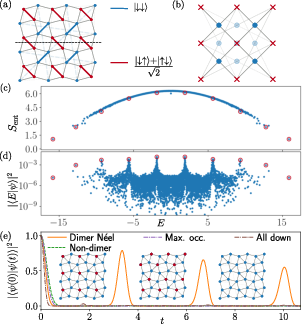
Figure 1: Type-I scarring in the Shastry-Sutherland lattice on a torus with 36 spins, depicted by dimer cover, effective bipartite lattice, entanglement entropy, state overlaps, and return fidelities.
Crucially, the authors show that in the hexagonal lattice, the space of bipartite dimer covers scales exponentially with the system width, generating an exponential family of type-I scarred trajectories and enabling robust encoding of quantum information resistant to thermalization.
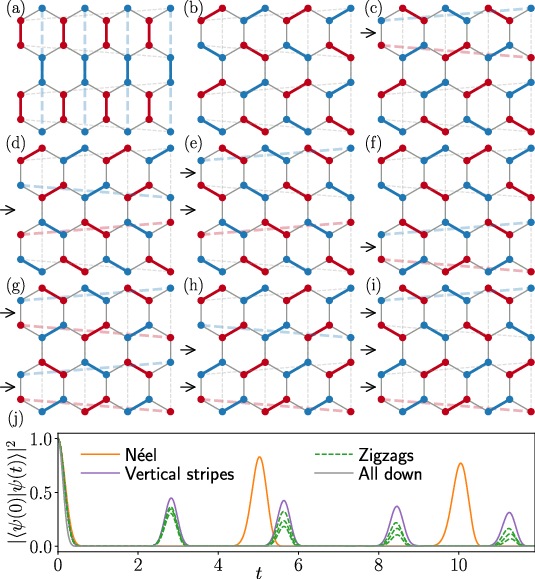
Figure 2: Type-I scarring in the hexagonal lattice, displaying multiple bipartite dimer covers and a spectrum of return fidelities after quenches from distinct scarred initial states.
Type-II Scars: Frustration-Induced Scar Stabilization
Type-II scarring arises in strongly frustrated systems, where dense local constraints prohibit reduction to a bipartite quotient. Here, the construction explicitly introduces a nontrivial Jα3 sublattice, such that Jα4 and Jα5 only couple via Jα6, and Jα7's own dynamics are suppressed by its connectivity and the blockade constraint. Type-II scars are stabilized by choosing Jα8 such that:
- All Jα9 and A0 sites only neighbor A1,
- Every A2 site connects to both A3 and A4, and
- The subgraph A5 is strongly connected and sufficiently blockaded.
The paper provides rigorous graph-based criteria for these constructions and demonstrates their efficacy in quasi-2D frustrated lattices like the asanoha and pyrochlore variants.
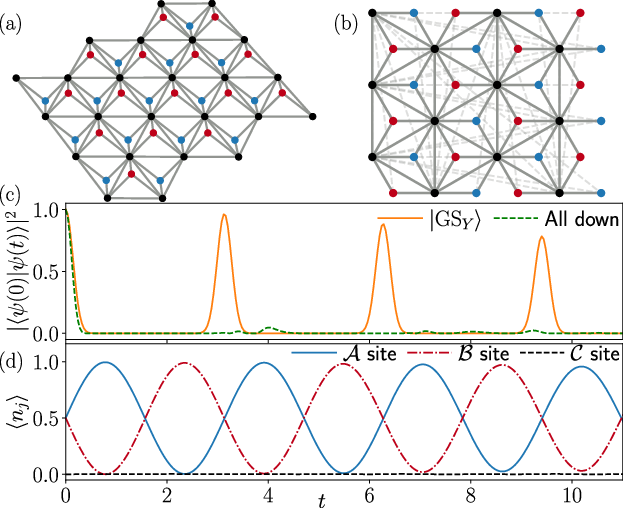
Figure 3: Type-II scarring in the quasi-2D asanoha lattice; plots show the suppression of dynamics on sublattice A6 and robust coherent oscillations in A7 and A8.
Additionally, lattices that cannot be covered by type-I or type-II constructions (e.g., triangular and kagome) fail to support robust long-lived scarring, highlighting the sharpness of the theoretical framework.
Strong and Contradictory Claims
- Scarring is established as a generic, not accidental, feature of Rydberg systems beyond 1D and bipartite cases.
- The type-II scar mechanism, stabilizing scars via frustration-induced 'dead' sublattices, is fundamentally distinct from known bipartite or weakly frustrated scarring.
- An exponential family of robust type-I scarring trajectories is demonstrated for hexagonal lattice geometries, enabling information storage resilient to quantum thermalization.
Practical and Theoretical Implications
The algebraic and combinatorial framework outlined enables efficient identification of suitable initial states for experimental observation of scars in arbitrary lattice geometries, providing a recipe for rapid testing in quantum simulators. The results suggest new routes for robust nonthermal memory in engineered quantum systems, as well as extensions toward quantum error-modulated information storage in noisy intermediate-scale quantum hardware.
On a theoretical level, this work deepens the connection between QMBSs, independent set combinatorics, and emergent collective algebraic structures in constrained quantum dynamics. The potential role of the identified scarred vacua as platforms for nontrivial solitary or plasma-like quasiparticles and their possible coupling to superdiffusive hydrodynamics offers a promising research direction.
Extensions could target:
- Robustness of scarring mechanisms under deviations from blockade conditions or presence of disorder,
- Hybrid constructions with coexisting type-I/II scars,
- Generalizations to higher-spin systems or different classes of kinetic constraints,
- Exploration of energy transport phenomena and the role of scars as nonergodic vacua for mobile excitations.
Conclusion
The paper provides a unifying and systematic framework for identifying and classifying quantum many-body scars in Rydberg arrays with arbitrary geometry and frustration. The dual type-I/type-II taxonomy encapsulates both known and novel scarring mechanisms, with strong numerical and analytic evidence provided for each. These results significantly broaden the class of nonthermalizable quantum states accessible in constrained quantum simulators and open new possibilities for the study of coherent nonergodic dynamics, memory, and transport phenomena in many-body quantum systems.
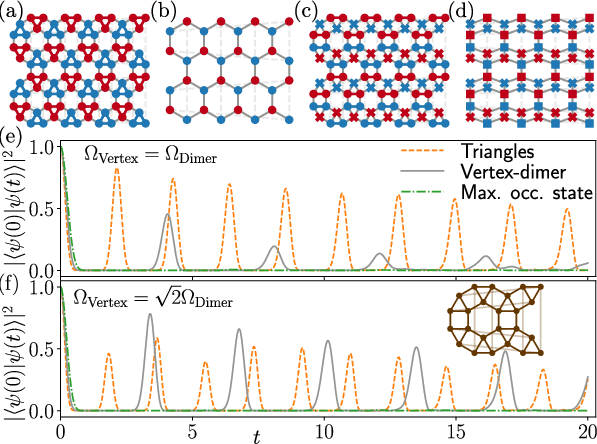
Figure 4: Distinct type-I scar constructions in the ruby lattice via triangle and vertex-dimer covers.
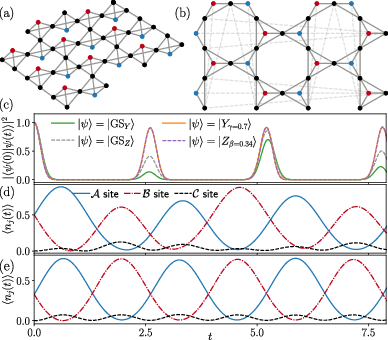
Figure 5: Type-II scarring in a quasi-2D pyrochlore lattice, demonstrating sublattice-resolved occupation and enhanced stability via optimized initial states.
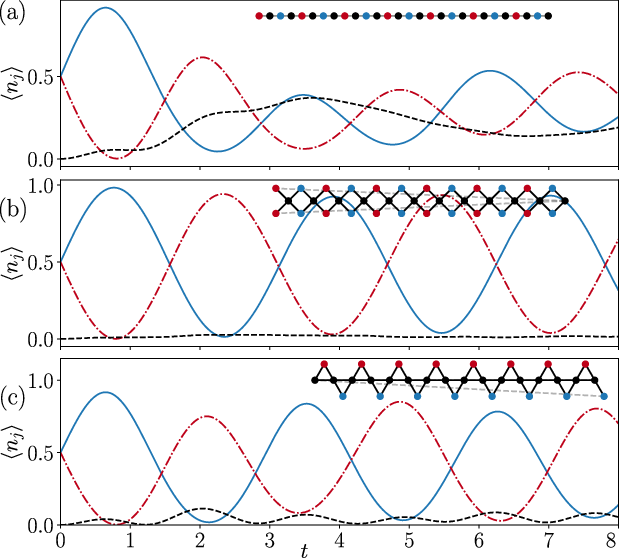
Figure 6: Enhanced lifetime of type-II scars through modifications of quasi-1D geometries in standard PXP models and ladders.
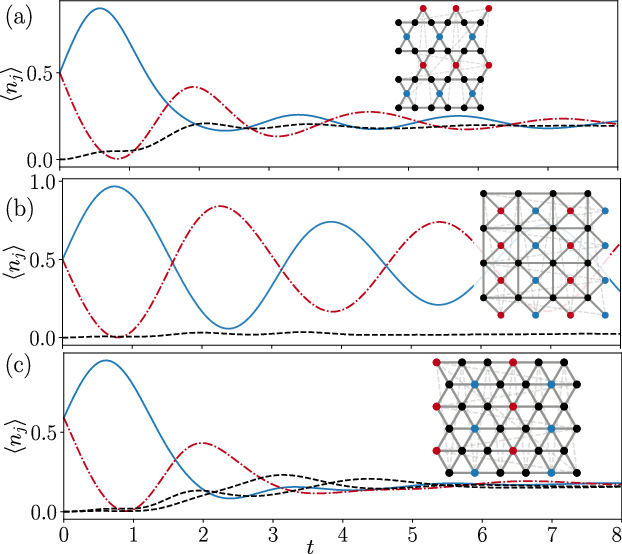
Figure 7: Comparative analysis of type-II scarring in 2D, showing decay in the kagome and triangular lattices and robust scars in the face-centered square geometry.
Reference: "Systematic construction of quantum many-body scars in frustrated Rydberg arrays" (2605.05297).

