- The paper presents the explicit construction of gravitational saddle points, differentiating between black hole, thermal AdS2, and baby universe phases.
- It employs chord diagrammatics and Hilbert space slicing to elucidate the entanglement structure across distinct bulk topologies.
- The study quantitatively analyzes matter insertions and wormhole chord suppression, offering insights into factorization puzzles in quantum gravity.
Microscopic Baby Universes in the Coupled Double Scaled SYK Model
Introduction and Context
This work investigates the emergence of baby universes within the framework of a double-scaled Sachdev-Ye-Kitaev (DSSYK) model extended with a Maldacena-Qi (MQ) coupling, focusing on a detailed diagrammatic and Hilbert space-level analysis of the model's path integral at leading order. The main objective is to explicitly construct and probe distinct gravitational saddle points that have holographic duals with differing topology: (1) a pair of black holes (two thermal disks), (2) thermal AdS2 (a cylinder), and (3) thermal AdS2 containing a baby universe (a cylinder with a handle). The work deploys explicit chord diagrammatics, develops corresponding chord algebraic rules, and slices open the path integral to construct the Hilbert space assignments and entanglement structures associated to these geometries. Most notably, the baby universe phase is found to encode genuine entanglement with the AdS regions—providing evidence that closed universes support nontrivial, dynamically meaningful internal Hilbert spaces.
Model Setup and Bulk Phases
The model consists of two SYK systems coupled via the MQ term, analyzed in the double scaling limit: N,p→∞ with λ=2p2/N fixed. The phases of the model are classified by saddle points of the path integral and associated topology:
- High-temperature (Disks) Phase: Decoupled SYK systems, each dual to a thermal disk (black hole) geometry.
- Intermediate (Tube) Phase: A Hawking-Page (HP) transition yields a cylinder geometry, corresponding to thermal AdS2 without a black hole.
- Low-temperature (Ribbon/AS2) Phase with Matter Insertions: Further, the introduction of heavy matter operators causes the dominant saddle to acquire an additional handle, capturing a baby universe geometry.
Critical to the analysis is that each of these bulk topologies admits a precise translation into rules for chord diagrams—combinatorial objects that fully capture the (dis)connectedness of the constituent Hilbert spaces via their topology and crossing structures.
The path integral of the coupled DSSYK model is rewritten as a weighted sum over chord diagrams. For each phase, the chord rules encode both the local geometry (through factors such as geodesic length penalties) and topology (through possibilities for chords to connect, cross, or tunnel):
- Disks Phase: Chords reside on each disk independently; weights count only local crossings. Crossing numbers give exponential penalties e−λ per crossing.
- Tube (Cylinder) Phase: Chords can wrap between the two disks, fully probing the emergent cylindrical geometry. Traveling (“nonlocal”) chords acquire a suppression e−ℓ(τ,τ′), where ℓ is a “geodesic” on the thermal circle proportional to the MQ coupling.
- Baby Universe Phase: Heavy matter operators localize at definite boundary positions (typically τ=β/4,3β/4), pinching off a new “handle” in the bulk (baby universe). Chord rules now allow for “wormhole” chords that traverse the handle with a suppression related to the operator's scaling dimension.
The precise penalty for nonlocal chords in the presence of discrete couplings or matter insertions is supported by mean-field/statistical arguments and exact combinatorial enumeration.

Figure 2: Plots of the free cylinder (tube) saddle in the DSSYK-MQ model, visualizing the relevant geodesic suppression patterns in the chord factor.
Hilbert Space Slicing and Entanglement Structure
A key innovation is the slicing of chord diagrams along a spatial slice, translating diagrammatic data into explicit Hilbert space factors:
- Disks: The chord Hilbert space is a tensor product 20. The Hartle-Hawking (“HH”) state is unentangled between disks, corresponding to a direct product state.
- Tube: The Hilbert space is similarly a double factor, but with the inclusion of cross-chords. The HH state becomes a thermofield double, maximizing entanglement across the two AdS regions.
- Baby Universe: The spatial slice is now partitioned into three regions: left (L), right (R), and baby universe (B). The Hilbert space is 21, with explicit pairing rules for open chords (see Figures below). The HH state features genuine tripartite entanglement, with the baby universe dynamically entangled with the exterior AdS regions in a manner computable from the chord diagram expansion.
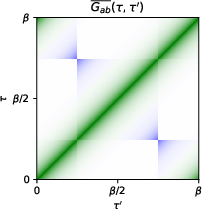
Figure 4: Plot of the chord factor 22 reflecting the wormhole contribution in the AS23 geometry with two heavy matter insertions; blue peaks showcase enhanced amplitude for cross-“handle” propagation.

Figure 1: Plot of the chord factor 24 for the AS25 geometry with a single heavy operator; connectivity is maintained across slices except at the insertion, with corresponding suppression factors for chords passing through.
Further, by examining the structure of the maximally entangled state and its chord basis expansion, the essay makes explicit the combinatorial origin of the entanglement—demonstrating that wormhole traversing chords correspond to non-vanishing matrix elements in the baby universe sector, suppressed by 26 (the wormhole length).

Figure 7: Plots of 27 in the free AS28 saddle point with two heavy operators, illustrating the spatial localization of the wormhole and discontinuities corresponding to operator insertions.
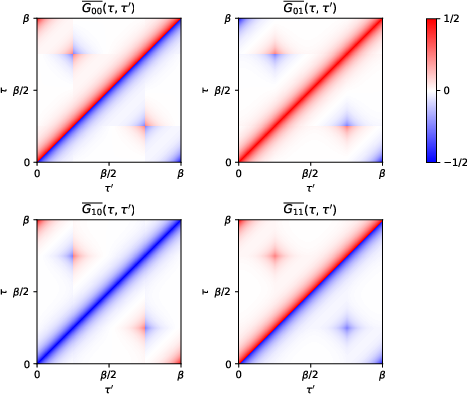
Figure 9: Plots of 29 in the free ASN,p→∞0 saddle with a single heavy operator, verifying the survival of off-diagonal connectivity except at the heavy matter insertion.
Numerical and Analytical Results
- Topological Action Contributions: The action for each saddle exhibits phase-specific, topology-dependent contributions (specifically, a topological entropy term encoding Euler characteristic), highlighted by the precise value differences between disks and cylinder phases.
- Wormhole Length and Chord Suppression: The suppression for wormhole-crossing chords scales as N,p→∞1, with N,p→∞2 the number of Majoranas and N,p→∞3 the operator scaling dimension. This quantifies how the baby universe Hilbert space dimension and the scaling dimension of the operator control the semiclassical accessibility of the interior.
- Factorization and AR Puzzle Resolution: The results directly address the Almheiri-Rolnick (AR) puzzle. The chord Hilbert space encodes a nontrivial baby universe sector, with entanglement structure that persists after coarse-graining and disorder averaging, implying that the baby universe does not correspond to a trivial Hilbert space or a unique quantum state but supports a spectrum of entangled configurations.
Theoretical and Future Implications
This analysis solidifies the chord diagram formalism as a precise tool for diagnosing Hilbert space factorization in models of quantum gravity with fluctuating topology. The results suggest that in models with sufficient disorder (random couplings), sharply defined Hilbert space factors for baby universes survive coarse-graining. This opens several future directions:
- Bulk Observable Construction: Developing systematically the set of semiclassical observables that survive disorder averaging and are “self-averaging” in the sense of pointer states.
- Entanglement and Information Transfer: Quantitative investigation of the amount and structure of entanglement between closed universes and external regions, and its disorder/statistical stability.
- Extensions to Higher Dimensional Models: Adapting chord diagrammatic rules to more complex low-dimensional gravity models, and testing the combinatorial origins of bulk topology in broader holographic models.
- Large N,p→∞4 Limit and Random Matrix Theory: Further developing the connection between large N,p→∞5 diagrammatics and classical geometry/topology transitions in gravitational path integrals.
Conclusion
This work provides a detailed, explicit mapping between saddle points in a double-scaled, coupled SYK model and specific bulk topologies, demonstrating how baby universes with nontrivial Hilbert spaces and entanglement structure naturally emerge from well-controlled microscopic dynamics. The chord diagram expansion and Hilbert space slicing provide powerful techniques for dissecting quantum gravitational partition functions, offering an unambiguous laboratory for testing ideas about factorization, coarse-graining, and information structure in quantum gravity.
The findings suggest that coarse-grained, disorder-averaged quantum gravity retains a robust notion of baby universe Hilbert spaces, with implications for the encoding of cosmological interiors, information flow, and the holographic dictionary in models with fluctuating topology.
References:
"Baby Universe in a Coupled SYK Model" (2605.05291)