- The paper establishes that fractional-time dynamics effectively control quantum coherence, entanglement, and nonlocality in PBI dimers.
- The paper employs the time-fractional Schrödinger equation with Caputo derivatives to quantify quantum resource evolution via dipole-dipole interactions.
- The paper reveals that tuning the fractional order and local detuning optimizes preservation and generation of quantum resources in molecular systems.
Fractional-Time Dynamics of Quantum Resources in Dimeric Perylene-Bisimide Organic Molecules
Introduction
This study provides a comprehensive analysis of the fractional-time quantum dynamics of a perylene-bisimide (PBI) molecular dimer, focusing on the control and behavior of quantum coherence, entanglement, and Bell nonlocality resources in organic dimers mediated via dipole-dipole interactions and governed by a time-fractional Schrödinger equation (TFSE). The main thrust is the introduction of fractional calculus as a phenomenological framework for non-Markovian quantum dynamics, where the order parameter τ characterizes the strength of memory effects. The implications for quantum information processing in realistic molecular systems are central, with specific emphasis on environmental engineering, initial state preparation, and dynamical parameter management.
The studied system features two PBI molecules coupled via long-range dipole-dipole interactions, which allows the clean observation and quantification of quantum correlations over time as a function of system and environmental parameters.
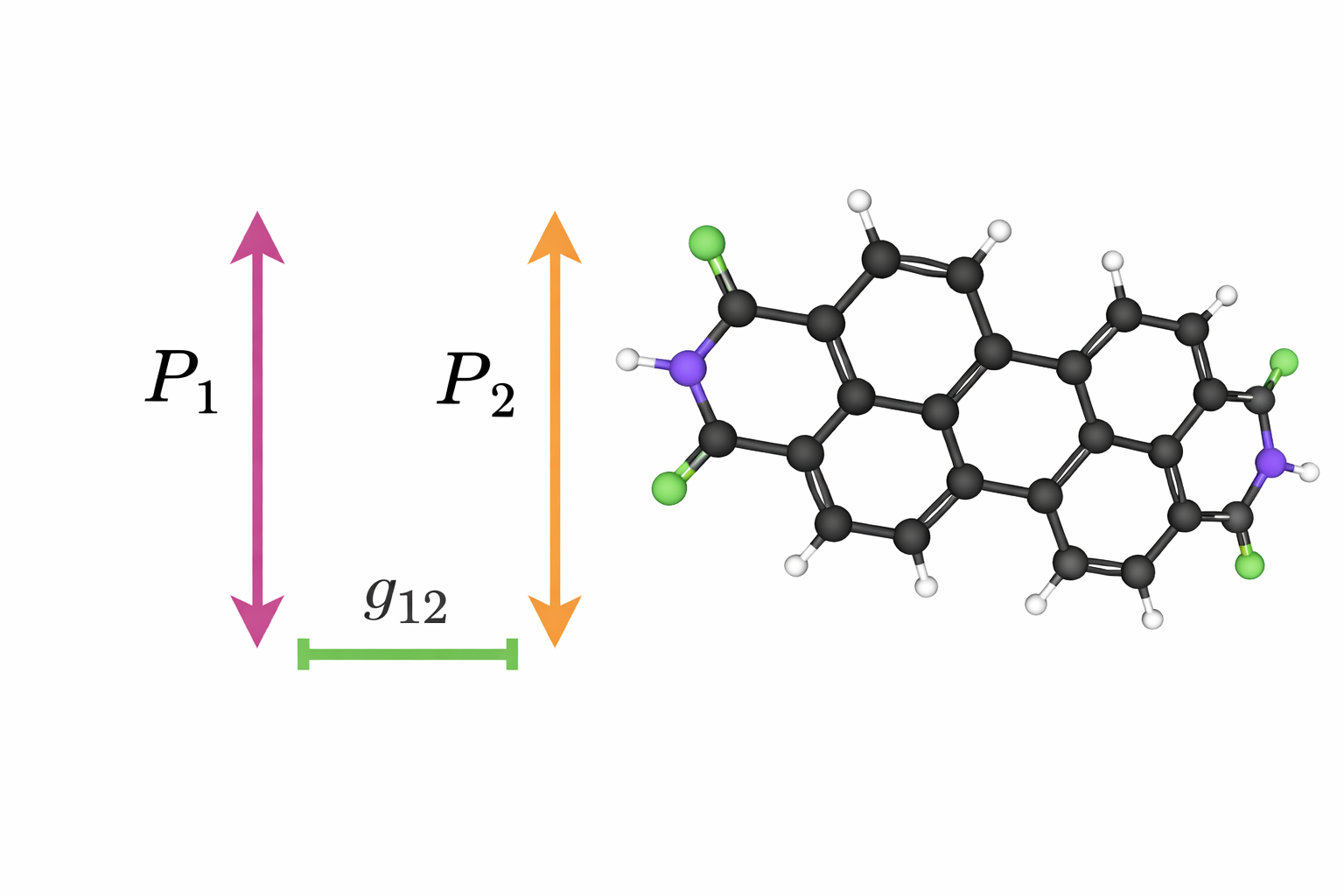
Figure 1: Schematic representation of the molecular dimer system. Two organic molecules are modeled as effective two-level quantum emitters with transition dipole moments P1 and P2; the coupling strength g12 mediates coherent exchange.
Model and Theoretical Framework
The core architecture is a PBI dimer comprising two quantum emitters, described by an effective two-level system with transition energies ν1, ν2, and interaction strength V12. The effective Hamiltonian in the absence of external driving is
Heff=−2ℏ(ν1σz(1)+ν2σz(2))+2ℏV12(σx(1)σx(2)+σy(1)σy(2))
yielding separable ground/excited states and coherent superpositions within the one-excitation manifold.
For temporal evolution, the system is treated via the time-fractional Schrödinger equation (TFSE) with Caputo derivatives: iτℏτCDtτ∣Ψ(t)⟩=Heff∣Ψ(t)⟩,0<τ≤1
where τ is the fractional order and P10 denotes the Caputo derivative, capturing non-Markovian temporal memory. The state evolution is analytically constructed using the spectral decomposition of P11, leading to solutions involving Mittag-Leffler functions, which generalize exponential decay into power-law and stretched-exponential regimes as P12 is varied.
Initial states are parametrized as P13, allowing the systematic study of both pure and mixed-state quantum resource dynamics.
Quantifiers of Quantum Resources
The quantification of resources is carried out using:
- Relative entropy of coherence P14, measuring basis-dependent quantum superpositions,
- Logarithmic negativity P15 as a computable, operational measure of bipartite entanglement,
- CHSH-Bell correlator P16, characterizing both quantum nonlocality and its violation relative to the classical threshold.
These quantifiers are tracked as functions of time, environmental (P17), and system (P18) parameters.
Numerical Results: Memory Control and Quantum Resource Management
Impact of Fractional Parameter P19
Temporal evolution of all quantum resources is drastically modulated by P20.
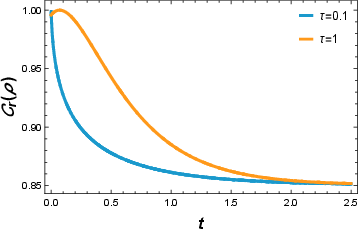
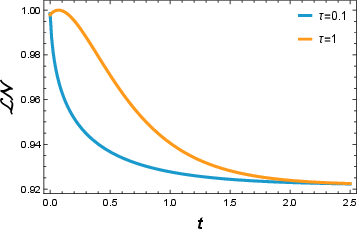
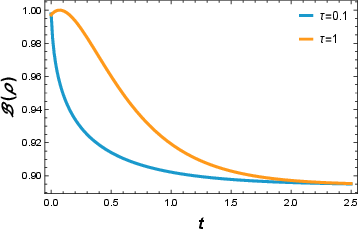
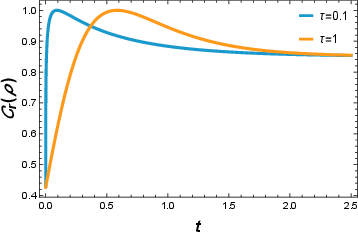
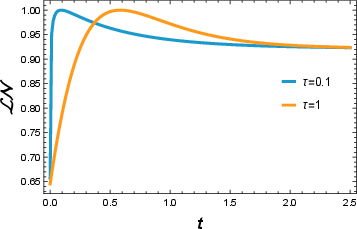
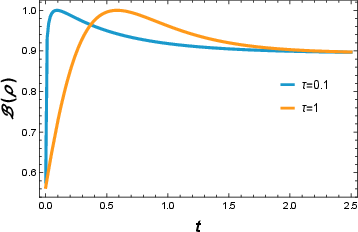
Figure 2: Time evolution of coherence, logarithmic negativity, and CHSH nonlocality for various P21 and initial purities. Reduced P22 (black curves) slows decay and supports dynamical resource generation.
In the maximally entangled case (P23), all resources decay monotonically, with smaller P24 significantly retarding the loss and maintaining higher resource magnitudes over time. In weakly coherent initial states (P25), P26 not only preserves existing coherences but also enhances their dynamical generation, amplifying maxima and delaying decoherence relative to standard (P27) quantum mechanics.
Theoretical implications are robust: P28 functions as an empirical dial on non-Markovianity/memory in quantum environments, directly extending or regenerating quantum resources under realistic, noisy conditions.
Detuning and Local Frequency Effects
Transition frequencies P29, g120 serve as critical handles for both the preservation and creation of quantum correlations.
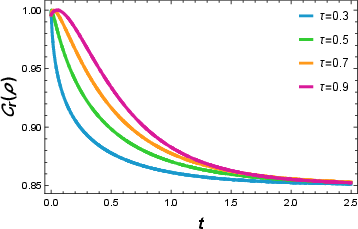
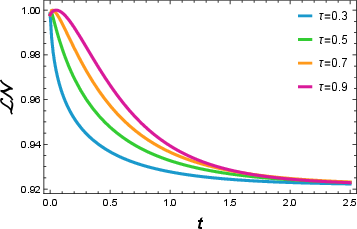
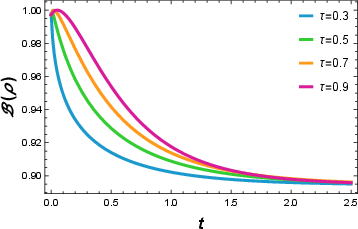
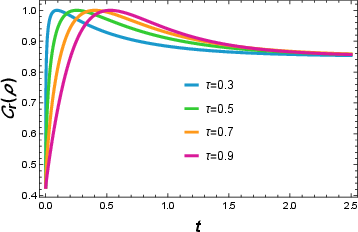
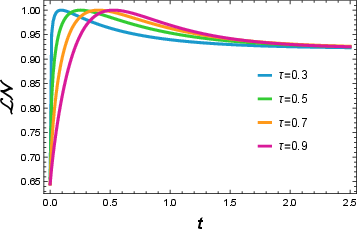
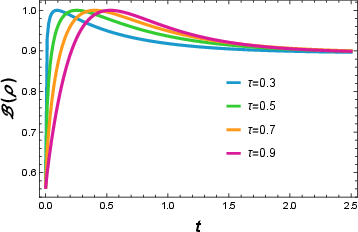
Figure 3: Quantum resource dependence on the site 1 transition frequency g121, at fixed g122. Detuning strongly modulates entanglement and nonlocality; optimal detuning can enhance resources for initially mixed states.
For high-purity states, increasing detuning suppresses all resources; for mixed states, there exists an optimal detuning maximizing resource creation via dynamical balance between interaction and energy mismatch. The sensitivity hierarchy persists with nonlocality being the most fragile, followed by entanglement, then coherence.
Analogous behavior is observed with variation of g123 (Figure 4), confirming the symmetry and tunability of frequency-mediated quantum resource control.
Dipole-Dipole Coupling Strength
The interaction strength g124 strongly dictates both the conservation and generation of quantum correlations.
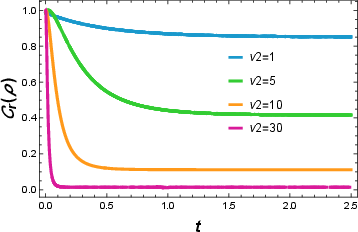
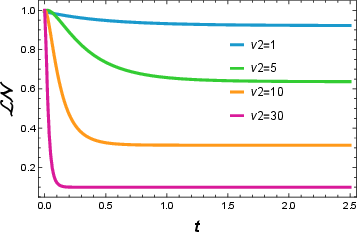
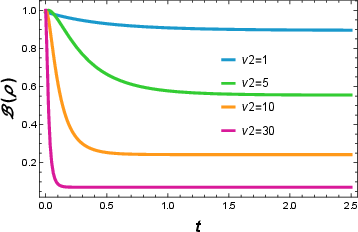
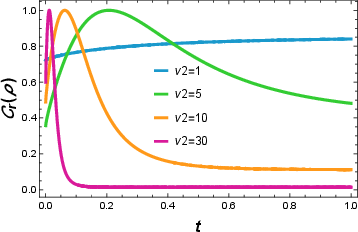
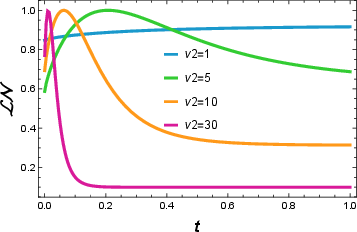
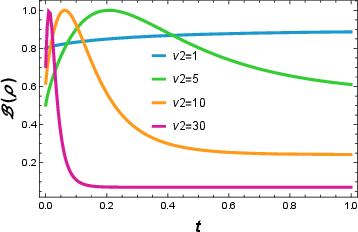
Figure 5: Effect of the dipole-dipole interaction g125 on resource dynamics. Stronger coupling delays decay for pure states and enhances creation for mixed states.
For maximally entangled states, large g126 prolongs coherence and slows decay. In less coherent initial conditions, increasing g127 amplifies resource generation and heightens maxima, confirming the pivotal role of interaction engineering in molecular quantum information platforms.
Implications and Future Directions
The fractional-time framework quantitatively demonstrates that non-Markovianity, tunable via g128, provides an active resource for quantum information processing in molecular systems. In practical terms, environmental engineering (modifying rigidity, disorder, phononic spectra etc.) and optical or electrostatic control of site energies and couplings enable dynamic, robust management of quantum resources. These results are directly applicable to the design of decoherence-resistant, scalable organic molecular quantum architectures operable under realistic laboratory conditions.
From a theoretical perspective, the synergy between fractional calculus and quantum resource theory highlights new pathways for modeling and exploiting long-time memory phenomena, fundamentally altering strategies for coherence preservation, entanglement amplification, and nonlocality protection.
Potential future developments include:
- Extension to multipartite or multichromophoric systems,
- Integration with specific models for environment-induced noise and spectral densities,
- Experimental validation and tuning of g129 via controlled disorder or nanofabrication.
Conclusion
This work establishes the time-fractional Schrödinger equation as an effective and practical approach for actively controlling quantum resources in organic molecular systems. The fractional order ν10 serves as a tunable parameter linking environmental memory to coherence times and entanglement dynamics, thereby offering a prescription for resource optimization in non-Markovian quantum technologies. Through systematic studies of initial condition purity, dipole-dipole coupling strength, and local transition frequencies, all essential mechanisms for coherence and entanglement management in the presence of realistic open-system effects are enumerated. This theoretical framework and its quantitative predictions motivate and inform experimental efforts toward robust, controllable, molecular-scale quantum computing and communication architectures (2605.05109).