- The paper demonstrates that quantum coherence modifies traditional TUR bounds, selectively optimizing charge and heat currents in different operational modes.
- It employs both scalar and multidimensional formulations to reveal mode-dependent fluctuations, where near-saturation of TUR indicates reduced noise in key currents.
- The study shows that minimized MTUR near equilibrium aligns with enhanced device performance, offering insights for designing efficient quantum thermal machines.
Quantum Coherence and Thermodynamic Uncertainty in Two-Terminal Quantum Dot Thermal Machines
Introduction and Physical Framework
The study rigorously examines the constraints imposed by thermodynamic uncertainty relations (TURs) and their multidimensional extensions (MTURs) on quantum-coherent two-terminal thermal machines, with a focus on quantum dot systems modeled via the Landauer-Büttiker formalism. In sharp contrast to macroscopic thermal machines, these quantum-scale devices operate under substantial influence from quantum coherence, mesoscopic fluctuations, and shot noise, introducing new operational regimes and limitations inaccessible to classical thermodynamics.
The physical system under investigation is a single-level quantum dot coupled to two leads, each characterized by their distinct chemical potentials, μL/R, and temperatures, TL/R. The machine is driven out of equilibrium by an applied voltage bias V and thermal gradient θ, which define the operational mode: heat engine, refrigerator, or heat pump. The schematic representation and phase diagram of operational modes are shown in (Figure 1).
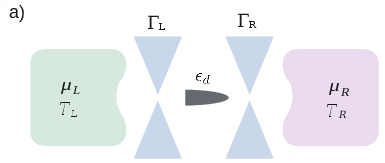
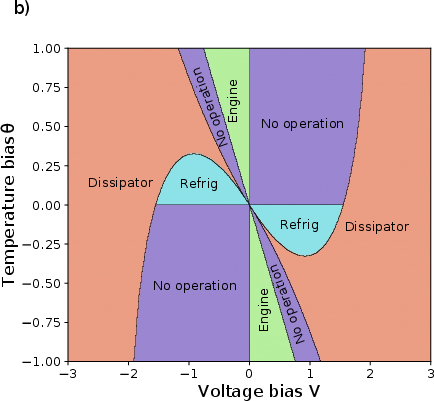
Figure 1: Schematic of the two-terminal quantum dot thermal machine and its operational mode phase diagram in the (V,θ) plane.
The energy-filtering property of quantum dots enables simultaneous control of charge and heat currents by tuning the dot energy level ϵd and tunnel couplings ΓL,R. The device operates as a heat engine when extracting electrical work from a thermal gradient, as a refrigerator when using work to pump heat against the temperature gradient, and as a dissipator or non-operational mode when power is consumed without yielding useful thermodynamic function.
TURs set rigorous lower bounds on the ratio of current noise (variance) to squared mean value in nonequilibrium steady states, as a function of the total entropy production rate σ. For classical Markovian processes, the canonical TUR reads:
⟨x⟩2Var(x)≥σ2kB
Quantum-coherent conductors, however, can violate this bound due to coherent transport effects, necessitating quantum-corrected versions (QTURs). This study systematically evaluates both the classical and quantum TURs for charge and heat currents in the quantum dot device.
The MTUR further generalizes this to vector-valued currents by introducing a matrix inequality involving the full current covariance matrix S. The MTUR is formulated as
TL/R0
where TL/R1 is the vector of mean charge and heat currents. The saturation parameters TL/R2 (for charge TL/R3 or heat TL/R4) and TL/R5 quantify the proximity to these lower bounds, identifying regions where the precision-dissipation trade-off imposed by the TUR/MTUR is minimized (or violated).
Results: Mode-Dependent TUR Saturation
Electric Current TUR
The analysis of the charge-current TUR factor TL/R6 over the operational parameter space shows regime-dependent behavior: TL/R7 is minimized (i.e., the TUR is nearly saturated) in the refrigerator/heat pump regime, indicating strongly suppressed relative fluctuations in the input charge current. Large deviations from the TUR bound (high TL/R8) occur in the engine regime, evidencing large fluctuations in the output current for a given entropy cost.
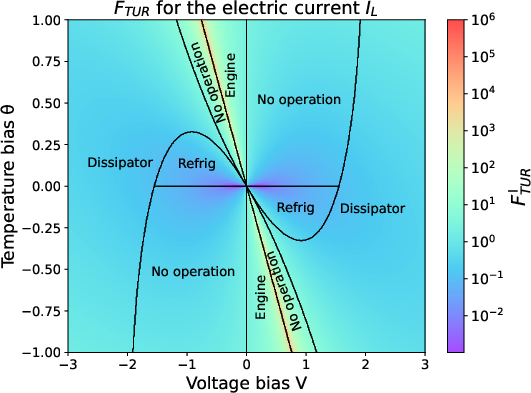
Figure 2: Charge-current TUR saturation parameter TL/R9 as a function of voltage and temperature bias.
Heat Current TUR: Role Reversal
A qualitative inversion is observed for the heat-current TUR factor V0. This quantity is minimized in the heat engine region, meaning the thermal input (fuel) current is as regular as permitted by thermodynamic constraints. In the refrigerator mode, V1 is elevated, revealing larger fluctuations in the heat current.
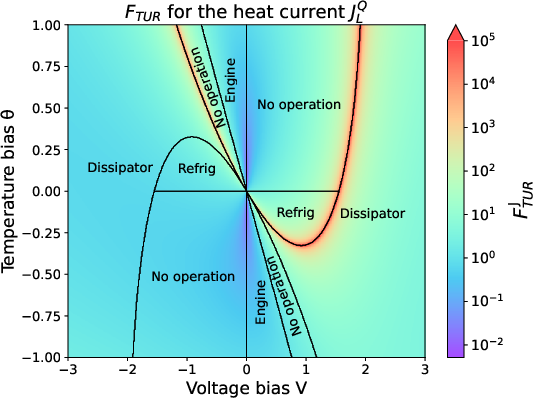
Figure 3: Heat-current TUR saturation parameter V2 over the operational phase space.
This role reversal—where only one current (charge or heat) can approach TUR-limited relative fluctuations depending on the operational mode—emerges as a direct consequence of quantum coherence and the resource-driven nature of thermodynamic tasks.
MTUR and the Precision-Efficiency Landscape
Incorporating the full covariance of charge and heat currents via the MTUR, the study maps V3 and uncovers distinct features: V4 attains its smallest values near the boundary between engine and refrigerator regimes, i.e., in the vicinity of linear response around equilibrium. This regime displays a symmetric optimization of joint current precision and is driven by strong charge-heat cross-correlations.
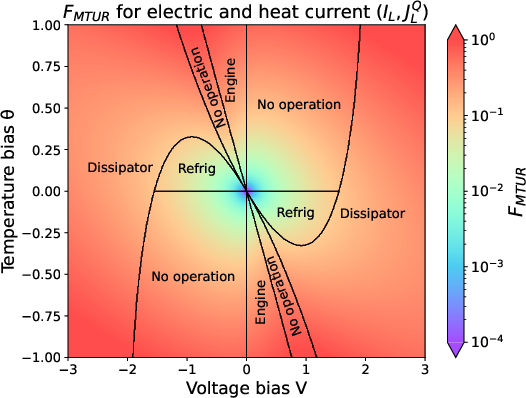
Figure 4: MTUR saturation parameter V5 demonstrating joint charge-heat precision optimization around equilibrium.
Unlike the scalar TURs, the MTUR does not privilege a specific operational mode, reflecting a universal, near-equilibrium precision constraint applying to both engine and refrigerator function.
Mapping efficiency and coefficient of performance (COP) alongside TUR/MTUR saturation reveals that individual current TUR saturation does not trivially imply optimal thermodynamic efficiency or COP. Scalar TUR saturation regions and high-performance regions only partially overlap. However, the minimization of V6 near equilibrium coincides with enhanced device performance, especially in the refrigeration regime. This correlation suggests that the MTUR, rather than any single-current TUR, most effectively signals balanced and efficient quantum thermal machine operation.
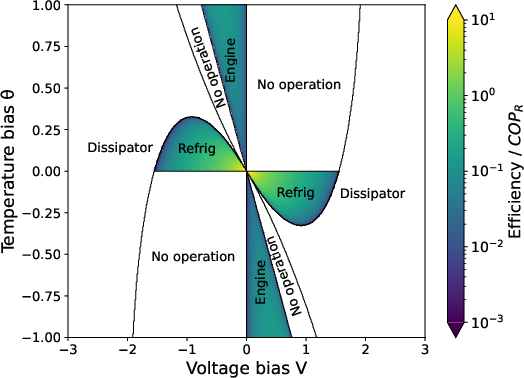
Figure 5: Device efficiencies and coefficients of performance across operational regimes.
Implications and Prospects
The findings elucidate fundamental constraints for quantum-coherent thermal machine design. Precision in the resource current (electrical in refrigeration, heat in engine mode) can be optimized at the cost of increased relative noise in the output current, precluding simultaneous precision in both. The multidimensional precision boundary described by the MTUR reflects an intrinsic, quantum-origin incompatibility: low-noise, large current operation of both charge and heat currents is inaccessible at fixed dissipation.
The theoretical implications extend to the design and optimal control of nanoscale quantum thermal machines, including molecular and optically controlled devices. Practically, these results emphasize the importance of tuning operational and device parameters such as V7 and V8 to exploit or mitigate precision trade-offs for targeted tasks (e.g., quantum heat engines with stabilized input/fuel currents). As experimental control and measurement capabilities advance, precision-dissipation trade-offs highlighted by the MTUR are likely to become primary design constraints.
Conclusion
This study systematically characterizes the influence of quantum coherence on thermodynamic uncertainty and efficiency in two-terminal quantum dot thermal machines. The scalar TURs select the resource current for precision optimization depending on mode, while the MTUR reveals a universal, symmetric near-equilibrium constraint on joint current regularity. Efficient and stable quantum thermal machines must navigate a precision landscape fundamentally restructured by quantum mechanics, where cross-correlations between heat and charge currents play a decisive role in approaching the theoretical precision bound. Future theoretical and experimental work will further clarify mechanisms for engineering optimal charge-heat cross-correlations, as well as the applicability of precision constraints to more complex or interacting nanoscale thermal systems.
Reference: "Quantum Coherence Reshapes Thermodynamic Bounds for Thermal Machines" (2605.04648)