Published 6 May 2026 in hep-th, astro-ph.CO, gr-qc, and hep-ph | (2605.04415v1)
Abstract: We introduce a new family of cosmological attractors with non-minimal coupling of gravity and non-canonical kinetic terms. In the Einstein frame, these models transform into a class of exponential and polynomial attractors with the spectral index $n_{s}$ spanning a broad range $1-2/N \leq n_{s} < 1-1/N$, and $r$ can decrease to zero in the limit $ξ\to \infty$. This is sufficient to match any combination of Planck, BICEP/Keck, ACT, SPT, and DESI data. We present a supergravity implementation of these models.
The paper introduces generalized ξ‐attractor models that integrate exponential and polynomial inflation scenarios via non-minimal couplings.
It employs a detailed framework transforming Jordan frame dynamics to the Einstein frame, enabling accurate predictions of nₛ and r through supergravity embedding.
Numerical analysis shows these models can satisfy current CMB and LSS constraints while providing discrete B-mode targets for future experiments.
New Families of Exponential and Polynomial ξ-Attractors in Inflationary Cosmology
Introduction
The theory of cosmological attractors has become a cornerstone of modern inflationary model building, offering geometric explanations for the robustness of cosmological predictions. "New Exponential and Polynomial ξ-attractors" (2605.04415) presents a comprehensive generalization of ξ-attractor models, introducing new classes of single-field inflationary models characterized by a non-minimal coupling to gravity and generalized kinetic terms. The work extends both exponential and polynomial attractor paradigms, providing an explicit bridge to supergravity embeddings and enabling compatibility with the full spectrum of recent CMB and LSS constraints.
Model Framework and Generalization of ξ-Attractors
The construction begins with the most general scalar-tensor Lagrangian in the Jordan frame featuring non-minimal coupling and non-canonical kinetic terms: LJ/−gJ=21Ω(ϕ)R−21KJ(ϕ)(∂ϕ)2−VJ(ϕ).
A Weyl transformation to the Einstein frame yields
LE/−g=21R−21KE(ϕ)(∂ϕ)2−VE(ϕ),
with KE(ϕ) capturing contributions from both the Jordan-frame kinetic structure and the conformal factor, thereby encoding a rich moduli space geometry.
The key innovation is to select KJ(ϕ), Ω(ϕ), and VJ(ϕ) so that ξ0 and ξ1 can attain the full functional freedom necessary to reproduce any known single-field attractor model. This approach naturally permits both "exponential" and "polynomial" asymptotic plateaus in the Einstein-frame potential, unifying and extending prior attractor classifications.
Exponential and Polynomial Attractors: Observational Predictions
The new families interpolate between the canonical predictions of Starobinsky/Higgs inflation and those of more general pole inflation models. For exponential (E-model and T-model) ξ2-attractors with hyperbolic geometry (pole order ξ3), the potentials and kinetic terms take the form
ξ4
with
ξ5
allowing for the direct mapping to ξ6-attractors with the identification ξ7. In the strong coupling (ξ8) regime, these models yield the familiar predictions ξ9 and ξ0.
Polynomial (P-model/KKLTI-type) ξ1-attractors are realized through
ξ2
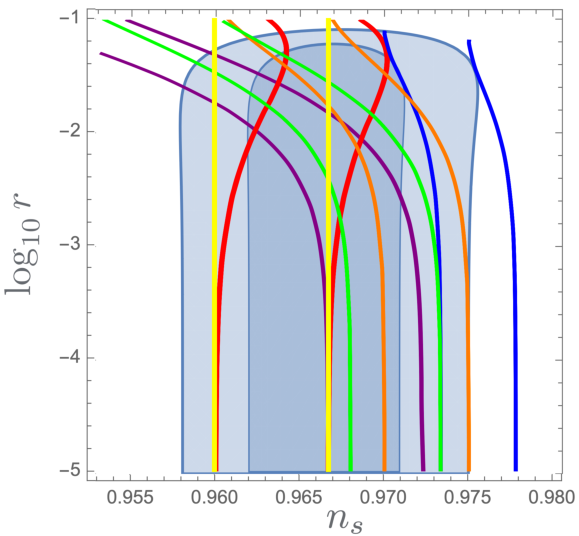
enabling a continuous range of ξ3 and ξ4 values: ξ5
By varying ξ6 and ξ7, the models accommodate both the "universal" predictions and the larger ξ8 values favored by joint CMB+DESI analyses.
Figure 2: Predictions of exponential and polynomial ξ9-attractors for different ξ0, showing the full span in ξ1 and covering both Planck-only and Planck+LSS favored regions.
Supergravity Embedding and Moduli Space Geometry
A central achievement is the explicit construction of these attractor models within the framework of superconformal supergravity. Utilizing half-plane variables, the relevant Kahler potential and superpotential data can directly reproduce any desired ξ2 and ξ3, so long as the underlying geometry remains consistent with supergravity requirements. This allows the construction of discrete series of targets (ξ4) motivated by higher-dimensional (10D, 11D) scenarios and the associated hyperbolic moduli space curvature.
Such embeddings provide not only natural UV completions of the attractor models but also dictate the allowed kinetic structures, influencing the phenomenology of ξ5 and ξ6, and introducing discrete "B-mode targets" for future experimental exploration.
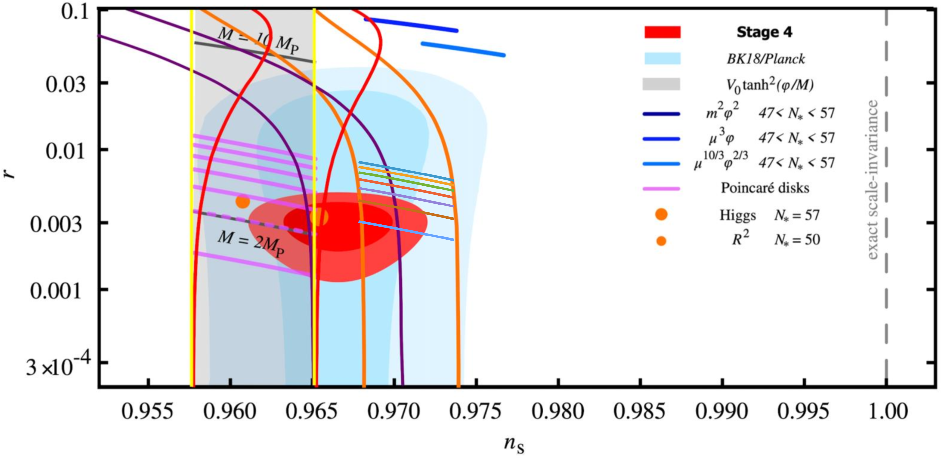
Figure 4: Exponential and polynomial ξ7 attractor predictions in ξ8, with discrete target series corresponding to integer-valued hyperbolic curvatures, overlaid on contemporary observational contours.
Numerical Results and Comparison with Observational Constraints
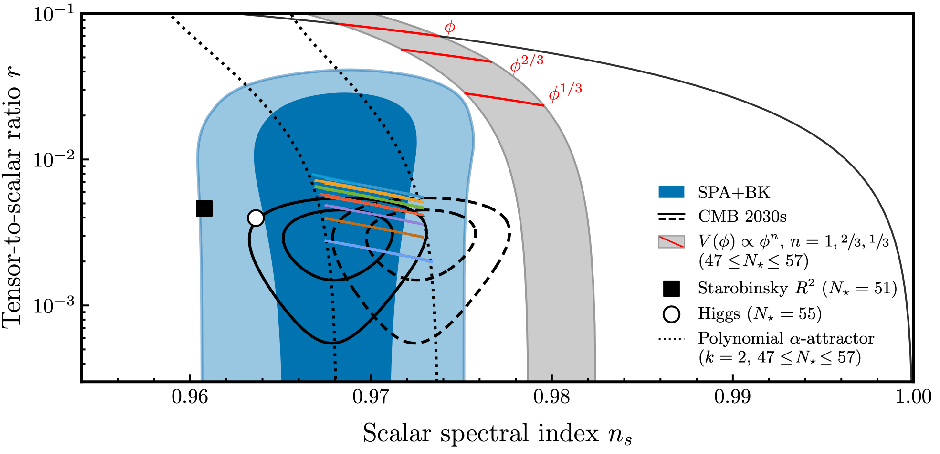
The authors perform a detailed mapping between the theoretical parameter space and the most recent observational limits. The flexibility of the ξ9 parameterization enables models to saturate or interpolate between the LJ/−gJ=21Ω(ϕ)R−21KJ(ϕ)(∂ϕ)2−VJ(ϕ).0 and LJ/−gJ=21Ω(ϕ)R−21KJ(ϕ)(∂ϕ)2−VJ(ϕ).1 regions preferred by joint Planck, BICEP/Keck, ACT, SPT, and DESI analyses, including the upward shift in LJ/−gJ=21Ω(ϕ)R−21KJ(ϕ)(∂ϕ)2−VJ(ϕ).2 driven by LSS data.
For LJ/−gJ=21Ω(ϕ)R−21KJ(ϕ)(∂ϕ)2−VJ(ϕ).3, the new polynomial attractors can achieve LJ/−gJ=21Ω(ϕ)R−21KJ(ϕ)(∂ϕ)2−VJ(ϕ).4 in the range LJ/−gJ=21Ω(ϕ)R−21KJ(ϕ)(∂ϕ)2−VJ(ϕ).5, naturally covering all recent central values even in the presence of dataset tensions. LJ/−gJ=21Ω(ϕ)R−21KJ(ϕ)(∂ϕ)2−VJ(ϕ).6 can be made arbitrarily small by increasing LJ/−gJ=21Ω(ϕ)R−21KJ(ϕ)(∂ϕ)2−VJ(ϕ).7 or tuning LJ/−gJ=21Ω(ϕ)R−21KJ(ϕ)(∂ϕ)2−VJ(ϕ).8, while discrete supergravity-motivated values provide benchmark predictions for B-mode searches.
Figure 1: The LJ/−gJ=21Ω(ϕ)R−21KJ(ϕ)(∂ϕ)2−VJ(ϕ).9 vs LE/−g=21R−21KE(ϕ)(∂ϕ)2−VE(ϕ),0 plot illustrating the coverage of polynomial LE/−g=21R−21KE(ϕ)(∂ϕ)2−VE(ϕ),1-attractor predictions for LE/−g=21R−21KE(ϕ)(∂ϕ)2−VE(ϕ),2 against forecasted experimental sensitivities, highlighting the model space overlapping with projected future constraints.
Theoretical and Practical Implications
The presented formalism demonstrates that essentially all known single-field attractor models—exponential, polynomial, Starobinsky, Higgs, KKLTI, T-models, E-models—admit a unified interpretation as LE/−g=21R−21KE(ϕ)(∂ϕ)2−VE(ϕ),3-attractors with appropriate choices of Jordan-frame functions and supergravity data. This comprehensive generalization has several implications:
Model-building flexibility: The parameter space can easily absorb current and future shifts in inferred LE/−g=21R−21KE(ϕ)(∂ϕ)2−VE(ϕ),4, resolving or evading possible tensions between CMB and LSS data.
Supergravity and UV completeness: Every attractor model of this class is automatically embeddable in LE/−g=21R−21KE(ϕ)(∂ϕ)2−VE(ϕ),5 supergravity, providing natural connections to string theory moduli spaces.
Experimental targets: The identification of discrete "ladder" targets for B-mode searches, based on geometric/geodesic lengths in moduli space, motivates concrete experimental priorities.
Outlook
Further developments are anticipated in refining the reheating physics and post-inflationary dynamics within the unified LE/−g=21R−21KE(ϕ)(∂ϕ)2−VE(ϕ),6 attractor space. Exploration of the connection to multifield dynamics, alternative gravitational sector modifications, and potential dark sector couplings could yield additional insights. The explicit sensitivity of tensor-to-scalar ratio LE/−g=21R−21KE(ϕ)(∂ϕ)2−VE(ϕ),7 to underlying moduli space curvature sets sharp targets for next-generation probes aiming to distinguish among attractor scenarios.
Conclusion
This work provides a systematic and unifying generalization of the attractor inflation paradigm, rooted in the geometric structure of supergravity and accommodating the totality of single-field CMB-compatible models. The identification of new exponential and polynomial LE/−g=21R−21KE(ϕ)(∂ϕ)2−VE(ϕ),8-attractor families—together with explicit supergravity realizations and precise observational predictions—offers both theoretical robustness and practical direction for the ongoing search for inflationary gravitational waves. The parameter and model versatility ensure continued relevance as experimental limits and cosmological datasets evolve.