- The paper presents a quantitative framework establishing a universal tradeoff between control energy and logical error rates in QEC encoding.
- It analyzes various QEC codes and encoding circuit variants, showing that circuit design and gate energy constraints critically influence error performance.
- The study demonstrates exponential scaling of energy requirements with increasing code distance, highlighting resource limitations for fault-tolerant quantum computing.
Energy-Error Tradeoff in Quantum Error Correction Encoding
Overview of Energy-Precision Constraints in Quantum Gates
This paper presents a comprehensive quantitative framework for the energetic requirements associated with encoding quantum error correction (QEC), establishing a universal tradeoff between control energy and attainable logical error rates. The analysis leverages a precision-noise model for electromagnetic field control of quantum gates, showing that gate fidelity and error rates are fundamentally limited by gate-level energy resources and quantum fluctuations in control parameters. Specifically, the lower bound on control energies required for gate-operations is inversely proportional to the gate infidelity, i.e., for sufficiently high energies, 1−⟨Fave⟩∝⟨ELG⟩−1, where ⟨Fave⟩ is the average gate fidelity and ⟨ELG⟩ is the expected control energy.
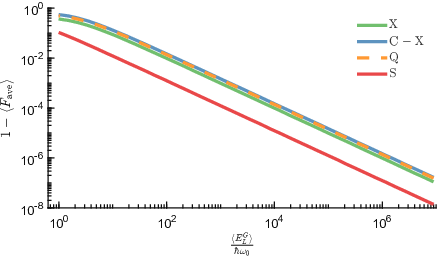
Figure 1: Gate error (one minus the average gate fidelity) versus the lower bound on control energy for several quantum gates; error decreases inversely with energy at high regimes.
This result is critical as it situates energy as a central constraint not only in the physical maintenance of quantum hardware but also as a limiting factor for computational accuracy in algorithmic implementations.
Quantum Error Correction Codes and Resource Scaling
The focus then shifts to characterizing the minimum control energy required to implement logical qubit states for various QEC codes, including repetition, perfect, and Steane codes. The analysis uses explicit circuit decompositions, gate counts, and noise models to numerically estimate logical error rates as a function of both control energy and channel error probabilities.
A generic depiction of the QEC process, including channel errors and logical computation, is provided for clarity.
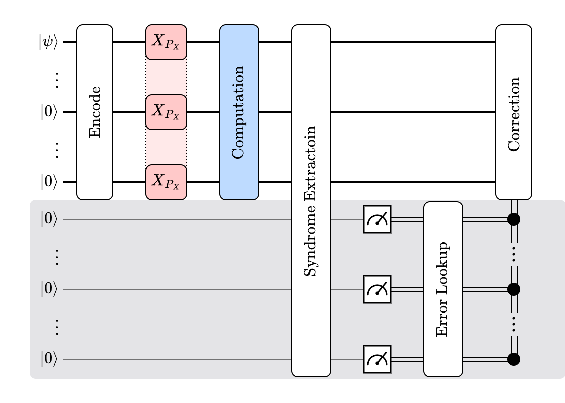
Figure 2: Schematic representation of the logical computation and QEC steps, with channel errors and ancilla registers highlighted.
Impact of Encoding Circuit Variants
It is demonstrated that logically equivalent circuits for state encoding exhibit disparate error performance due to distinct propagation of noise through their gate decompositions. Three encoding schemas—waterfall, direct, and parallel—were assessed for the N-qubit repetition code, revealing that direct encoding obtains the lowest error at intermediate energies.
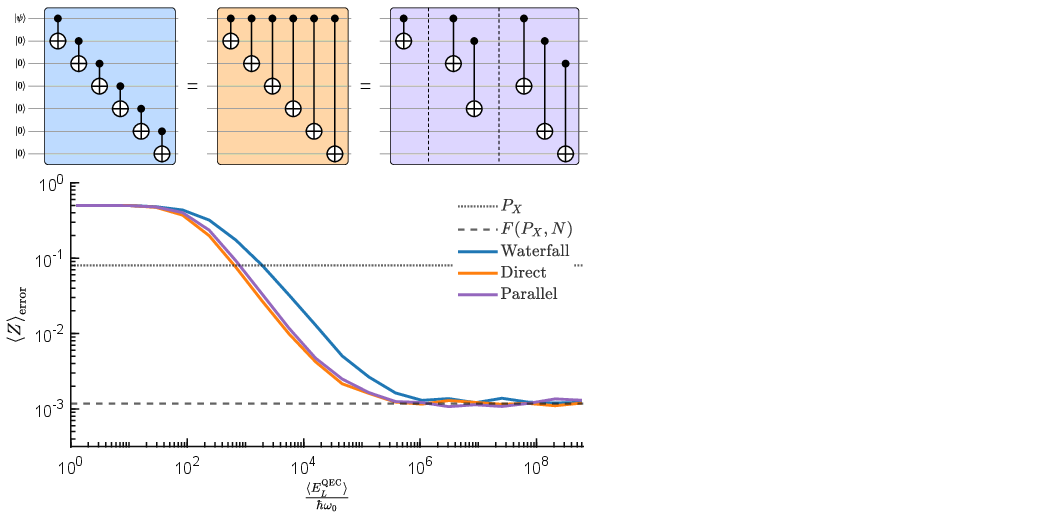
Figure 3: Computation error for three N-qubit repetition code encoding schemes with PX=0.08; direct encoding outperforms alternatives.
This observation underscores the sensitivity of QEC efficacy to device connectivity and transpilation choices even when gate-count overhead is unchanged.
Exponential Scaling of Energetic Requirements
A primary result is the exponential scaling of control energy required to achieve error-correcting advantage with increasing code size (distance) in repetition codes. For a fixed channel error rate, each additional code qubit necessitates exponentially greater energy to reduce logical errors below the threshold of shorter codes.
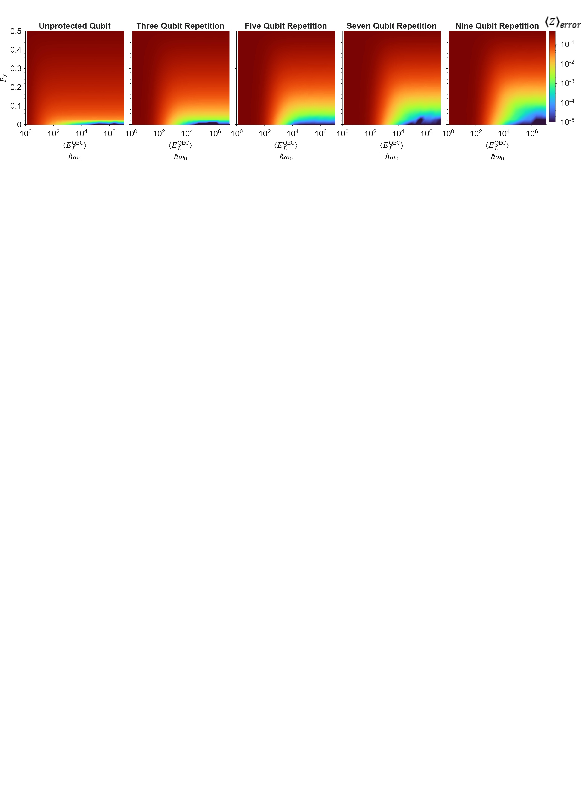
Figure 4: Error rates for N-qubit repetition codes as functions of control energy and channel error probability; larger codes demand higher energies for correction.
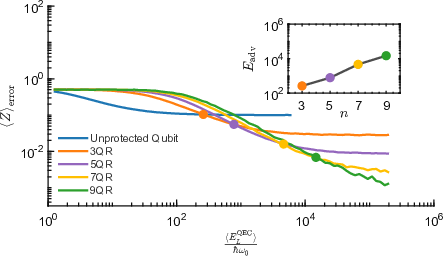
Figure 5: Error rates and energy thresholds showing exponential scaling for repetition codes; energies required for each code surpassing previous are highlighted.
These results formally quantify the resource cost of augmenting code distance in simple QEC schemes.
Advanced Codes: Perfect and Steane
The five-qubit perfect code and the seven-qubit Steane code are evaluated in the same energy-error tradeoff framework. For the five-qubit code, multiple logically equivalent encoding circuits were compared and found to exhibit minor performance discrepancies, much less pronounced than those seen for repetition codes.
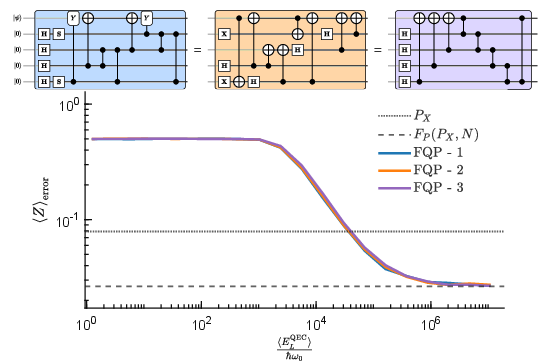
Figure 6: Variants of encoding circuits for the five-qubit perfect code, showing near-identical error performance for PX=0.08.
Distance-three codes—three-qubit repetition, five-qubit perfect, and seven-qubit Steane—were compared across control energy and channel error rate axes. Results indicate the code with minimal qubits achieves the most robust error suppression at fixed channel error, with the complexity of encoding circuit largely dictating energy demands for error correction onset.
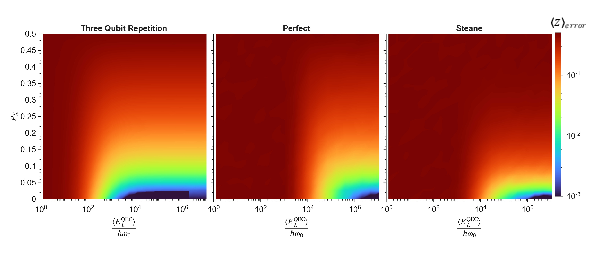
Figure 7: Computation error for distance-three codes versus control energy and channel error rate; minimum-qubit codes are more efficient.
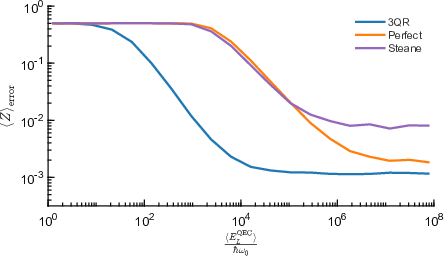
Figure 8: Computation error at fixed PX=0.02 for distance-three codes, highlighting performance at all energy levels.
Energetic Overhead of Fault-Tolerant Measurements
Fault-tolerant measurement protocols, including GHZ-state validation, were analyzed for energetic and error overhead. The results indicate that under the studied gate precision error model, the energetic cost of fault-tolerant measurement substantially increases with code size and does not yield net reduction in logical error at fixed energy.
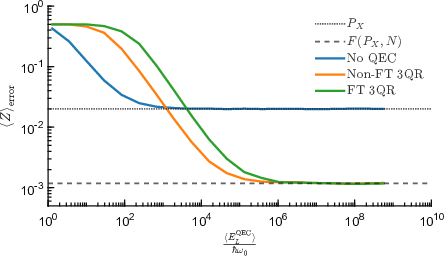
Figure 9: Error rate comparison for the bare qubit, repetition code without, and with fault-tolerant readout; fault-tolerant circuits require much higher energies for comparable protection.
Implications and Future Directions
This study rigorously establishes that QEC protected computations are subject to an exponential energy-error tradeoff as code distance increases. Strong numerical evidence shows energetic resources intimately depend on the physical realization and circuit-level transpilation of QEC codes, with logical equivalence breaking down under realistic noise models. There is an explicit scaling law tying code size to energy requirements for achieving error correction, implying practical limitations for large-scale fault tolerance.
Theoretical implications extend to the optimal design of QEC circuits, device topology selection, and gate decomposition strategies. Practically, these results are essential for resource accounting in quantum hardware design, benchmarking QEC feasibility, and identifying code families compatible with realistic energy budgets.
Future research should analyze scaling behavior for additional code families, explore circuit complexity-energy tradeoffs for large codes, and develop optimal encoding and decoding circuits for noisy hardware. Quantitative studies on energetic constraints may guide the design of next-generation quantum devices and algorithms, advancing the operational feasibility of fault-tolerant quantum computing.
Conclusion
Through a rigorous precision-noise framework, the paper demonstrates a universal energy-error tradeoff for QEC encoding. Exponential resource scaling with code distance is evident in repetition codes, and the energetic footprint of circuit transpilation choices is shown to critically affect logical error rates. Fault-tolerant measurement protocols, while theoretically attractive, can increase error in the regime dominated by gate precision noise. These findings mandate careful resource optimization and motivate further studies on energetic and topological aspects of QEC for practical quantum computation (2605.04329).