- The paper presents a formal multiplex network framework that generalizes classical network science to capture multi-layer interdependencies.
- It employs rigorous analyses and modeling, including generative models, percolation theory, and supra-Laplacian dynamics for diffusion and synchronization.
- Implications include enhanced resilience analysis, novel dynamical regimes, and tailored control strategies for real-world multilayer systems.
Dynamical Processes and Emergent Behaviors in Multiplex Networks
Introduction and Framework
"Dynamical processes and emergent behaviors in multiplex networks" (2605.04199) delivers an extensive review that establishes a rigorous mathematical and conceptual foundation for the study of dynamics on multiplex and multilayer networks. The authors formalize the multiplex paradigm as a generalization of classical network science to settings where nodes are embedded in several distinct relational layers, each capturing a different interaction type. This approach is motivated by the limitations of single-layer analyses to capture phenomena inherent in real-world systems—ranging from transportation infrastructures, ecological networks, and neural systems, to social and technological multilayered interactions.
A multiplex network is defined by sets of intra-layer adjacency matrices and inter-layer coupling matrices, enforcing a one-to-one correspondence of node replicas across layers (see Figure 1 below). The framework is extended to encompass edge-colored graphs and more general tensorial representations to encompass arbitrary multilayer interdependencies. This formalism enables the generic description of node states, layer or aggregated states, and system-wide dynamics—both for time-invariant and coevolving structural-dynamical regimes.
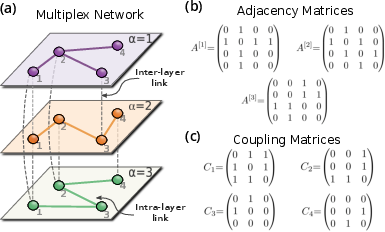
Figure 1: Formal construction of a multiplex network, with both intra-layer adjacency matrices for each layer and inter-layer coupling matrices encoding cross-layer node interactions.
Structural Properties and Models
The review systematically analyzes structural quantifiers at edge, node, layer, and mesoscale levels, emphasizing their implications for dynamic processes. Multiplex edge overlap, node activity and participation, and inter-layer similarity indices are detailed, and the consequences of structural correlations (such as degree correlation and edge overlap) are highlighted for their critical impact on dynamical resilience, synchronization thresholds, and diffusion regimes.
Special attention is paid to mesoscale structures unique to multiplex networks, such as multiplex motifs, multilayer clustering, community structure, and core-periphery patterns, emphasizing both the algorithmic and theoretical complexity added by layered architectures (Figure 2). The reducibility of multiplex systems is framed as a problem of preserving relevant structural/functional features under layer aggregation, with discussions on quantum-inspired measures, entropy-based approaches, and surrogate model selection.
Generative models, from equilibrium random multiplex ensembles to growth and multiplex stochastic block models, are reviewed as foundations for both null-model construction and principled inference in empirical multilayer data.
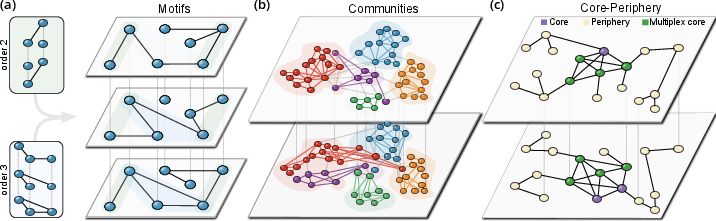
Figure 2: Micro- and meso-scale patterns in multiplex networks, illustrating the diversity of motifs and the nontrivial nature of aggregated versus layered community structure and core-periphery organization.
Cascading Failures, Percolation, and Robustness
The review delivers a comprehensive analysis of percolation processes on multiplex networks, showing that multiplexity fundamentally alters the character and criticality of network robustness. In contrast to single-layer networks, where percolation transitions are typically continuous, the paper identifies regimes—especially with strong interlayer interdependence—where discontinuous, hybrid transitions and catastrophic cascades become dominant, an effect originally revealed by Buldyrev et al. and explored via message-passing (MP) approaches.
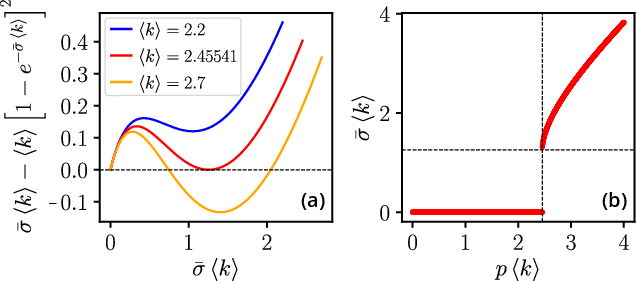
Figure 3: Percolation phase diagrams in synthetic multiplex networks, displaying unique discontinuities in the mutually connected giant component and threshold shifts not present in single-layer analogs.
On real-world systems, percolation transitions are shown to be smoothed due to edge overlap and correlated mesoscale structures, but targeted attacks and optimal percolation protocols reveal enhanced vulnerability and the necessity of correct layer-aware interventions (Figure 4). The review discusses a variety of percolation variants (k-core, redundant, viable, observability, antagonistic), highlighting both theoretical advances and implications for critical infrastructure protection.
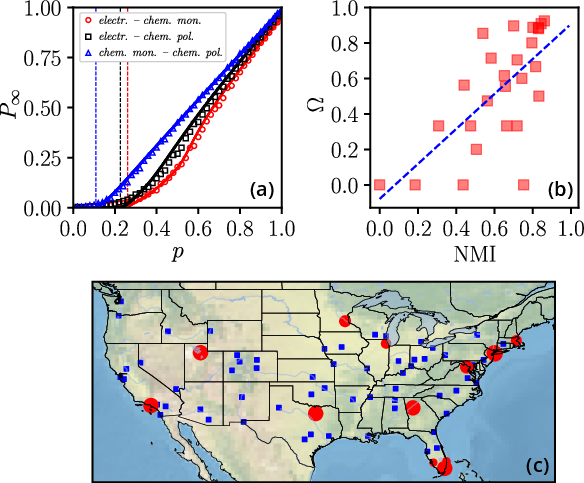
Figure 4: Percolation on real-world multiplex networks, showing smooth transitions in biological networks (a), the dependence of robustness on community similarity (b), and the impact of optimal node removals (c).
Diffusion, Reaction, and Transport
The extension of random walk, diffusion, and reaction-diffusion paradigms to multiplex networks exposes new dynamical outcomes that are unattainable on single-layer structures. Linear diffusive processes analyzed via supra-Laplacian formulations reveal "superdiffusive" regimes, where coupling between redundant layers accelerates the relaxation beyond the fastest single layer, and interlayer coupling is further shown to induce nonmonotonicity and impact diffusive speed, pattern formation, and accessibility (Figure 5).
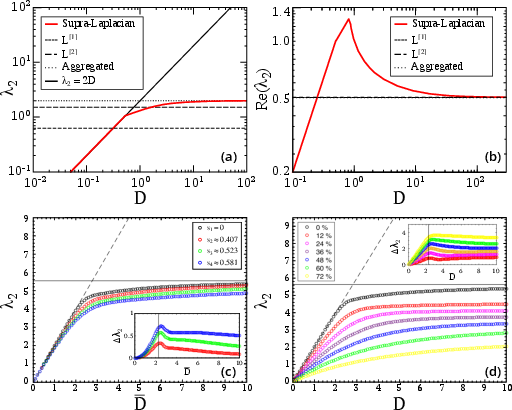
Figure 5: Spectral properties of diffusion in multiplex configurations, highlighting faster-than-layer diffusion (superdiffusion) and how heterogeneity across interlayer couplings modulates system-level connectivity.
In nonlinear settings, the adaptation of reaction-diffusion systems (notably Turing pattern models) demonstrates that multiplexity can enable symmetry-breaking and spatial patterning even when each layer considered in isolation would preclude such instabilities (Figure 6). Models of congestion further show that multiplexity can produce counterintuitive outcomes—such as speed-up by slowing individual subsystems ("slower is faster" effect)—and the impact of buffer and mobility diversity on system throughput (Figure 7).
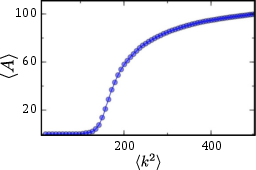
Figure 6: Turing pattern amplitudes illustrating the enablement of pattern formation by multiplexed inhibitor and activator layers.
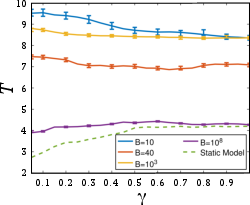
Figure 7: Mean travel time in multiplex mobility models as a function of travel-time ratios and buffer size, revealing nonmonotonic congestion dependence unique to multiplex settings.
Synchronization Phenomena
Multiplex assemblies of oscillators (Kuramoto, Rössler, Stuart-Landau) enable the study of synchronization phenomena beyond traditional network science, as multiple forms of synchrony—complete, inter-layer, intra-layer, and cluster synchronization—manifest due to both intra- and inter-layer couplings (Figure 8). The master stability function framework, adapted with supra-Laplacian and parametric bifurcation analyses, enables general predictions for synchronization regions and transition scenarios.
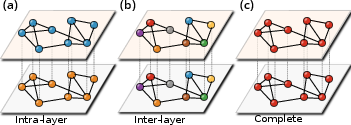
Figure 8: Canonical synchronization regimes—complete, inter-layer, and intra-layer—showcased for a two-layer multiplex network.
Phenomena discussed include relay synchronization, where layers act as mediators for synchronizing otherwise disconnected nodes, cluster and chimera states, explosive synchronization triggered by inhibitory-excitatory layer couplings (Figure 9), and the stabilization of synchronization in the face of heterogeneous, even antagonistic, interlayer links. Multiplex control and proportional-integral-derivative (PID) strategies are outlined as specific instances in which multiplexity is leveraged for distributed control targets (Figure 10).
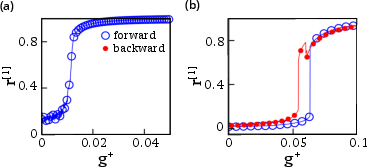
Figure 9: Abrupt, hysteretic transition (“explosive synchronization”) in a multiplex with one excitatory and one inhibitory layer, marking a sharp departure from single-layer synchronization dynamics.
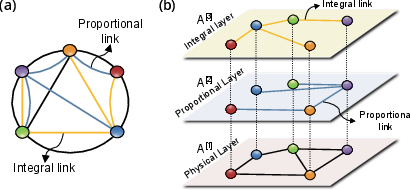
Figure 10: Control via multiplexing, where distinct layers are deployed as physical, proportional, and integral controllers in networked systems.
Spreading, Epidemics, and Competing Processes
The interplay of spreading processes (epidemic, information, awareness) in multiplex settings leads to threshold shifts, new localization phenomena, and qualitatively novel critical phenomena. The review details how supra-adjacency formulations and MMCA approaches extend classical SIS/SIR analyses to multimodal contagion and interacting-disease scenarios, allowing for explicit layer- and interlayer-coupling dependent thresholds (see Figure 11).
Crucially, the coupling between awareness dynamics and epidemics, studied here via coupled SIS/UAU models, yields metacritical phenomena (interdependent thresholds), abrupt and hybrid transitions, and counterintuitive mitigation effects due to rapid spread of awareness or stifler populations.
Social and Evolutionary Dynamics
The review systematically covers how multiplexity modifies opinion formation, social contagion, and evolutionary game dynamics. Variants of the voter, majority-vote, Ising, Deffuant, Axelrod, and contagion models are analyzed; layerwise state vectors and cross-layer consistency constraints yield irreducible multiplex effects, such as the persistence of multiple opinions, multistability, and the shifting of consensus points (Figures 22–24).
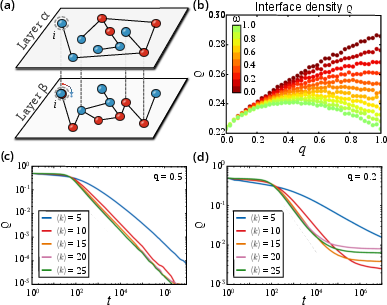
Figure 11: Voter model behavior and consensus trapping as functions of multiplexity and interlayer coupling in layered opinion systems.
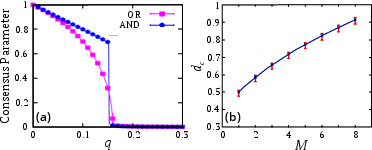
Figure 12: Majority-vote and Deffuant models illustrating how multiplex consensus thresholds and critical behavior are altered by the layering of interactions.
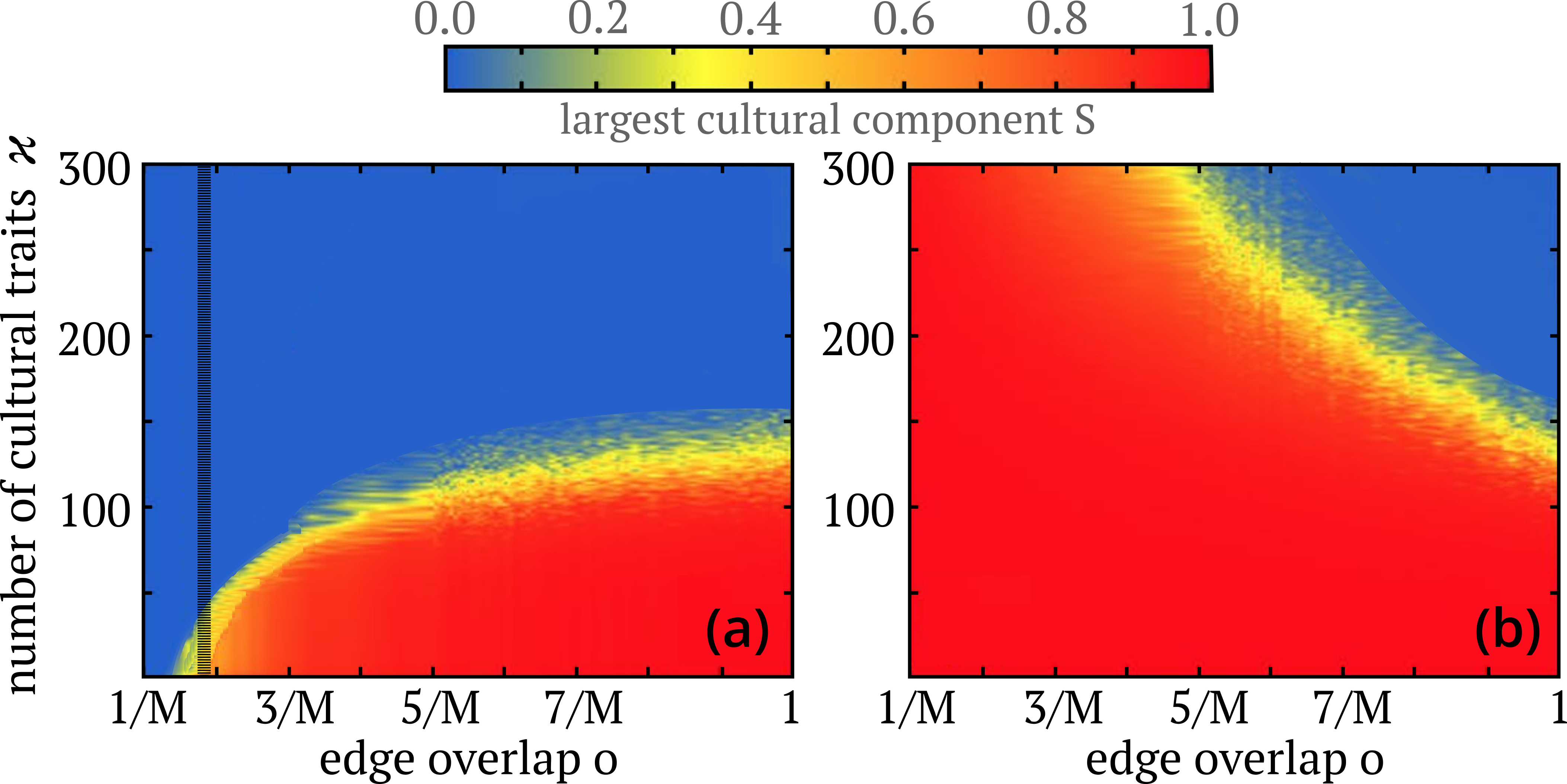
Figure 13: Emergence of multiculturality in the multiplex Axelrod model as a function of the number of available cultural traits and edge overlap, showing qualitative divergence from single-layer results.
Similarly, multiplayer and pairwise evolutionary games (Prisoner’s Dilemma, snowdrift, public goods) on multiplex architectures reveal enhanced, inhibited, or symmetry-broken prosocial behavior contingent on the degree of edge overlap and interlayer correlation.
Intertwined and Coevolving Dynamics
A distinguishing contribution is the treatment of intertwined processes: synchronization coupled to transport, opinion–game interplay, and epidemic–awareness coevolution are shown to yield multistability, explosive transitions, and cyclic phase behavior not present in homogeneous or single-layer systems (Figure 14). Coevolution of topology and dynamics is explored in multiplex adaptive voter and epidemic models, demonstrating that structural adaptation (e.g., rewiring) due to dynamics on individual or multiple layers reshapes system-wide phase structure and consensus properties.
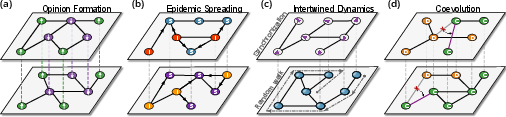
Figure 14: Exemplars of multiplex dynamical processes—voter/opinion, disease co-diffusion, synchronization–transport intertwinement, and game-theoretic network–dynamics coevolution.
Conclusions and Outlook
The review rigorously demonstrates that multiplex frameworks are essential for a precise understanding of collective phenomena in complex systems with heterogeneous, multifaceted interactions. Theoretical and simulation-based evidence is provided for novel dynamical regimes—discontinuous transitions, multistabilities, unique critical points, and nontrivial pattern formation—that are provably impossible in the corresponding aggregated or isolated-layer models.
The implications span theoretical physics (novel universality classes and critical phenomena), network robustness engineering, neuroscience, social science, and epidemic mitigation. Practically, the work argues for the necessity of layer-aware monitoring, algorithmic intervention, and diagnostic tools in real-world systems ranging from infrastructure to cyberphysical and social-technological platforms.
The paper closes by highlighting open directions: the extension of multiplex frameworks to higher-order topologies (simplicial complexes, hypergraphs), principled inference for real multilayer data, and the formal identification and control of emergent multiplex-specific phenomena.
Conclusion
This review achieves a comprehensive synthesis of structural theory, dynamic modeling, and empirical analysis in multiplex networks. By establishing both unifying formalism and meticulous analysis of diverse dynamical processes, it demonstrates that multiplexity is not a minor extension but a transformational principle in network science, with broad implications for both the theory and application of complex systems. The documented mechanisms fundamentally challenge reductionist perspectives, requiring new tools and paradigms for analyzing, predicting, and engineering collective behaviors in multilayered environments.

