- The paper presents a new class of supersymmetric AdS2×spindle solutions by coupling hyperscalars to the U(1)^4 STU gauged supergravity model.
- Methodology involves detailed algebraic classification, orbibundle data analysis, and numerical ODE integration to ensure smoothness and supersymmetry.
- Findings reveal that hyperscalar deformations trigger RG flows with monotonic entropy decreases, enriching the holographic AdS/CFT framework.
Supersymmetric Spindle Solutions with Hyperscalars in D=4 Gauged Supergravity
Introduction and Theoretical Framework
This work develops new classes of supersymmetric AdS2×Σ solutions in the context of D=4 U(1)4 STU gauged supergravity, coupled to a charged hyperscalar and focuses on the case where Σ is a spindle Σ(nN,nS). Such spacetimes are realized as near-horizon geometries of supersymmetric, accelerating black holes. The construction admits both coprime and non-coprime spindle orbifolds, incorporating orbifolds of S2, and includes configurations where the hyperscalar may vanish at one or both poles.
A notable feature is that these AdS2 backgrounds can uplift to smooth supersymmetric AdS2×Y9 solutions of D=11 supergravity. By considering non-coprime AdS2×Σ0 and careful treatment of orbibundle data, the authors generalize previous work, providing a systematic classification of smooth, globally regular solutions. The theoretical implications are broad, offering new backgrounds for AdS/CFT dualities involving orbifolded geometries and relevant hyperscalar deformations as triggers for holographic RG flows from classical STU fixed points.
Construction, Boundary Conditions, and Fields
The AdS2×Σ1 theory is the AdS2×Σ2 STU model with one active complex hyperscalar charged under a broken AdS2×Σ3. The scalars in the vector multiplets AdS2×Σ4 are parametrized by three real scalars AdS2×Σ5, with one complex hyperscalar AdS2×Σ6. Orbibundle data AdS2×Σ7 reflect the topology and smoothness of the uplifted solution; for coprime spindles, these are uniquely specified by the fluxes AdS2×Σ8, but for non-coprime cases, there are generally multiple inequivalent choices, affecting the global structure and field spectra.
The metric ansatz is:
AdS2×Σ9
where D=40 and D=41 parametrize the spindle, with appropriate coordinate ranges and singularity structures at the poles to accommodate orbifold singularities D=42. The BPS equations reduce to ODEs and algebraic constraints on the field values at the fixed points.
Crucially, the smoothness and supersymmetry conditions tie the Chern numbers (magnetic fluxes) D=43, the discrete orbibundle data D=44, the values of the hyperscalar at the poles, and the chiralities of the Killing spinors. The chirality content of the unbroken supersymmetry determines a twist/anti-twist dichotomy: only in the anti-twist sector do hyperscalar solutions exist, and only for configurations where the hyperscalar vanishes at at most one pole, always with an even power of the local coordinate. Both coprime and non-coprime spindle solutions are constructed, but the smoothness and spin structure requirements always enforce D=45 odd.
Algebraic Solution Space and Entropy Evaluation
The STU subsector (vanishing hyperscalar) is fully solvable analytically. For both twist and anti-twist classes, explicit algebraic expressions for the scalar field values and the Bekenstein-Hawking entropy are provided as functions of the spindle data and magnetic fluxes, with the entropy (in the anti-twist class and for appropriately aligned fluxes) given by:
D=46
where D=47 and D=48 are symmetric polynomials in the D=49, extending the formulae of "A tale of (M)2 twists" (Couzens, 2021). The anti-twist class, physically relevant for hyperscalar deformations, is characterized by U(1)40 and explicit bounds on U(1)41 to ensure regularity.
When nontrivial hyperscalar profiles are allowed, analytic solution of the BPS/regularity constraints reduces to solving systems including the algebraic boundary data (field values, fluxes, orbibundle charges, and hyperscalar vanishing order). It is observed numerically and argued analytically that algebraic satisfaction of boundary data is necessary but not sufficient for existence of smooth interpolating solutions—full ODE integration is required. Only in the anti-twist sector, and under stricter conditions related to the existence of relevant hyperscalar modes in the associated STU background, do smooth backreacted solutions exist.
Fluctuation Analysis and RG Interpretation
A critical development is the elucidation of a precise RG scenario: a hyperscalar solution exists if and only if the "parent" STU solution, with identical magnetic flux data, supports a relevant (i.e., U(1)42) hyperscalar mode. The linearized BPS fluctuation analysis provides explicit formulae for scaling dimensions U(1)43 in terms of spindle and flux data, as well as orbibundle charges. Only configurations with a hyperscalar vanishing at one pole and with even order support relevant modes, matching numerically constructed full solutions.
This directly connects the existence of smooth hyperscalar backgrounds and the structure of RG flows: in all numerically studied cases, the entropy of the hyperscalar solution is strictly less than that of the associated STU solution with the same fluxes. This monotonic entropy decrease along the holographic RG flow is structurally similar to the monotonicity of the central charge in U(1)44 compactifications, but no general U(1)45-theorem is proven for the U(1)46 sector. This relationship tightly constrains the allowed solution and RG flow space.
Examples are tabulated for both coprime and non-coprime spindles, with detailed spectra of relevant/irrelevant modes as a function of U(1)47, and the twist sector. For spindles with enhanced flavor symmetry (three or four equal U(1)48), the presence or absence of relevant hyperscalar deformations is determined by the divisibility structure of U(1)49 and the symmetry of orbibundle charges.
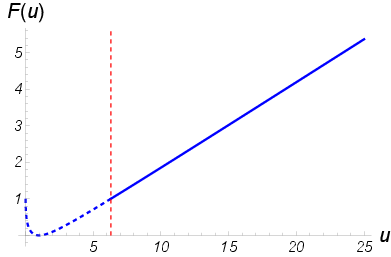
Figure 1: Plot of Σ0, the upper bound for allowed vanishing order Σ1 of the hyperscalar, in the anti-twist STU sector with three equal fluxes, as determined by the scaling dimension positivity condition; Σ2.
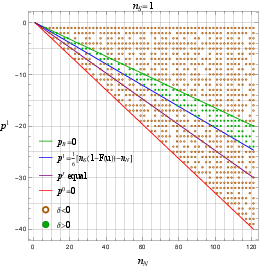
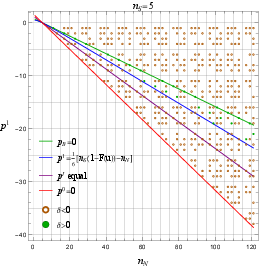
Figure 2: Distribution of anti-twist STU solutions with three equal fluxes for Σ3 (left) and Σ4 (right); brown circles indicate smooth supersymmetric solutions, green dots mark those admitting a relevant hyperscalar mode, and the line denotes the locus with four equal fluxes (irrelevant modes only).
Localization and Entropy Function
A complementary derivation via equivariant localization is developed, following "Localization and attraction" (Genolini et al., 2024). The Bekenstein-Hawking entropy is expressed as an extremum of an off-shell entropy functional, integrating equivariantly closed forms over Σ5. The pivotal result is that, with proper treatment of symmetry-breaking charges and boundary conditions, the localized functional extremizes to the on-shell entropy previously computed with BPS equations, providing an alternative formalism for counting microstates.
Practical and Theoretical Implications
These results supply new classes of smooth supersymmetric solutions in gauged supergravity (and M-theory upon uplift) with nontrivial hyperscalar structure, expanding the catalog of backgrounds for holographic studies of strongly coupled quantum mechanical systems and the AdS/CFT toolkit. The classification of coprime/non-coprime spindle orbifolds and correspondence of orbibundle data with field theory global structure points to new candidate duals and index computations. The anti-twist/relevant mode correspondence and entropy monotonicity add new structure to the understanding of RG flows between AdS vacua in 1d and their field-theoretic avatars.
From a mathematical standpoint, the classification of orbibundles, allowed fluxes, and spin structures on orbifolds advances the understanding of topology in string/M-theory backgrounds. The technical approach, combining algebraic analysis, fluctuation spectra, bundle cohomology, and localization, is broadly applicable to similar compactification problems in dimensions Σ6, with or without hyperscalars.
Future developments should target explicit interpolating solutions representing the full RG flows with Σ7-dependence, systematic understanding of monotonicity of the entropy, and connections to exact quantum field theoretic results for the dual quantum mechanical systems, such as index calculations and localization.
Conclusion
This work achieves a comprehensive classification and explicit construction of supersymmetric Σ8 solutions with nontrivial hyperscalars in Σ9 gauged supergravity. The analysis demonstrates that the presence of smooth, globally defined solutions is intimately connected to the existence of relevant operator deformations in the associated STU backgrounds, leading to a robust RG scenario where flows realized by relevant hyperscalar VEVs necessarily decrease the entropy. The paper's algebraic and computational infrastructure, including a complete treatment of orbibundle data, provides the foundation for further investigations into 1d SCFTs, AdS/CFT for orbifolded geometries, and the global landscape of supersymmetric M-theory vacua.