- The paper demonstrates that cutoff-based self-normalized importance sampling significantly reduces estimation bias in time-dependent VMC simulations, ensuring robust time evolution.
- It introduces an alternative tensor cross interpolation technique that, despite limitations for larger systems, offers insights into active learning for quantum observables.
- Numerical results confirm substantial fidelity improvements in simulating quantum many-body dynamics, especially during critical quench processes.
Background and Motivation
Variational Monte Carlo (VMC) with neural quantum states (NQS) has become a dominant paradigm for simulating quantum many-body systems, including real-time dynamics, due to its scalability and expressiveness. However, the standard implementation of time-dependent VMC (t-VMC) leverages Born-distribution sampling and suffers from a subtle estimation bias when the variational wavefunction exhibits roots. This bias, arising from support mismatches between the distribution and certain observables, can critically impair the accuracy of TDVP-based time evolution, especially in dynamical or pathological cases [sinibaldi2023unbiasing]. This paper systematically investigates and addresses this bias via two numerical avenues: self-normalized importance sampling with a cutoff-deformed Born distribution, and an active learning scheme using tensor cross interpolation (TCI).
Methodology
TDVP and Monte Carlo Estimators
The paper employs the stationary action formulation of TDVP, which leads to parameter evolution prescribed by a coupled system involving the quantum geometric tensor (QGT) and the force vector. Their explicit forms involve sums over configurations, efficiently tackled via VMC sampling:
EP[∂klogψ∗Eloc]
where P is the Born distribution and Eloc the local energy.
However, when ψθ(s)=0 for some configurations, the estimator is inherently biased, as the sampling fails to capture the necessary contributions.
Self-normalized Importance Sampling with Cutoff
To remedy the bias, the authors deform the Born distribution via a global cutoff ϵ:
qϵ(s)={∣ψθ(s)∣2,if ∣ψθ(s)∣2/max∣ψθ(s)∣2>ϵ ϵ,otherwise
Sampling with this distribution guarantees non-vanishing weights over the entire configuration space, eliminating the estimation bias. The normalization constant ratio is efficiently estimated and shown to have negligible variance for suitable ϵ, making practical implementation viable.
Tensor Cross Interpolation (TCI)
TCI is explored as a non-sampling, active-learning alternative. By iteratively adding pivots where the function or its derivatives are poorly approximated, TCI builds a low-rank tensor network representation of required objects (e.g., gradient, local energy). The contraction yields exact or near-exact covariances if the rank is manageable.
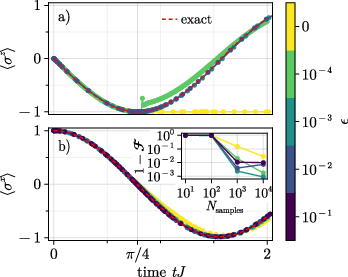
Figure 1: Magnetization dynamics for single-spin and many-body systems illustrates the failure of Born-distribution sampling for ϵ=0 and robust recovery of correct dynamics with cutoff sampling (ϵ>0).
Numerical Results and Analysis
The efficacy of the cutoff-based SNIS estimator is demonstrated first in the canonical pathological single-spin case and then for many-body systems undergoing quench dynamics. When sampling with ϵ=0 (Born distribution), the dynamics stalls or displays severe infidelities. Introducing P0 restores correct evolution, sharply reducing infidelity by almost two orders of magnitude with only P1 samples in the many-body context.
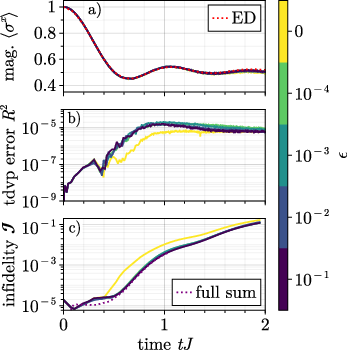
Figure 2: Magnetization dynamics and fidelity for a TFIM quench with P2 under various P3 values; cutoff sampling yields superior precision and minimized projection error, nearly matching full Hilbert space summation.
Detailed benchmarking in the TFIM critical regime reveals that cutoff-based sampling reproduces exact dynamics up to P4, with deviation only at late times and higher cutoffs. The infidelity to exact states remains minimal and invariant with P5, validating the robustness of the estimator.
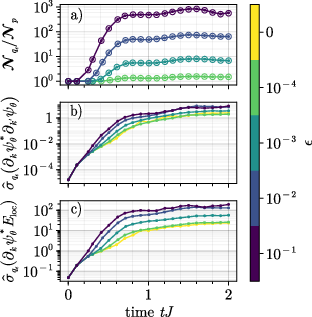
Figure 3: Time evolution of normalization constant ratio under cutoff sampling (P6), showing excellent agreement between sampled and exact calculations, and limited variance even at higher P7.
Variance analysis indicates that the introduction of cutoff (for small P8) does not significantly inflate estimator variance, confirming that unbiasedness can be achieved without penalizing statistical efficiency.
TCI results are mixed. For small lattices (P9), increasing bond dimension achieves errors below MC sampling benchmarks (Eloc0 for QGT and force vector). At larger sizes (Eloc1), relative error rises sharply for QGT, evidencing limitations due to insufficient low-rank structure.
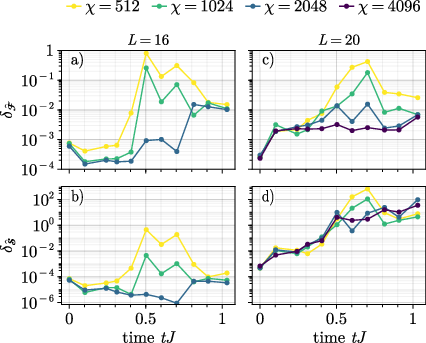
Figure 4: Relative errors of force vector and QGT using TCI, as function of bond dimension and system size; large systems expose a breakdown in TCI accuracy for QGT even at maximal bond dimensions.
Implications and Outlook
The cutoff-based SNIS methodology provides a clear fix for one of the most fundamental sources of bias in t-VMC time evolution. Its computational cost is comparable to traditional VMC, and accuracy is maintained or improved without elevated statistical noise. This will enable more efficient and accurate studies of dynamical quantum phenomena, particularly in regimes where zero crossings in NQS representations are prevalent (e.g., critical quenches, fermionic systems, frustrated magnets).
The limited success of TCI suggests that active learning and low-rank approximations may not universally apply for TDVP observables due to structural constraints, e.g., gradient complexity. Nonetheless, exploration of alternative tensor network architectures or direct learning of TDVP objects may open new routes for bias mitigation and efficiency optimization.
Conclusion
This work provides a rigorous, practical solution to estimation bias in time-dependent variational Monte Carlo for quantum dynamics, leveraging cutoff-based self-normalized importance sampling. The methodology is shown to be effective across pathological and generic dynamical scenarios, with strong numerical evidence for error reduction and fidelity improvement. TCI-based active learning is found to be limited by the absence of low-rank structure in the relevant quantities, but offers an alternate perspective for future algorithmic development. The theoretical advancement will have significant practical implications for scalable, unbiased simulation of quantum many-body dynamics using NQS and VMC approaches.