- The paper demonstrates a 50% increase in vacuum optomechanical coupling by employing X-HOPE mode engineering in a release-free OMC design.
- It utilizes a gradient-based multiphysics inverse-design algorithm with adjoint sensitivity analysis to simultaneously optimize optical and mechanical eigenmodes.
- The study shows record-breaking thermal stability and high optical quality factors, paving the way for advanced quantum transduction and robust optomechanical applications.
Motivation and Background
Optomechanical crystals (OMCs) are integral to coherent photon-phonon interactions, enabling applications in quantum information, precision sensing, and microwave–optical transduction. Traditionally, OMCs have favored suspended nanobeam architectures to suppress mechanical radiation loss, maximizing photon–phonon spatial overlap and thereby optimizing vacuum optomechanical coupling rates (g0). However, these suspended geometries exhibit significant limitations in thermal management, rendering them susceptible to optical absorption-induced heating and noise.
Release-free (clamped) OMCs overcome these thermal anchoring issues by directly connecting to the substrate. Previous implementations, though, suffered trade-offs: improved resilience to laser-induced heating came with suboptimal g0 and reduced optomechanical scattering rates (Γ0), mostly due to challenges in simultaneously phase-matching optical and mechanical modes and achieving sufficient spatial mode overlap.
X-HOPE Mode Engineering: Maximizing Photon–Phonon Overlap
The paper introduces a physics-driven mode engineering technique termed X-HOPE (eXtended High Overlap Photon-Phonon Engineering), which addresses the challenge of spatial overlap in release-free architectures. By pairwise perturbation of unit cells, the periodicity is doubled, relocating the X-point in reciprocal space to match the optical wavevector (k=0.5π/a) and facilitating phase-matched optomechanical interactions. This geometric manipulation immediately opens a bandgap for the cavity frequency, resulting in enhanced confinement and tight spatial overlap between optical and mechanical eigenfields.
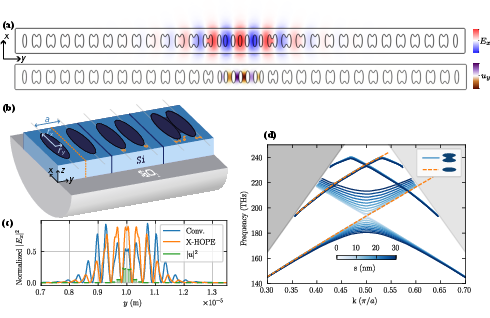
Figure 1: Release-free optomechanical crystal cavity engineered for improved photon-phonon overlap using the X-HOPE design principle.
X-HOPE thus enables the structure to attain a spatial distribution where the optical field peaks centrally, coinciding with maximal mechanical displacement, directly increasing g0. This approach fundamentally diverges from previous mirror transition solutions where optical field maxima were located towards cavity edges, leading to poorer photon–phonon overlap.
Multiphysics Inverse Design: Co-Optimization of Resonant Eigenmodes
The X-HOPE technique alone does not guarantee optical and mechanical quality factors (Q) adequate for practical application. To resolve this, the authors implement a gradient-based multiphysics inverse-design algorithm rooted in adjoint sensitivity analysis, tailored for eigenmode simulations with both field and eigenvalue gradients incorporated into the figure of merit (FoM). The FoM is primarily the single-photon optomechanical scattering rate (Γ0), with additional penalty terms enforcing frequency constraints, minimum radii, and radiation-limited Q.
The optimization variables are the position and radii of transition region holes, and the algorithm iteratively updates parameters, leveraging the ADAM optimizer. Manufacturing robustness is incorporated via stochastic geometric erosion/dilation every iteration, mitigating trapping in sharp local optima and improving tolerance to fabrication inaccuracies.
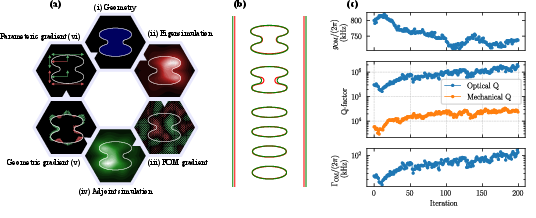
Figure 2: Schematic of the multiphysics inverse-design optimization cycle and the effect on defect-region geometry.
Radiation-limited optical quality factors surpassing 106 are consistently achieved in simulation, with final designs reminiscent of topologically distinct photonic nanocavities, but with defect regions dedicated to the photon–phonon interaction, and transitions optimized for non-adiabatic high-Q performance.
Experimental Characterization
The authors fabricate optimized X-HOPE cavities in 220 nm silicon on SiOg00, characterized via reflectance spectroscopy and thermal sideband analysis. The optical resonance is measured at g01 THz, with g02. The mechanical resonance occurs at g03 GHz with an intrinsic linewidth of g04 MHz. Blue and red detuned measurements yield vacuum optomechanical coupling rates of g05 kHz and g06 kHz respectively, representing a 50% enhancement over previous release-free implementations and approaching state-of-the-art suspended OMCs.
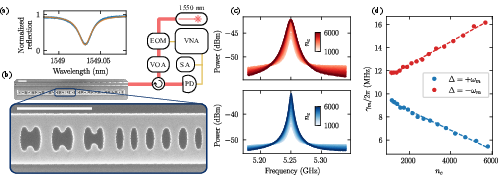
Figure 3: Optical resonance measurement and vacuum optomechanical coupling extraction via sideband spectroscopy.
Thermo-optic robustness is quantified by monitoring the resonance shift at elevated intracavity photon numbers; release-free X-HOPE devices remain stable at almost 10x the power at which suspended devices begin significant redshifting.
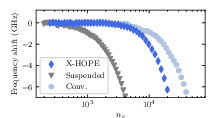
Figure 4: Thermo-optic shift comparison illustrating superior thermal resilience of the release-free X-HOPE OMC.
Robustness and Fabrication Imperfection Analysis
Random boundary perturbation simulations (OpenSimplex noise) demonstrate that the X-HOPE design exhibits optical quality factors matching or surpassing first-generation release-free OMCs across moderate fabrication imperfection amplitudes. However, the measured g07 drops markedly with even slight (g08) sidewall angles, highlighting a key limitation imposed by nanofabrication capabilities.
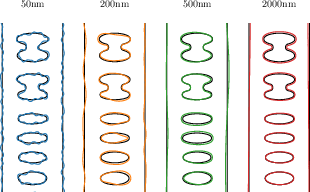
Figure 5: Simulation of geometric perturbations and their length scales in OMCs.
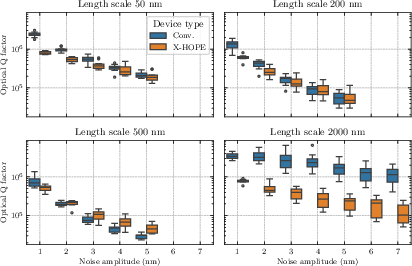
Figure 6: Radiation-limited optical quality factor vs perturbation amplitude for X-HOPE and conventional designs.
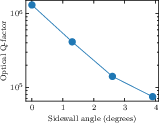
Figure 7: Effect of sidewall angle on simulated optical quality factor, demonstrating significant reduction for small deviations.
Implications and Future Directions
This work establishes release-free OMCs as a high-performance platform for low-noise, high-power optomechanics, eliminating the previous necessity to trade coupling strength for thermal resilience. The inverse-design methodology is broadly applicable to optomechanical and other multiphysics resonant architectures, capable of simultaneous eigenvalue/eigenvector co-optimization and robust to manufacturing constraints.
Shortcomings in measured g09 are traced to sidewall scattering and Akhiezer damping, neither captured in radiation-limited simulations. Theoretical implications include the need for cryogenic operation to suppress mechanical loss, and for fabrication-aware adjoint optimization to improve optical Γ00 further. Extending inverse design to free-form optimization (beyond parametrizations) is expected to unlock higher coupling strengths and novel mode configurations.
Practically, the demonstrated X-HOPE OMC is a key enabling component for release-free piezo-optomechanical quantum transducers, with immediate relevance for microwave–optical quantum state conversion, scalable quantum networks, and high-speed optomechanical signal processing. The design principle and adjoint optimization framework also generalize to nonlinear and multimode photonics, such as phase-matched second-harmonic generation and advanced quantum electro-optomechanical interfaces.
Conclusion
The paper advances release-free OMCs by integrating X-HOPE mode engineering and multiphysics inverse-design, achieving record-breaking vacuum optomechanical coupling in a thermally robust architecture. Theoretical and practical implications extend far beyond the specific device, offering a scalable methodology for high-coherence photon–phonon systems and paving the way for quantum transduction and hybrid photonic platforms. Ongoing developments should focus on fabrication-aware optimization, cryogenic operation, and free-form geometric inverse-design to fully exploit the potential of release-free optomechanics.
(2605.03910)

