- The paper presents a novel diffusion model climate emulator using classifier guidance to accurately estimate probabilities of rare extreme events like tropical cyclones.
- It employs probability flow ODEs to compute sample log probabilities and leverages importance sampling, achieving lower standard error than traditional Monte Carlo methods.
- The study also identifies computational challenges from divergence evaluations, suggesting potential optimizations such as classifier-free guidance and model distillation.
Accurate Quantification of Extreme Event Likelihoods via Diffusion Model Climate Emulators
Introduction
This paper presents an in-depth analysis and methodological advancement in calculating extreme event likelihoods using diffusion model-based climate emulators, notably the cBottle model. By leveraging score-based denoising diffusion models conditioned on sea surface temperature (SST) and solar position, this study demonstrates robust means of both oversampling rare events such as tropical cyclones (TCs) and quantifying their true likelihoods within generative AI-driven atmospheric state simulations. The integration of classifier-driven guidance within the diffusion framework, combined with probability flow ODEs, enables importance sampling—substantially improving the efficiency of likelihood estimation for low-frequency, high-impact phenomena.
Diffusion Models and Probability Flow ODEs
Diffusion models such as cBottle operate by learning the probability density of the data distribution through score-matching objectives. Sampling is achieved via a reverse stochastic process, reconstructing atmospheric states from Gaussian latents through an ODE parameterized by the denoiser network. Critically, the probability flow (PF) ODE enables explicit computation of sample log probabilities by integrating the divergence of the ODE velocity field along the denoising trajectory.
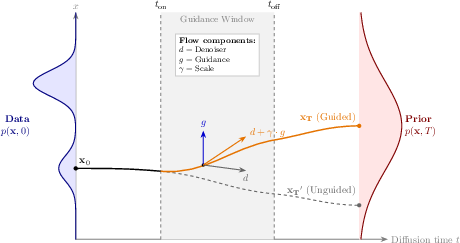
Figure 1: Visualization of the PF ODE illustrating sampling and likelihood computation, with odds ratio quantification performed by integrating divergence under guided and unguided velocity fields.
The PF ODE accommodates accurate evaluation of the model’s density for individual samples, contingent on the fidelity of the denoiser's score approximation. For guided sampling, additional terms driven by classifier gradients are introduced to steer the process toward desired states, such as TCs at specified geographic locations.
Guidance Strategies and Divergence Analysis
The implementation of classifier-guidance involves supplementing the ODE with gradients from a binary TC probability classifier. The pivotal insight from this work is the necessity of applying guidance only during selective intervals along the denoising trajectory. Empirically, confining guidance to a single narrow window—corresponding to noise levels where the physical signal of interest emerges—mitigates implausible divergence accumulations and stabilizes the odds ratio calculation.
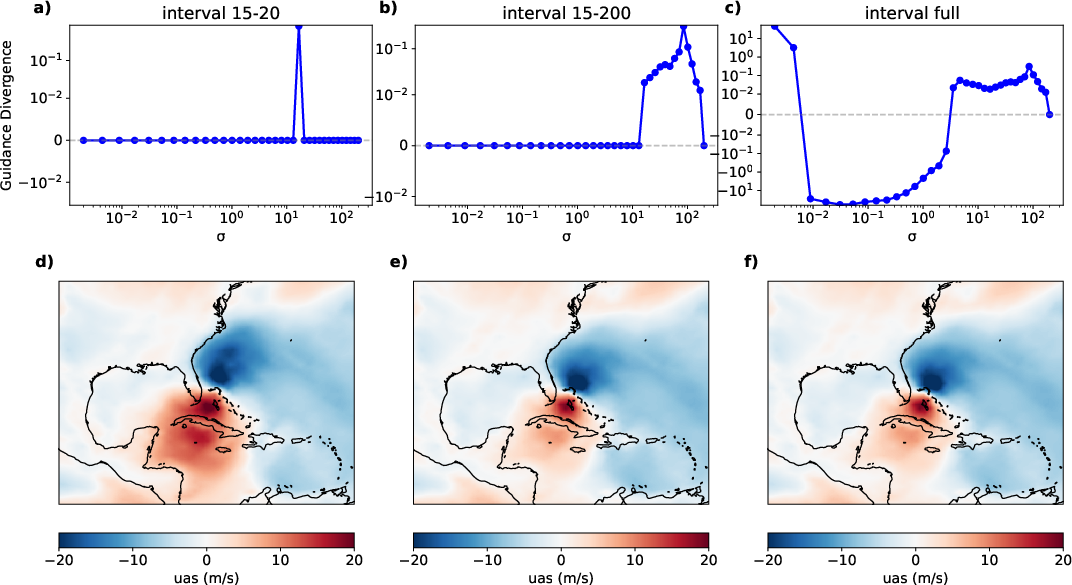
Figure 2: Impact of guidance interval on divergence dynamics and resulting atmospheric states, revealing optimality of short, targeted guidance windows.
This targeted approach reduces both computational complexity and discretization artifacts, concentrating updates when TCs physically manifest in the generated states, rather than applying guidance uniformly across the entire denoising path.
Sample-Wise Odds Ratios and Guidance Strength
The paper documents substantial variability in sample-wise odds ratios as a function of guidance strength. Strong guidance reliably produces desired TC samples, but at the cost of highly variable (and sometimes paradoxically positive) odds ratios due to divergence contributions and possible network approximation errors. Lower guidance strengths yield more stable and reliable odds ratios, improving the effectiveness of importance sampling.

Figure 3: Distribution of TC probabilities and odds ratio components across guidance strengths, justifying the preference for weaker, more focused guidance.
Variance decomposition reveals that both latent probability differences and guidance divergence dominate the uncertainty. This motivates conservative tuning of guidance parameters for practical importance sampling applications.
Importance Sampling for Extreme Event Likelihoods
The methodology enables accurate downweighting of oversampled guided TC events, yielding likelihood estimates that are consistent with Monte Carlo evaluation from unguided cBottle runs. Importantly, for exceedingly rare events (high threshold TC probability detections), importance sampling achieves lower standard error than pure Monte Carlo estimation—substantiated by empirical comparisons with both the emulator and historical ERA5 record.
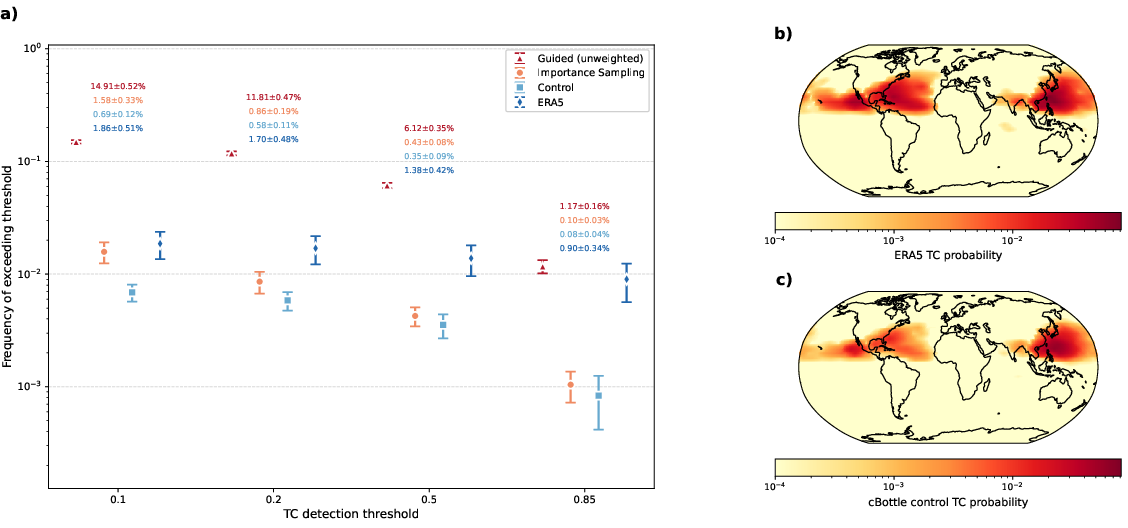
Figure 4: Importance sampling estimates versus control and historical ERA5 frequencies, with spatial climatology comparison demonstrating emulator bias.
Despite this statistical improvement, practical deployment is currently hindered by computational overhead: the odds ratio computation requires costly divergence evaluations through automatic differentiation, resulting in a ∼33× slowdown relative to unguided Monte Carlo sampling. This overhead may, however, be amortized for the rarest extremes or mitigated with advanced distillation techniques.
Attribution and Counterfactual Likelihoods
Beyond event frequency estimation, the PF ODE framework facilitates attribution experiments by evaluating the likelihood of real-world ERA5 reanalysis samples under the model. A retrained student model for Antarctic surface temperature reveals moderate sensitivity to SST perturbations, intuitively yielding higher probabilities for warmer extremes under elevated SST conditions.
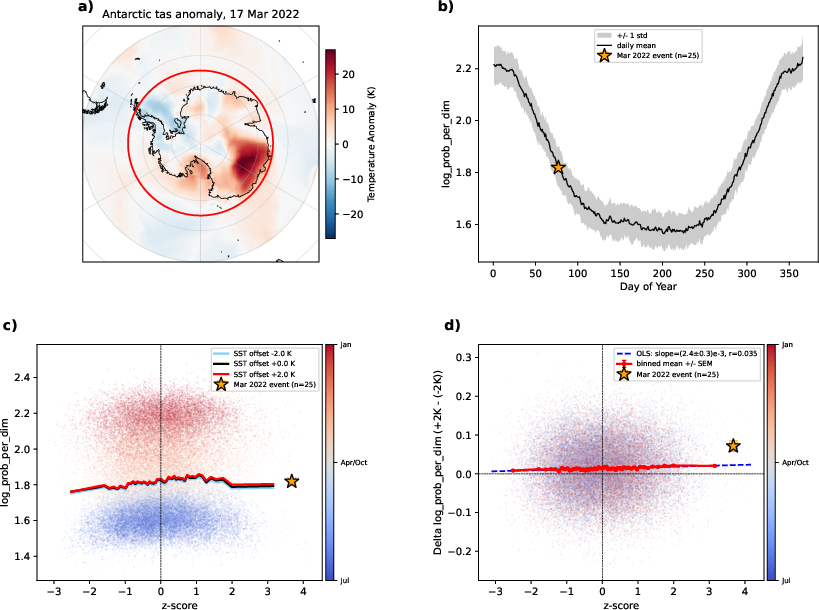
Figure 5: Calculation of sample likelihoods for Antarctic heatwaves, illustrating seasonal probability dynamics and SST perturbation responses.
Notably, the assigned log probabilities do not systematically correlate with extreme anomalies, highlighting inherent limitations in interpreting generative model densities for attribution purposes and underscoring the necessity for model improvements in capturing tail risks.
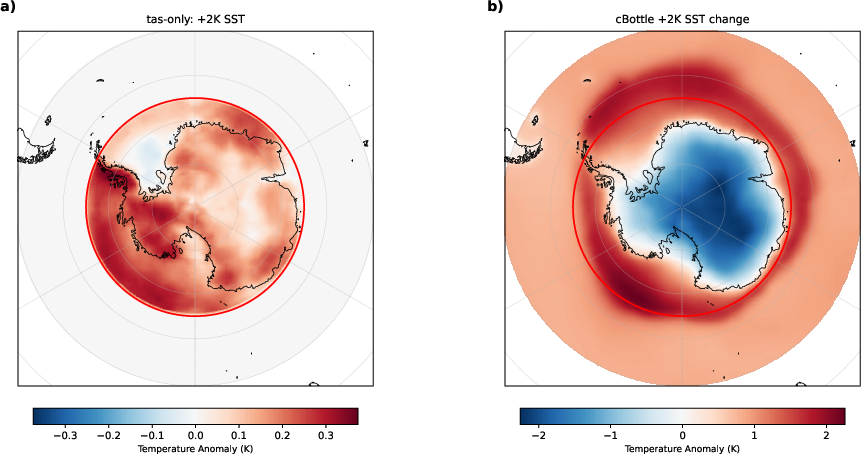
Figure 6: Comparison of SST perturbation responses between student and cBottle teacher models, indicating further avenues for emulator refinement.
Practical and Theoretical Implications
This research delivers a rigorous framework for quantifying the probability of extreme weather events within AI-generated atmospheric states, supporting both scenario-based risk assessment and model validation. The odds ratio approach is formally valid and transferable to other classifier-guidance diffusion models. However, practical utility hinges on computational optimizations—especially for guidance and likelihood calculation, where classifier-free guidance or advanced distillation could reduce inference costs.
From a climate modeling perspective, improved representation of extreme events within generative models critically impacts risk quantification and attribution capabilities. This work suggests that future emulator development should prioritize regularization, architecture advances, and conditional training (e.g., for counterfactual SST states) to overcome biases in event detection.
Conclusion
The study establishes that guided diffusion model emulators, specifically cBottle, can be used not merely to generate extreme atmospheric events but to robustly estimate their probabilistic likelihood, via importance sampling informed by odds ratios computed from model densities. While the approach is currently computationally intensive, it demonstrates statistical superiority for ultra-rare extremes and opens new directions in climate event attribution and counterfactual analysis. Model improvements and more efficient inference algorithms are likely to further enhance the power and accessibility of generative climate models for research and operational forecasting.

